Plan about 45 minutes for the palace halls and 30 for the Royal Armoury, which is the palace's own estimate for a self-guided visit, or one to two hours if you stop at the stories. Walk it in circuit order: the Plaza de la Armería, the Main Staircase and the Hall of Columns, the rooms of Charles III with the Gasparini and Porcelain Rooms, the Gala Dining Room and the chapel, the Stradivarius room and the Crown Room, and last the Throne Room under Tiepolo's ceiling. The Armoury is a separate hall on the plaza.
Royal Palace of Madrid audio guide
Madrid · 2 floors · stories room by room
The Royal Palace of Madrid is still the King of Spain's palace for state occasions, which is why it is laid out as a sequence: you arrive at the foot of a staircase, climb it, and pass through rooms that get more private and then more formal until you reach the Throne Room. If you are asking what to see, the short answer is the Main Staircase, the Hall of Columns, the Gasparini and Porcelain Rooms of Charles III, the Gala Dining Room, the Stradivarius room and the Throne Room, with the Royal Armoury on the plaza. If you are asking how long it takes, the palace's own ticket page says about 45 minutes for the halls and 30 for the Armoury, and the Roamer guide has routes from 45 minutes to two hours.
A palace of stone on the Alcázar's ground
The palace stands where the royal Alcázar burned on Christmas Eve 1734. The story that French courtiers of Philip the Fifth started the fire is, in Patrimonio Nacional's words, a legend. Philip had the new palace built on the same site, in stone and on vaults, with no timber in the structure and only the doors and windows of wood. Filippo Juvarra drew a far bigger palace, four times the size by Patrimonio's description, and died in Madrid in 1736. His pupil Giovanni Battista Sacchetti adapted the design to the old site, and the first stone was laid in 1738. Charles the Third, who came from Naples in 1759, was the first king to live here, from 1764, and he died in his bedroom on the main floor in 1788.
By Patrimonio Nacional's count the palace has more than 135,000 square metres, and the visit covers a small part of that. The Roamer guide treats the building's own story as a route of its own, From Burned Alcázar to Working Palace.
The Plaza de la Armería and the entrance hall
Hear a stop from this walk
Mirador del Templo de Debod: The Edge Again
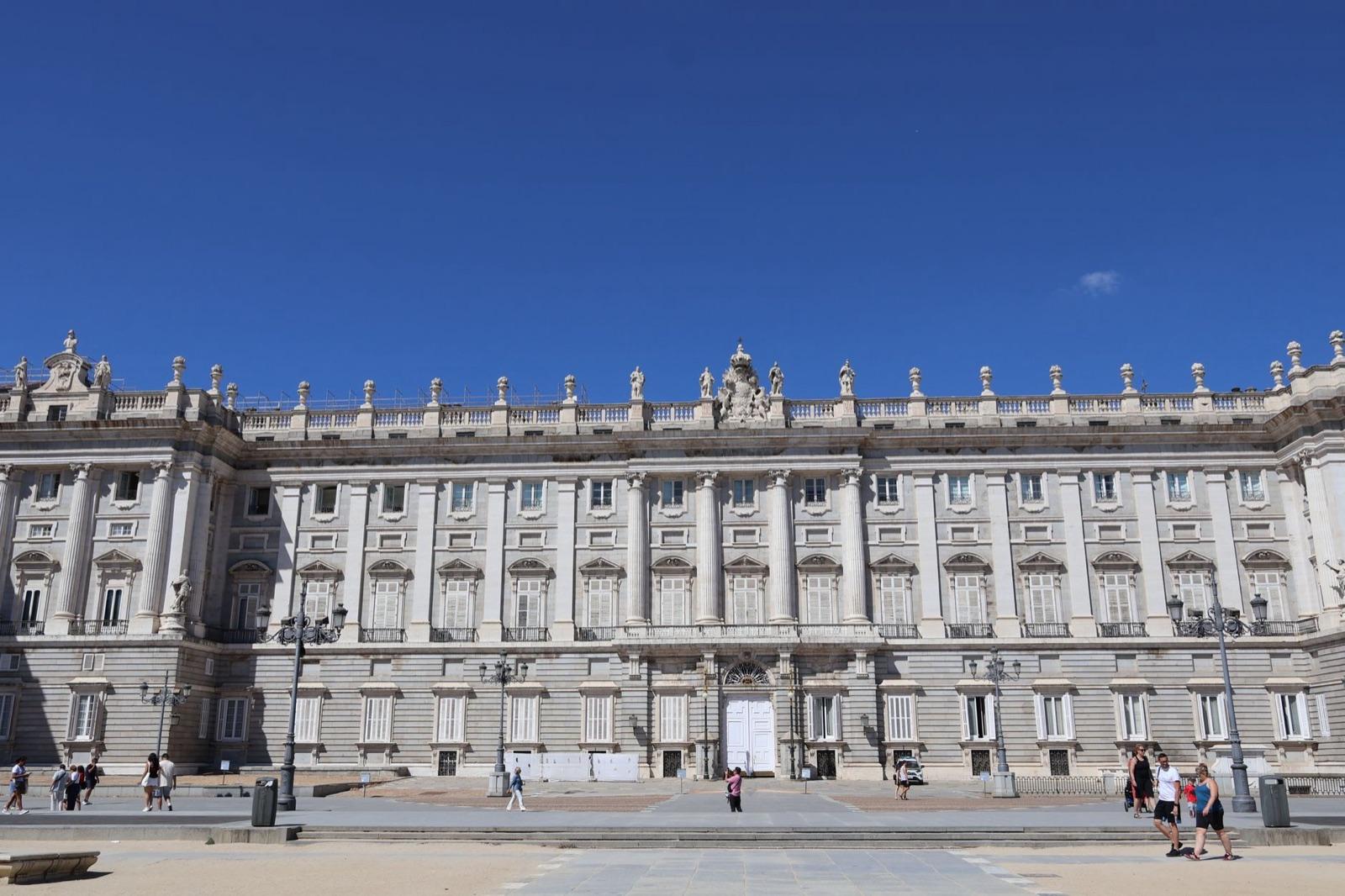
You start in the plaza, facing the south front: grey granite against white limestone, five doors at ground level, the clock designed by Sabatini in the middle. The three central doors open into the entrance hall, where coaches stopped at the foot of the staircase and where a statue of Charles the Third as a Roman general looks at everyone arriving. Facing the palace across the square is the Almudena Cathedral. The Royal Pharmacy, in the palace precinct, has been closed since 2013; its reopening was announced for the last quarter of 2026, and it was still shut in late August, so the guide mentions it only as closed.
The Main Staircase and the great halls
Sabatini's staircase has low steps on purpose, and Corrado Giaquinto's fresco of the Spanish monarchy and the Church spreads over the vault. Stop where the handrail ends: a pair of lions by Felipe de Castro and Robert Michel, one watching the climb and one at rest. At the top is the Hall of Halberdiers, planned as a ballroom and made a guard room by Charles the Third, with plain walls so that everything went into Tiepolo's ceiling of Venus asking Vulcan for armour for Aeneas. Beyond it the Hall of Columns, the staircase's twin, has Giaquinto's vault of the Sun and the seasons and tapestries woven after Raphael's designs. Spain signed its treaty to join what is now the European Union here in 1985, and King Juan Carlos the First abdicated here in 2014.
The King's apartment: Charles III's rooms
Each room of an apartment was more private than the one before. The first, Charles the Third's Saleta, has Mengs's ceiling of the emperor Trajan, begun in 1768 and left unfinished until Mengs came back in 1774. Next is the antechamber, where Mengs's gods welcome Hercules overhead and Goya's portraits of Charles the Fourth and María Luisa of Parma hang below. Then come the two rooms that most visitors remember: the Gasparini Room and the Porcelain Room, one rococo and one lined with porcelain plaques from the king's own Buen Retiro factory. Between them lies the narrow Tranvía and the bedroom where he died, remade by his grandson Ferdinand the Seventh in the white and blue of the Order of Charles the Third. The Yellow Room, with chairs in the antique taste of Pompeii and Herculaneum, starts the Queen's apartment.
The Gala Dining Room and the Royal Chapel
Alfonso the Twelfth joined three rooms into one for banquets, and the table, built of boards that can be added or taken away, runs about 40 metres and seats up to 144. The three ceilings of the old rooms are still there, by Mengs, Antonio González Velázquez and Francisco Bayeu. State dinners are still held here. The next two rooms hold the royal table services of Meissen, Sèvres and Berlin and the glass of the royal works at La Granja. The Royal Chapel is the palace's tallest space, with Giaquinto's dome, ten single-piece black marble columns and an eighteenth century organ that still plays.
The Queen's rooms, the Stradivarius room and the Crown Room
The passage to Queen María Cristina's rooms now holds an Erard harp, a piano and a double bass by Nicolò Amati. In the next room are the palace's Stradivari instruments: the decorated Palatine quartet and a plain cello of 1700, the subject of the Stradivarius piece. The Crown Room shows the silver-gilt crown made in Madrid in 1775 and a sceptre of the later 1600s. Spain proclaims its kings rather than crowning them, and the crown has no jewels. Beside them is the original throne chair of Charles the Third, made in Naples.
The state rooms and the Throne Room
The last rooms are the ones the King uses. The State Antechamber, where new ambassadors are presented, has a ceiling of the Golden Fleece by Giandomenico Tiepolo. The State Saleta, where visiting heads of state are received and photographed, has Giambattista Tiepolo's ceiling of the Spanish Monarchy. Then the Throne Room: Genoese velvet, twelve consoles and twelve mirror frames made in Naples, bronze lions, two thrones and Tiepolo's ceiling, covered in the Throne Room piece.
The Royal Armoury
The Armoury is in its own hall on the plaza and reopened on 9 April 2026 after almost two years of works. It shows about 2,500 pieces from a collection of more than 7,000, built on the order of Philip the Second that the royal arms must never be sold. The old armoury burned in 1884. Charles the Fifth's armour from the battle of Mühlberg is the centrepiece; the full story is in the Mühlberg armour piece, along with the dog armour and the child-sized armours that families look for.
How long it takes, and what to do with less
At a comfortable pace, plan about two hours for the palace and the Armoury together with the stories, and an hour for the palace alone. With one hour, keep to the staircase, the Hall of Columns, the Gasparini and Porcelain Rooms, the Gala Dining Room, the chapel, the Stradivari and the Throne Room. The palace's own self-guided estimate is about 45 minutes for the halls and 30 for the Armoury, which is a walk without stopping. You can end any route at any stop.
Closures for state ceremonies
Rooms can close at short notice for state ceremonies. The rooms from the State Antechamber onward are the ones the King uses, so they are the likeliest to shut. The palace publishes no standing list of dates, so check its calendar the day before. A shut room still has its story in the Roamer guide.
The Changing of the Guard
The solemn Changing of the Guard is held in the Plaza de la Armería on set days of the year, and a smaller change takes place at the Puerta del Príncipe on Calle Bailén more often. It is called off when it coincides with a state event, so check Patrimonio Nacional's calendar before you plan around it.
Photography
Photographs inside are allowed for personal use and without flash, except where signs forbid them; tripods and selfie sticks are not allowed. That is why the Roamer guide shows the building from outside and tells you what to look for inside, instead of showing the rooms.
Five ready-made routes
The Roamer guide groups the palace into five routes. Each is a plan on its own, and you can leave any of them at any stop.
- The Royal Palace in an Hour (60 minutes, 10 stops): Giaquinto's staircase ceiling, Tiepolo's Halberdiers ceiling, the Hall of Columns vault, the Gasparini and Porcelain Rooms, the Gala Dining Room, the chapel dome, the Palatine quartet, the crown and sceptre, and the Throne Room ceiling.
- The Palace and the Armoury in Two Hours (120 minutes, 22 stops): the whole circuit and the Armoury, from the south front and the lions to Charles the Fifth's armour and the princes' armours.
- A Working Palace: Kings, Ambassadors and State Dinners (50 minutes, 9 stops): the Changing of the Guard, the Hall of Columns, the state dinner table, the throne chair, the state rooms and the Throne Room.
- Lions, Clocks and Small Wonders (50 minutes, 11 stops): the staircase lions, the Shepherd and Atlas clocks, the Yellow Room chairs, the Amati bass, a Stradivari cello, a Japanese helmet and armour made for a dog.
- From Burned Alcázar to Working Palace (45 minutes, 8 stops): the building's own story, from the fire of 1734 and Juvarra's unbuilt palace to Sabatini's staircase and the palace today.
How this fits the Roamer guide
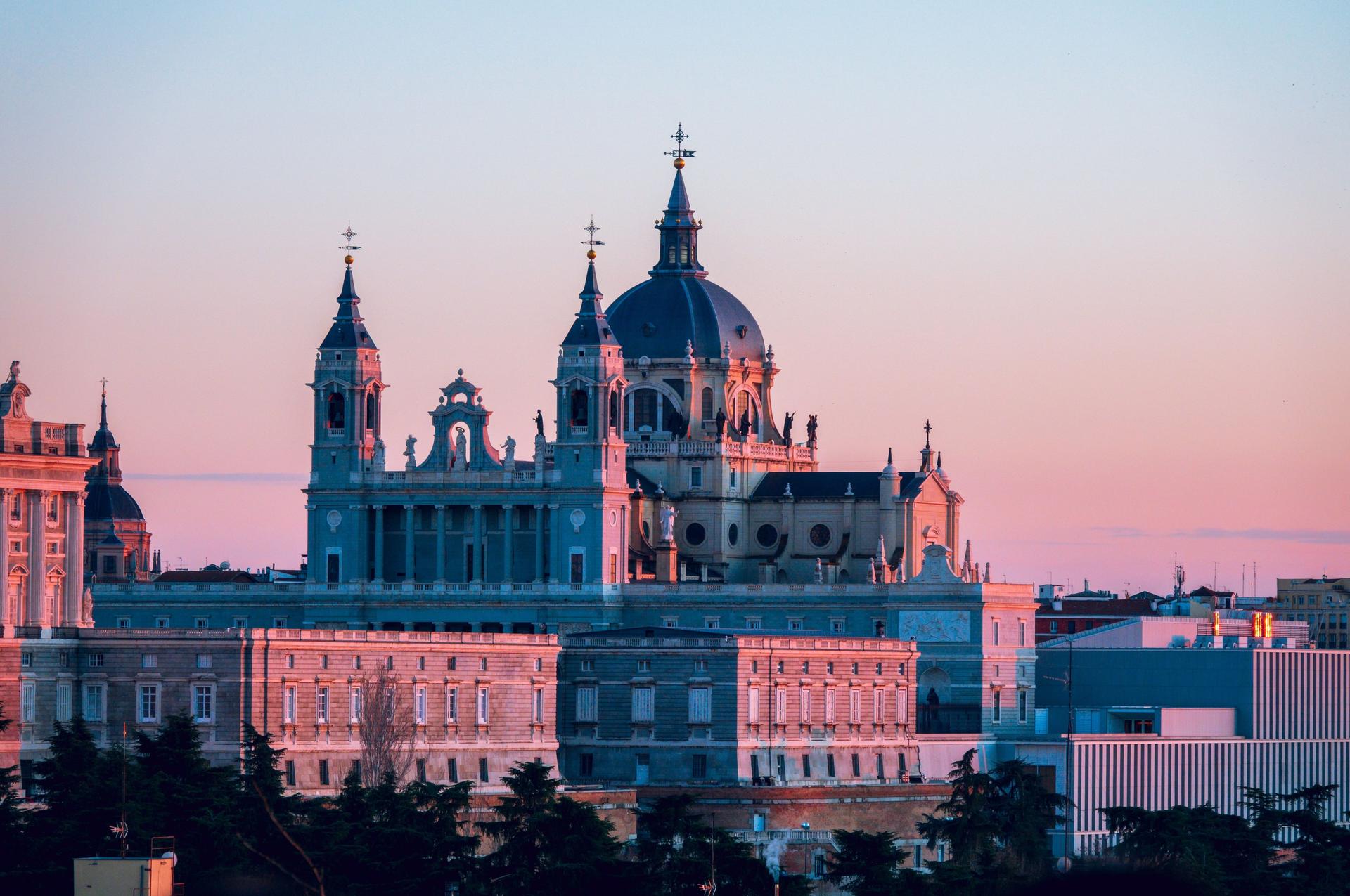
Roamer's Royal Palace guide works room by room, at your own pace and with no group to keep up with: open any room, hear its story, skip what you do not want. It is for individual visitors with their own phone; groups visiting together must follow the palace's rules for groups. It is an independent guide and is not affiliated with the palace or Patrimonio Nacional, and palace admission is separate. You can find it here: the Royal Palace of Madrid guide. For the outside, our Royal Palace and Temple of Debod walk covers the palace from the street, the Plaza de Oriente and the gardens, without going in. For the museum a few minutes away, see the Prado guide.
Cover: the south front of the Royal Palace across the Plaza de la Armería. Photograph by Travel Photographer, Pexels. The palace interiors are not photographed here.
Frequently asked questions
- Is the Royal Palace of Madrid worth it?
- Yes, especially if you enjoy rooms as much as paintings. The visit climbs Sabatini's Main Staircase under Giaquinto's fresco, then runs through the Hall of Halberdiers and the Hall of Columns, the Gasparini and Porcelain Rooms of Charles III, the Gala Dining Room still used for state dinners, the Royal Chapel, the Stradivari instruments and the Crown Room, and ends in the Throne Room under Tiepolo's ceiling. The Royal Armoury on the plaza adds Charles V's Mühlberg armour. The Roamer guide's routes take 45 minutes to two hours.
- Is it worth going inside the Royal Palace of Madrid?
- Yes. From the street you see the stone fronts and the Plaza de la Armería, but the reasons to come are inside: the painted ceilings of Giaquinto, Mengs and Tiepolo, the porcelain-lined room, the gala table of about 40 metres and the Throne Room. With an hour, The Royal Palace in an Hour route covers ten of them; with two, The Palace and the Armoury in Two Hours adds the Armoury. Rooms, or the whole palace, can close at short notice for a state ceremony, so check the palace's calendar the day before; a shut room still has its story in the guide.
Ready to experience it?
Royal Palace and Temple of Debod: Madrid on the Edge
75 min · 2.9 km · easy
More from Madrid
Explore more at your own pace.
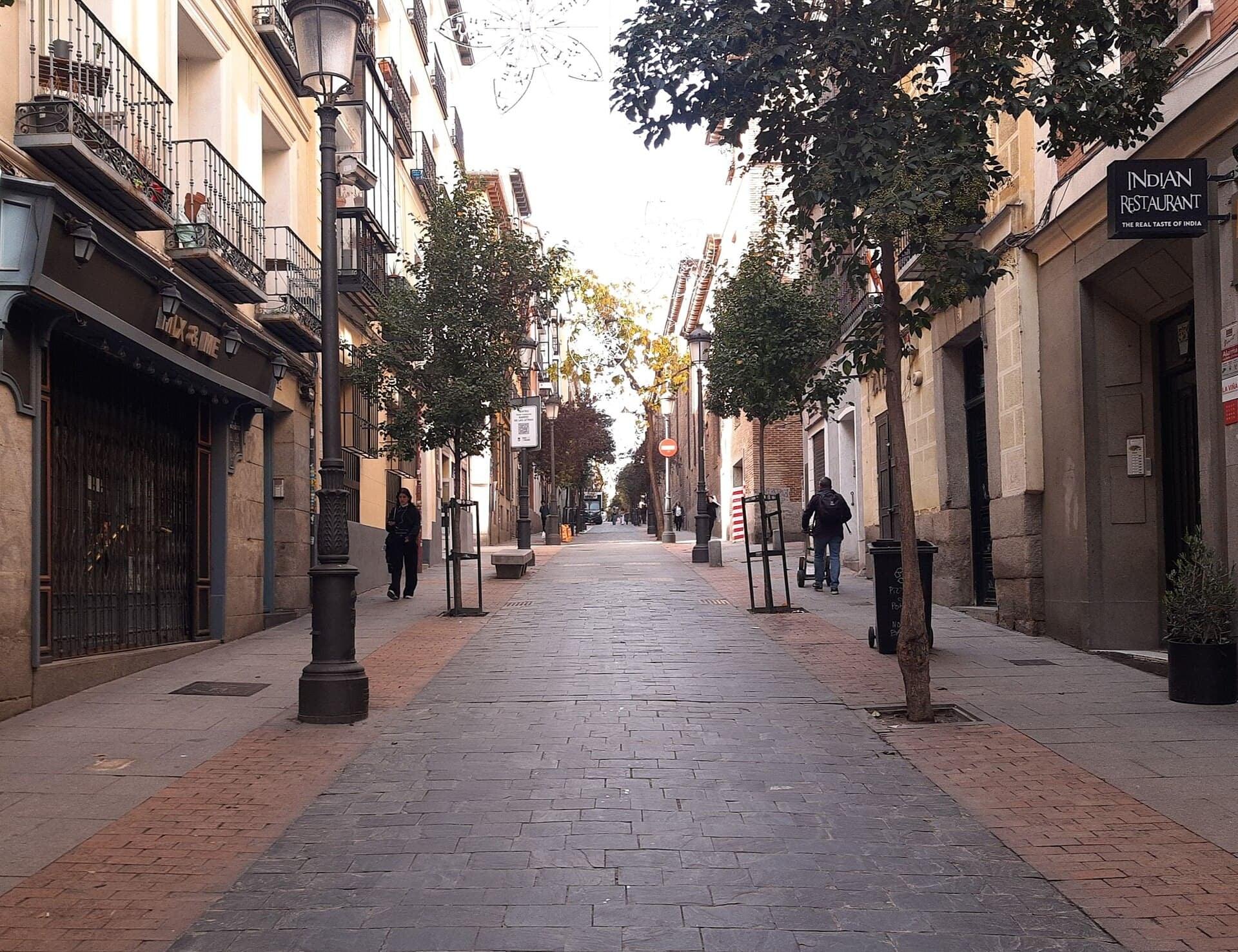
Barrio de las Letras: Madrid's Writers' Quarter in Three Layers
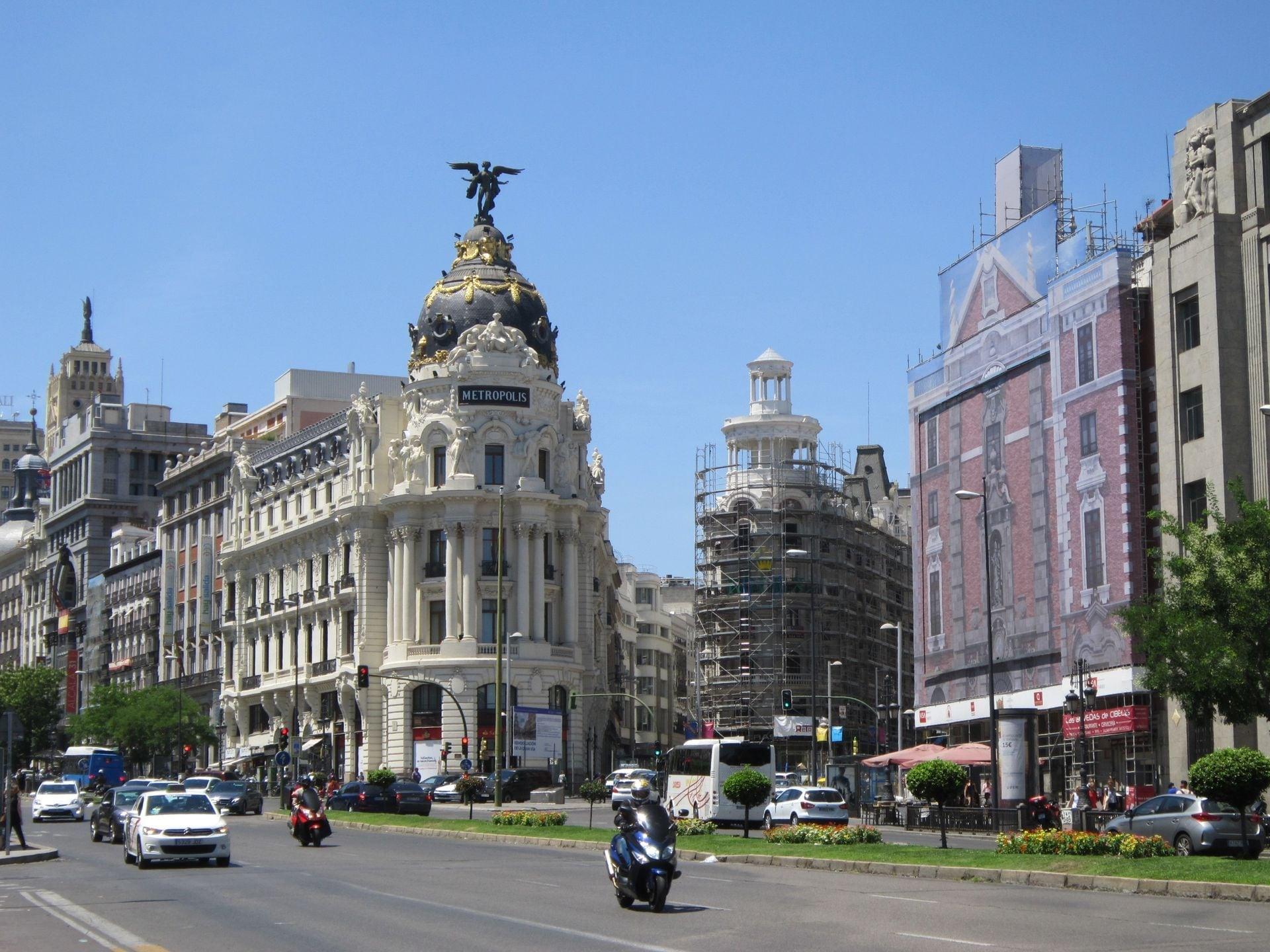
Gran Vía: How Madrid's Great Way Grew Wider and Taller as It Was Cut
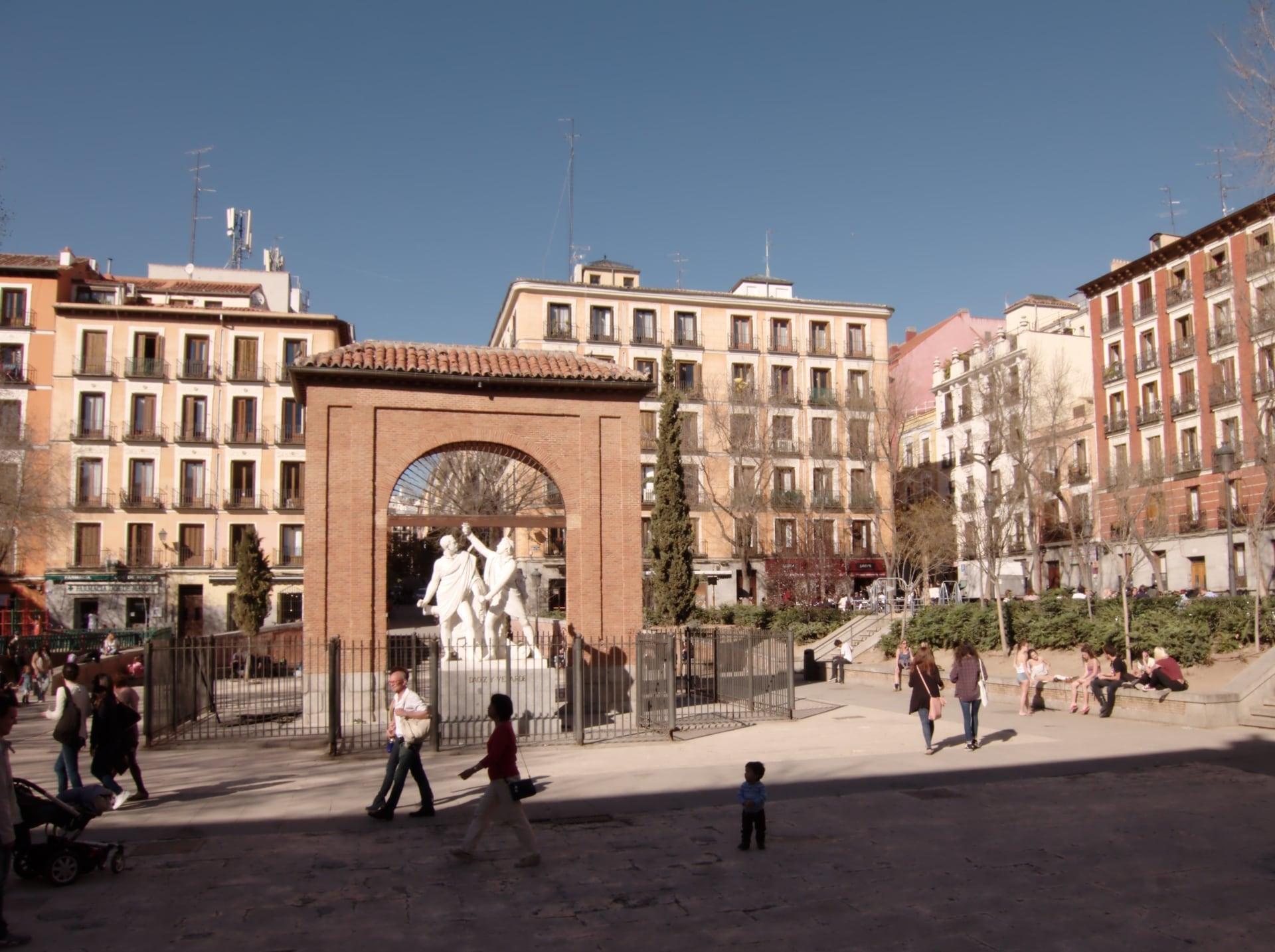
Malasaña and Chueca: Madrid's Old Northern Edge, Taken Back by the City
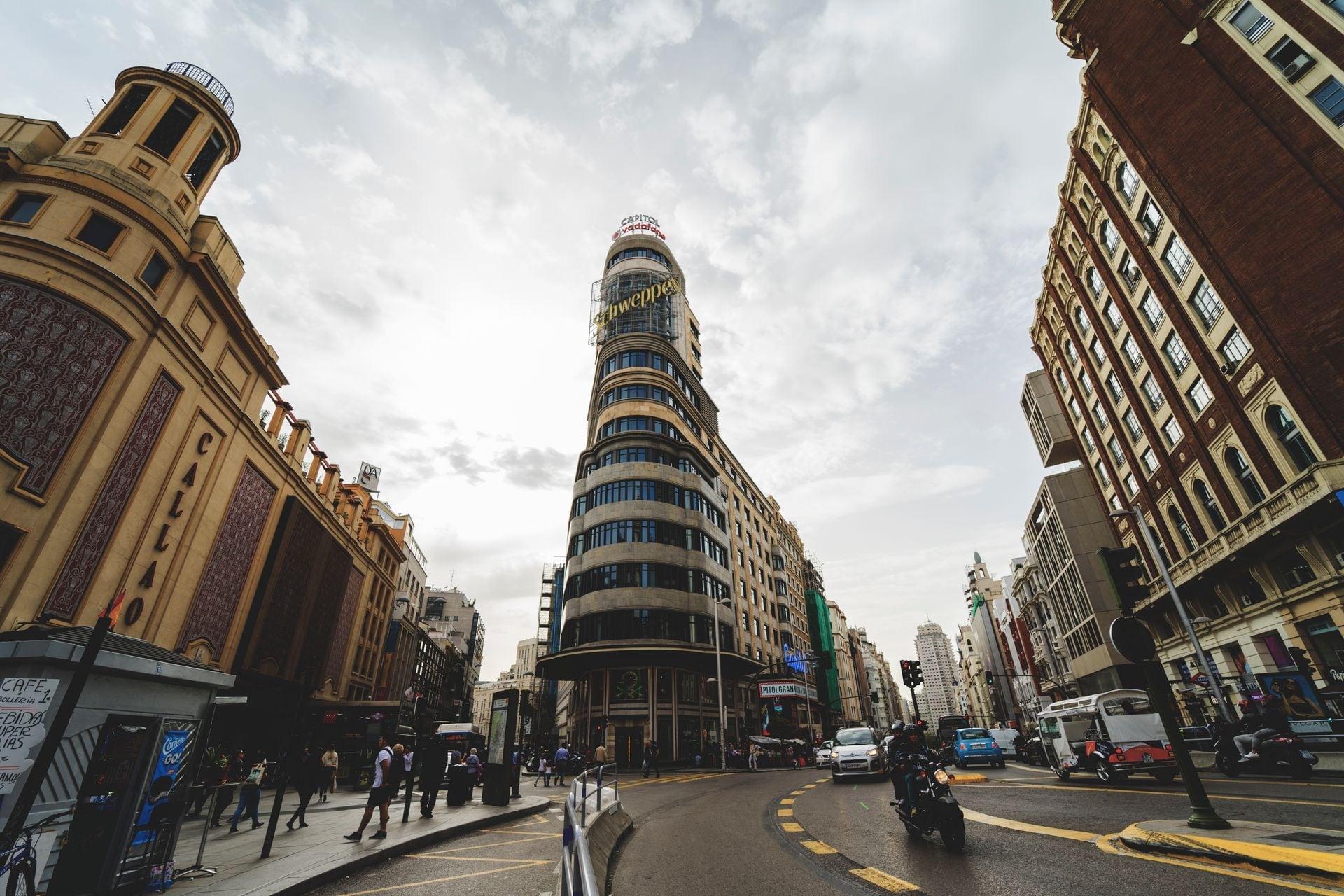
Edificio Carrión: The Curved Corner at Callao and the Sign That Stayed
Plaza de las Cortes: Cervantes, His Lion and the Congreso Lions