In the 1700s these streets were Madrid's northern edge, and the crown and the city used the edge the way cities do: for the big institutions that needed room. A barracks for the king's guard went up here, and a poorhouse for close to a thousand people, an artillery park, and a royal convent that was also meant to be a king and queen's tomb. Then, one by one, the city and the people living around them took those places back. The barracks became an archive, the poorhouse a museum, the artillery park a square, the convent the courts. And in the 1980s Chueca's run-down streets were cheap enough to let in the people who remade them. Malasaña and Chueca are not just nightlife districts. They are a long lesson in what a city does with its own leftovers.
Ribera's doorways
The walk keeps meeting one architect: Pedro de Ribera, the city's architect in the early 1700s. His trick is easy to spot once you know it. He took plain, practical buildings and spent all the decoration on the door.
The Conde Duque barracks, begun in 1717, is one of the largest buildings in Madrid and almost entirely plain: long brick ranges around three courtyards, window after window in a steady rhythm. Then comes the doorway, a heavy stone frame wrapped in garlands, trophies and the crown's arms. The Royal Hospice on Calle de Fuencarral, the city's poorhouse, which Ribera enlarged from 1721, does the same. Its granite doorway is laid over the front like an altarpiece, with stone angels drawing back carved curtains as if a show were about to begin. The museum that occupies it today calls it a doorway more fitting for a palace than a charity.
Ribera also finished the church of Our Lady of Montserrat, whose money ran out before it got its dome. He planned a tower on each side of the front. One was built. The other still stops at its base, and you can count the missing tower from across Calle de San Bernardo.
What the city kept
Hear a stop from this walk
Mercado de San Antón: The Market Remade
The pattern on this walk is not preservation in a neat sense. It is the city choosing a fragment and letting the rest go.
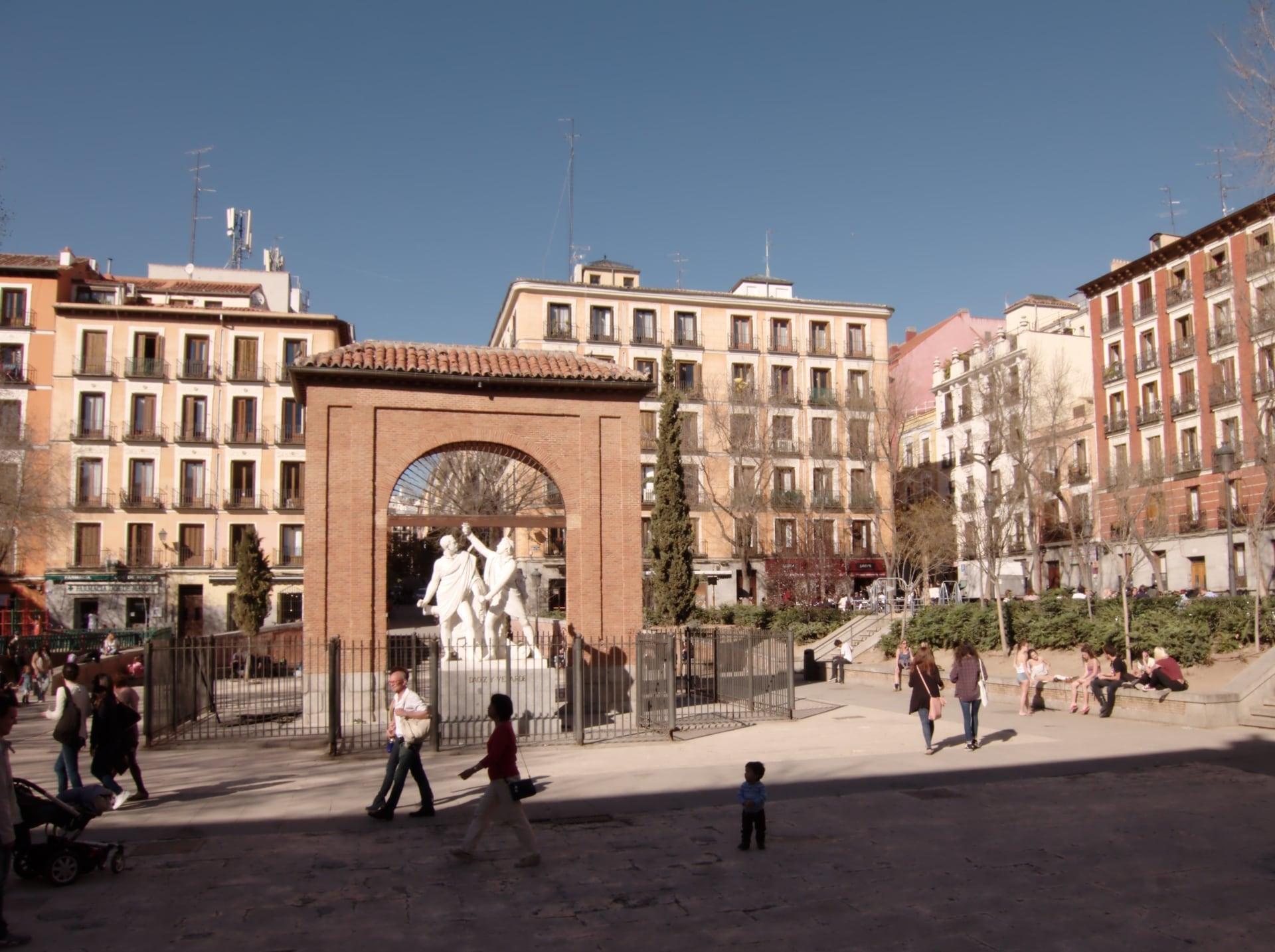
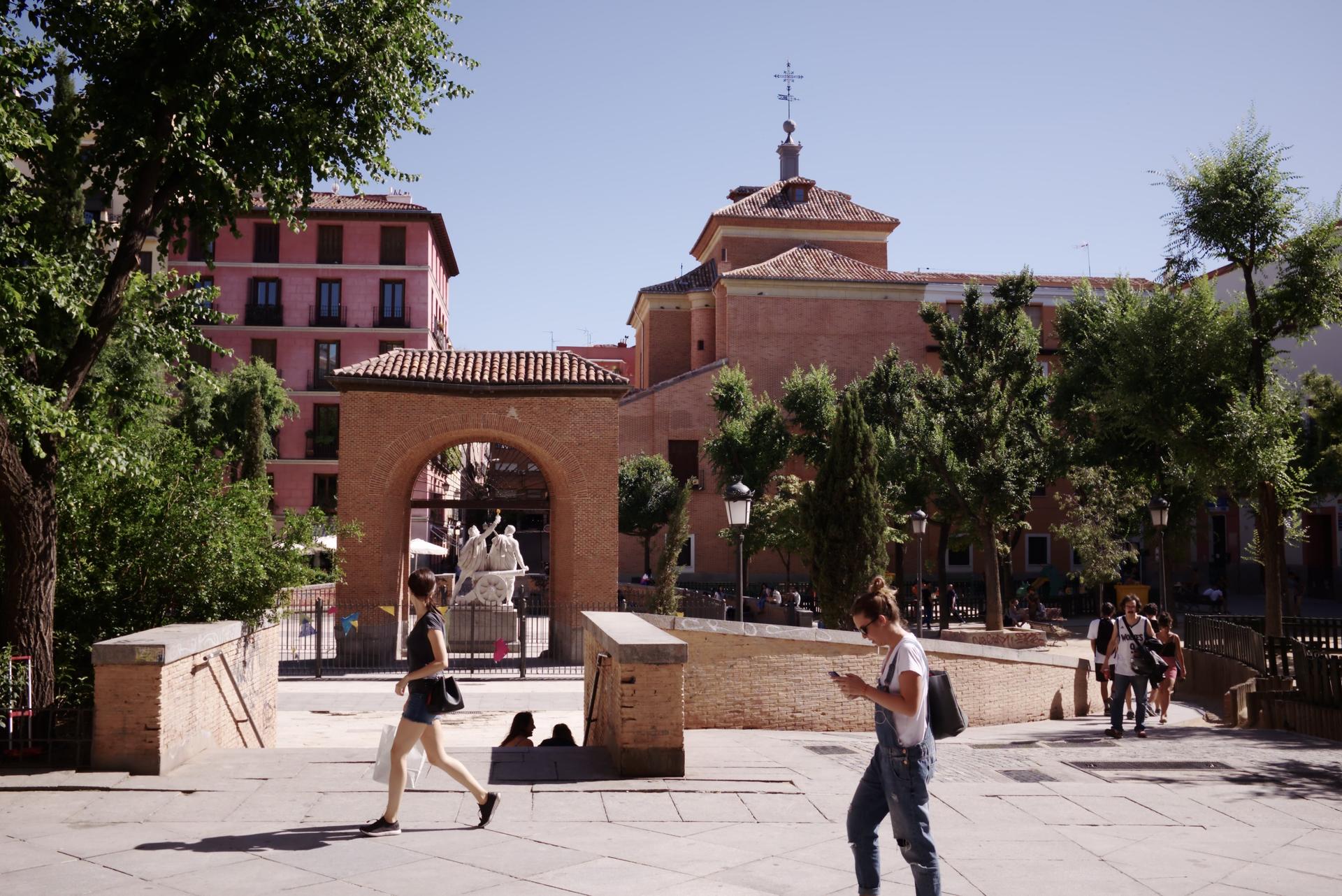
At the Plaza del Dos de Mayo the arch is the real entrance to the Monteleón artillery park, whose defense on the second of May, 1808, is what the square remembers. When the barracks came down in 1868, the city bought the gate, iron railings and all, and used it as the base for the monument to the heroes Daoíz and Velarde. Everything else on that ground is gone.
The poorhouse got the same treatment. By 1917 it was nearly in ruins. In 1919 only its front, the first range, the chapel and the door were protected, and the rest came down from 1923. The city opened its history museum in what was saved in 1929. On the cleared ground behind it, neighbors asked for a garden rather than a market or housing. After years as a garden and then a temporary market, it reopened in 2017 as the Jardines del Arquitecto Ribera, with Ribera's own Fountain of Fame, moved here from across town, standing behind the museum's railings.
A king and queen with no heir
Toward Chueca the scale changes. The Salesas Reales was built for Fernando the Sixth and Bárbara de Braganza, who had no children and so would not lie in the royal pantheon at El Escorial. They built their own church to be buried in, finished in 1757, with a convent school for noble girls beside it, on what was then the outskirts of Madrid. In 1870 the convent became the Palace of Justice, and today it holds Spain's Supreme Court. The king and queen are still in the church.
Between the Salesas and the poorhouse, two houses show how fast taste moved. The Museo del Romanticismo is a calm neoclassical house finished in 1779. The Palacio Longoria, built from 1902 to 1904 for a financier, is one of Madrid's few modernista buildings, its artificial stone fronts swelling with plant forms so the whole facade becomes the ornament.
Chueca's turn
The last chapter belongs to people rather than institutions. Plaza de Chueca takes its name from the zarzuela composer Federico Chueca, but the neighborhood's modern story began in the 1980s, when these streets were run down and rents were low. That cheapness is exactly why they mattered. COGAM, Madrid's LGBT collective, began here, and Chueca became the center of the city's Pride. The streets that were let go are now among the most expensive in Madrid.
The walk ends at the Mercado de San Antón, rebuilt in 2011 as a stack of floors: a supermarket in the basement, fresh food above it, tapas counters higher up and a roof terrace on top. A neighborhood market became a place to eat out, the latest version of the city taking something back and making it into something else.
Walking it
The tour is twelve stops over about 2.7 kilometers, around seventy-five minutes, flat the whole way, from the Conde Duque near Ventura Rodríguez Metro to the San Antón market beside Chueca Metro. Every stop works from the street, so the museums along the way are optional. On your own schedule you can step into the history museum, take a coffee in a square, or skip a stop on a crowded weekend night. These are lived-in streets with homes above the shops, so keep voices low by the doorways.
The walk begins at stop 1 of Malasaña and Chueca: The Old Edge of Madrid, at the Conde Duque barracks. See every route on the Madrid page.
Sources
- esmadrid, Plaza del Dos de Mayo: the rising of 2 May 1808 and the monument to Daoíz and Velarde.
- esmadrid, Palacio de Longoria: one of Madrid's few modernista buildings.
- esmadrid, Iglesia de Santa Bárbara: the Salesas Reales convent, its role as a retreat on the edge of Madrid, the 1870 Palace of Justice.
- eldiario.es, Chueca and the making of a Pride neighborhood: Chueca as a run-down area in the 1980s and the LGBT community that remade it.
Ready to experience it?
Malasaña and Chueca: The Old Edge of Madrid
75 min · 2.7 km · easy
More from Madrid
Explore more at your own pace.
Barrio de las Letras: Madrid's Writers' Quarter in Three Layers
Gran Vía: How Madrid's Great Way Grew Wider and Taller as It Was Cut
Retiro Park: How a King's Garden Became Madrid's
Edificio Carrión: The Curved Corner at Callao and the Sign That Stayed
Plaza de las Cortes: Cervantes, His Lion and the Congreso Lions