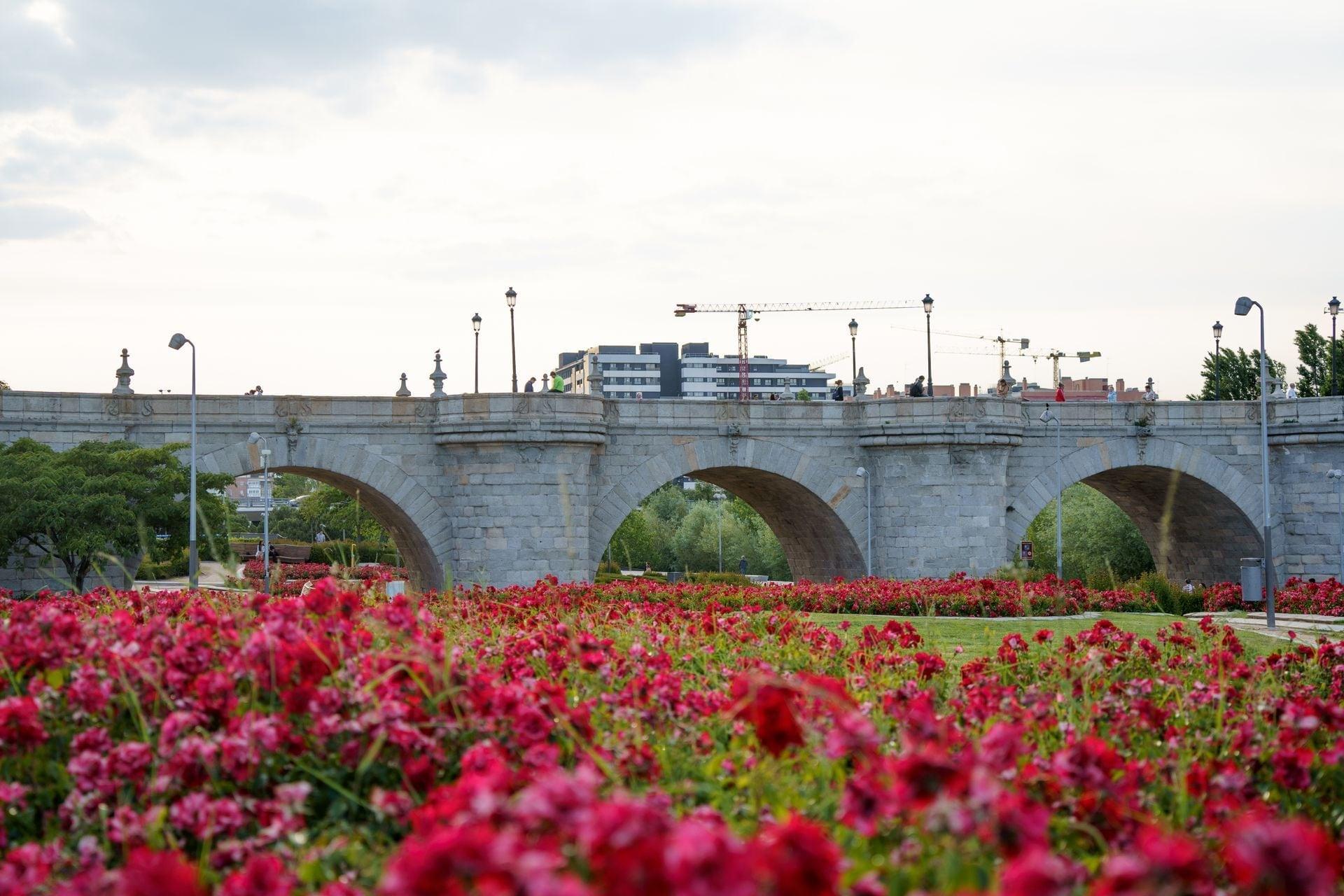
The Puente de Toledo is Pedro de Ribera's Baroque answer to the plain bridge upstream. It has the same nine round granite arches as Juan de Herrera's Puente de Segovia, but Ribera did not stop at the arches. He dressed the road itself, with half-round bays swinging out along the parapet and two stone shrines over the central arch holding Madrid's patron saint and his wife. And since the motorway works of the early 1970s, this bridge built for carts and coaches has carried only people on foot.
Same arches, different idea
Start with the comparison, because it is the reason the walk sends you past both bridges. Herrera's Segovia bridge, opened in 1584, is an engineer's bridge. Its great change was to make the road dead level, and its ornament is almost nothing: granite arches, a flat deck, restraint in the manner of El Escorial.
Ribera built the Toledo bridge about a century and a half later, in the 1720s. Madrid's tourist office calls it one of the most representative works of the city's own Baroque, the style known in Spanish as barroco castizo. It is made of the same material, granite blocks, and it uses the same structural move, nine semicircular arches. The difference is all in what sits on top.
Look along the deck. The parapet does not run straight. It swings outward in a series of half-circles, little balconies over the water where a walker can step aside from the road. Over the middle arch, on each side, stands a small Baroque pavilion, called a casalicio, a kind of open shrine in stone.
The saints on the parapet
Hear a stop from this walk
Fuente Castellana: The Fountain That Moved
In those two shrines stand San Isidro, Madrid's patron saint and the patron of farmers, and his wife, Santa María de la Cabeza. Ribera commissioned the statues from the sculptor Juan Alonso Villabrille y Ron, and they face each other across the road. Seen side-on from the gardens, you only notice the pavilions. Walk up onto the deck to the middle and you see the pair as they were meant to be seen, a married couple keeping watch over everyone who crosses.
The patron is part of the story too. Ribera built the bridge for the Marquis of Vadillo, who ran the city for the king, the same man who paid for the Ermita de la Virgen del Puerto, the riverside chapel where the Madrid Río walk begins. One architect and one patron gave this stretch of river both its chapel and its grandest crossing.
How it lost its traffic
The bridge was declared a monument in 1956. Two decades later the road it carried became a problem. During the M-30 motorway works of 1972 to 1974, the engineer Fernández Casado designed two new curved crossings beside it to take the traffic, and the old bridge was closed to cars.
Since then it has been looked after as a piece of the city rather than a piece of road. The city restored and consolidated it between 1992 and 1997. The building of Madrid Río touched its side spans. In March and April 2023 the statues of San Isidro and Santa María de la Cabeza and their shrines were cleaned and restored.
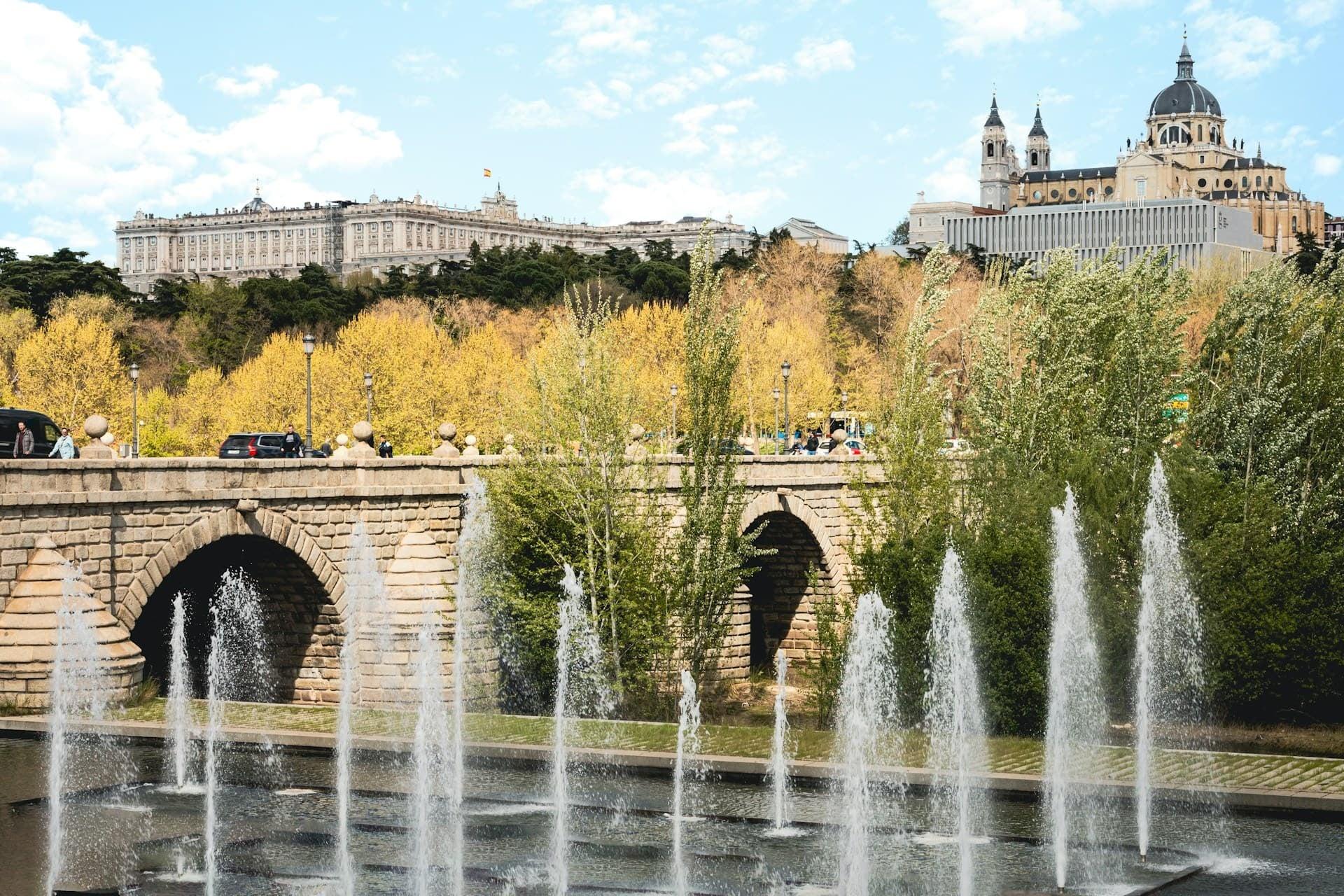
Today the motorway runs in tunnels, the riverbanks are gardens, and the bridge sits among flower beds as a promenade. The irony is pleasant: a bridge built for traffic, saved for walkers by the very motorway that later went underground.
Seeing it on the walk
The tour stops at the foot of a path in the south-bank gardens, about fifty meters from the bridge, where you see the arches and pavilions side-on. Walking up to the shrines and back takes a few minutes. On a self-guided walk that detour is yours to take or skip, and if you want to end the walk early, Marqués de Vadillo Metro is close by at this end of the bridge.
The bridge is stop 7 of Madrid Río: The City Gets Its River Back, which follows the Manzanares from Ribera's chapel to a royal fountain in the Arganzuela park. See all routes on the Madrid page.
Sources
- esmadrid, Puente de Toledo: Ribera as builder, the barroco castizo verdict, the nine granite arches, the semicircles along the deck, the two shrines with San Isidro and Santa María de la Cabeza, the 1956 monument declaration, the 1972 to 1974 works with Fernández Casado's curved crossings and the closure to traffic, the 1992 to 1997 restoration, the Madrid Río works and the 2023 restoration of the statues and shrines.
- esmadrid, Puente de Segovia: the older bridge upstream for comparison.
- esmadrid, Ermita de la Virgen del Puerto: the Marquis of Vadillo as Ribera's patron at the riverside.
- esmadrid, Madrid Río: the Puente de Toledo gardens within the river park.
Ready to experience it?
Madrid Río: The City Gets Its River Back
75 min · 3.4 km · easy
More from Madrid
Explore more at your own pace.
Barrio de las Letras: Madrid's Writers' Quarter in Three Layers
Gran Vía: How Madrid's Great Way Grew Wider and Taller as It Was Cut
Malasaña and Chueca: Madrid's Old Northern Edge, Taken Back by the City
Retiro Park: How a King's Garden Became Madrid's
Edificio Carrión: The Curved Corner at Callao and the Sign That Stayed