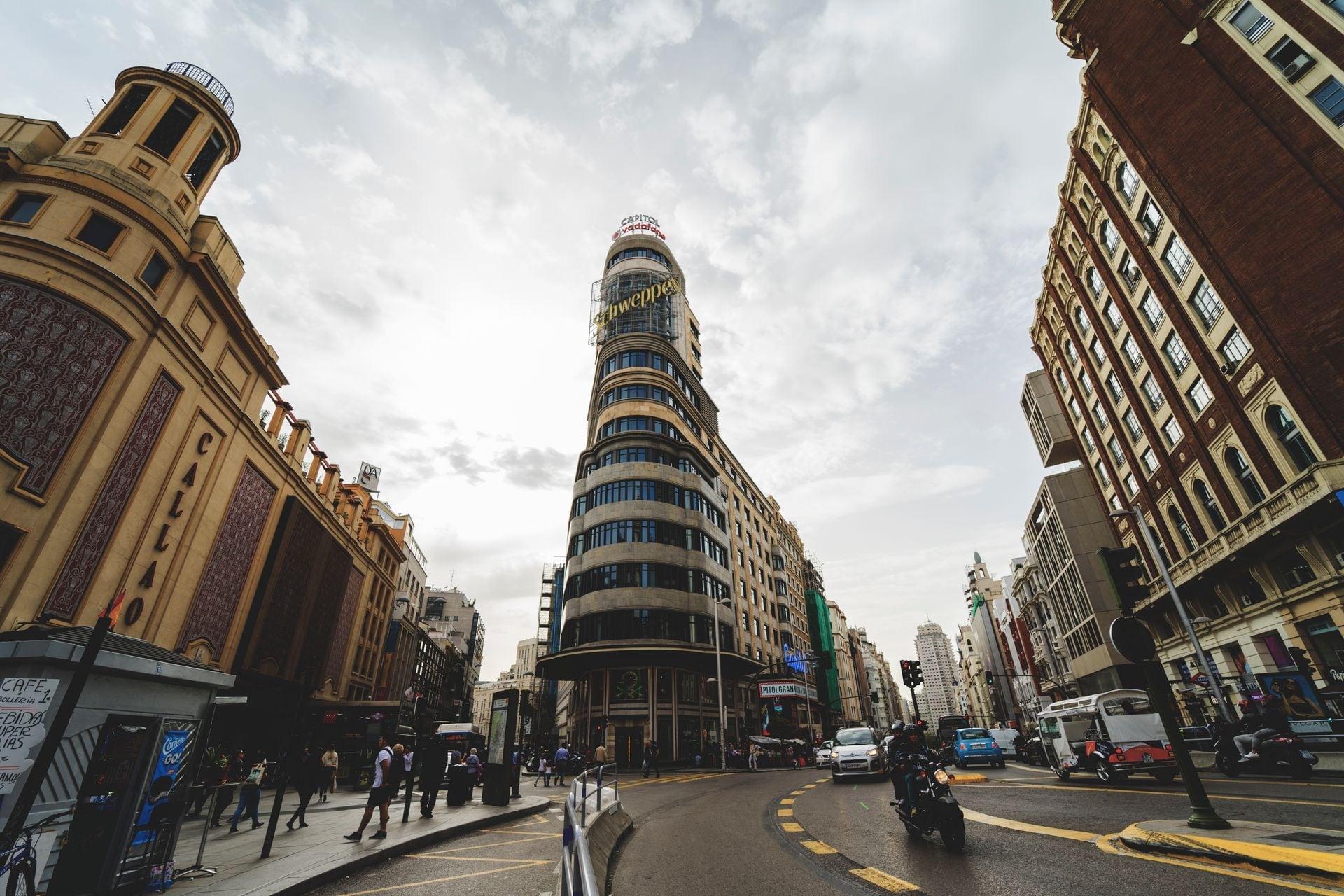
The Edificio Carrión turns the corner at Callao as one moving curve, and everything about it was designed to be seen from the square. Built between 1931 and 1933, it packed cinemas, a hotel, flats and offices into a single frame, and its roof was made to carry light. When a restoration in 2007 stripped the old advertising off the building, one neon sign was kept: the Schweppes sign that still glows over the Gran Vía. Stand in the Plaza del Callao and you are looking at a building that is half architecture and half billboard, on purpose.
A corner that does not stop
Look at how the building meets the corner. Most blocks on the Gran Vía turn a street corner with a tower or a chamfer, a vertical accent that says "here is the corner." The Carrión does the opposite. Its front sweeps round in one long curve, and horizontal bands run the whole way across it, so the eye slides from one street to the other without a break. The building seems to be moving.
The city's own history of the Gran Vía places it under the sign of German expressionism, in the line of Erich Mendelsohn, and calls it a clear bet on the avant-garde and an urban icon from the day it was finished. Madrid's tourist office describes the style as Art Deco. The two labels meet in the same idea: a modern, streamlined front, built of marble and granite, with its corner as the event.
The architects were Luis Martínez-Feduchi and Vicente Eced. The client was Enrique Carrión, Marquis of Melín, whose name the building first carried and still shows at its entrance. Its fourteen floors stand where the Gran Vía's second stretch meets the square.
A town in one building
Hear a stop from this walk
Monumento a Cervantes: Half a Century in the Making
The Carrión was planned as what the city's history calls a polyfunctional building. According to the tourist office, the original project held sixty-four apartments, a hotel, a café, a bar, a restaurant, a soda water factory, offices and ballrooms, with the Capitol cinema on the lower floors. It is a vertical slice of a whole neighborhood.
It was also technically ambitious. The tourist office singles out its concrete beams in the Vierendeel style, an open-frame beam with no diagonals, along with fire-resistant materials and Madrid's first centralized cooling system, which took up a whole floor. The building won design awards in its day.
That mix is still there. The building is known today as the Edificio Capitol, after the hotel and cinemas that carry the name, and the hotel and the screens are still working inside the same curve.
The sign that stayed
Now look up. The neon Schweppes sign on the roof had its installation licence issued on the fifth of August, 1972. It replaced an earlier sign in the same spot, an advert for Camel cigarettes, and it was made by Luisa Álvarez, a pioneer of neon art.
For decades the Carrión carried several rooftop signs. In 2007 a full restoration led by the architect Rafael de la Hoz removed the advertising from the facade, and kept only two: the Schweppes neon and a more modern sign on the roof. In April 2018 the regional government of Madrid declared the building a Monument of Cultural Interest, for its architecture and its place as an icon of the Gran Vía. The neon is not part of that protection, yet it is the sign people picture when they picture the building.
The idea under all of this is simple. A corner on a busy square is valuable space to look at. The Carrión's designers built a front that draws the eye round the curve and a crown that could hold light above the traffic. Ninety years later, the corner still works exactly that way.
Seeing it on the walk
On the tour you stop on the square's paving near the Gran Vía edge, with the Carrión at the far corner and the classical Palacio de la Prensa across the avenue on your right. Callao is the busiest square on the walk, so the self-guided format helps: you can wait for a gap in the crowd, take the curve in from a few different angles, or come back after dark to see the sign lit, without holding anyone up.
The building is stop 7 of Gran Vía: The Street That Grew Wider and Taller, which runs from the Metrópolis dome to the Cervantes monument. See all routes on the Madrid page.
Sources
- esmadrid, Carrión Building (Capitol): the Marquis of Melín, fourteen floors, Feduchi and Eced, 1931 to 1933, Art Deco, marble and granite, the Vierendeel beams and central cooling, the original programme, the 2007 restoration by Rafael de la Hoz that kept the Schweppes sign, the April 2018 declaration.
- Ayuntamiento de Madrid, Patrimonio Cultural y Paisaje Urbano, "Gran Vía": the building as an urban icon, its avant-garde bet under the sign of Mendelsohn's expressionism, and its many uses.
- Time Out Madrid, 50 years of the Schweppes neon: the licence of 5 August 1972, the earlier Camel sign, Luisa Álvarez as its maker.
Ready to experience it?
Gran Vía: The Street That Grew Wider and Taller
60 min · 1.8 km · easy
More from Madrid
Explore more at your own pace.
Barrio de las Letras: Madrid's Writers' Quarter in Three Layers
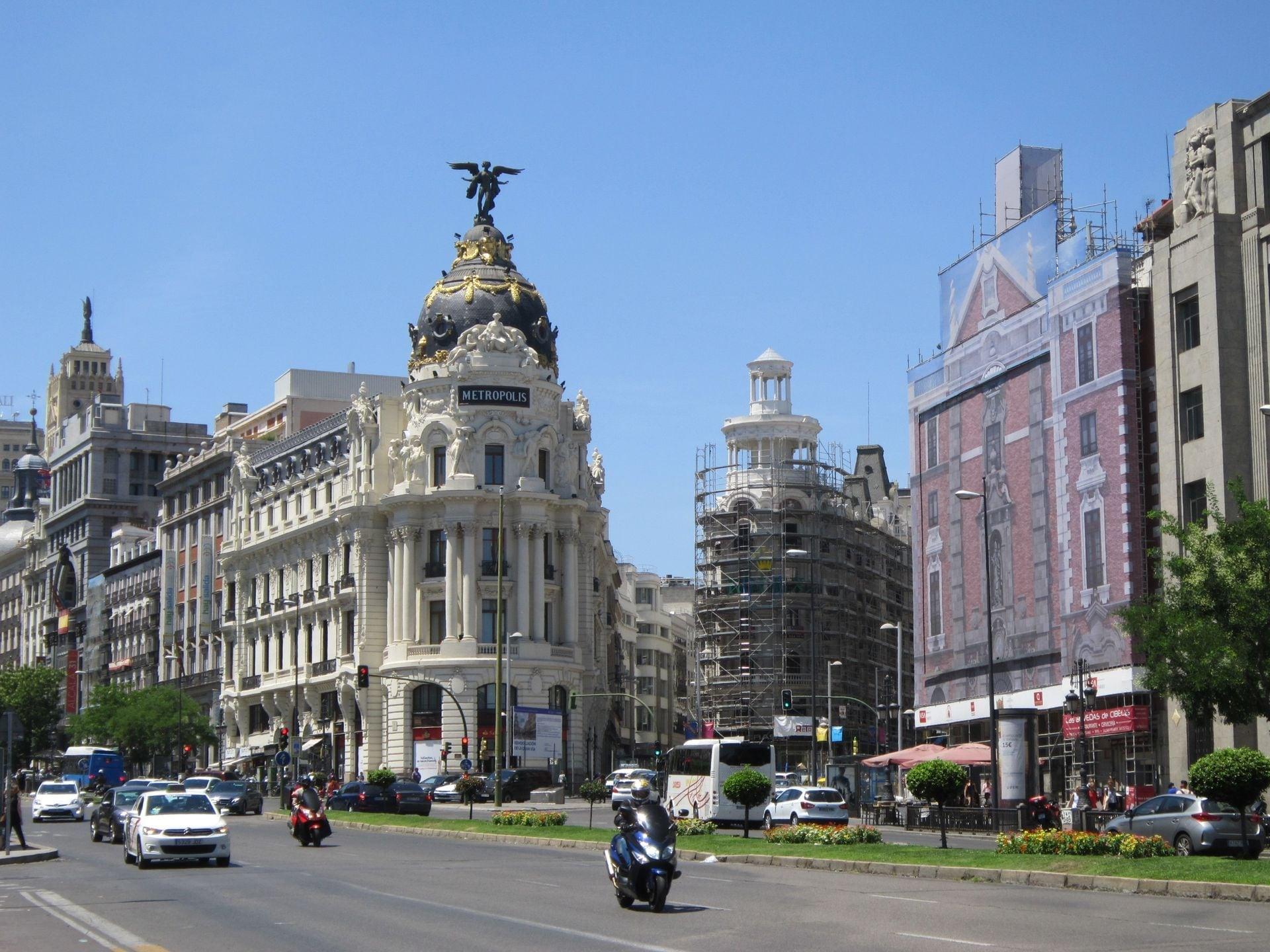
Gran Vía: How Madrid's Great Way Grew Wider and Taller as It Was Cut
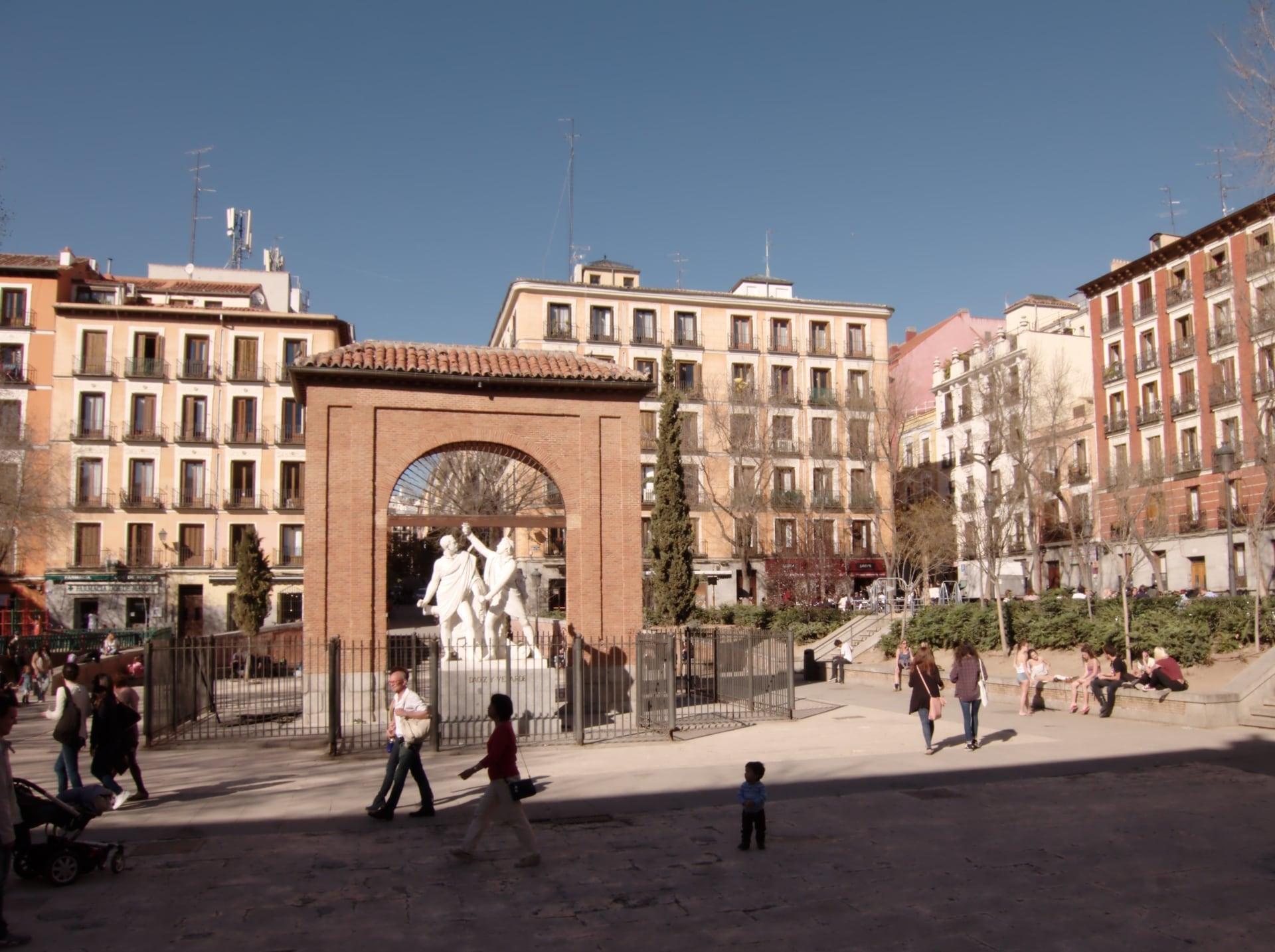
Malasaña and Chueca: Madrid's Old Northern Edge, Taken Back by the City
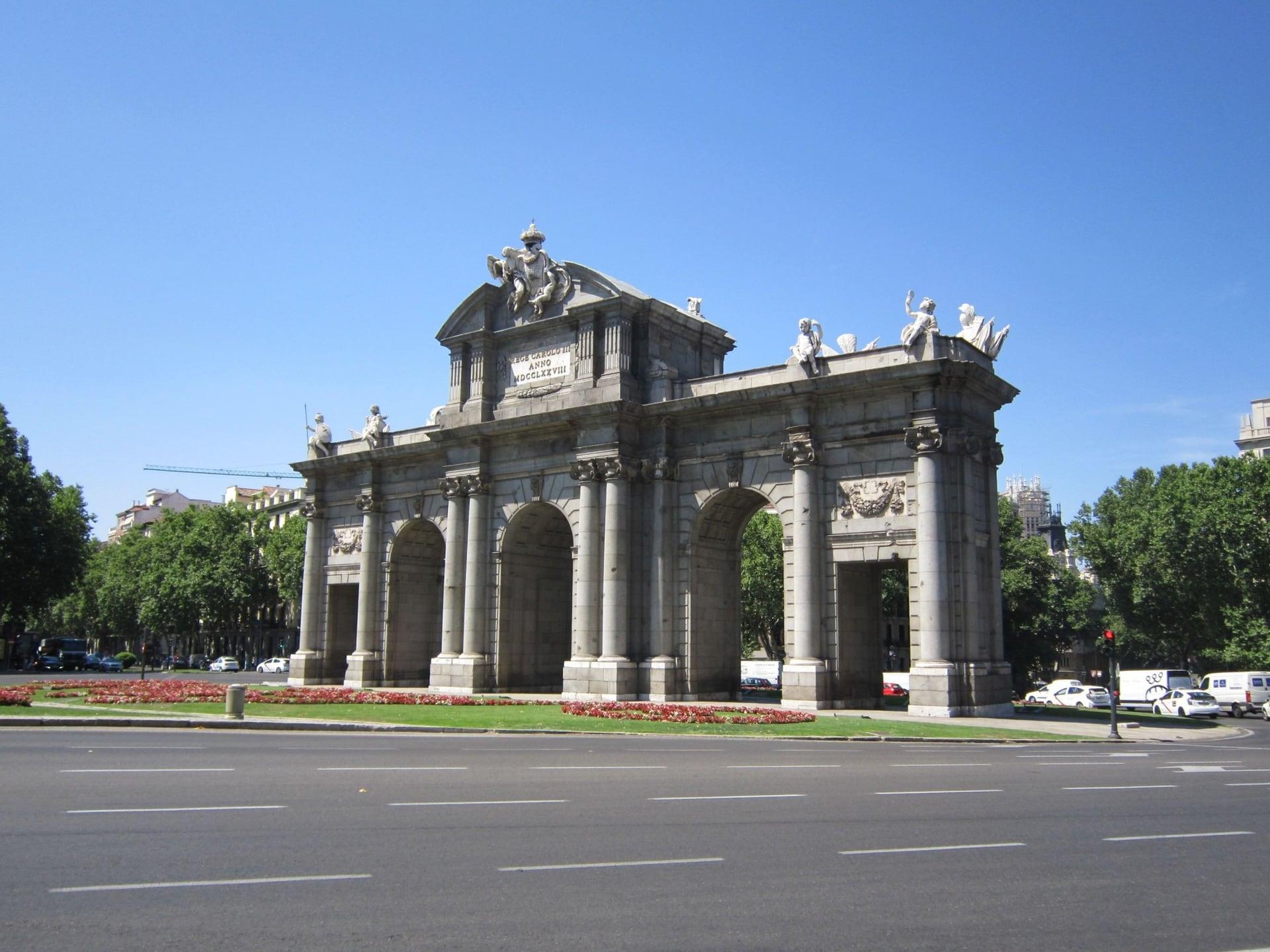
Retiro Park: How a King's Garden Became Madrid's
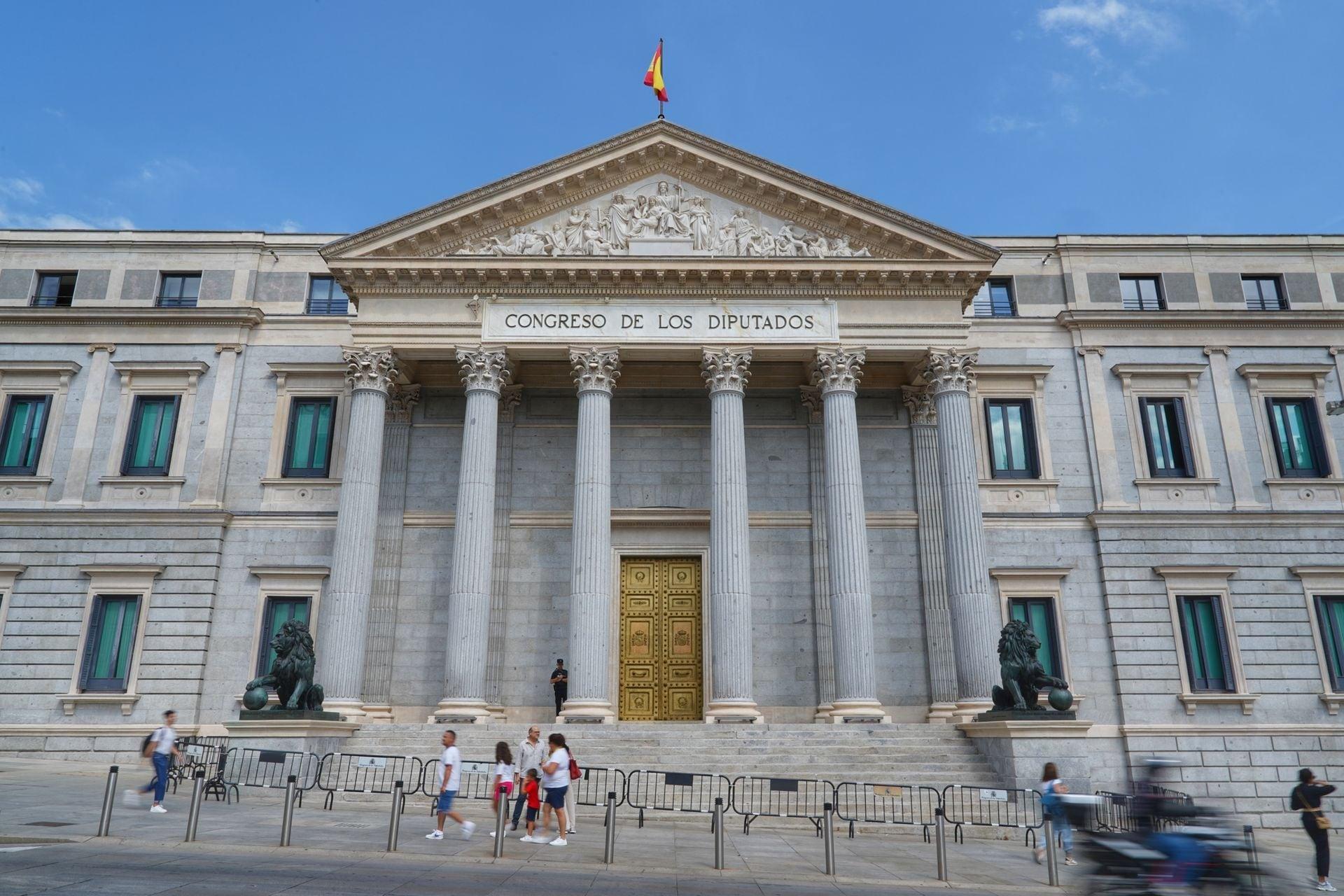
Plaza de las Cortes: Cervantes, His Lion and the Congreso Lions