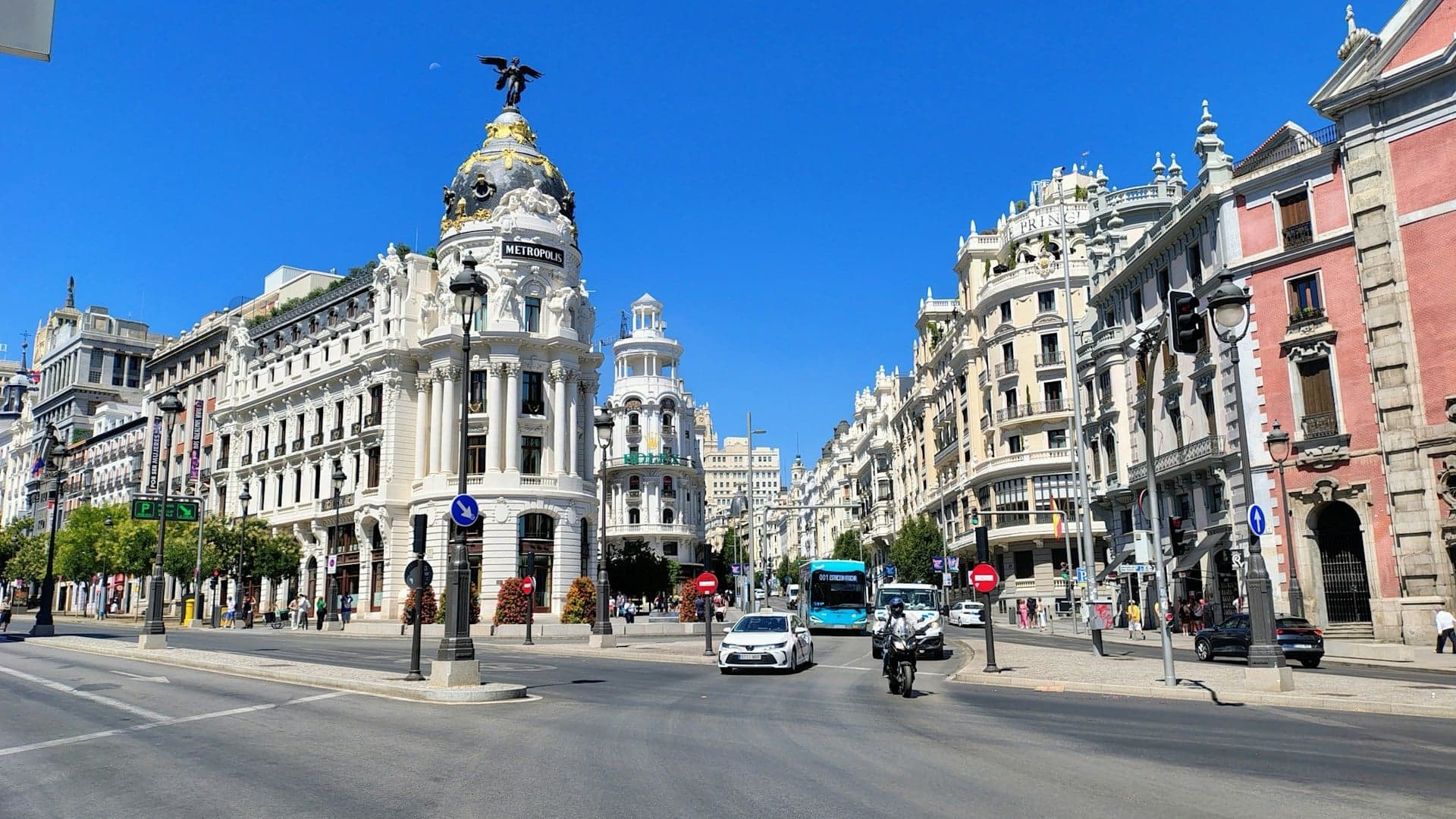
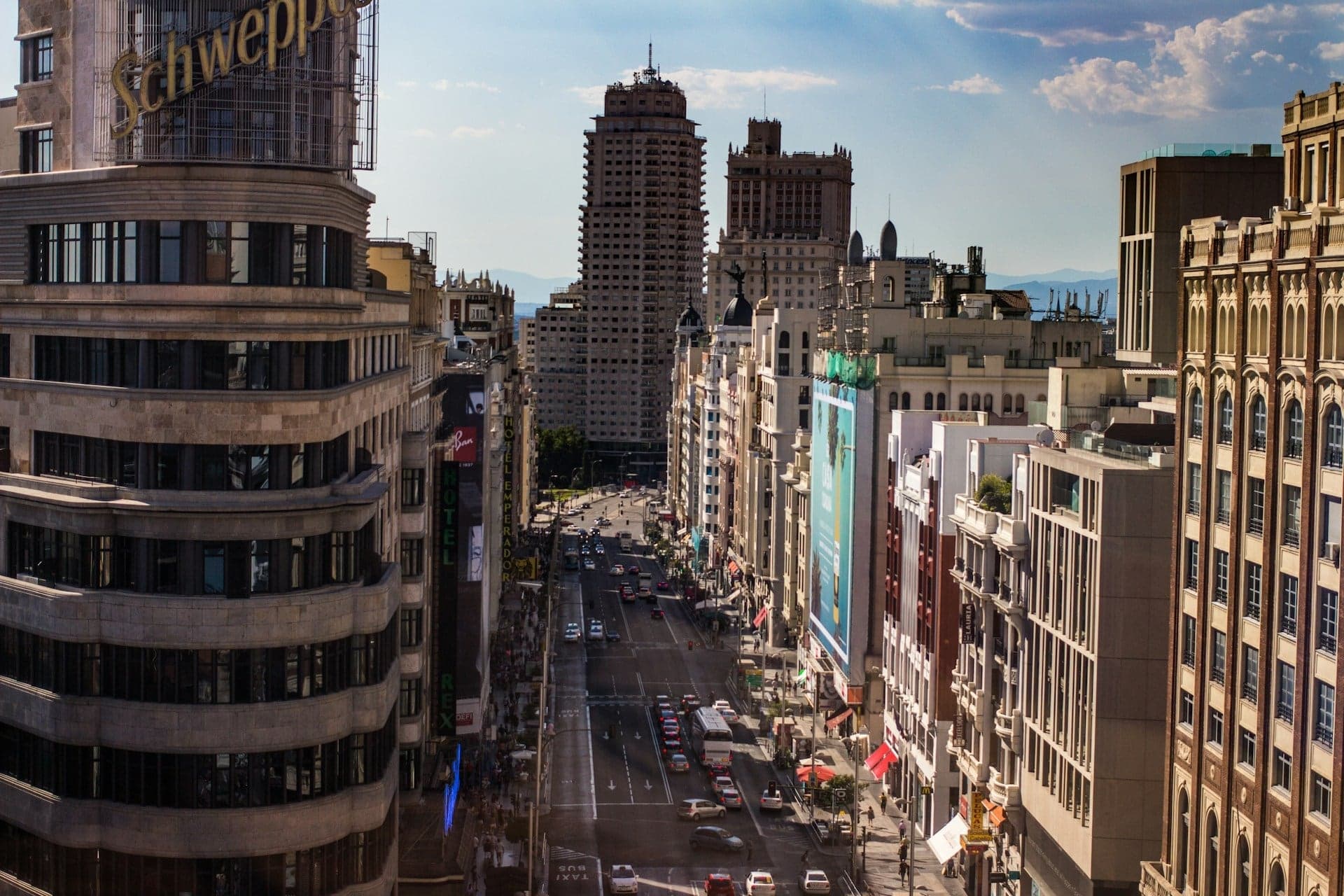
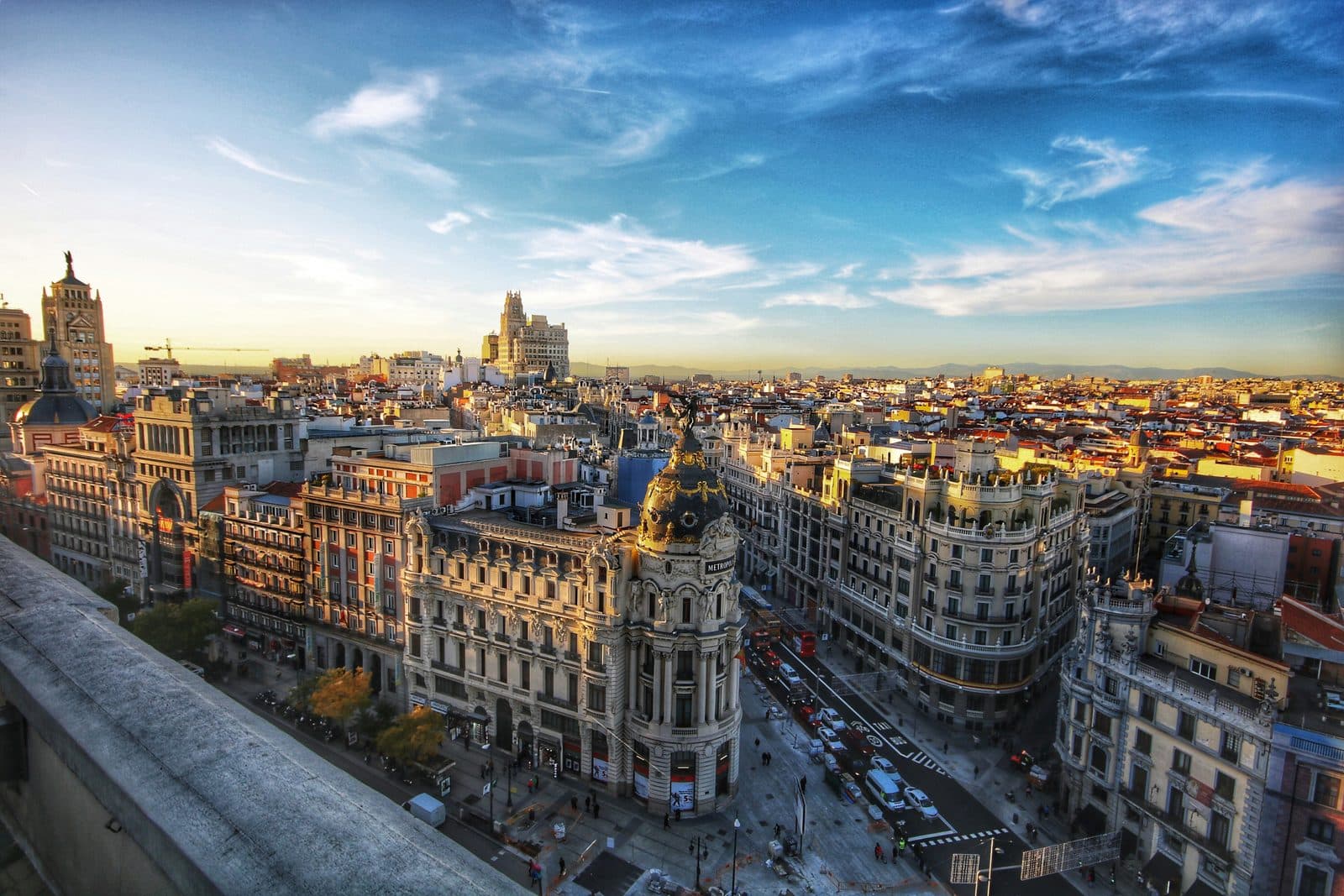
From the Metrópolis dome past the Círculo de Bellas Artes, the Telefónica tower, Callao's neon and the Coliseum to the Edificio España and the Cervantes monument in the Plaza de España.
Start · Edificio Metrópolis: The Dome at the Fork
DirectionsStops
- 1
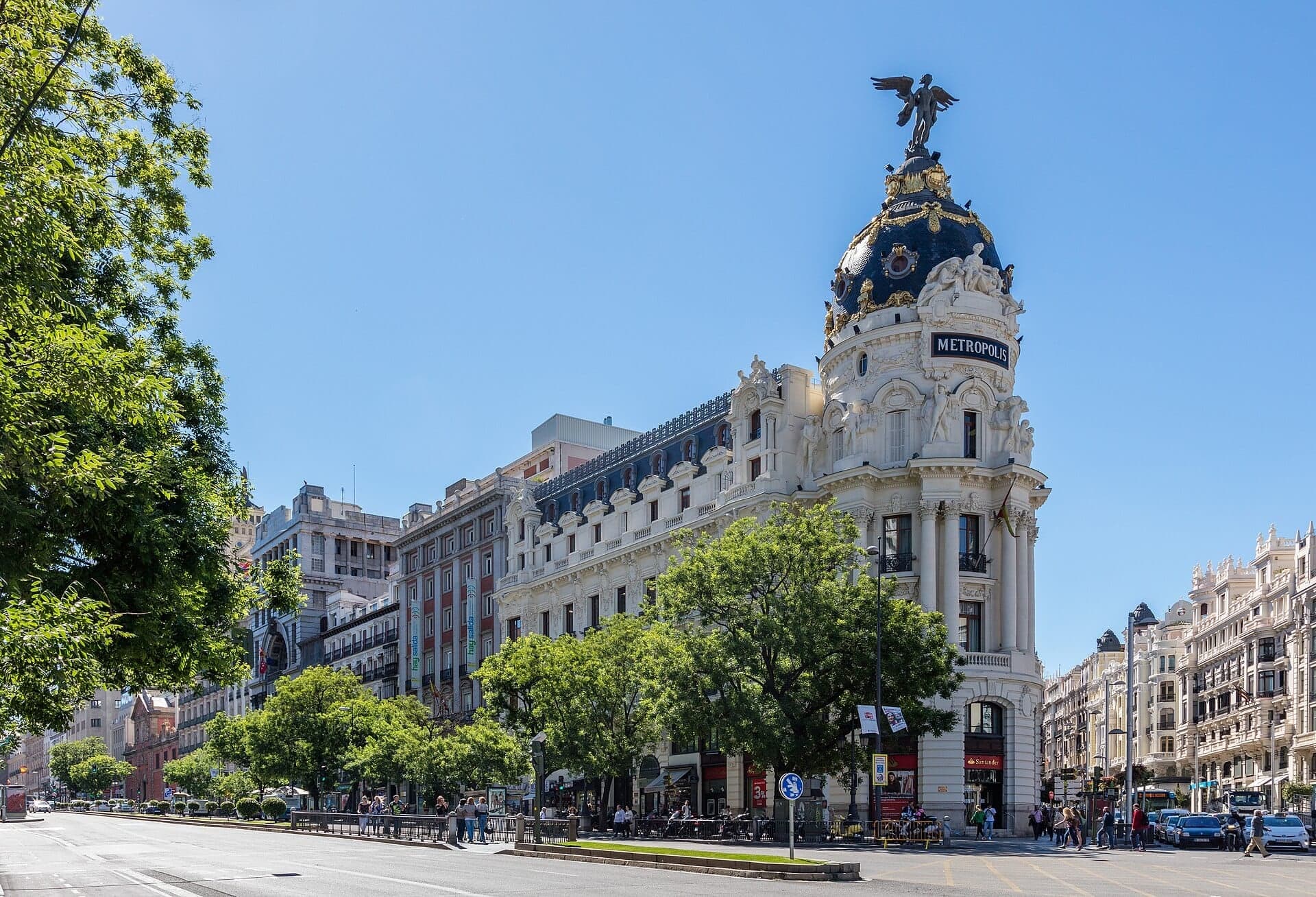
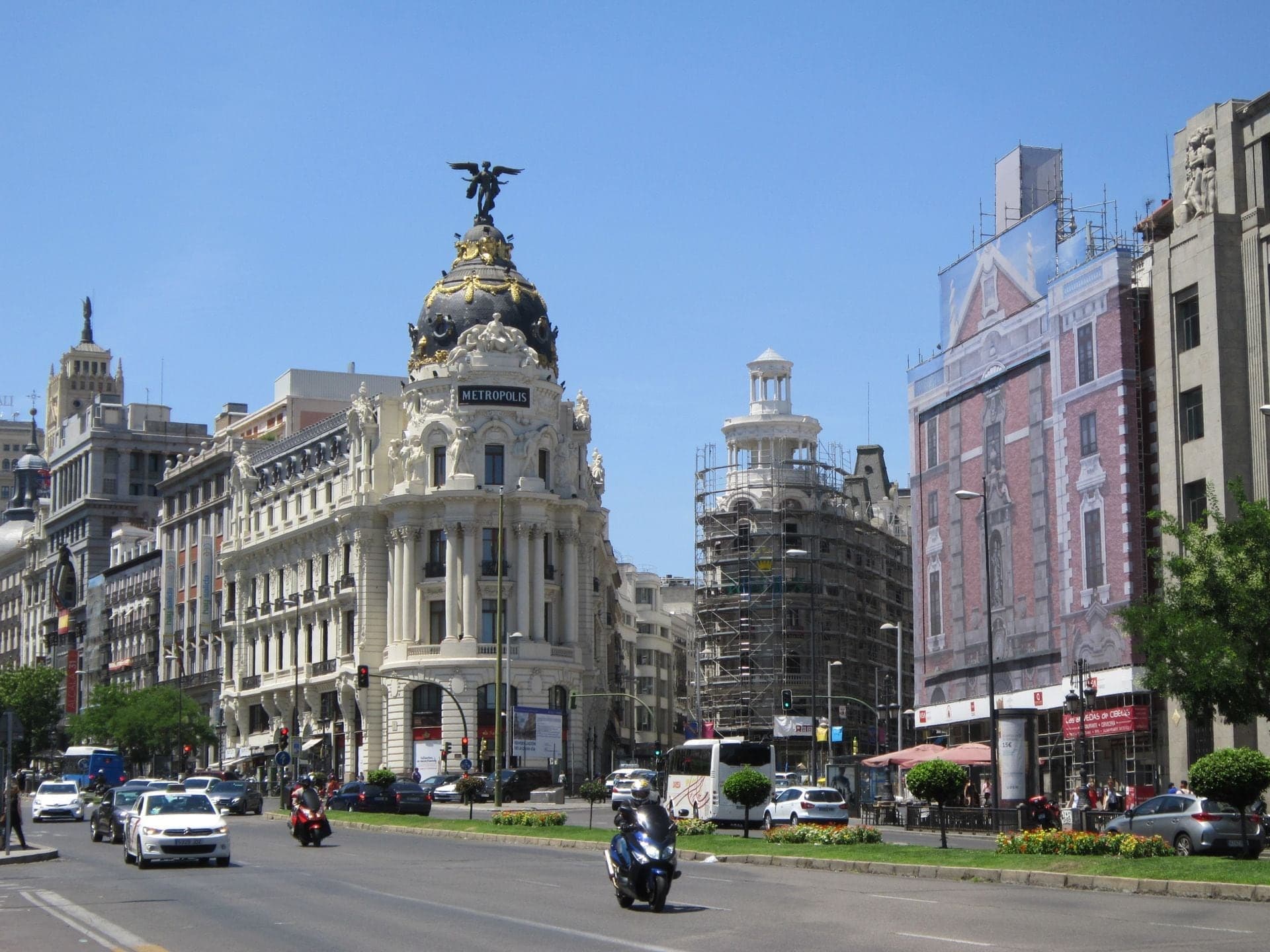
Edificio Metrópolis: The Dome at the Fork
A French-designed insurance building with a slate dome, seen whole down Calle de Alcalá at the fork where the Gran Vía begins.
- 2
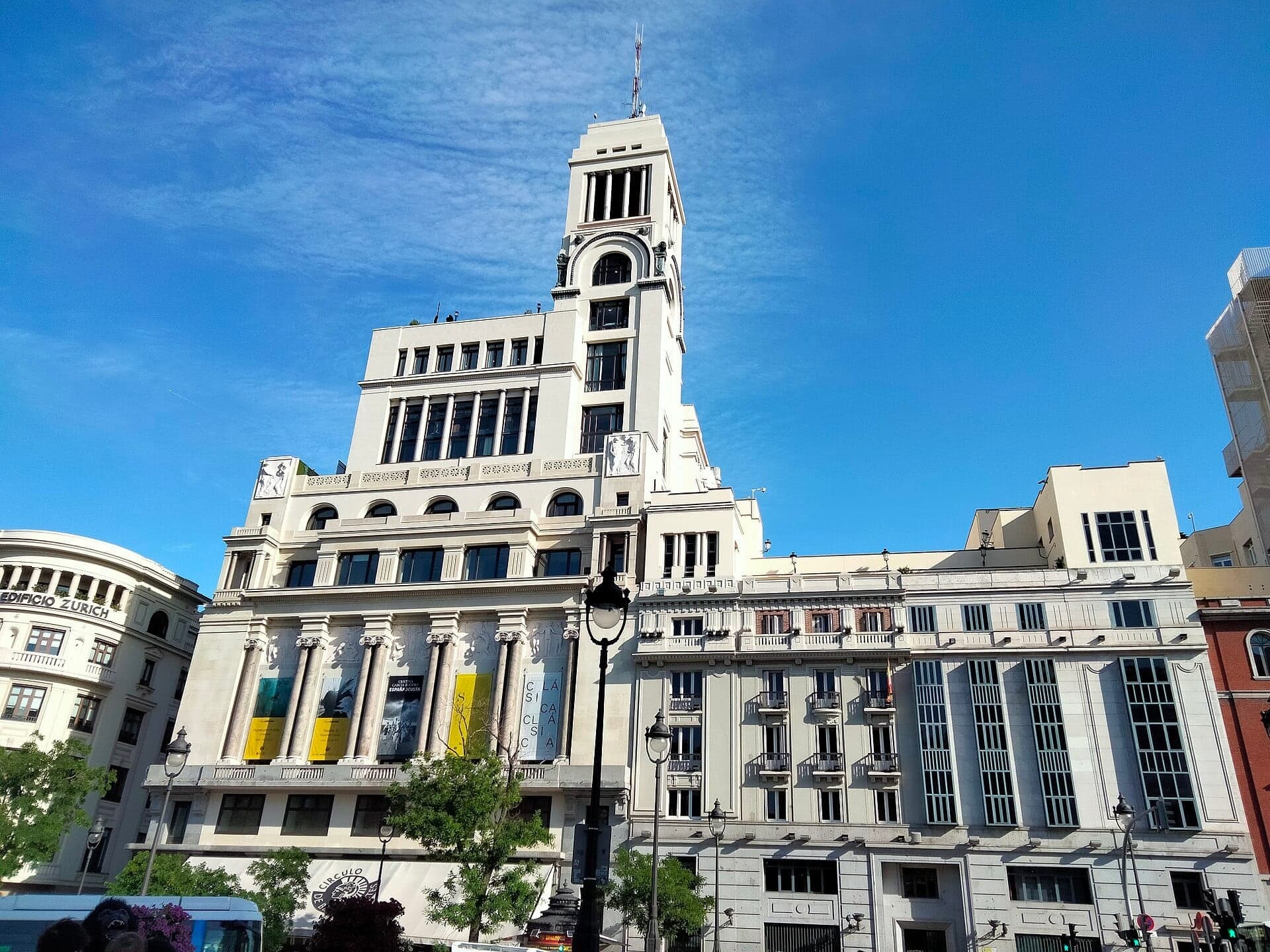
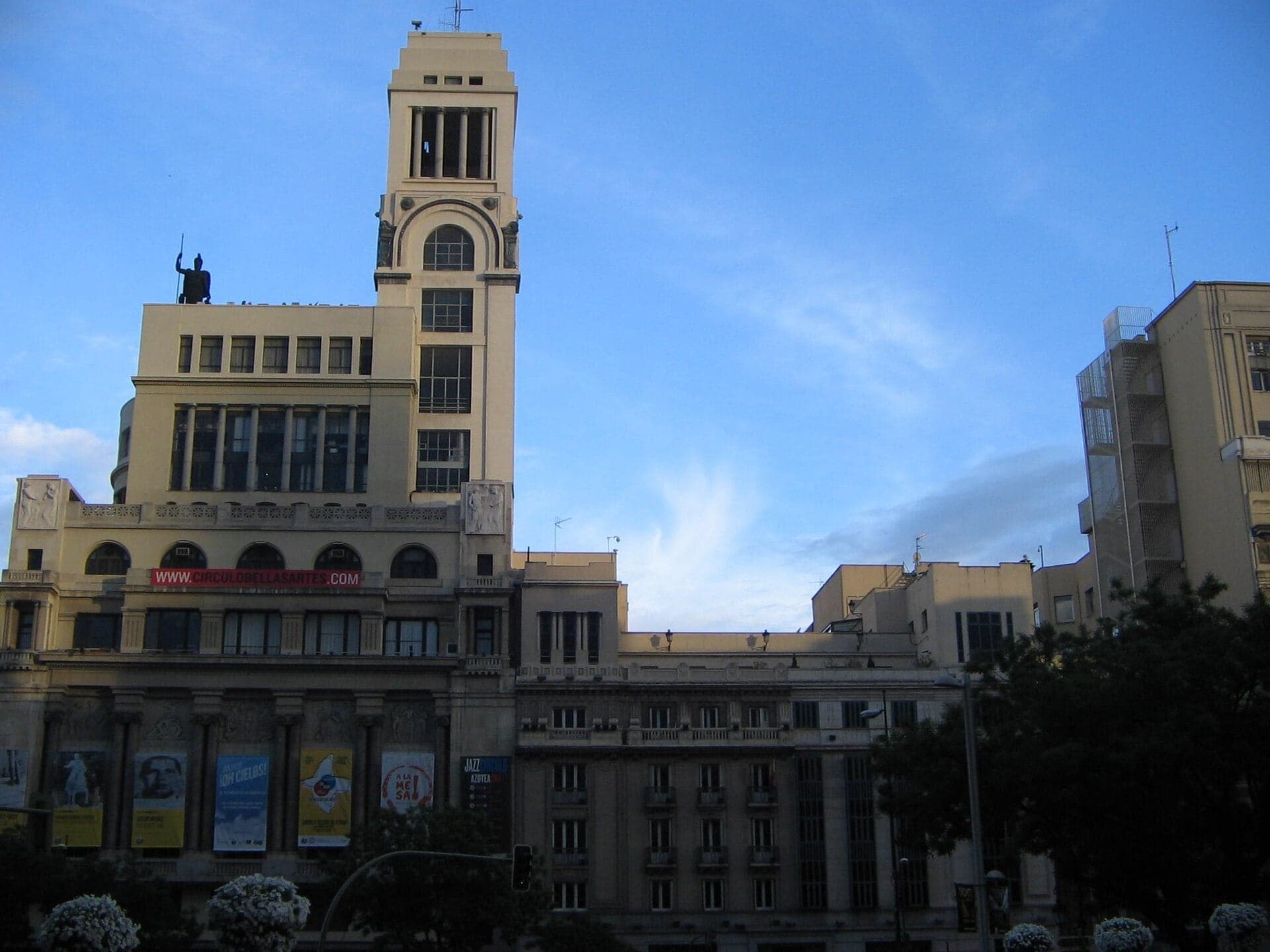
Círculo de Bellas Artes: Too Tall to Win
Antonio Palacios's arts club was rejected for its height, then chosen by its members, and is seen whole across Calle de Alcalá.
- 3
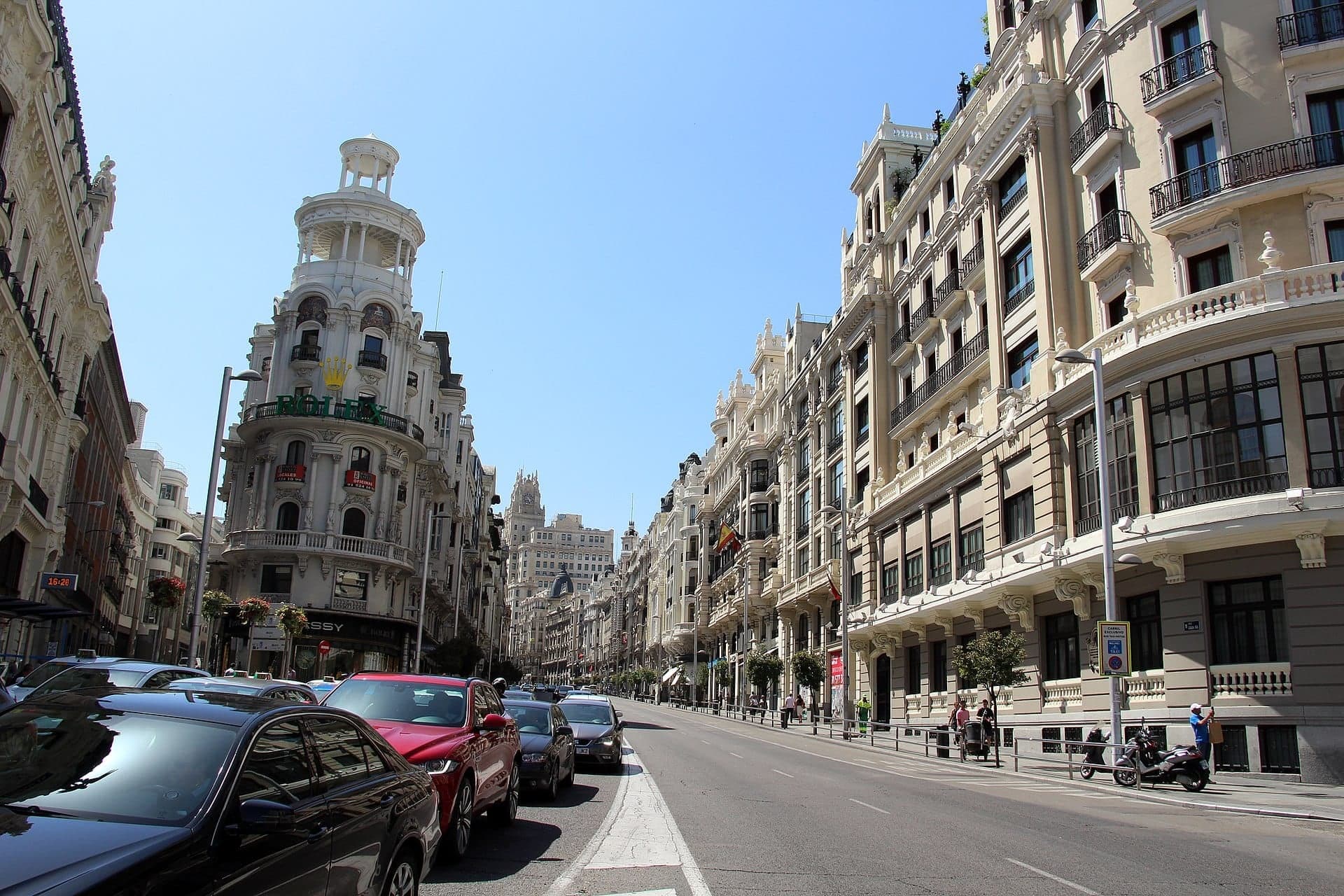
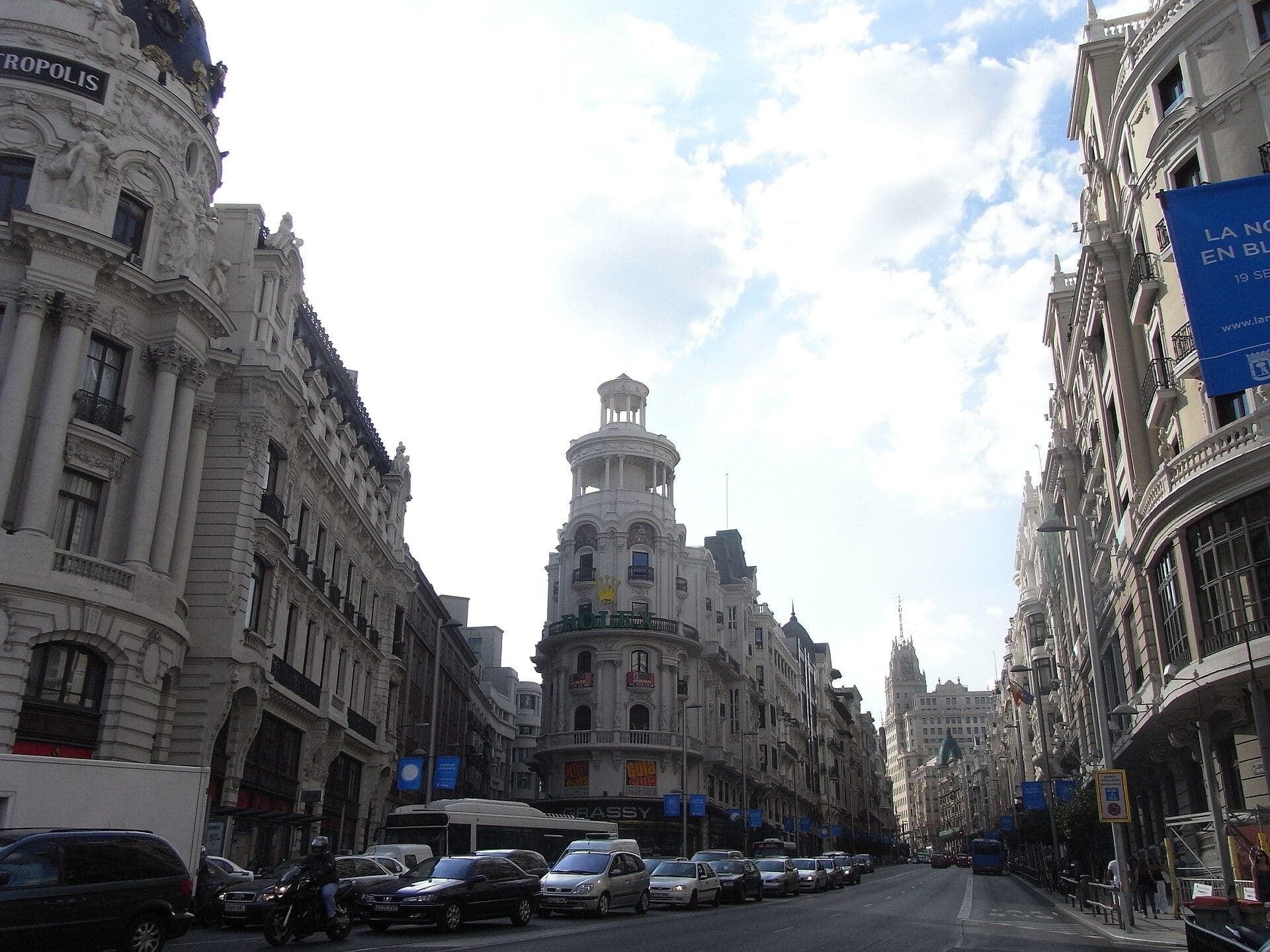
Edificio Grassy: A Tower on a Sharp Corner
One of the first buildings on the new street, turning a knife-sharp corner with a round tower, like the Metrópolis back at the fork.
- 4
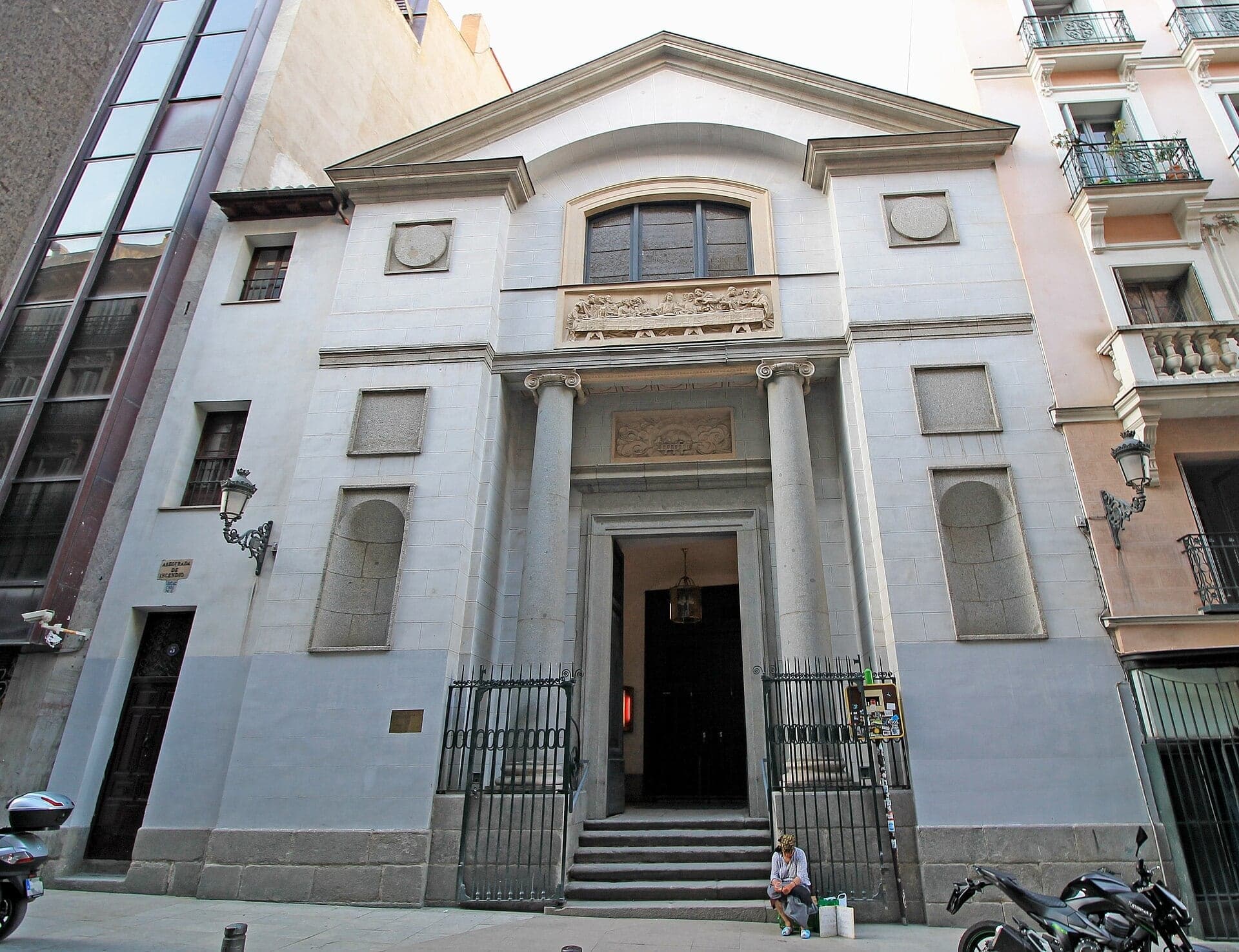
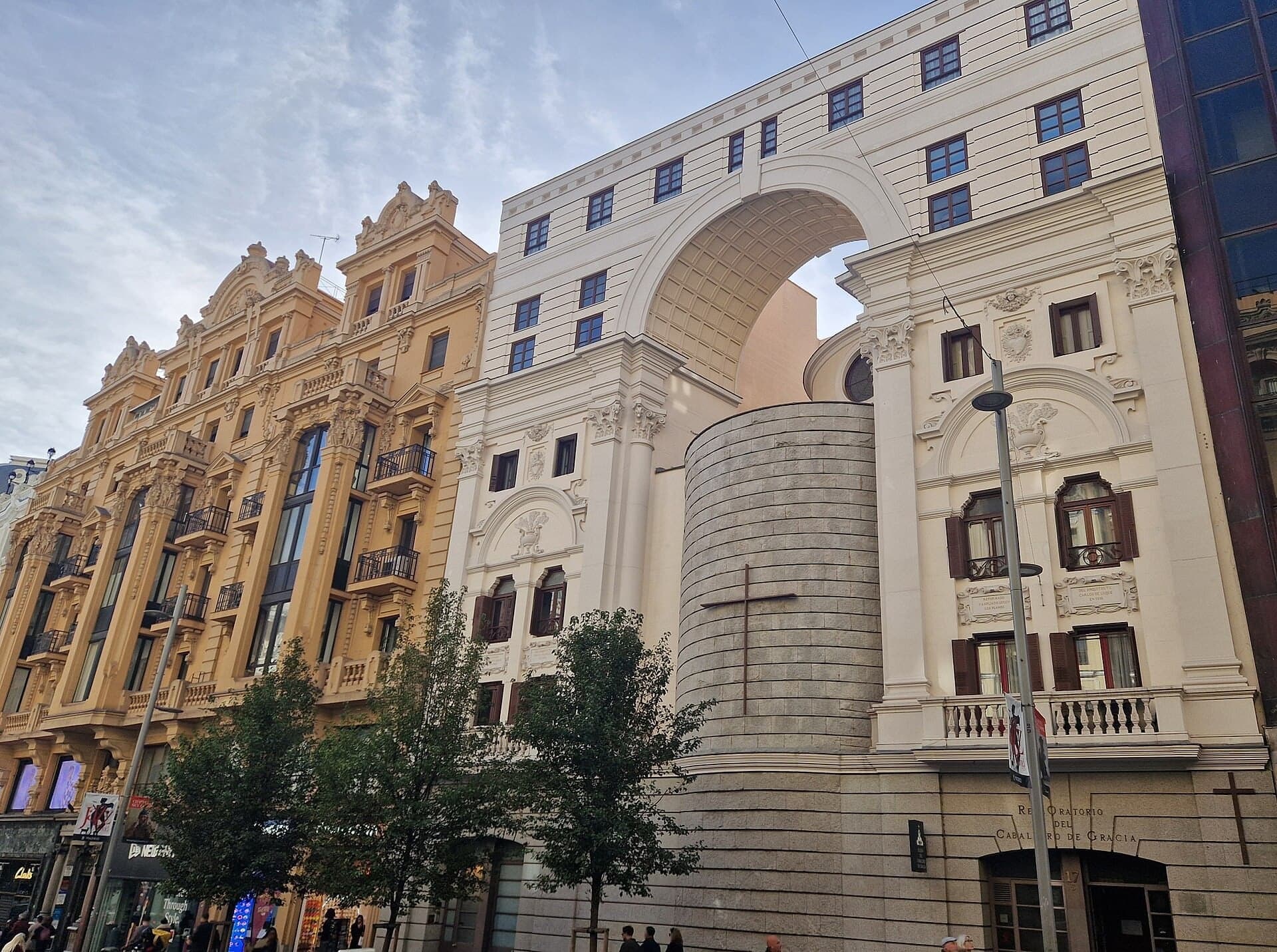
Oratorio del Caballero de Gracia: Facing Two Ways
Juan de Villanueva's calm classical church front on the old street, whose back was sliced off when the Gran Vía was cut.
- 5
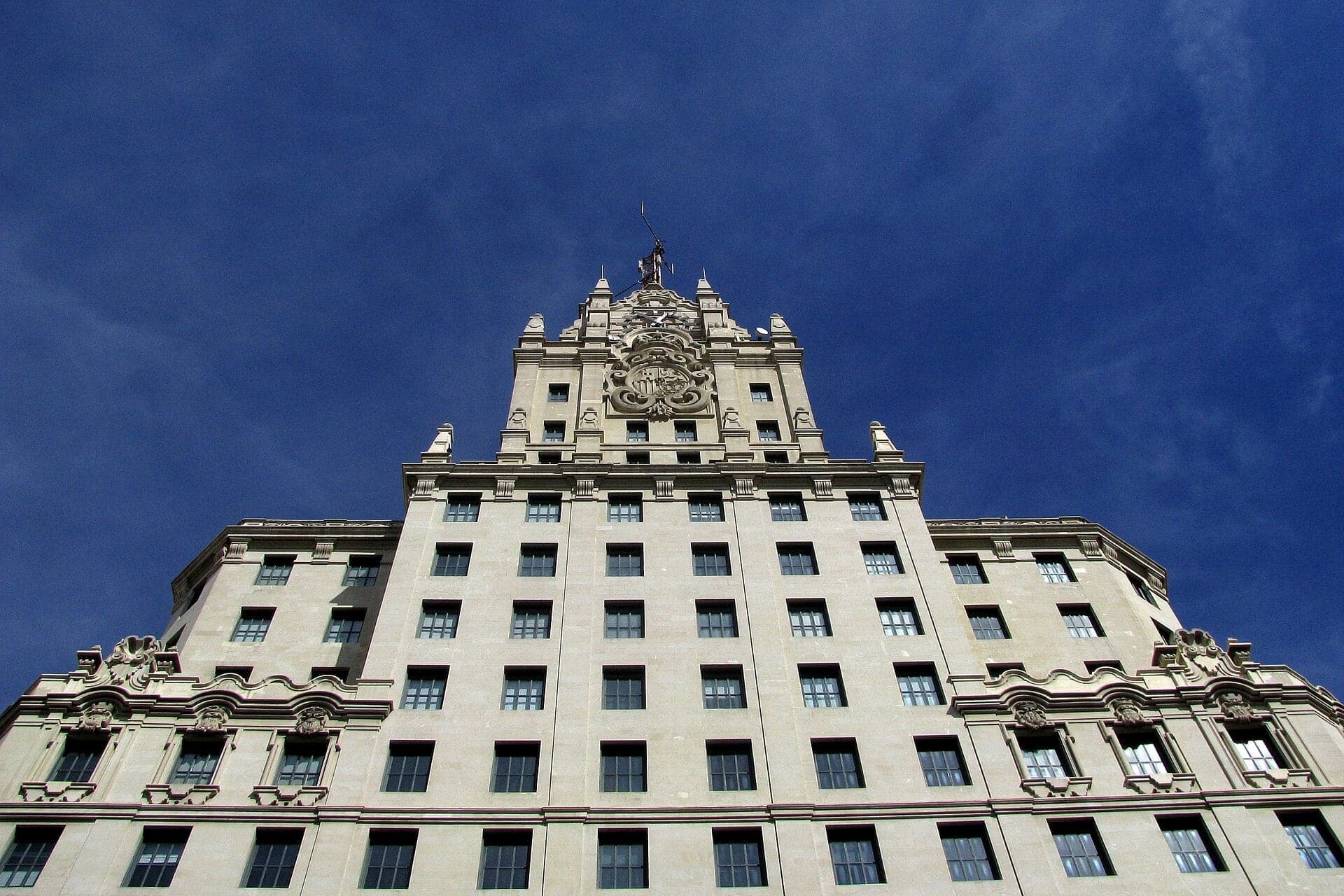
Telefónica Building: Chicago Tower, Baroque Dress
Madrid's tallest building until 1953 rises across the Red de San Luis, beside a granite copy of Palacios's Metro pavilion.
- 6
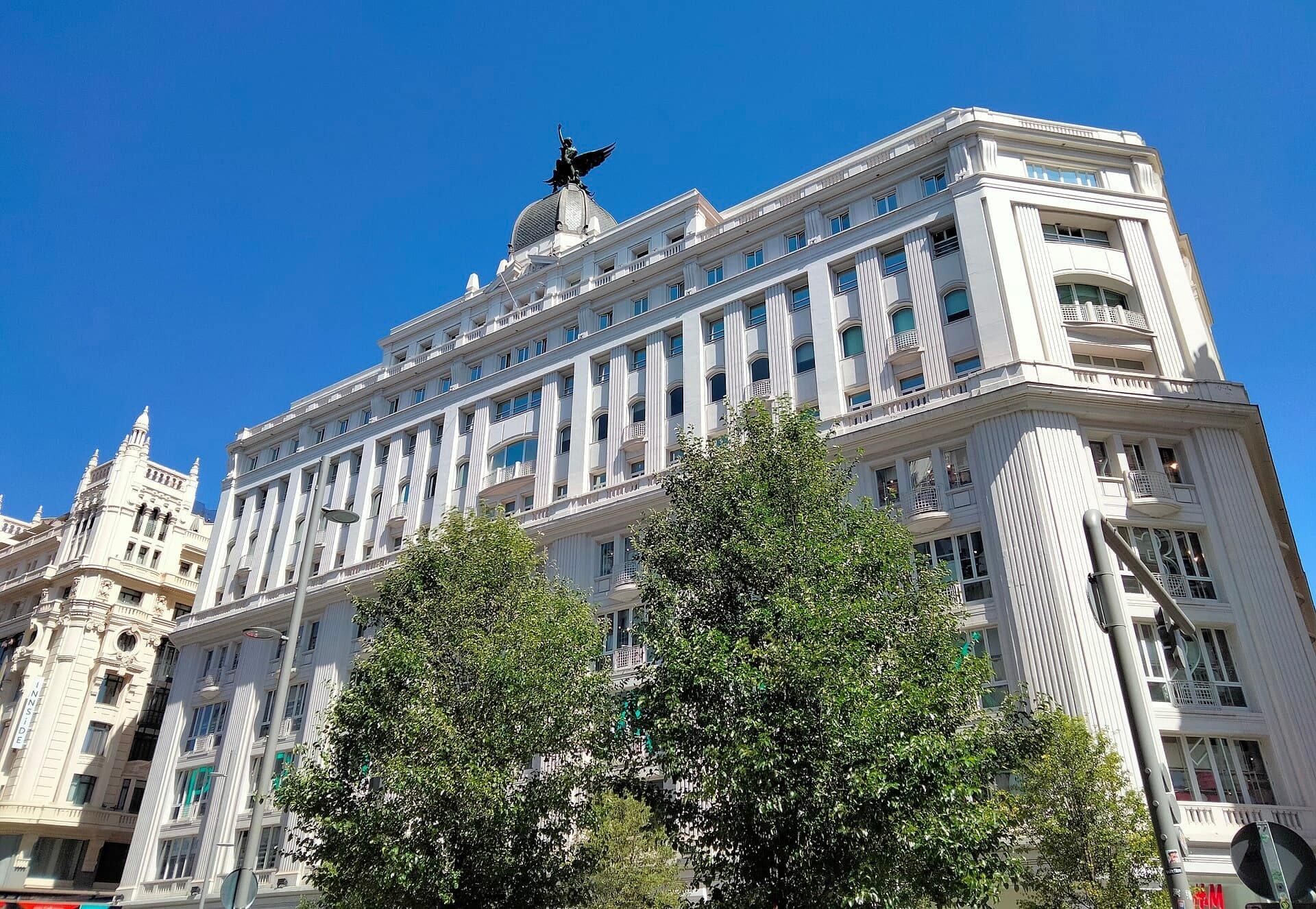
Gran Vía 32: The Store on the Paris Model
A department store on the Paris model and Palacios's Hotel Alfonso XIII, on a stretch ten meters wider than the first.
- 7
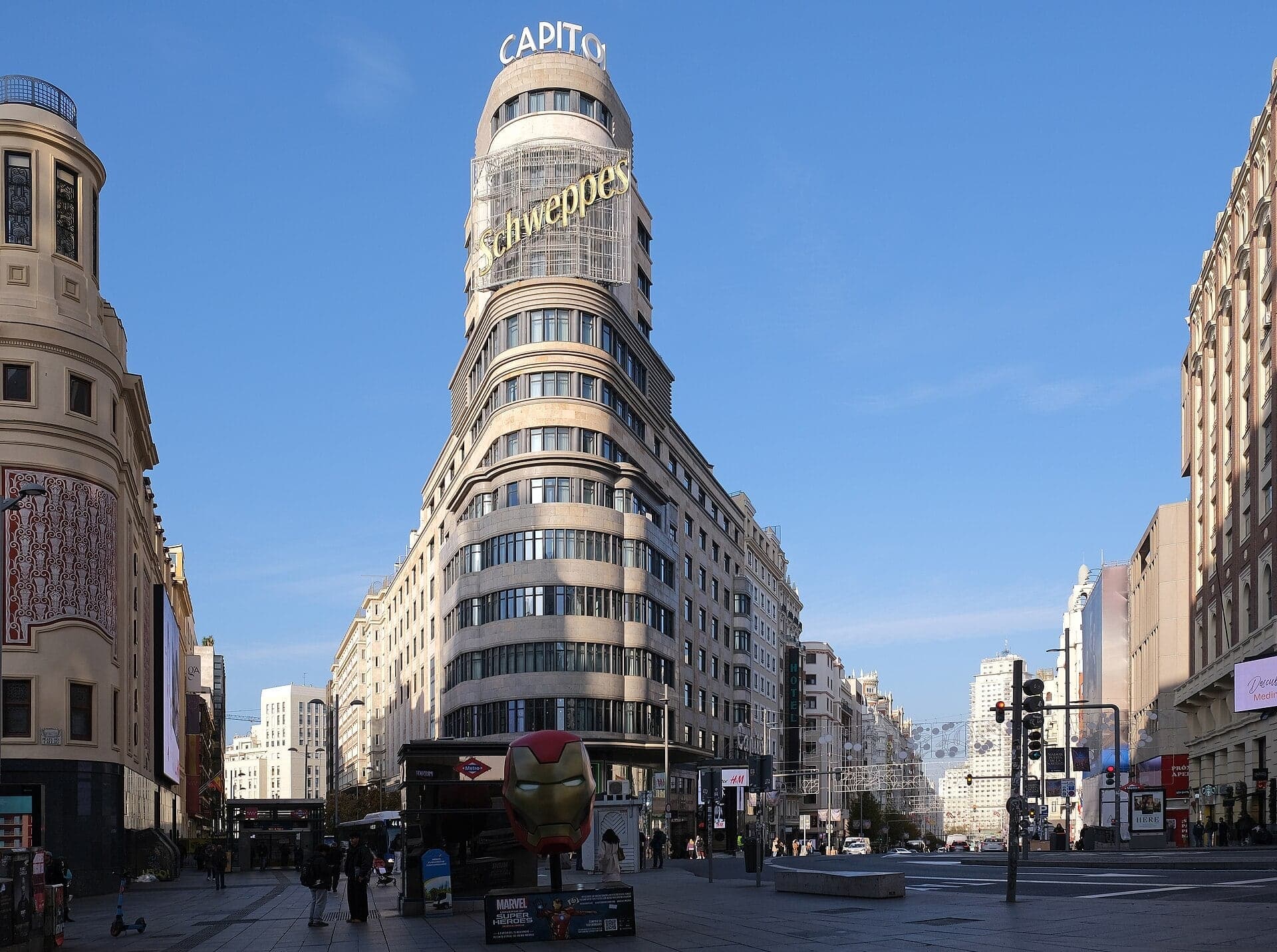
Plaza del Callao: The Carrión and Its Neon
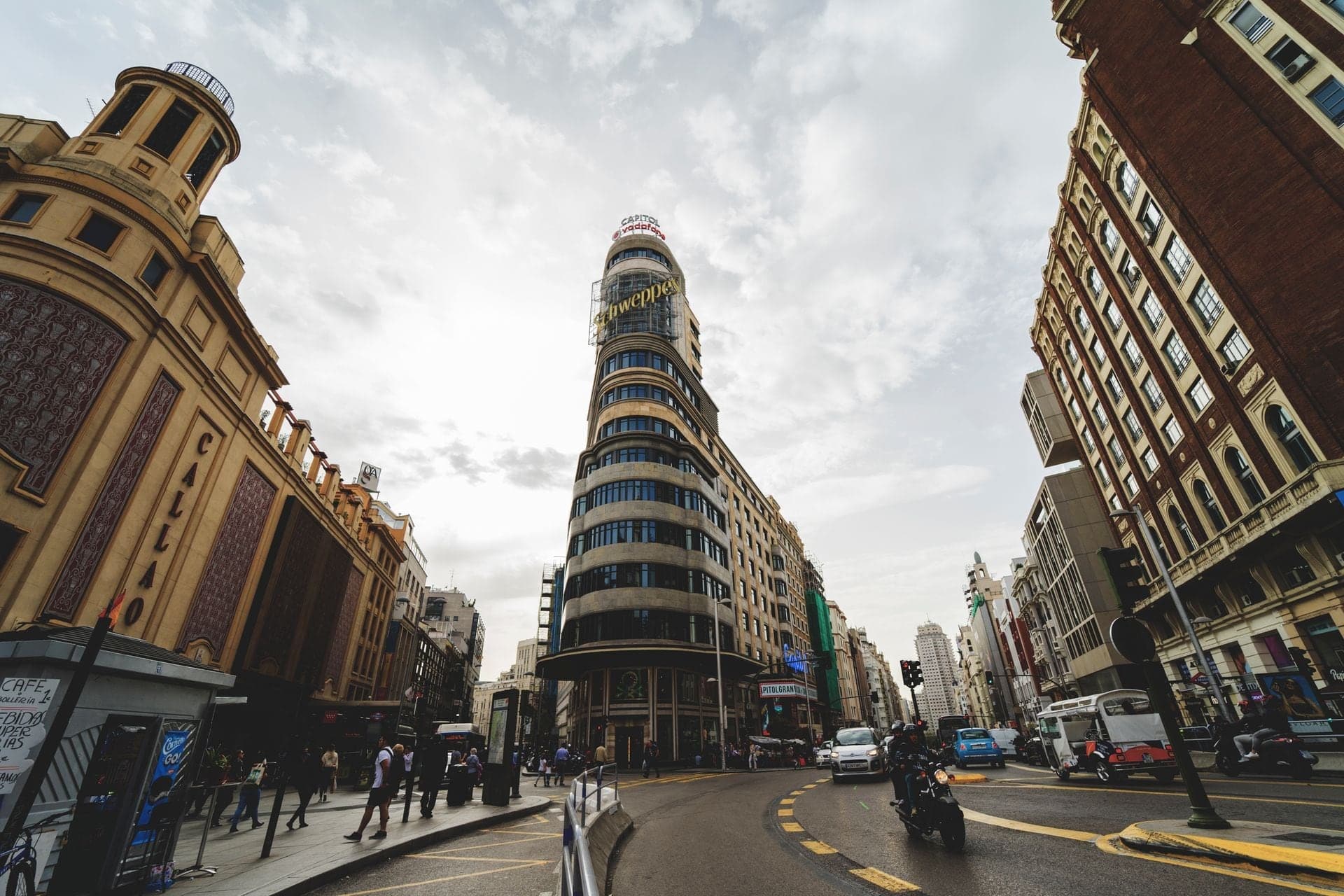
The Carrión building of 1933 curves round Callao under its Schweppes sign, with the Palacio de la Prensa across the Gran Vía.
- 8
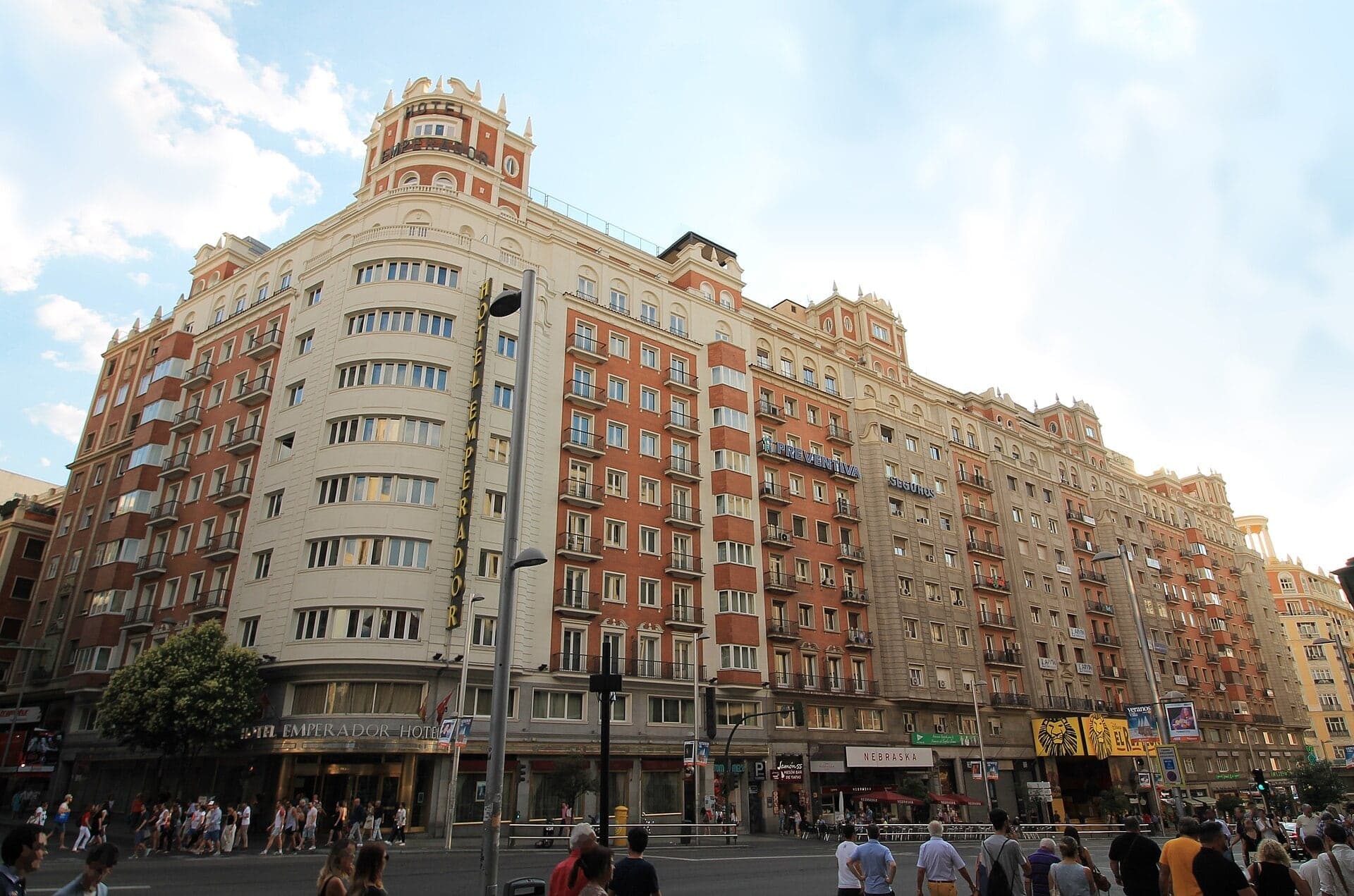
Los Sótanos: A Theater Hidden in the Block
The last stretch widened by ten meters on paper, and the Otamendi brothers' block of hotel, flats, shops and a theater.
- 9
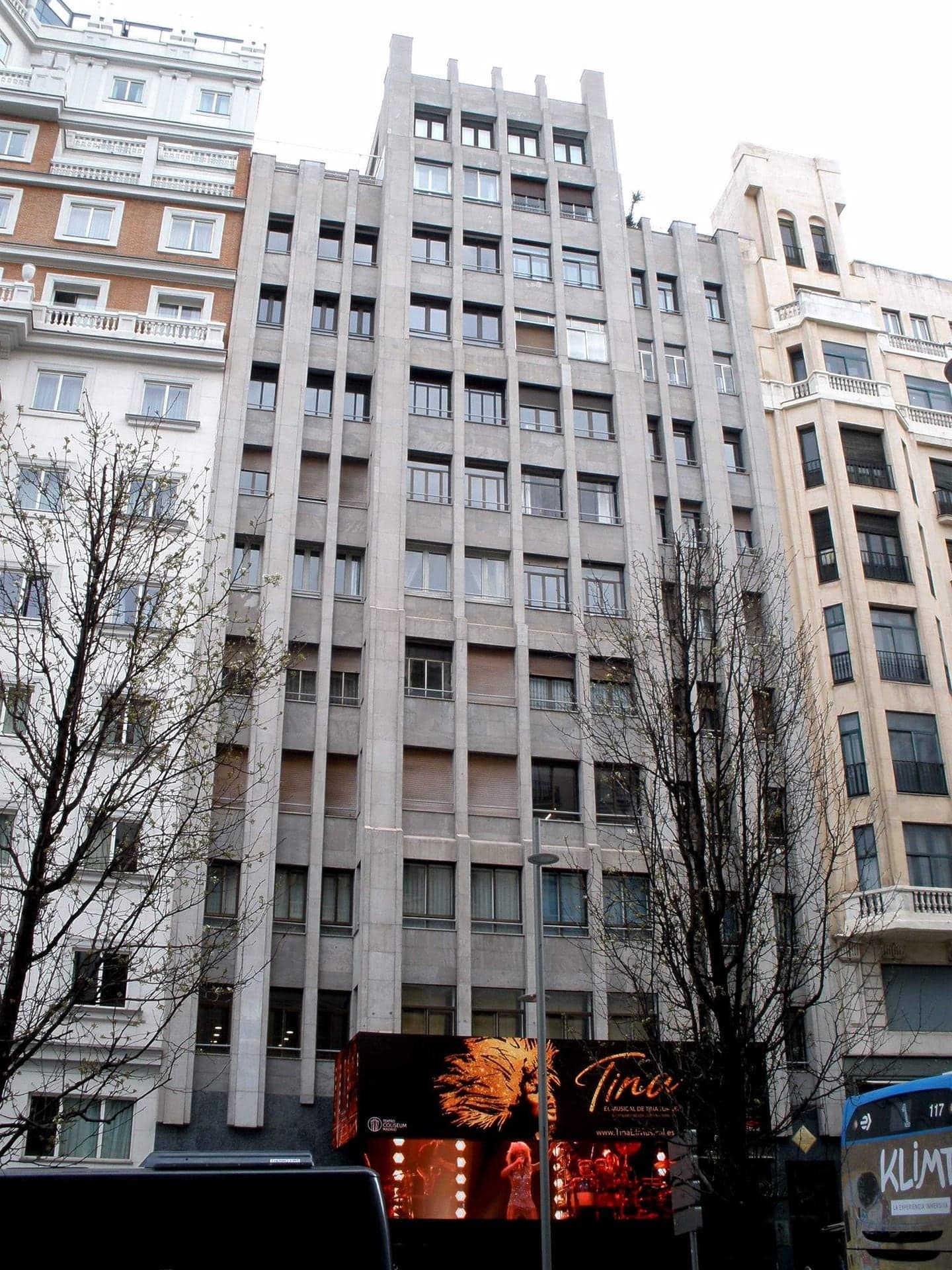
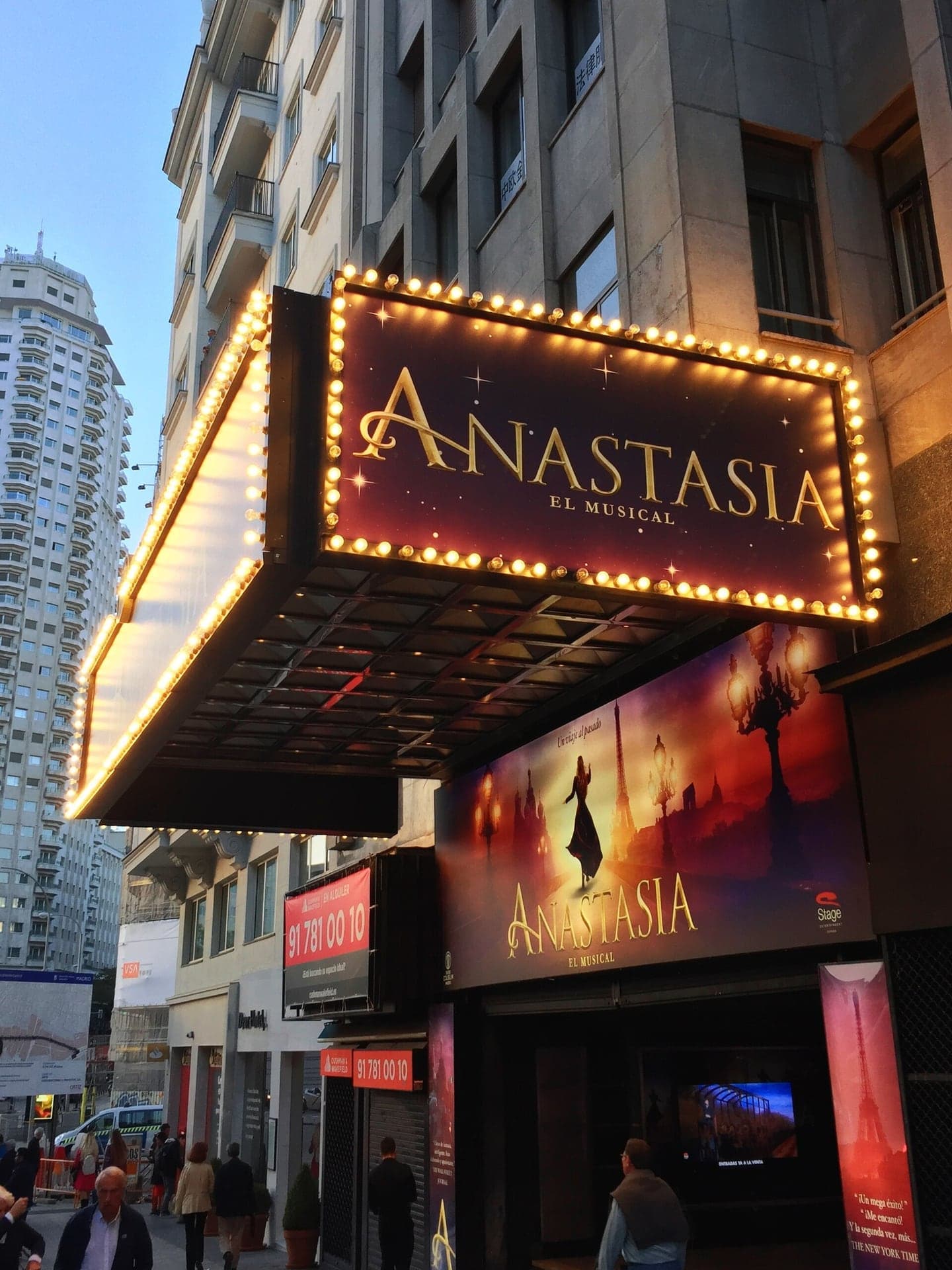
Edificio Coliseum: New York on the Gran Vía
A theater with a tower on top, designed in 1931 in the orbit of New York's Rockefeller Center, seen across the Gran Vía.
- 10
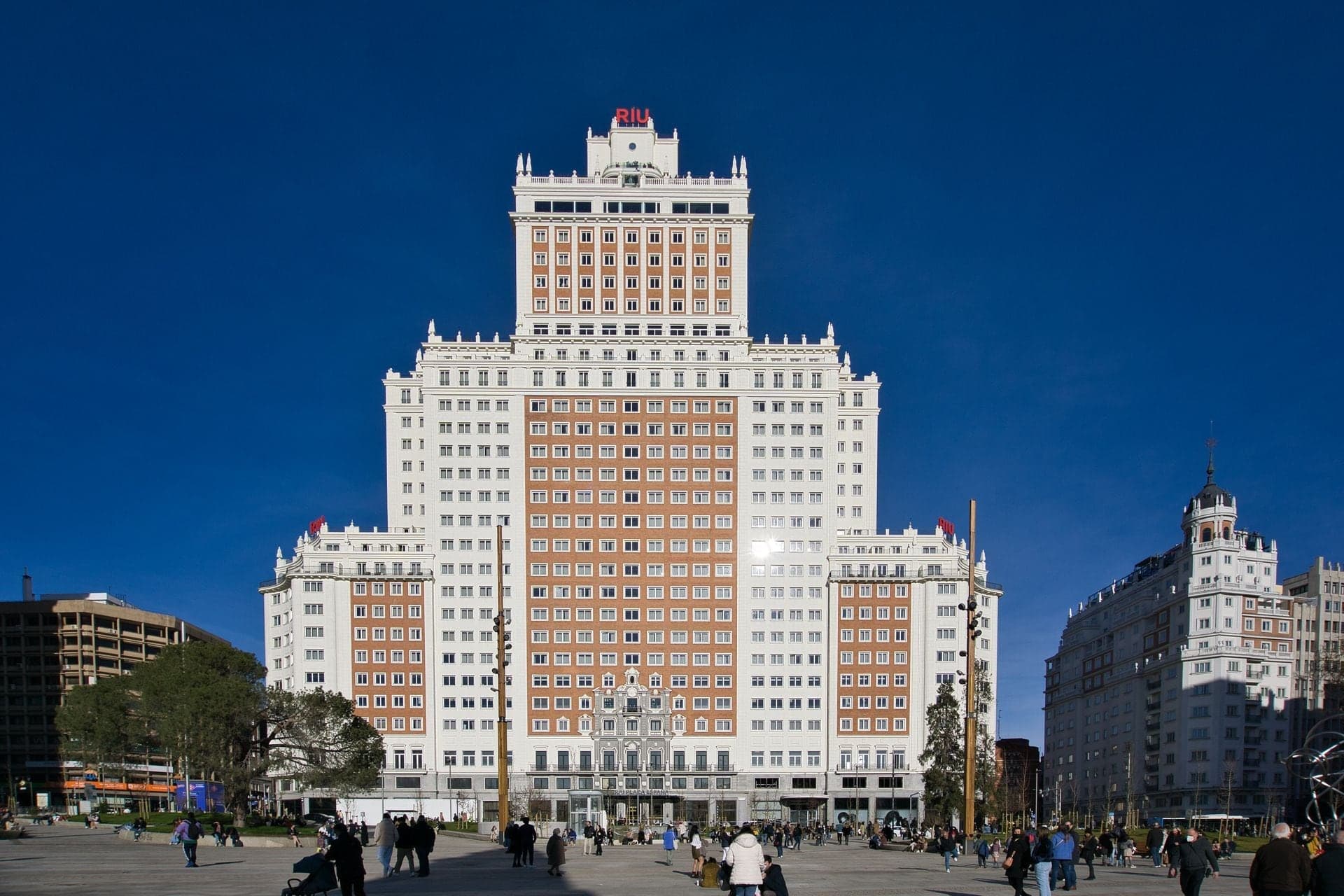
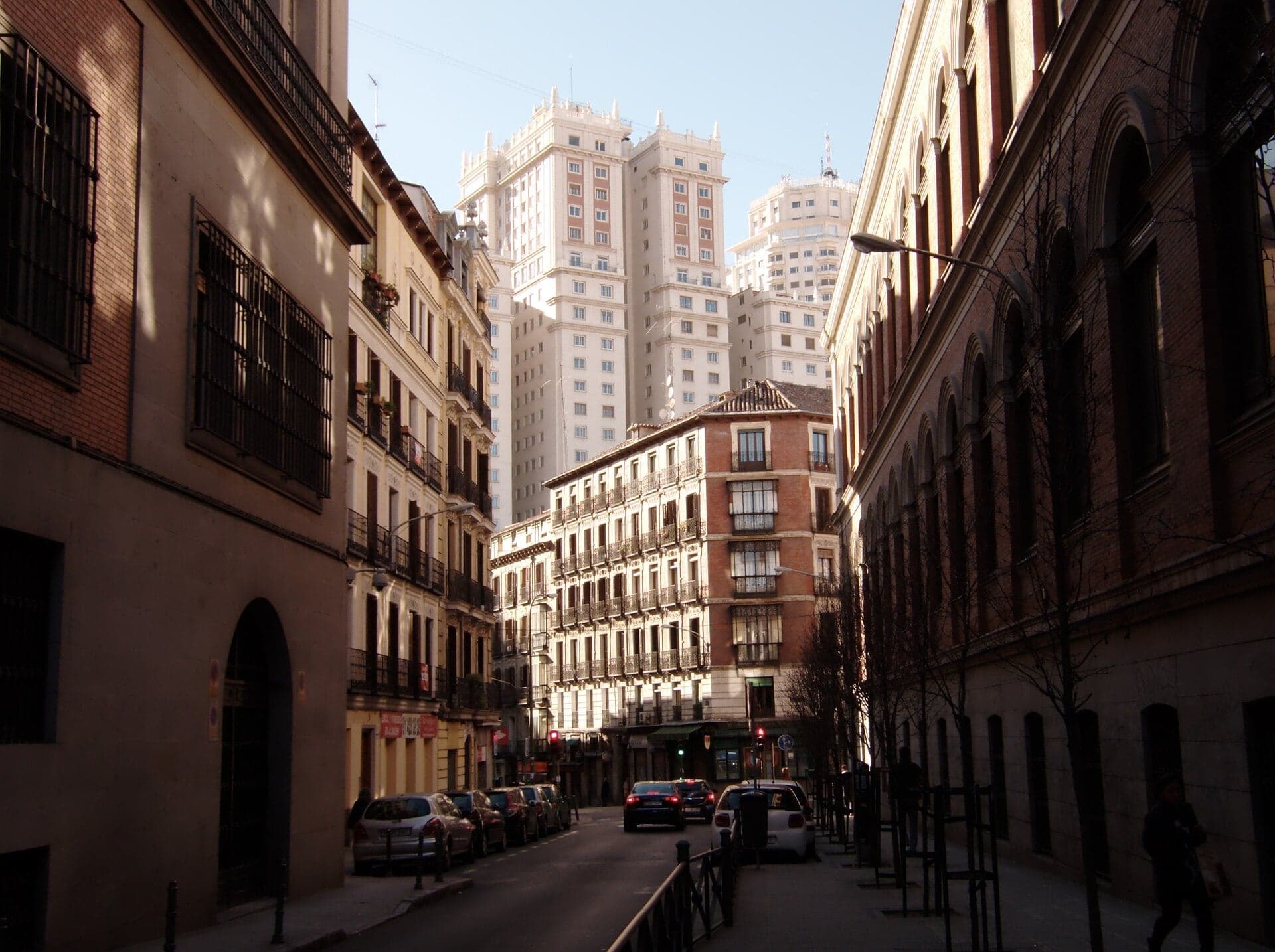
Edificio España and Torre de Madrid: The Street's End
The Otamendi brothers' two 1950s towers that close the Gran Vía, over the square that sent its traffic underground in 2021.
- 11
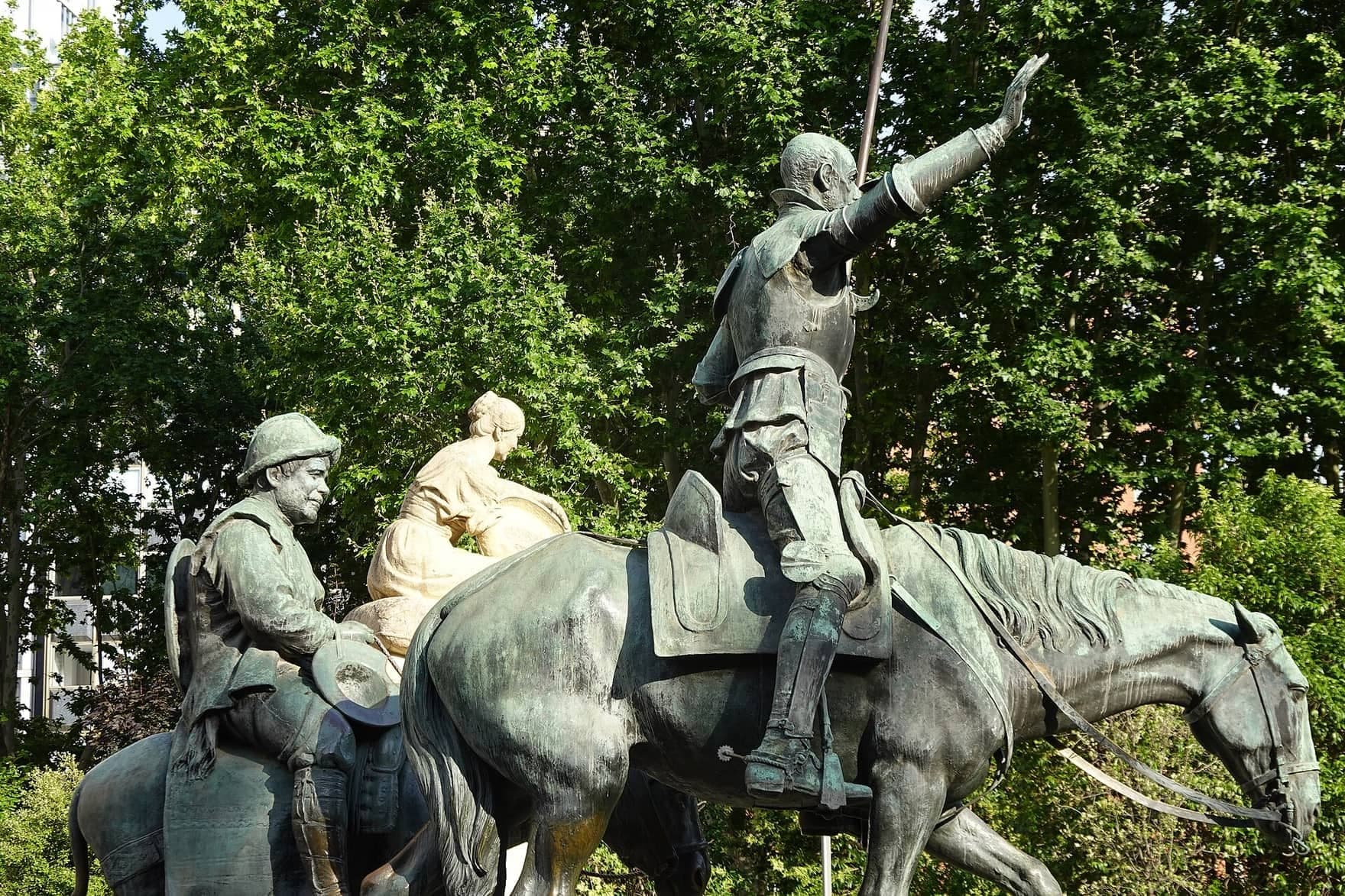
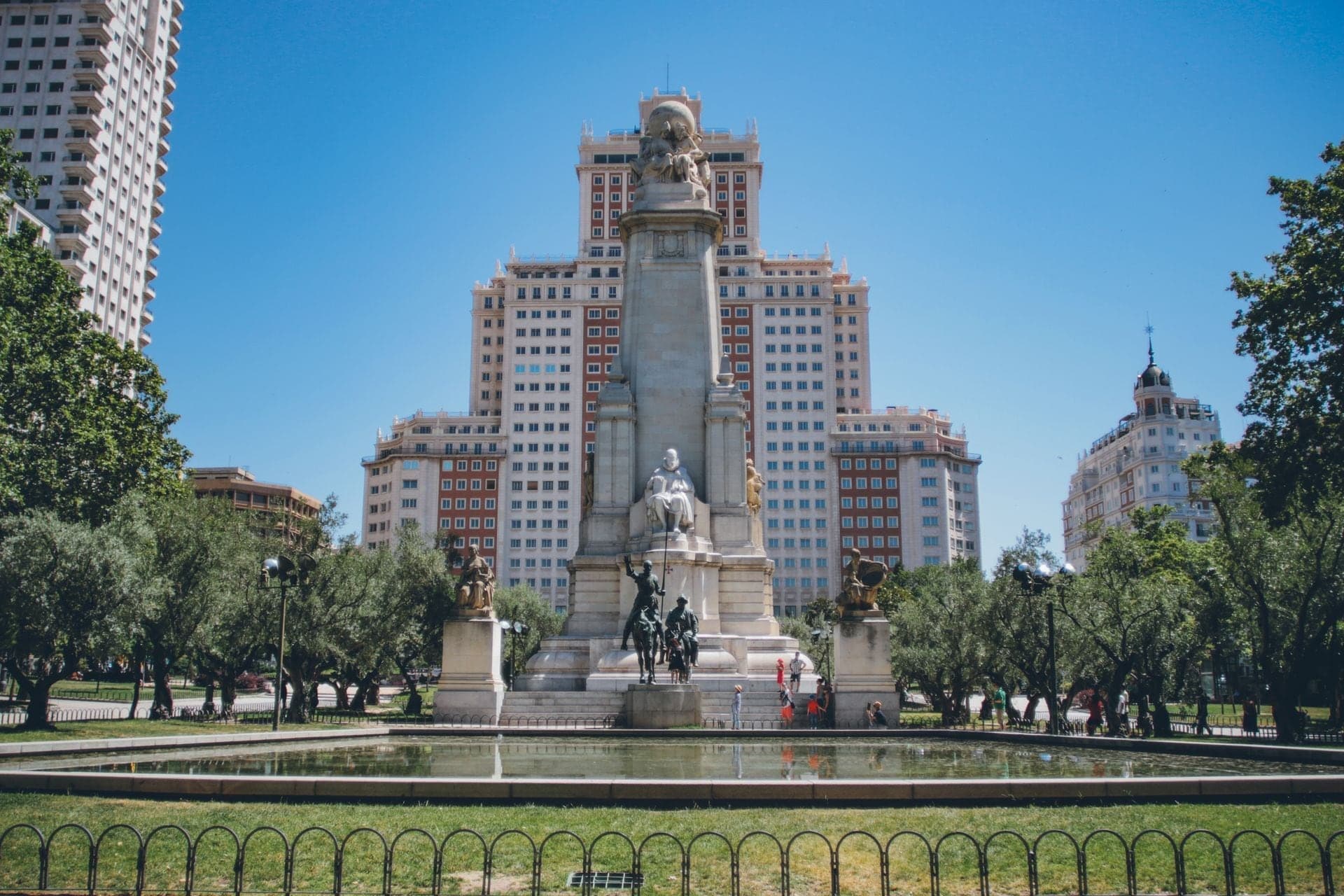
Monumento a Cervantes: Half a Century in the Making
Don Quixote and Sancho Panza below a seated Cervantes, begun after a 1915 competition and finished only in 1969.
Details
Best Time to Visit
Any day: every stop works from the street. A weekday morning is calmest on the pavements, and the start on Calle de Alcalá looks west, so morning light should fall on the Metrópolis's front from behind you. In the evening the street is lit and the Schweppes sign at Callao glows, but the pavements are at their most crowded, especially on Friday and Saturday evenings and at weekends. The Círculo's rooftop stays open past midnight. Checked 14 October 2026.
Pro Tips
- •Getting to the start: Banco de España Metro (line 2) has an entrance on Calle del Barquillo, a few steps from stop 1; Sevilla (line 2) is a short walk along Calle de Alcalá from the other direction. Madrid-Sol (Cercanías) is the nearest suburban train station. Checked 14 October 2026.
- •Getting away, or leaving halfway: Gran Vía Metro (lines 1 and 5) at stop 5, its entrance the granite pavilion; Callao (lines 3 and 5) at stop 7; Santo Domingo (line 2) by stop 8; Plaza de España (lines 2, 3 and 10) about 150 meters from the end, with Ventura Rodríguez (line 3) and Noviciado (line 2) also nearby. Checked 14 October 2026.
- •Círculo de Bellas Artes rooftop (stop 2): Sunday to Thursday 10am to 1.30am (last entry 12.30am), Friday and Saturday 10am to 2am (last entry 1am); 6 EUR, reduced 5 EUR, tickets at reception and a lift in the lobby. Exhibitions Tuesday to Sunday 11am to 2pm and 5pm to 9pm, closed Mondays. Checked 14 October 2026 at circulobellasartes.com.
- •Oratorio del Caballero de Gracia (stop 4): free, every day 10am to 1.45pm and 5pm to 8.45pm (July and August afternoons 6pm to 8.45pm); the entrance is on the Gran Vía, at number 17. A working church: go in quietly and not during services. Checked 14 October 2026 at esmadrid.com.
- •Espacio Fundación Telefónica (stop 5), entrance at Calle de Fuencarral 3 (the building was sold in September 2026; the foundation says its programme continues): free exhibitions, Tuesday to Friday 10am to 8pm, Saturday, Sunday and holidays 11am to 8pm; closed Mondays, 25 December and 1 and 6 January. Checked 14 October 2026 at fundaciontelefonica.com.
- •Teatro Coliseum (stop 9): box office Monday to Thursday 12pm to 8.30pm, Friday and Saturday 12pm to 10pm, Sunday 12pm to 6pm. Checked 14 October 2026 at esmadrid.com.
- •The Edificio España (stop 10) is the Riu Plaza España hotel; its rooftop bar on the top floors is ticketed, with prices that change by day and hour. Check the hotel's own site before you go.
- •The walk is step-free on wide pavements and paving. It climbs about 20 meters in the first 700 meters, to the Red de San Luis, then falls about 50 meters to the Plaza de España.
Safety & Precautions
- •Pickpockets work the Red de San Luis and the top of Calle de la Montera (stop 5), the Plaza del Callao (stop 7), the busy Gran Vía pavements and the Metro. Keep bags closed and in front of you, and phones out of back pockets.
- •The Gran Vía's pavements are crowded, above all in the evenings and at weekends. At each stop, step to the line of lamp posts and trees by the kerb, or back against the shop fronts, rather than stopping in the middle of the pavement.
- •Between stops 3 and 4 you cross the Gran Vía at the traffic lights beside the Grassy building. Walk west along that pavement, cross the mouth of Calle de la Virgen de los Peligros at the Gran Vía lights, and go down its west pavement. At the bottom, a few steps to the right, cross Calle del Caballero de Gracia on the zebra: no lights, one lane, cars coming from your right. Stop 4 is on its south pavement.
- •Calle del Caballero de Gracia (stops 4 and 5) is a narrow one-way street with one lane of traffic: keep to the pavement.
- •Between stops 5 and 6, the side streets off the Gran Vía have traffic lights, except Calle de Chinchilla, just before stop 6: a zebra crossing with no lights. Look both ways. Between stops 7 and 8 you cross Calle de Jacometrezo, the side street under the curved Carrión building: look both ways.
- •Between stops 8 and 9 you cross Calle de San Bernardo, three lanes of faster traffic, at the lights. Between stops 9 and 10 the crossing into the Plaza de España is long: a bike lane, the main road and a bus and taxi lane, all at signals. Cross only on the green.
- •The Grassy clock museum (stop 3) is temporarily closed, and the Palacio de la Música near Callao (stop 7) has been closed since 2008 and is awaiting reform under new owners. Checked 14 October 2026.
- •In winter the Plaza de España holds a Christmas market and an ice rink (last season from 25 November to 11 January), and stalls may stand near stops 10 and 11. Checked 14 October 2026.
- •Stop 11 is beside a children's playground: stay on the path.
Travel advisory: Exercise Increased Caution (Level 2).
Gallery
Related Reading
Go deeper on what you'll see, hear, and walk through.
Read the walk
The full story of Gran Vía: The Street That Grew Wider and Taller, in words. Prefer to listen? Play it narrated, from home or on location.
Introduction
Madrid, the capital of Spain, cut a modern avenue straight through its old streets more than a century ago. This walk follows it end to end: the Gran Vía, the Great Way.
Work began in nineteen ten, and the street was cut in three stretches. More than three hundred buildings and some fifteen streets came down. The first stretch was twenty-five meters wide, the next two stretches thirty-five, and the buildings climbed as the street went on: an insurance company's dome, a telephone company's skyscraper, cinemas and theaters, and at the far end two towers.
Three names shape what you will see: Antonio Palacios, architect of an arts club, a hotel and a granite Metro pavilion; the Otamendi brothers, who built a long block on the last stretch and the two towers at its end; and Miguel de Cervantes, whose Don Quixote waits at the finish.
The walk is eleven stops over about one point eight kilometers, just over a mile, and takes about an hour. It climbs gently to the Red de San Luis, the street's high point, then runs mostly downhill, with no steps. You cross the Gran Vía once, and the wide road into the Plaza de España, both at traffic lights. Two rooftop terraces are ticketed; every stop works from the street. The walk begins on Calle de Alcalá, by Banco de España Metro, and ends at the Cervantes monument in the Plaza de España.
1. Edificio Metrópolis: The Dome at the Fork
Welcome to Calle de Alcalá, where this walk begins. Find a spot on the wide paving, out of the way of people walking, and look down the street ahead, to where it splits in two. Rising at the fork is a building with a rounded corner, a dark dome and a winged figure on top. This is the Edificio Metrópolis, and from out here you see it whole.
The building was designed before work on the street began. Two French architects, brothers, designed it in nineteen oh five for an insurance company called La Unión y el Fénix, the Union and the Phoenix. It went up while the new avenue was being cut beside it, and it opened in January nineteen eleven.
Look at how it fills its ground. Where the two streets part, the land comes to a narrow point, like the bow of a ship. The architects rounded that point into a tower and crowned it with a dome you can see all the way down Alcalá. The dome is slate, set with golden inlays. Before it, a house famous for its shape stood here. Locals called it the coffin house, because its front was so narrow.
The figure on top has changed. The first crown was a phoenix, the insurance company's emblem. Today a winged Victory stands there, put up in the nineteen seventies. The name Metrópolis came later too, with a later owner.
The right-hand street at the fork is the Gran Vía, the Great Way, and the rest of this walk follows it all the way to the Plaza de España. Behind you, a short way down Alcalá, is the Cibeles fountain, where our Paseo del Prado walk begins.
Follow the route along this side of Alcalá. Next is an arts club whose building was too tall to win its own competition.
2. Círculo de Bellas Artes: Too Tall to Win
Walk on along Alcalá and stop on the open paving in front of the church, well clear of its doorway. Across the whole width of Alcalá, on your left, stands a tall building that steps back as it rises, with a statue on its roof. This is the Círculo de Bellas Artes, Madrid's fine arts club. Its rooftop terrace is ticketed and worth it for the view over this junction; the details are on this stop's card.
The club, founded in eighteen eighty, wanted a new home, and in nineteen nineteen it held a competition. The jury declared it void. One of the architects who entered, Antonio Palacios, had been turned down because his design was taller than the rules allowed. Palacios appealed. The members held a vote among themselves, and they chose the tall one. Then the building had trouble getting its license from the city, again because of its height.
It was built anyway. Work began in nineteen twenty-one, and King Alfonso the Thirteenth opened it in nineteen twenty-six. It stands forty-eight meters high, and its front tends toward a pyramid: broad and solid low down, narrowing as it climbs to the tower at the top. That is why you need the whole width of Alcalá to read it. From the pavement right below it, you would see only the lower floors.
The bronze statue on the roof is Minerva, the goddess of wisdom and the arts. She went up only in the nineteen sixties, decades after the building.
Now turn round to the church, San José. Beside it, on the fourth of April, nineteen ten, the same king struck the first blow of a pickaxe at an old house known as the Priest's House, and the Gran Vía began.
Follow the route up the Gran Vía, the street that starts beside this church. Next is one of the first buildings on the new street.
3. Edificio Grassy: A Tower on a Sharp Corner
Walk on up the Gran Vía and stop on this pavement before the next side street, out of the stream of people. Now turn and look back across the Gran Vía. On the far side, a narrow building fills the sharp corner between the Gran Vía and a smaller, older street, and turns that corner with a round tower. This is the Edificio Grassy.
Look at the shape of its ground. The new avenue was drawn straight across a tangle of older streets, and where it sliced through them it left wedges of land with pointed ends. The Metrópolis, back at the fork, sits on one of those points. The Grassy sits on another. Both had to turn a sharp corner, and both did it the same way, with a rounded tower.
It was built in nineteen sixteen and seventeen, which makes it one of the first buildings on the new street. Not the very first: the city's own history gives that to number eight, finished in nineteen seventeen.
The name comes from a French jeweler, Alexandre Grassy, and the jewelry shop at its foot still carries it.
It took about twenty years to push the street through to the Plaza de España, where this walk ends, and longer than that to fill it with buildings. Watch how the street changes as it goes. It grows wider, and the buildings grow taller.
Follow the route across the Gran Vía at the lights beside the Grassy, then turn right along that pavement to the next side street. Cross its mouth at the lights and turn left down it, keeping to its right-hand side. At the bottom, turn right, and after a few steps cross the narrow street on the zebra. It has no lights: one lane, with cars coming from your right. Then carry on along the far pavement. Next is a church that ended up facing two ways.
4. Oratorio del Caballero de Gracia: Facing Two Ways
Walk on along Calle del Caballero de Gracia, keeping to the narrow pavement on this side, and stop when a classical temple front comes into view ahead, on the far side of the street. Listen for a moment: the traffic has dropped away. This is the scale of Madrid before the Gran Vía.
The front belongs to the Oratorio del Caballero de Gracia, a church designed in the seventeen eighties by Juan de Villanueva, the architect of the Prado museum. Inside, the city's tourist office says, it looks like a small Roman basilica, with columns each cut from a single piece of granite.
The church belongs to a religious association founded by an Italian from Modena whom Madrid called the Caballero de Gracia, the Knight of Grace.
Now picture what lies behind it. The houses on your right hide the Gran Vía, only half a block away. When the new avenue was cut, it took the back of this church, its apse, the rounded end behind the altar, together with the little houses around it. The church itself was largely spared, but a history published by the city calls the meeting between the church and the new street a conflict that was never well resolved. For decades the avenue saw only a street front added in nineteen sixteen. Then, late in the twentieth century, the apse was rebuilt and turned to face the Gran Vía.
So this church faces two ways. Its classical front looks onto the old street, and its entrance today is boxed into a corner of the new one. It is free to enter at its opening hours, through that door on the Gran Vía. It is a working church, so go in quietly.
Follow the route on along this street. It comes out at a busy crossroads, the highest point of the Gran Vía.
5. Telefónica Building: Chicago Tower, Baroque Dress
Walk on into the open crossroads ahead and stop at its edge, near the small stone pavilion with an arch. This is the Red de San Luis, the highest point of the walk. Keep your bag closed and in front of you: from here to Callao, the crowds are where pickpockets work. Look across…
Full narration for this stop unlocks with the tour.
6. Gran Vía 32: The Store on the Paris Model
Cross the little side street on the zebra, looking both ways, then stop at the corner just beyond it, back against the shop fronts and out of the way of people waiting at the crossing. First, look at the street itself. Back at the start, the Gran Vía was twenty-five meters wide.…
Full narration for this stop unlocks with the tour.
7. Plaza del Callao: The Carrión and Its Neon
Walk on into the Plaza del Callao and stop on its paving near the Gran Vía edge, clear of the Metro entrance and the crowds. Ahead, at the far corner of the square, a building swings round its corner in one long curve, striped with horizontal bands, with a big neon sign on its…
Full narration for this stop unlocks with the tour.
8. Los Sótanos: A Theater Hidden in the Block
Walk on down the Gran Vía and stop at the corner before the wide side street, Calle de San Bernardo. Step back from the Metro stairs and the crossing; this corner gets crowded. This is the third and last stretch, which a history published by the city calls the most radical of…
Full narration for this stop unlocks with the tour.
9. Edificio Coliseum: New York on the Gran Vía
Walk on to the end of the block and stop before the corner, near the lamp posts at the edge of the pavement. Across the Gran Vía, and a little ahead, a narrow tower steps back as it climbs above a theater entrance. This is the Edificio Coliseum. In summer the street trees may…
Full narration for this stop unlocks with the tour.
10. Edificio España and Torre de Madrid: The Street's End
Walk on into the Plaza de España, turn left along the paved walk at its edge, and stop. Now turn round, toward the two towers rising over the square. The broad one, closer to you, stepping back in stages toward its crown, is the Edificio España. The slimmer, taller one to its…
Full narration for this stop unlocks with the tour.
11. Monumento a Cervantes: Half a Century in the Making
Walk on through the gardens and stop on the path, short of the children's playground. Now turn round to face the monument. In front, in bronze, are Don Quixote and his squire Sancho Panza. Above them, in stone, sits their author, Miguel de Cervantes, holding a copy of his book.…
Full narration for this stop unlocks with the tour.
- Metrópolis Building, Alcalá Street, Madrid, Spain — Diego Delso, CC BY-SA 4.0 · source
- Calle de Alcalá, 38-42 (Madrid), amb el Círculo de Bellas Artes a l'esquerra — Enric, CC BY-SA 4.0 · source
- Fachada del Círculo de Bellas Artes situado en la calle Alcalá de Madrid. — Rimbaud77, CC BY-SA 3.0 · source
- Salesas | Calle Gran Vía — Fred Romero from Paris, France, CC BY 2.0 · source
- Beginning of Gran Vía, a downtown avenue in Madrid (Spain). At the center, Grassy Building. — Jaume Meneses from Spain, CC BY-SA 2.0 · source
- South façade of Real Oratorio del Caballero de Gracia in Madrid (Spain). — Luis García (Zaqarbal), CC BY-SA 3.0 ES · source
- Gran Vía. Edificio Telefónica. — Rubén Vique, CC BY 2.0 · source
- Primark, Gran Vía 32 (Madrid), antics magatzems Madrid-París — Enric, CC BY 4.0 · source
- Edificio Carrión, Madrid. — kallerna, CC BY-SA 4.0 · source
- Façade of Los Sótanos Building in Madrid (Spain).. — Luis García (Zaqarbal), CC BY-SA 3.0 ES · source
- Anastasia at Teatro Coliseum in Madrid — BroadwaySpain, CC BY-SA 4.0 · source
- Monument to Miguel de Cervantes, Plaza de España, Madrid Spain — Joseolgon, CC BY 4.0 · source
Images may be cropped or resized. Other photos via Unsplash and Pexels.