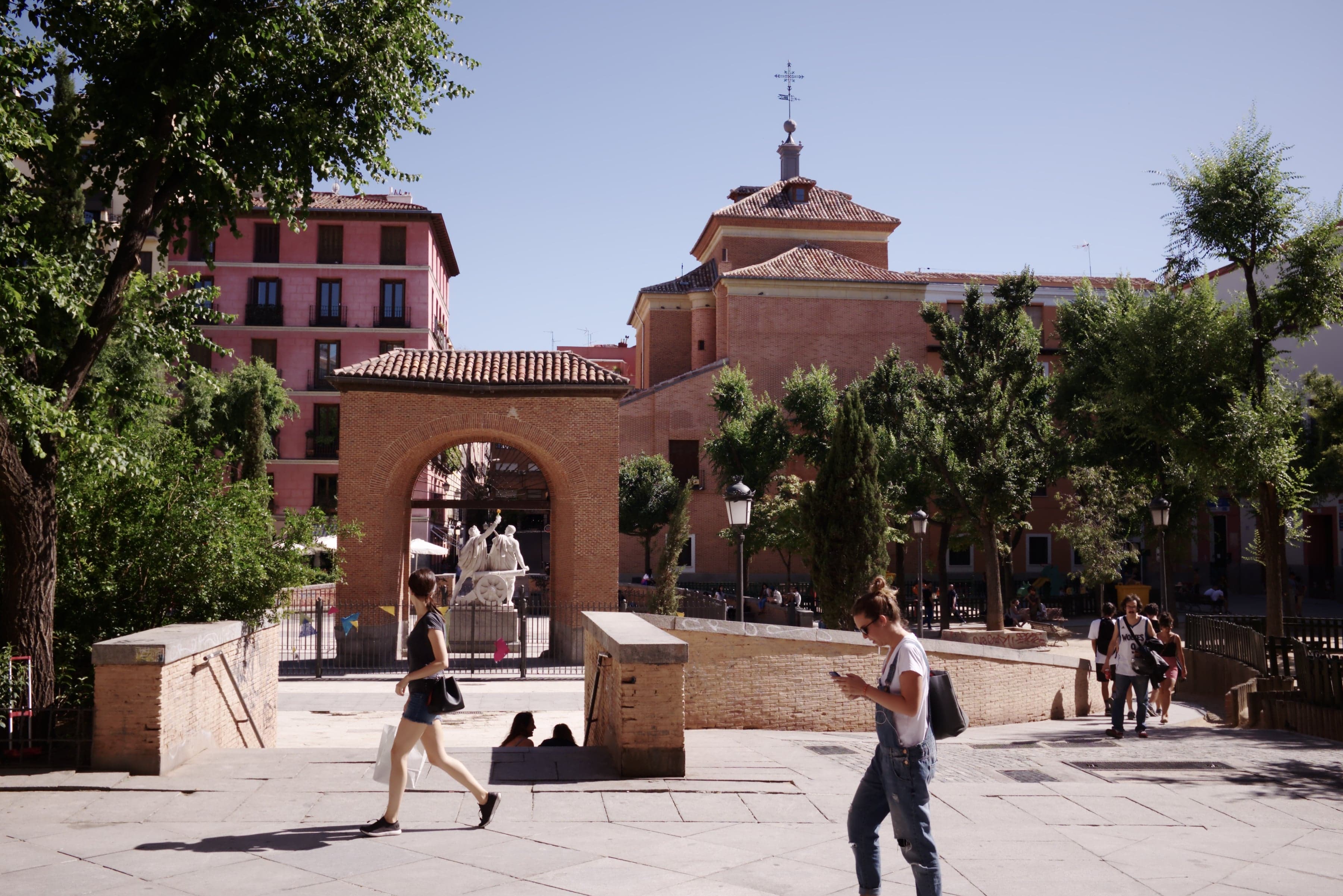
Walk Madrid's old northern edge from the Conde Duque barracks through Malasaña's Plaza del Dos de Mayo, a tiled pharmacy and the city museum's carved doorway, to the Palacio Longoria, the Salesas Reales and Plaza de Chueca.
Start · Conde Duque: The Barracks Doorway
DirectionsStops
- 1
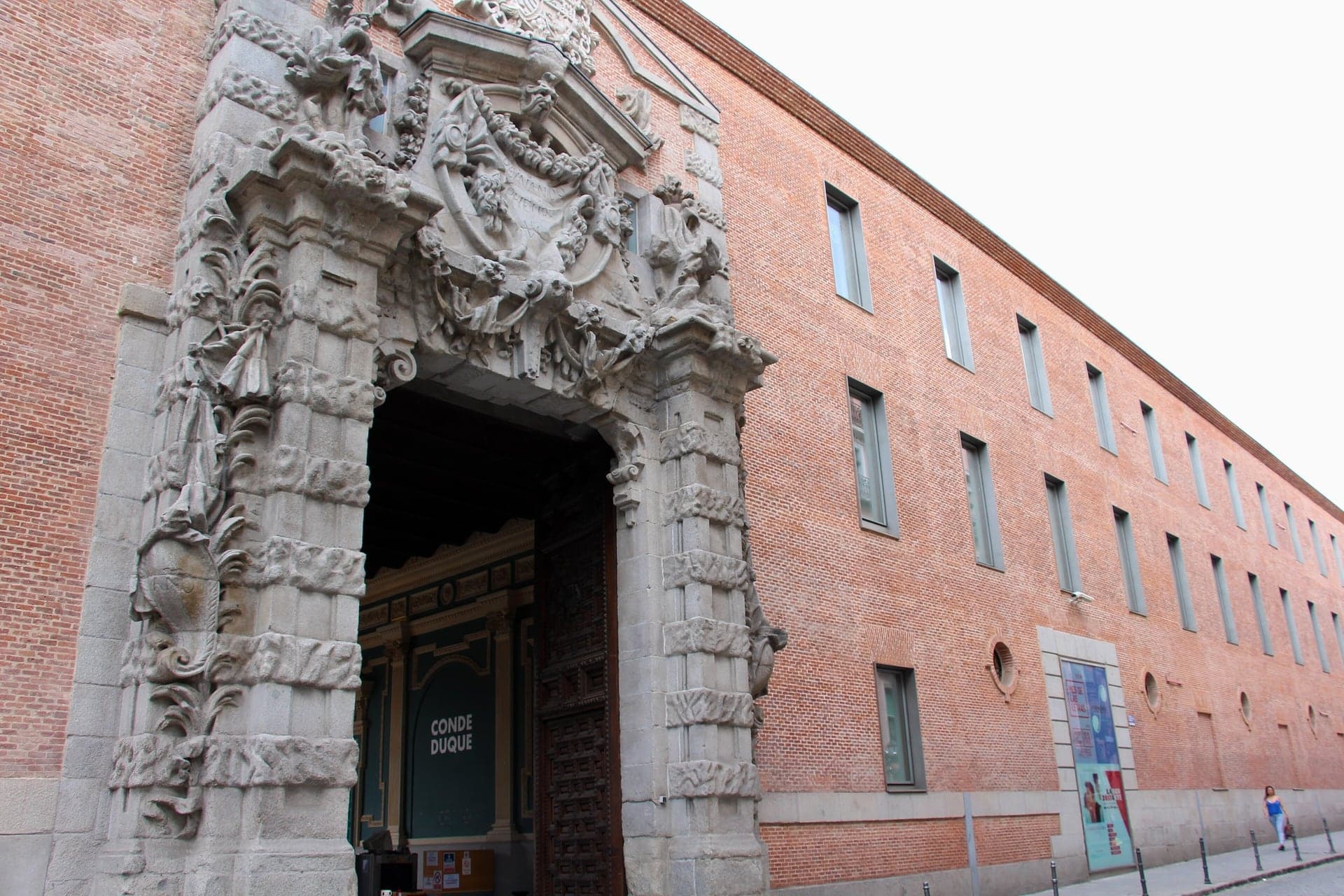
Conde Duque: The Barracks Doorway
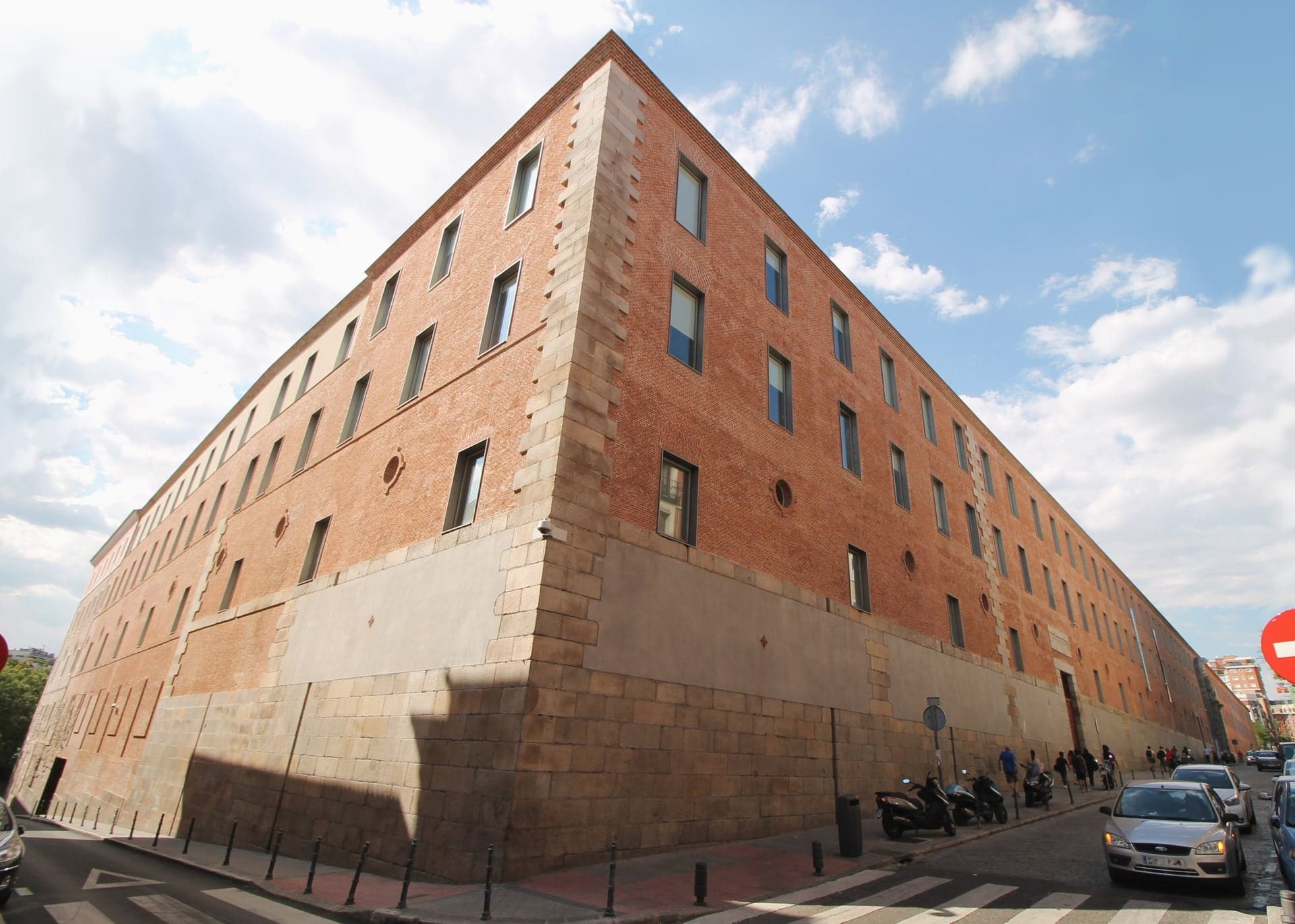
A plain royal barracks with one theatrical carved stone doorway, begun in 1717 for the king's guard and now the city's archive and arts center.
- 2
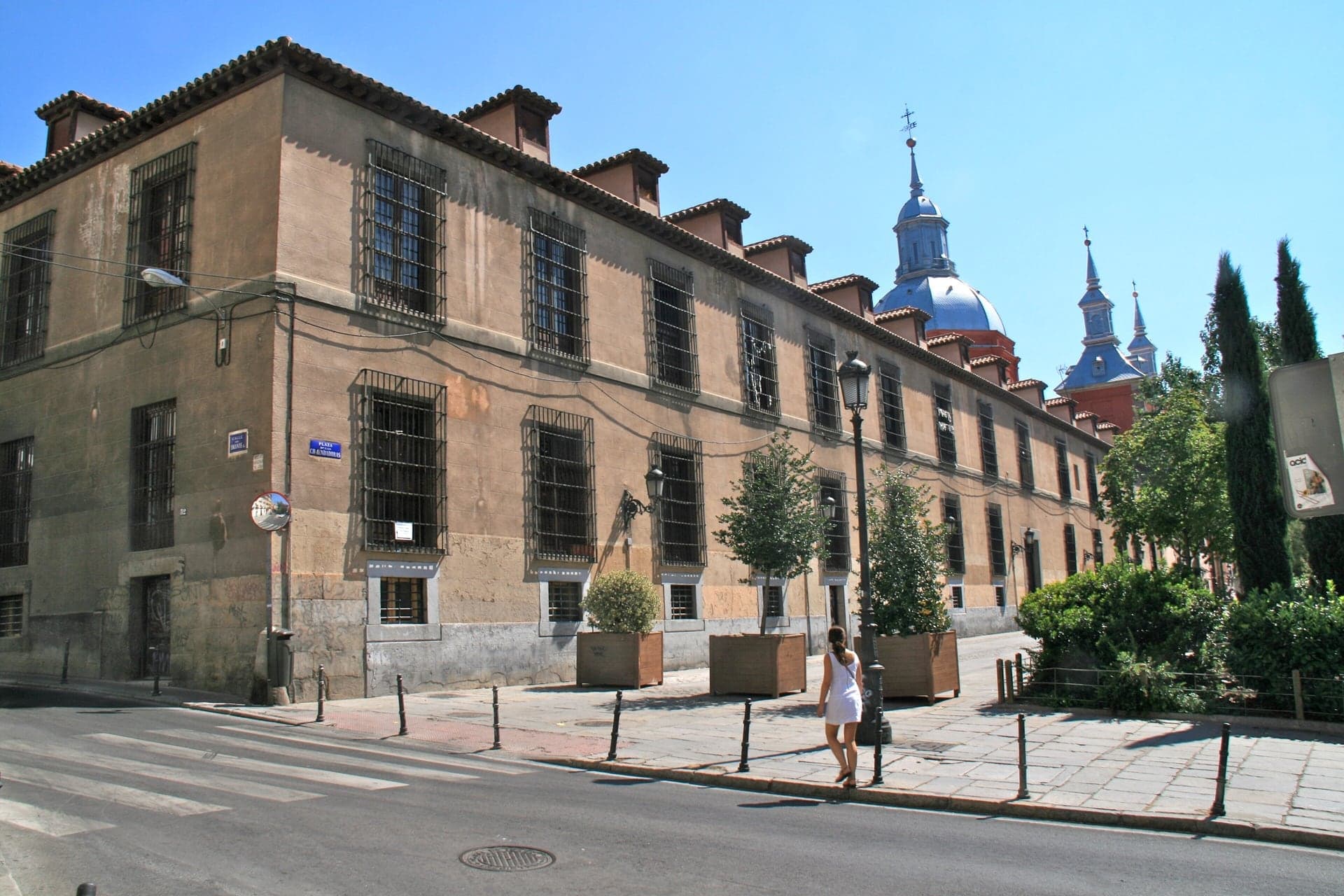
Plaza de las Comendadoras
A quiet convent square on the city's old edge, with a domed Greek-cross church founded in 1650 for the nuns of the Order of Santiago.
- 3
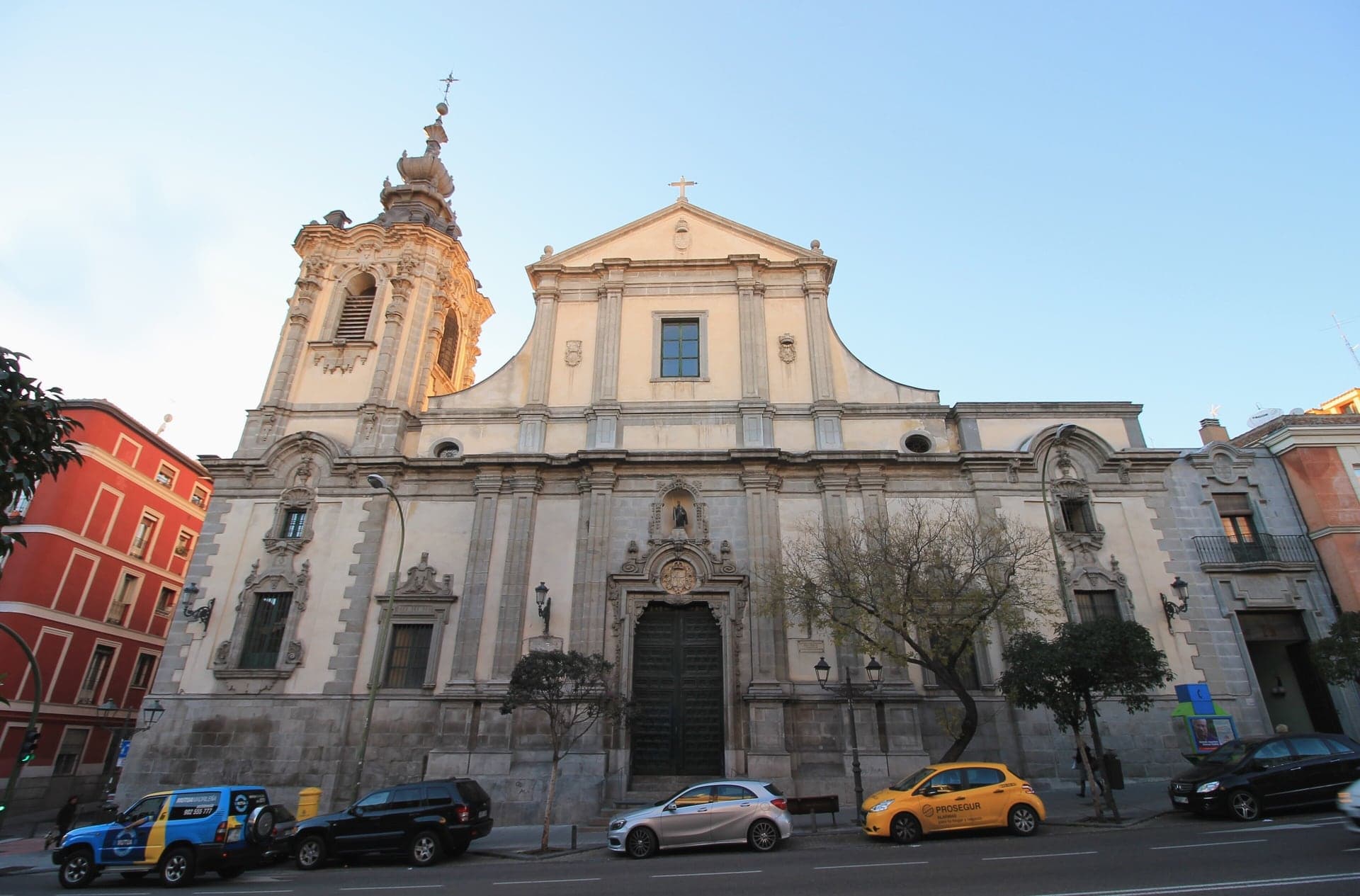
Montserrat: The Church With One Tower
A Baroque church that ran out of money, with one tower finished, the other stopped at its base and no dome.
- 4
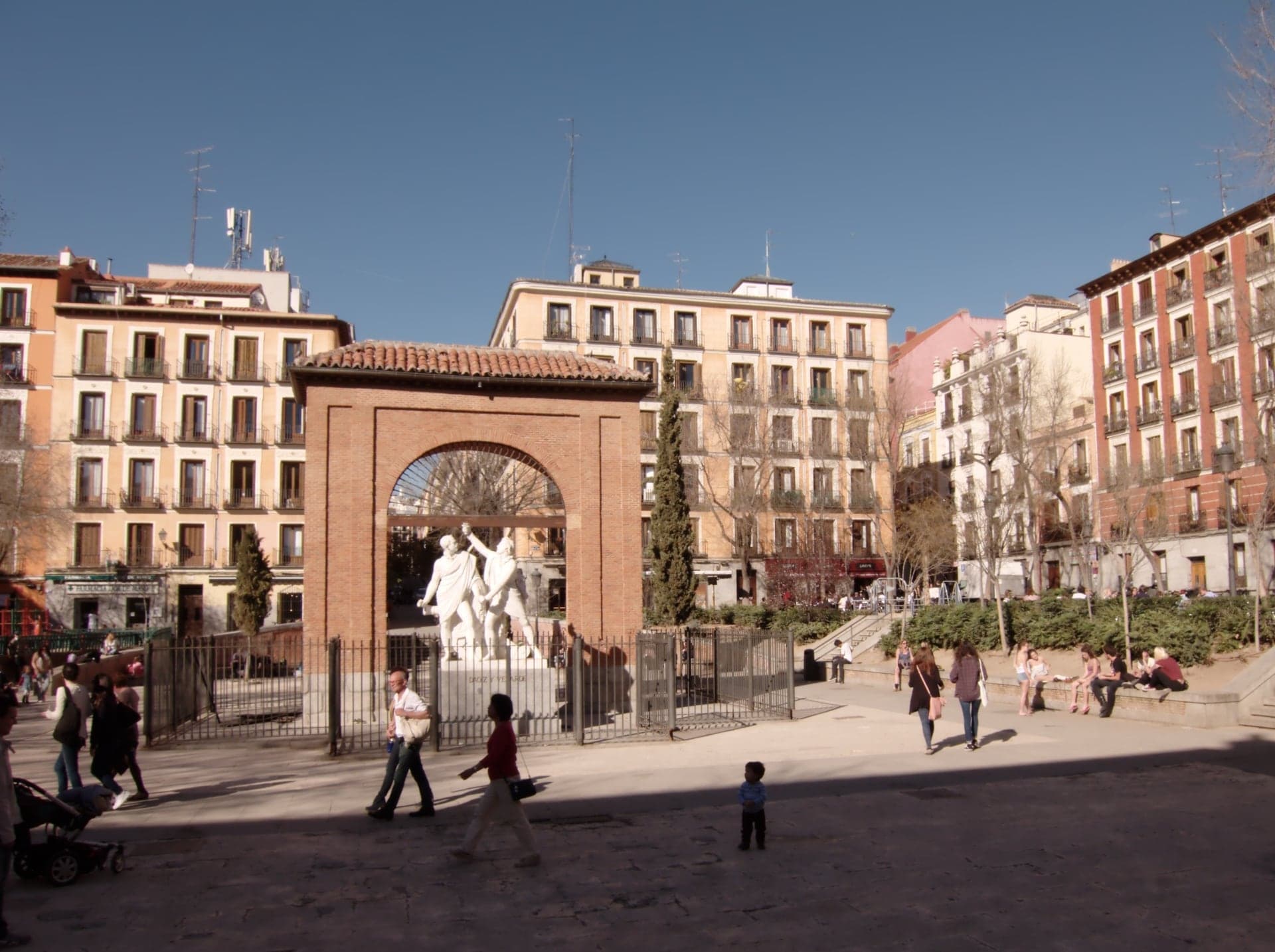
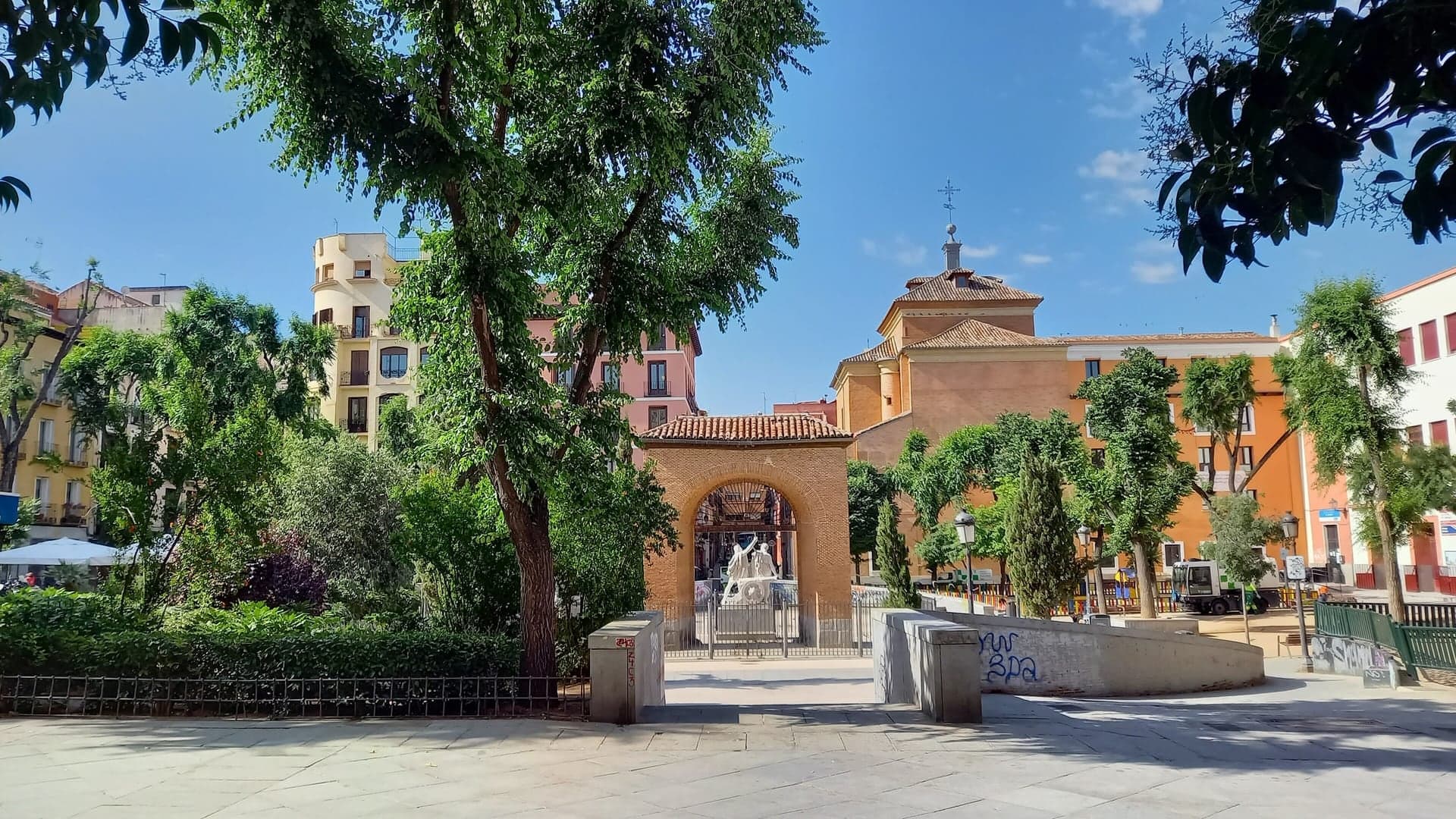
Plaza del Dos de Mayo: The Monteleón Arch
The square stands on the artillery park of the 1808 rising, and its brick arch is the barracks' real gate.
- 5
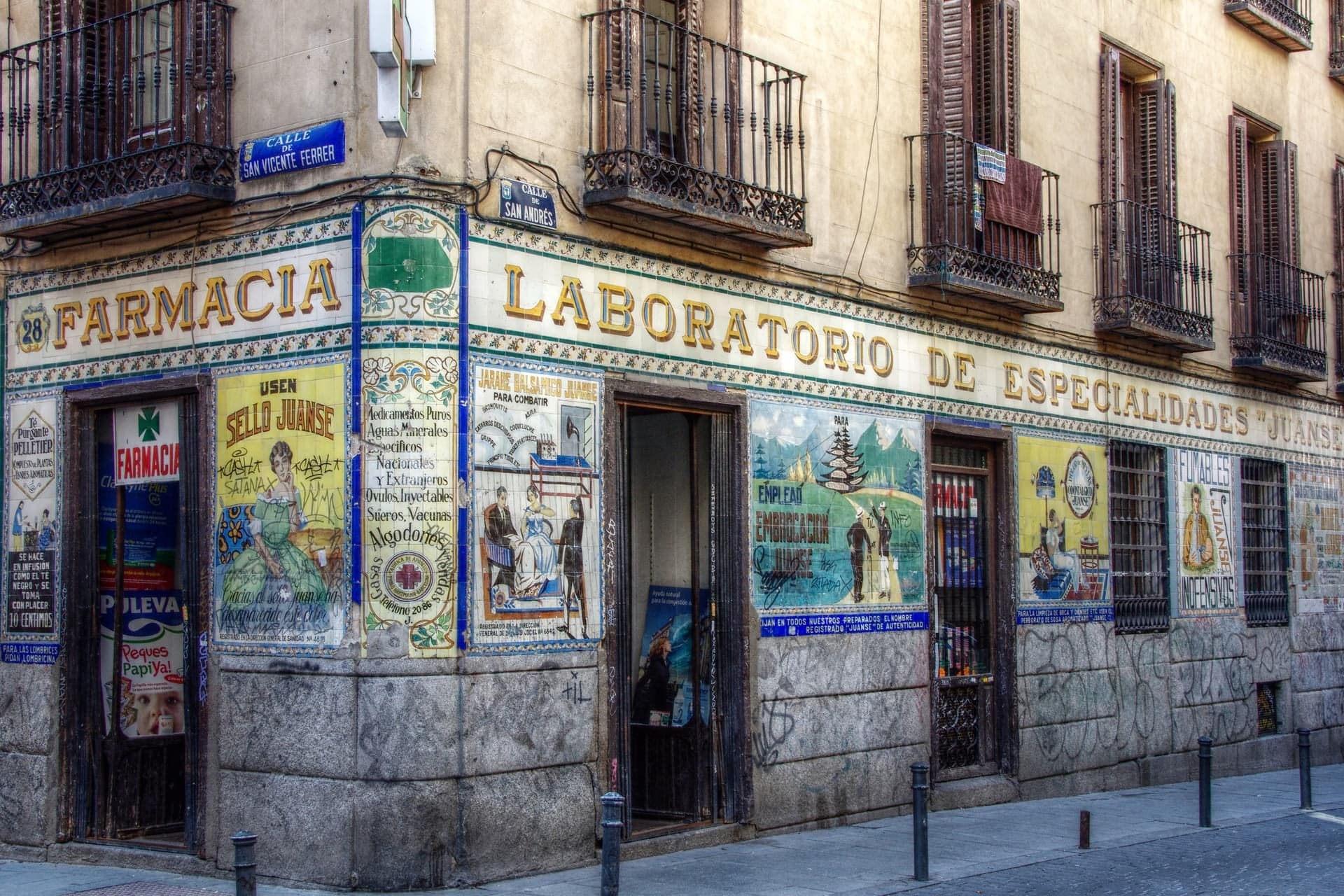
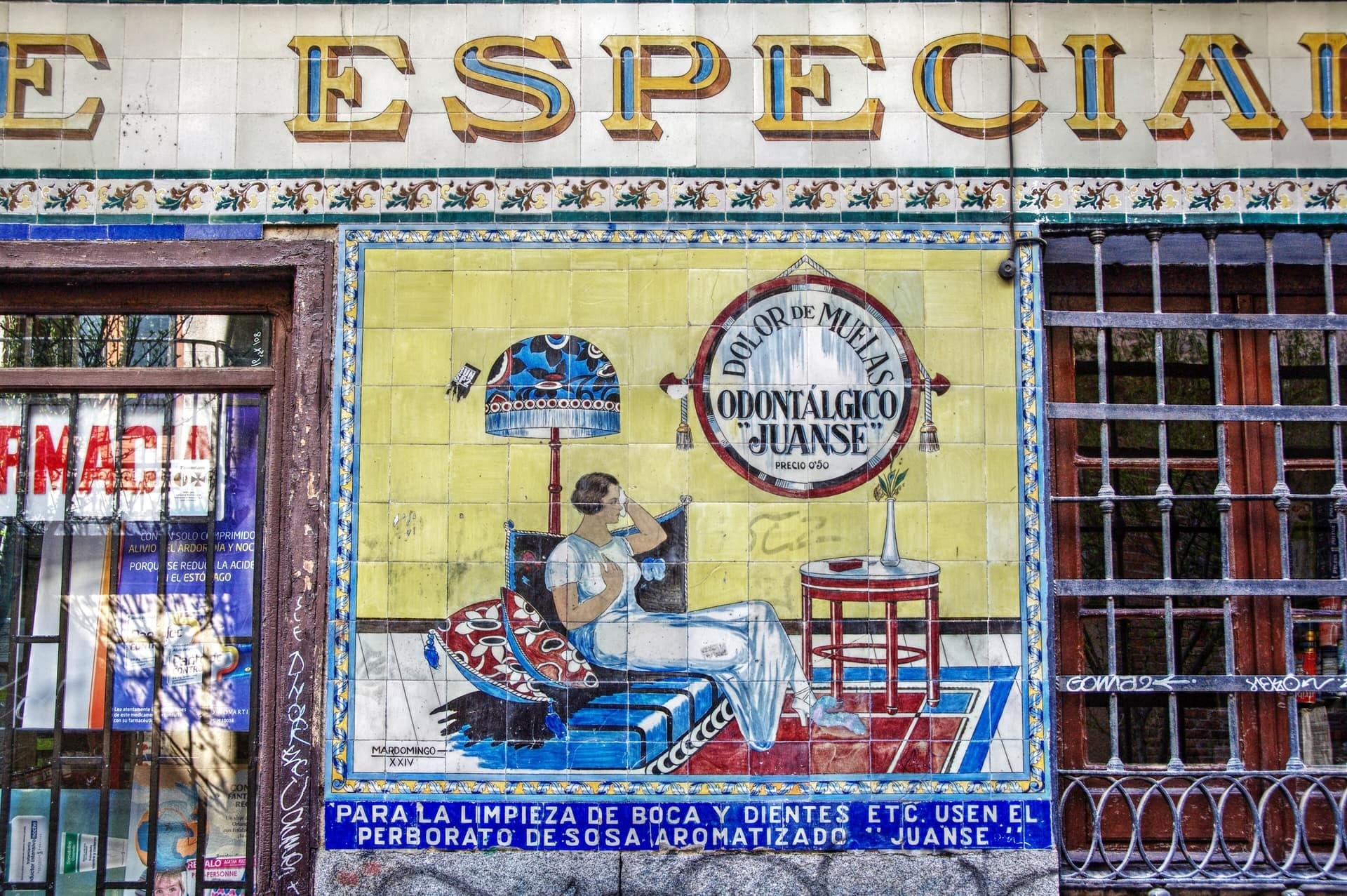
Farmacia Juanse: Adverts in Tile
A corner pharmacy front of painted tile adverts from 1925, plastered over to dodge a tax and restored in 2026.
- 6
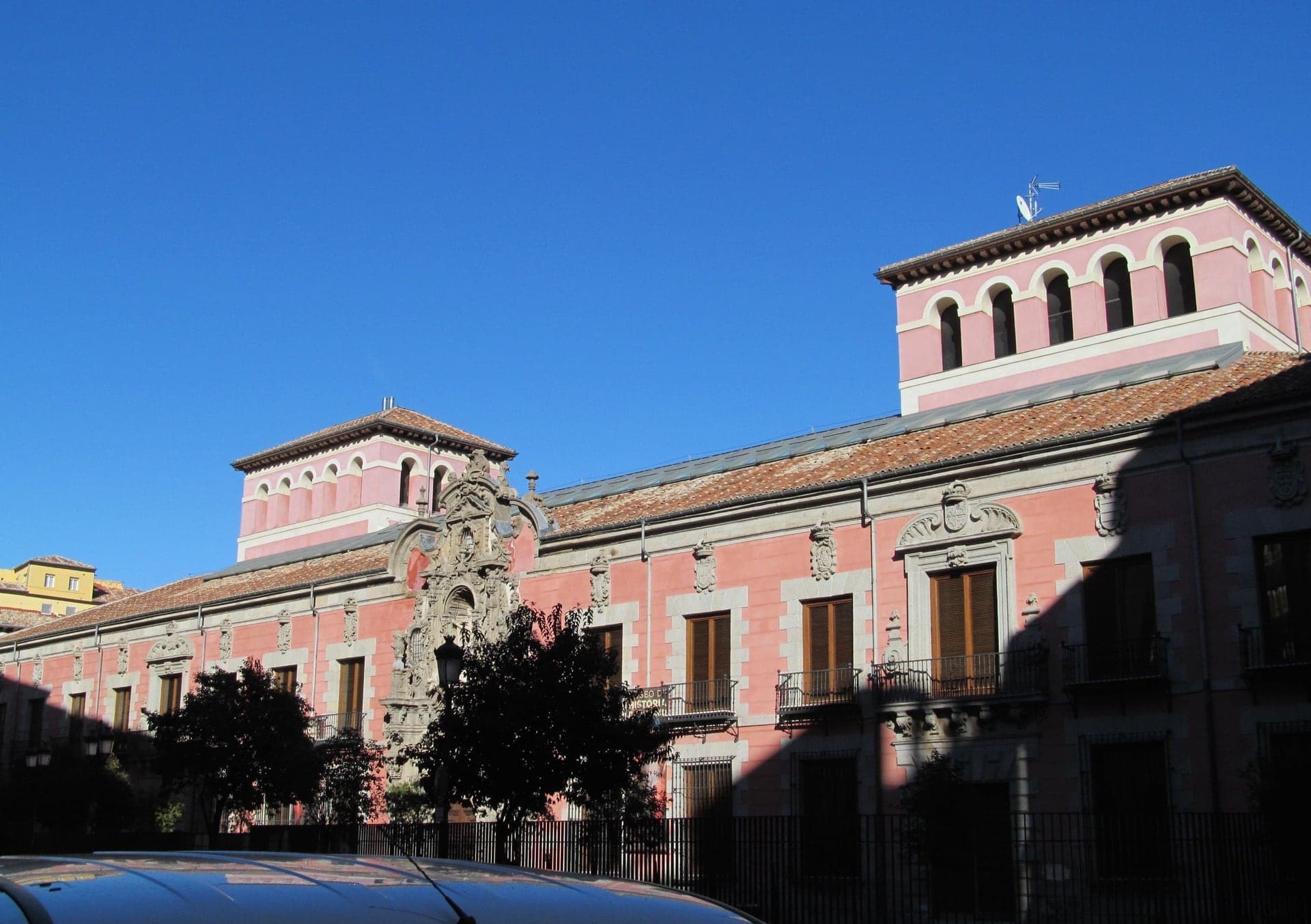
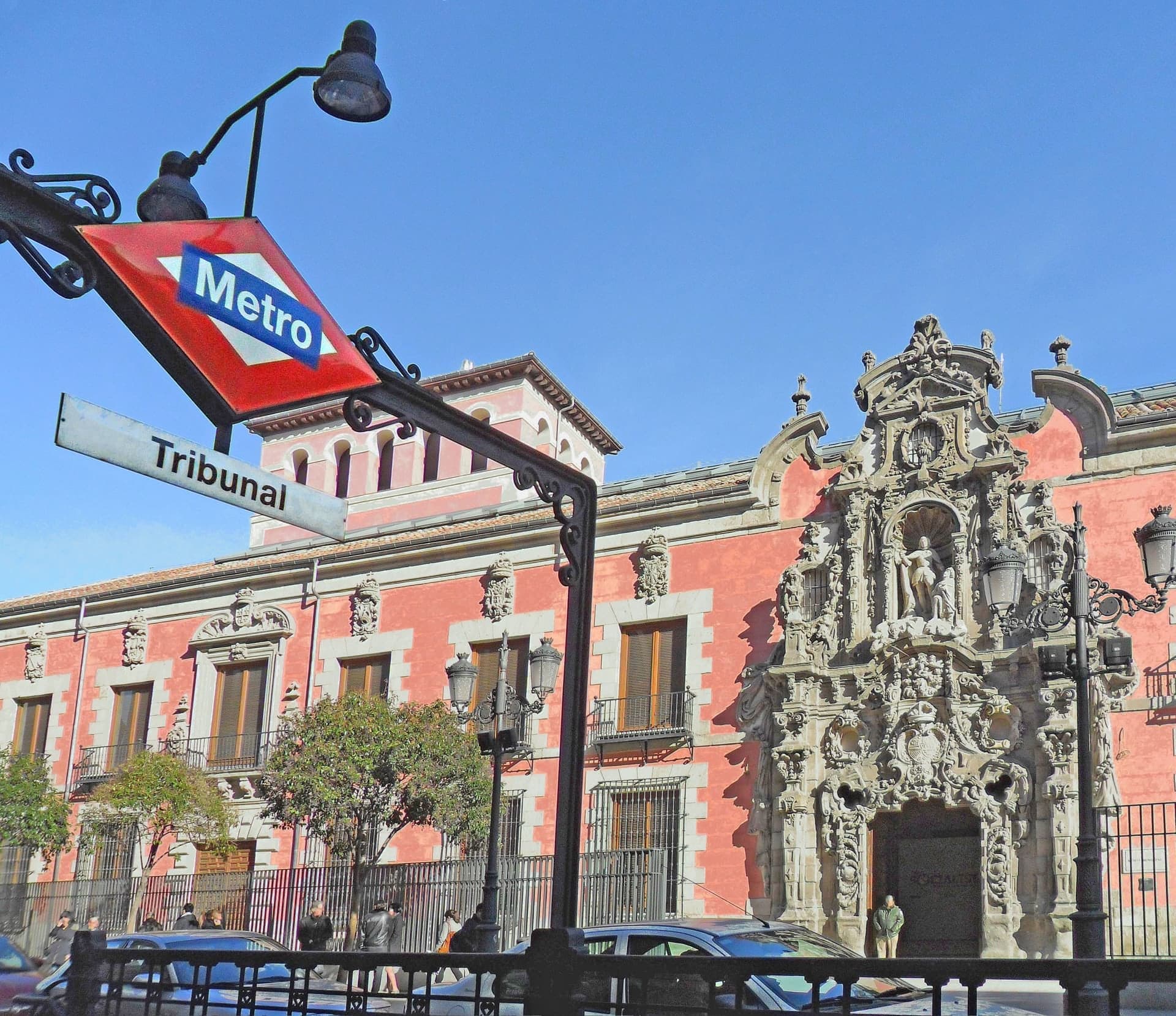
Museo de Historia: The Poorhouse Doorway
A royal poorhouse doorway fit for a palace, where stone angels draw back stone curtains; the city history museum since 1929.
- 7
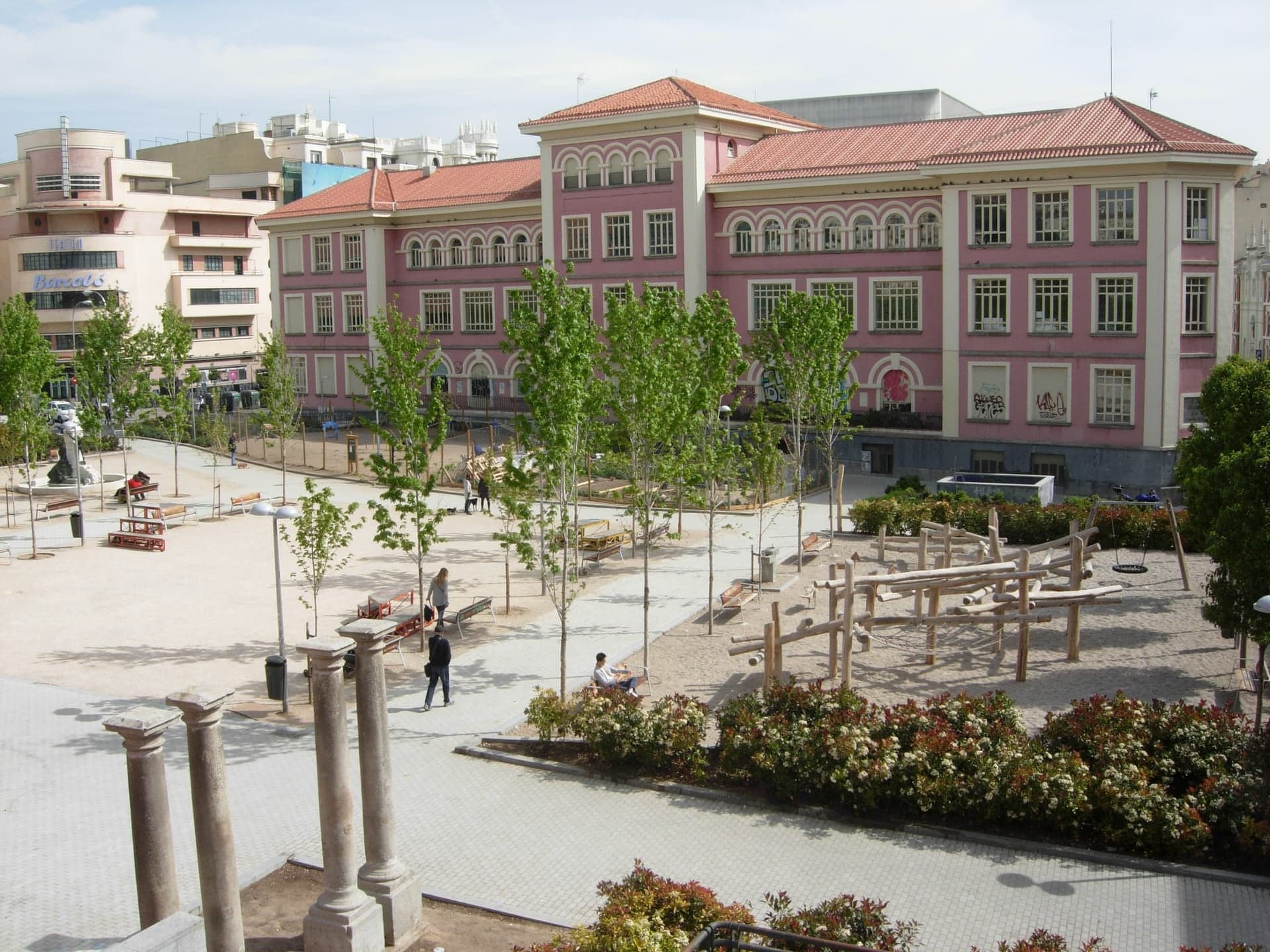
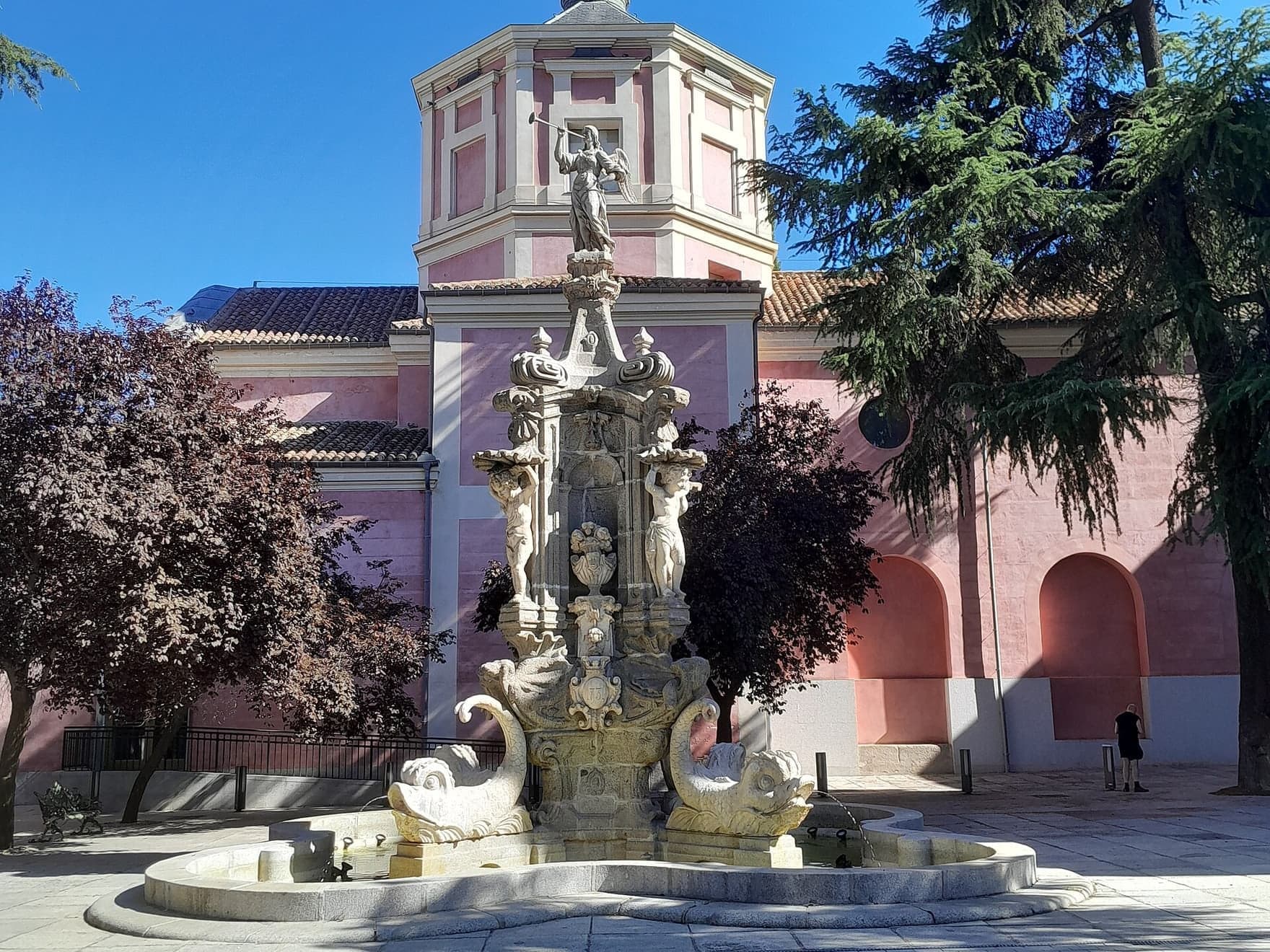
Jardines del Arquitecto Ribera: The Fountain of Fame
A neighbors' garden on the poorhouse's demolished ground, with a 1730s fountain of Fame behind the museum's railings.
- 8
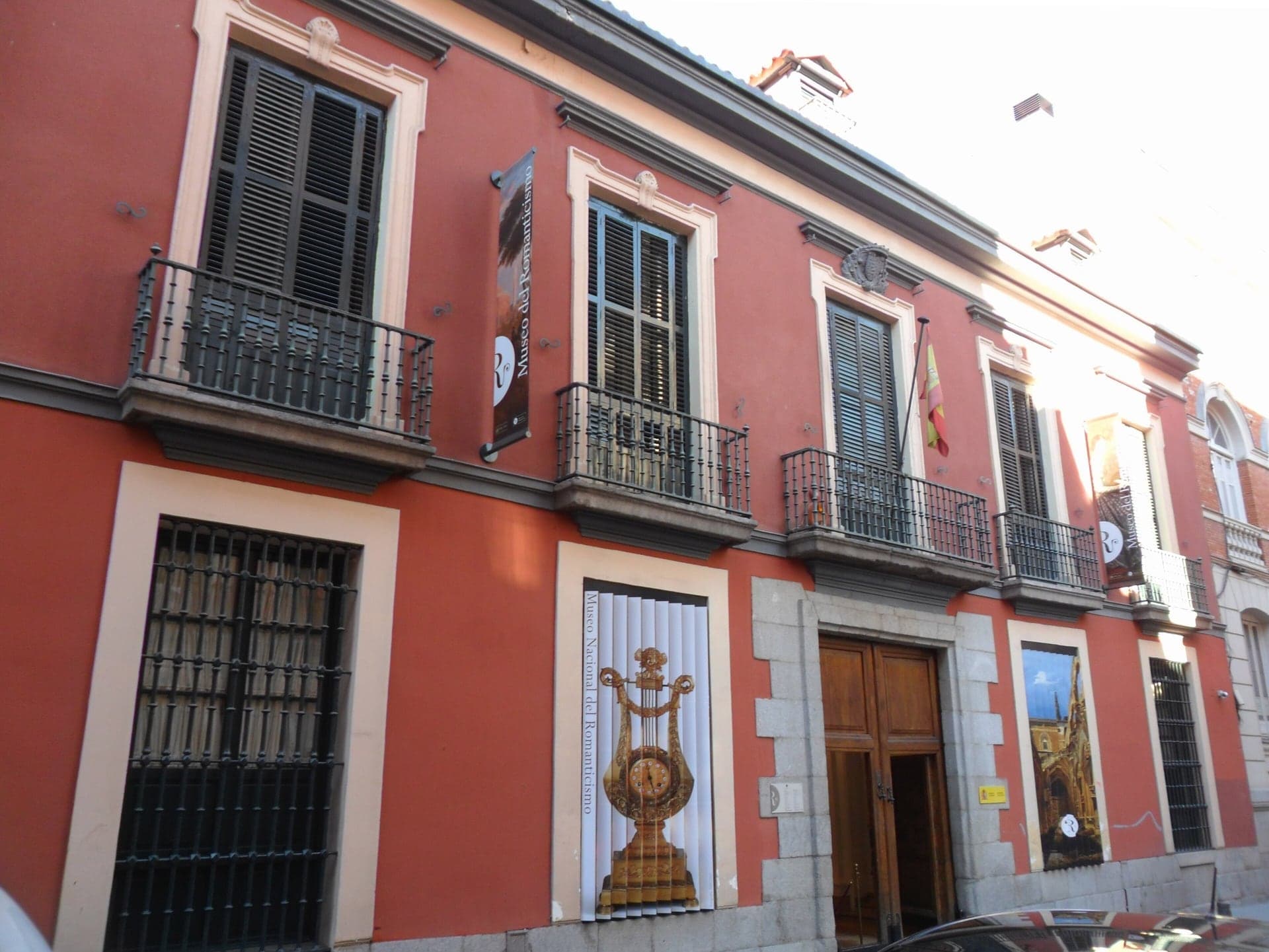
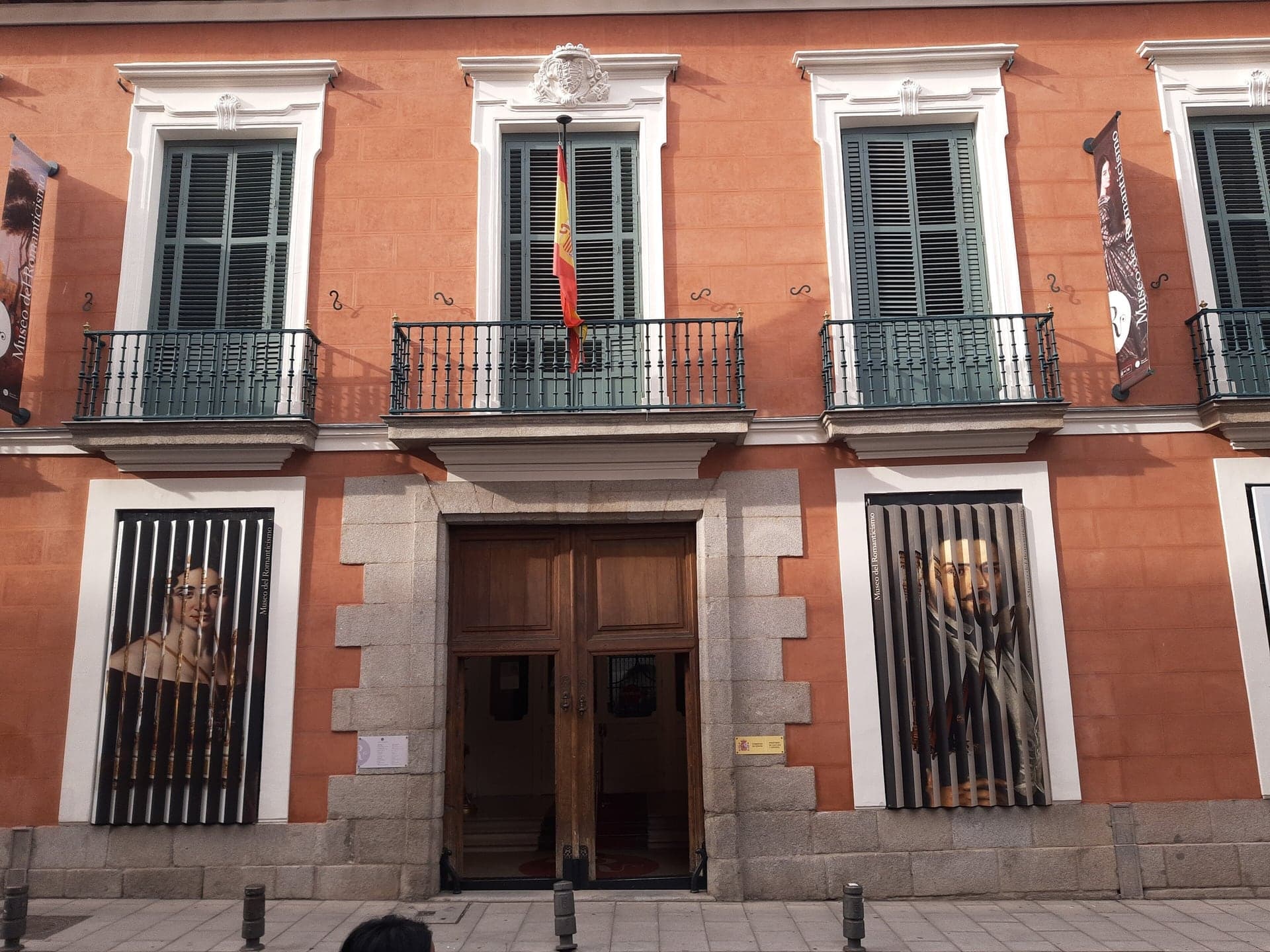
Museo del Romanticismo
A calm neoclassical house of the 1770s, later the seat of Spain's royal tourism commission and a museum of the Romantic era.
- 9
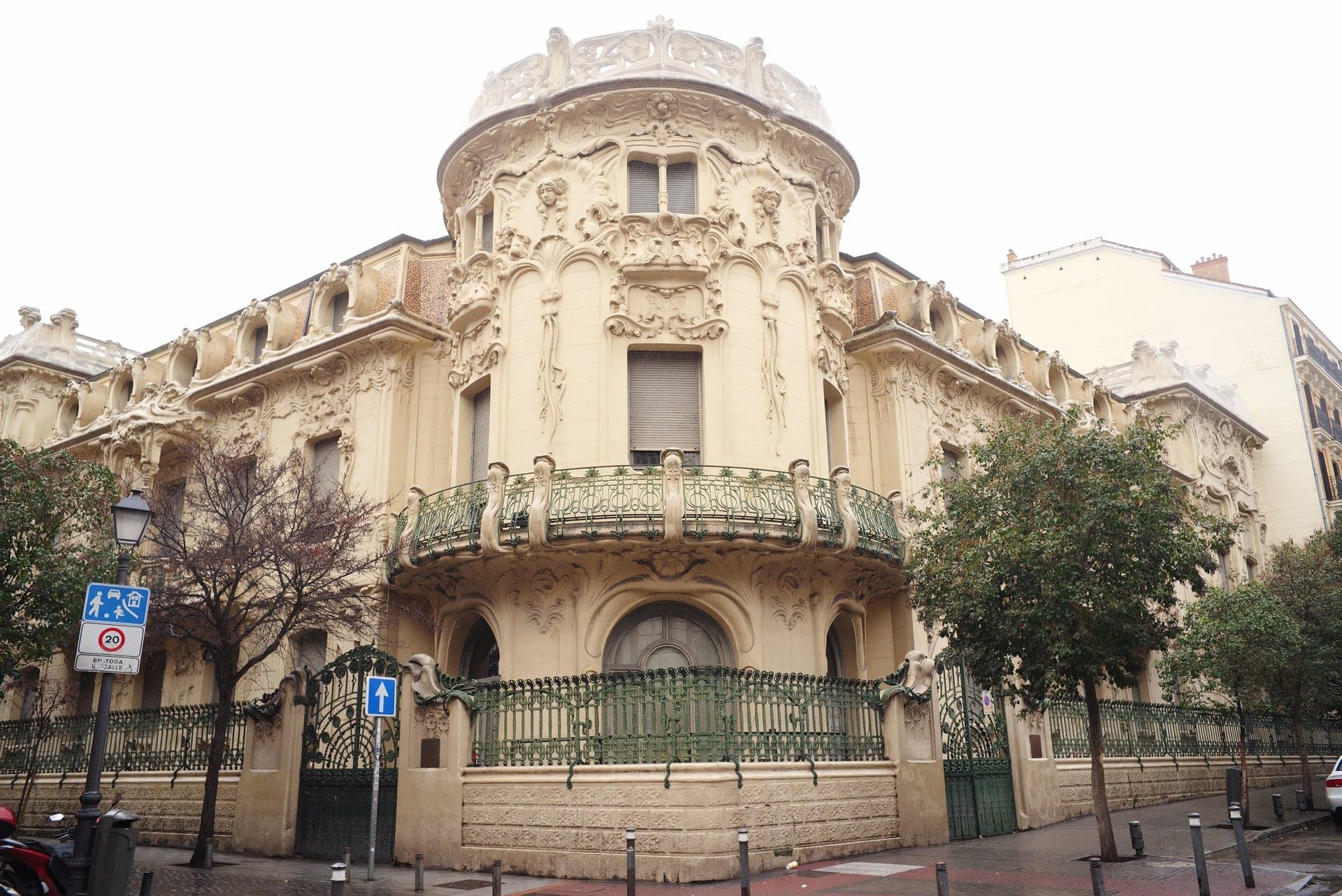
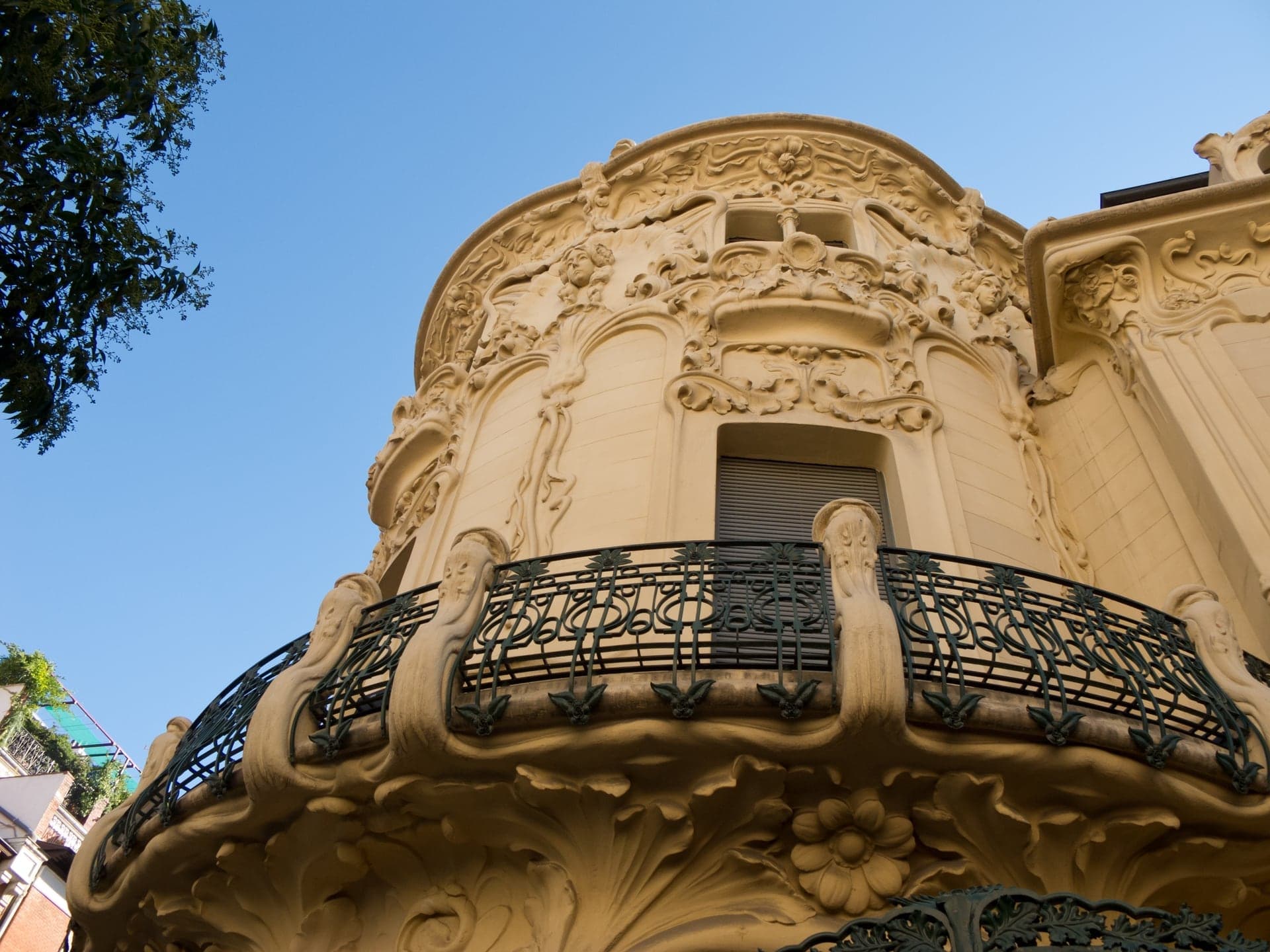
Palacio Longoria: A House That Grows
A banker's house that seems to grow, cast in plant-like artificial stone in 1902 to 1904.
- 10
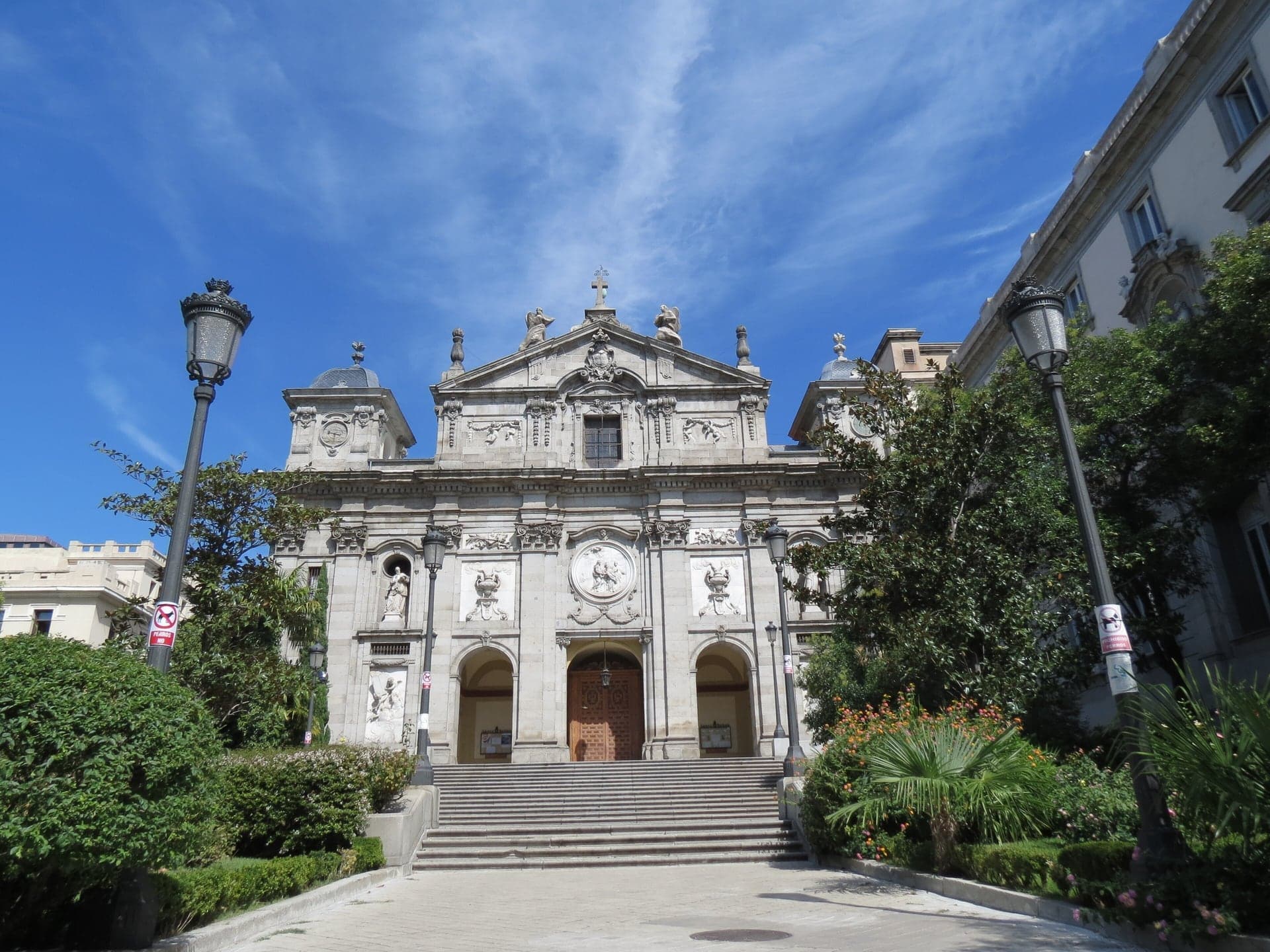
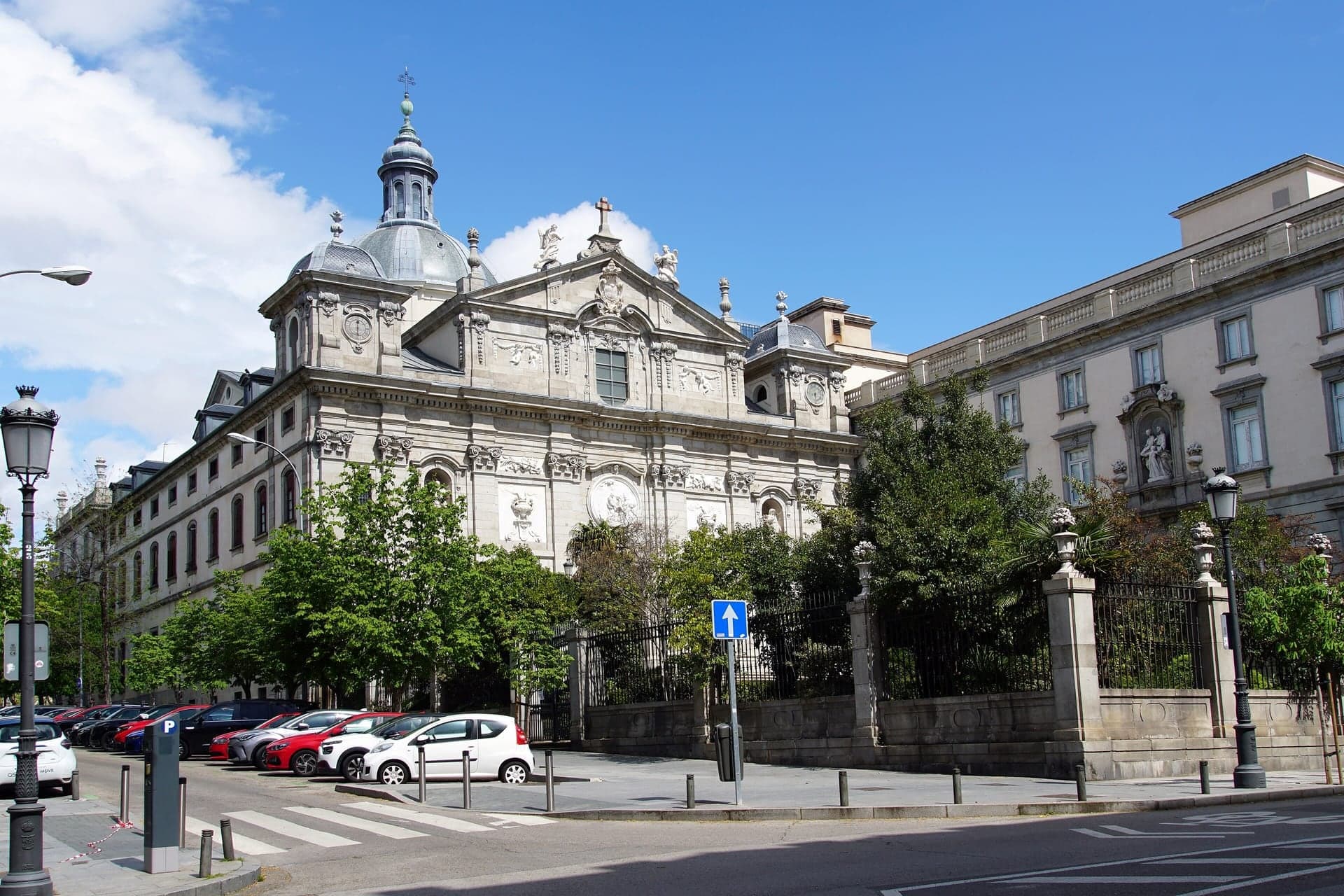
Salesas Reales: The Childless King's Tomb
The tomb church of a childless king and queen, built 1750 to 1757, with Spain's Supreme Court in its old convent.
- 11
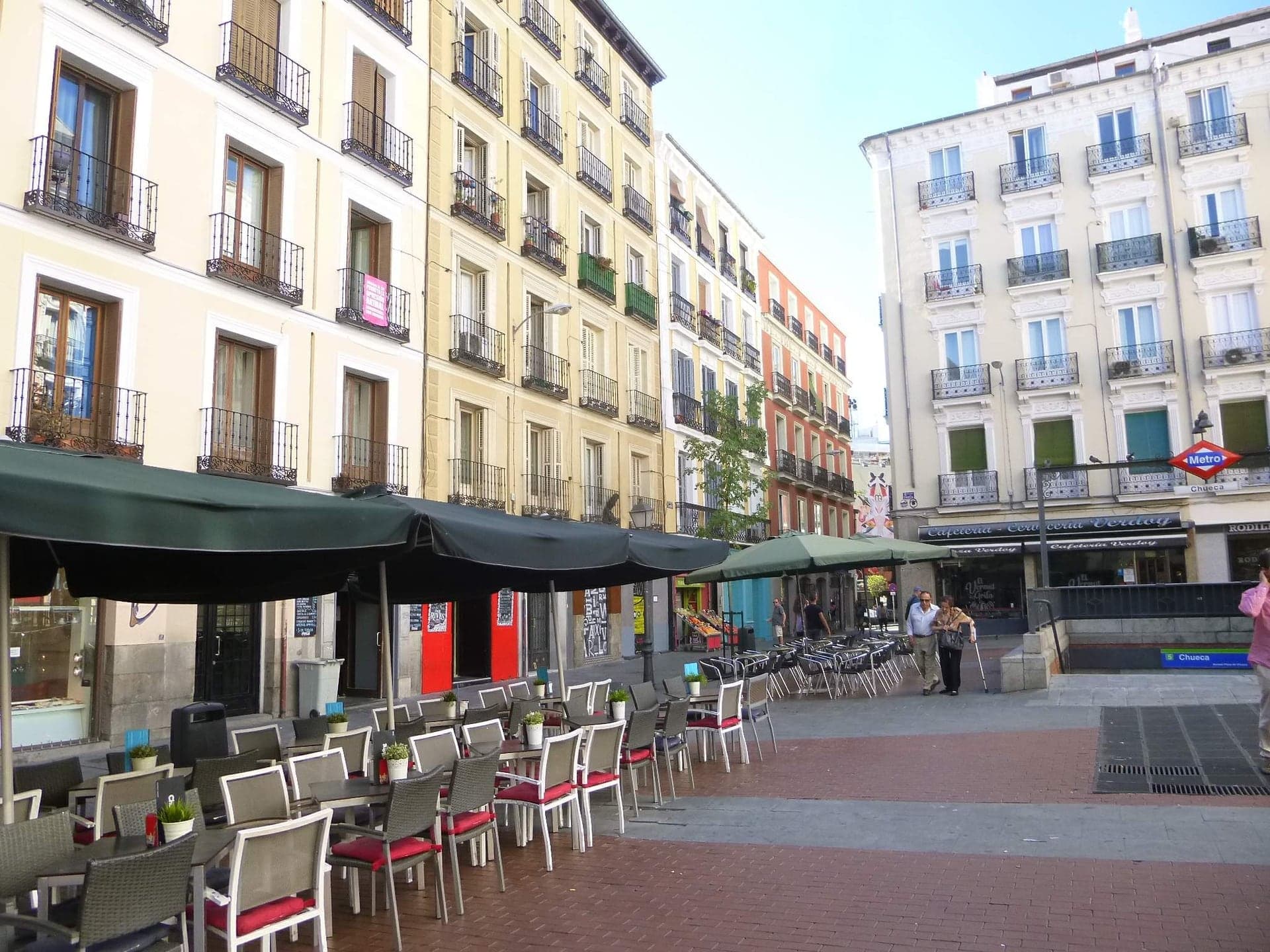
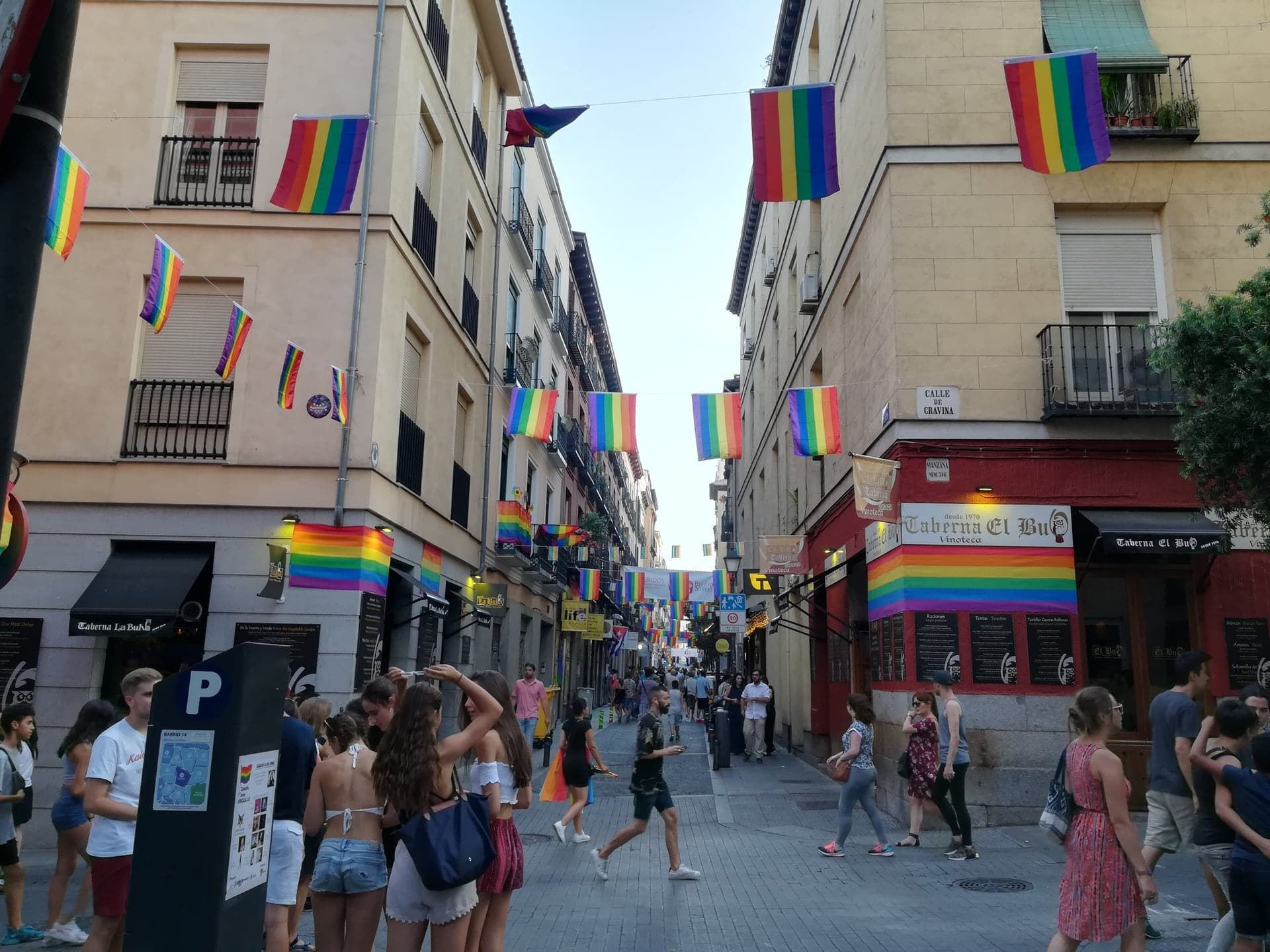
Plaza de Chueca
A small square named for a zarzuela composer, at the heart of the run-down quarter that became the center of Madrid's Pride.
- 12
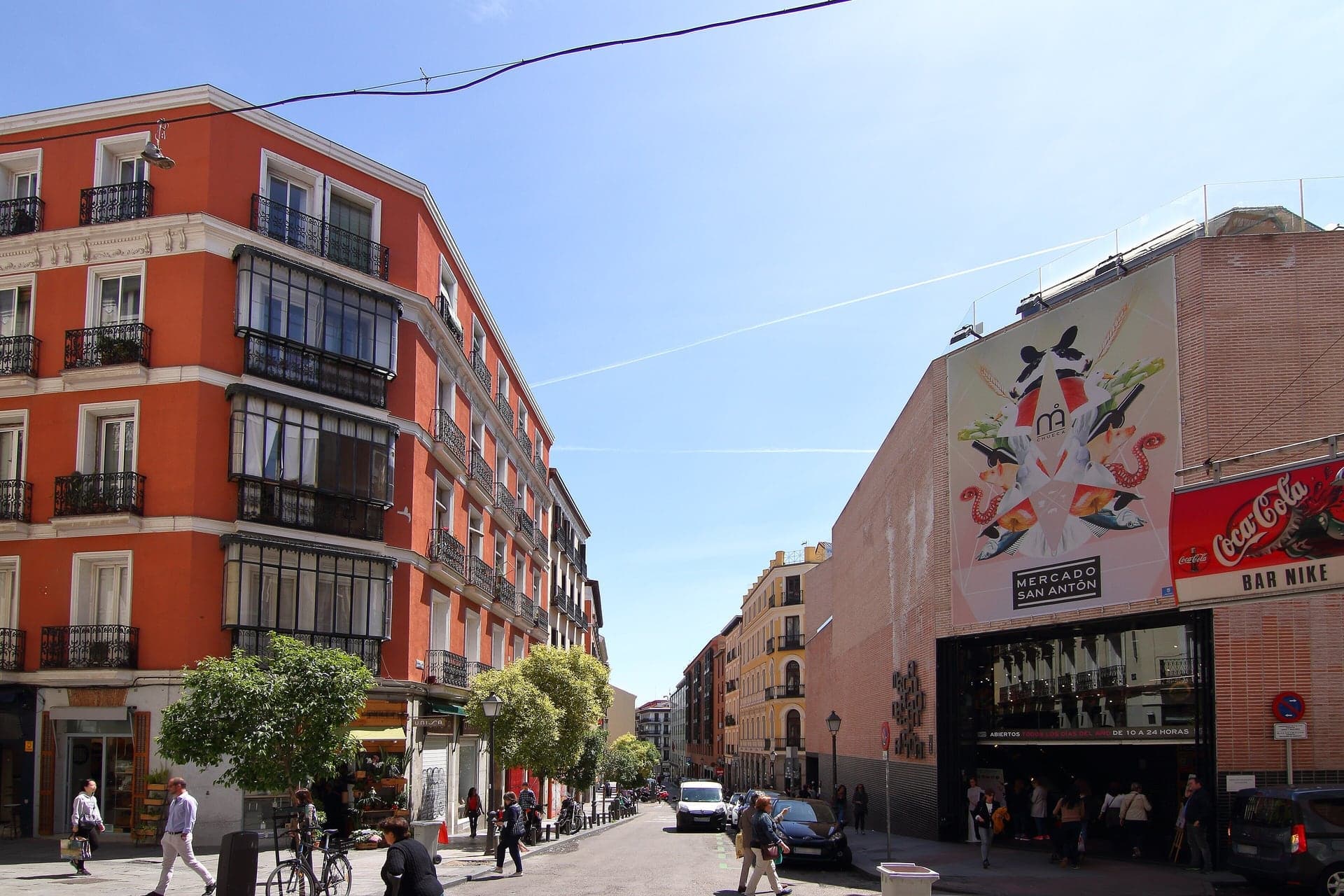
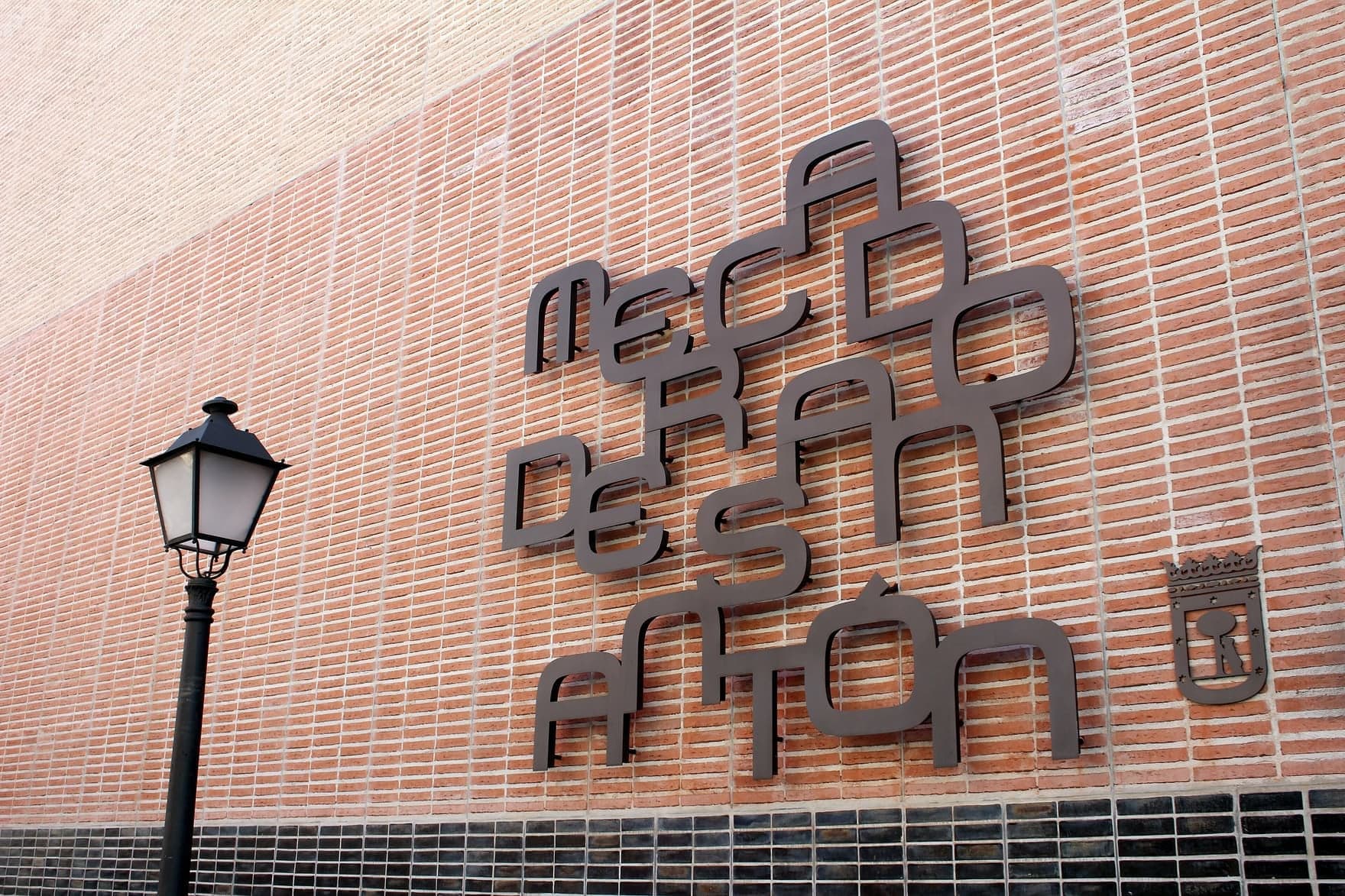
Mercado de San Antón: The Market Remade
A neighborhood market rebuilt in 2011 as a food hall, paid for by a supermarket underneath and topped by a roof terrace.
Details
Best Time to Visit
Tuesday to Saturday, starting at about 10.45am, so that the Montserrat church (stop 3) is open when you reach it (11am to 1pm) and both museums are open later on. On Sundays, start at about 11.30am to hear the monks' Gregorian chant at Montserrat at noon; the Museo del Romanticismo is free on Sundays but closes at 3pm. The Salesas Reales church (stop 10) closes at 1pm (1.30pm at weekends) and reopens in the evening. Mondays work from the street, but both museums are closed. Weekend nights in Malasaña and Chueca are loud and crowded. Checked 14 October 2026.
Pro Tips
- •Getting to the start: Ventura Rodríguez Metro (line 3) is about 240 meters from stop 1, Noviciado (line 2) about 330 meters, Plaza de España (lines 2, 3 and 10) about 370 meters and San Bernardo (lines 2 and 4) about 490 meters, all straight-line distances. Buses 1, 2, 44, 74, 133 and 749 also stop nearby. Checked 14 October 2026.
- •Getting away from the end: Chueca Metro (line 5) is about 50 meters from the market, Gran Vía (lines 1 and 5) about 420 meters and Banco de España (line 2) about 425 meters. Halfway, Tribunal Metro (lines 1 and 10) is at the corner of the Museo de Historia, by stop 6.
- •Contemporánea Condeduque (stop 1): the center is open Monday to Saturday 9am to 9pm and Sundays and holidays 10.30am to 2pm; exhibitions Tuesday to Saturday 10am to 2pm and 5.30pm to 9pm (to 8pm in summer), Sundays 10.30am to 2pm. Closed 24, 25 and 31 December and 1 January. Checked 14 October 2026 at condeduquemadrid.es.
- •Iglesia de Montserrat (stop 3): free; open Monday to Saturday 11am to 1pm and Sunday 11am to 2.15pm, with Mass Monday to Saturday at noon and Sunday at 11am and noon. On Sundays at noon the monks sing Gregorian chant. Checked 14 October 2026 at esmadrid.com.
- •Museo de Historia de Madrid (stop 6): free; Tuesday to Sunday 10am to 8pm (summer hours, 15 June to 15 September, are reported as 10am to 7pm); closed Mondays. Go in for the chapel, the model of the city, the 1862 painting of the Monteleón park and the only close view of the Fountain of Fame. Checked 14 October 2026.
- •Museo del Romanticismo (stop 8): entry is free for everyone until 31 October 2026 (the museum's own notice), and rooms XV to XXI are closed during building works. It is also closed on the Monday holidays of 2 and 9 November and 7 December 2026. Checked 14 October 2026 at cultura.gob.es/mromanticismo.
- •Santa Bárbara, Salesas Reales (stop 10): free; open Monday to Friday 9am to 1pm and 5.30pm to 8pm, and at weekends and on holidays in the morning and the evening (the parish gives 10am to 1.30pm and 6pm to 8pm). Mass on weekdays at 10.30am and 7.30pm, Sundays at 11am, noon, 1pm and 7.30pm; visit quietly. Checked 14 October 2026 at parroquiadesantabarbara.com.
- •Mercado de San Antón (stop 12): fresh-food stalls Monday to Saturday 9.30am to 9.30pm; food counters every day noon to midnight; roof terrace restaurant 1pm to 1am. The market says hours can change. Checked 14 October 2026 at mercadosananton.com.
- •The whole route is flat and step-free on the mapped line, on paving stones, setts and asphalt.
Safety & Precautions
- •Between stops 2 and 3 you walk the pavement of Calle de San Bernardo, a busy road with buses, and cross it at the traffic lights just past the far end of the Montserrat church, where the next stop stands.
- •Stop 6 stands on the pavement of Calle de Fuencarral, a one-way road of two lanes. Cross it only at the traffic lights by Tribunal Metro, just after the stop.
- •Between stops 8 and 9 you cross Calle de Hortaleza and Calle de Mejía Lequerica at the traffic lights. Between stops 9 and 10 you cross Calle del Barquillo at the traffic lights, then the one-way road round the Plaza de las Salesas on a zebra crossing with no lights. Between stops 10 and 11 you cross Calle del Barquillo again, on a zebra crossing with no lights. The traffic is one-way at both zebras: check which way it comes.
- •Calle de Fernando VI, Calle de Mejía Lequerica and Calle del Conde de Xiquena have narrow pavements, and a few steps of Calle de la Beneficencia after stop 7 have almost none: walk in single file and watch for cars on the narrow lanes around the Salesas.
- •The Jardines del Arquitecto Ribera (stop 7) post no opening hours. If the garden is closed, walk round it by Calle de Barceló and Calle de la Beneficencia and see the fountain through the railings from the street. The Fountain of Fame stands in the museum's own railed garden: never climb the railings.
- •Malasaña and Chueca are lived-in neighborhoods. The Juanse building at stop 5 is homes above the shops: keep doorways clear and do not photograph people at their windows.
- •Plaza del Dos de Mayo and Plaza de Chueca fill with terraces and, on weekend nights, crowds: keep bags closed and phones off café tables.
- •Chueca is the center of Madrid Pride, usually at the end of June and the start of July, when these streets are packed and some may be closed.
- •Montserrat and Santa Bárbara are working churches: keep voices low during Mass.
Travel advisory: Exercise Increased Caution (Level 2).
Gallery
Related Reading
Go deeper on what you'll see, hear, and walk through.
Read the walk
The full story of Malasaña and Chueca: The Old Edge of Madrid, in words. Prefer to listen? Play it narrated, from home or on location.
Introduction
Madrid, the capital of Spain, ended about here in the seventeen hundreds, and this walk follows that old edge across Malasaña and Chueca. On this edge the crown and the city put a barracks for the king's guard, a poorhouse for about a thousand people, an artillery park, and a royal convent that was also meant to be a king and queen's tomb.
Then the city took them back: the barracks became its archive, the poorhouse a museum. And in the nineteen eighties, Chueca's run-down streets were cheap enough to let in the people who remade them.
Malasaña takes its name, the story goes, from a young woman killed in the rising of eighteen oh eight.
You will meet one architect again and again: Pedro de Ribera, the city's architect in the early seventeen hundreds, who gave a barracks and a poorhouse doorways fit for a palace. You will also meet a king and queen with no children, Fernando the Sixth and Bárbara de Braganza, and a composer, Federico Chueca.
The walk is twelve stops over about two point seven kilometers, a little over a mile and a half, in about seventy-five minutes. It is flat. One museum on the way charges a small fee; every stop works from the street. It begins at the Conde Duque barracks, near Ventura Rodríguez Metro, and ends at the San Antón market, beside Chueca Metro.
1. Conde Duque: The Barracks Doorway
Welcome to the Conde Duque, the old barracks where this walk begins. Find the great carved stone doorway across the street, and look up.
This is one of the largest buildings in Madrid, and almost all of it is plain on purpose. It was begun in seventeen seventeen as a barracks for the king's guard, laid out the way French military engineers planned barracks: long ranges of brick vaults wrapped round three big rectangular courtyards. Look along the front, first one way, then the other. Window after window in a steady rhythm, broken only by small round openings and by one thing: the doorway in front of you.
All the decoration was spent here. The doorway is stone, a heavy rusticated frame wrapped in carved garlands, trophies of arms and military symbols, and crowned by the great coat of arms of the crown. The architect was Ribera, the city's architect, and this is the first of four works of his on this walk. He joined the plain logic of a military building to Madrid's Baroque, and put the Baroque exactly where people go in. Towers were planned for the corners. They were never built.
The building had a hard nineteenth century. It burned in eighteen sixty-nine and was later abandoned. In nineteen sixty-nine the city bought it, and from the nineteen eighties it was restored and turned into a library, a newspaper library, the city's archive and an arts center, today called Contemporánea Condeduque.
So the first stop already shows the pattern of this walk: something built on the city's edge for the crown, then taken back by the city.
Follow the route into the side streets. Next is a quiet convent square.
2. Plaza de las Comendadoras
Walk on into the Plaza de las Comendadoras, past the church front on your left. Step out onto the open paving of the square on your right and turn to face the church.
This is the convent of the Comendadoras de Santiago, nuns of the Order of Santiago, the military order of Saint James. It was founded in sixteen fifty, with the king's support. Its church is built as a Greek cross: four equal arms meeting under one big dome. From here you see the front; the dome rises behind it, best seen from the far side of the square when the trees allow. Inside, over the high altar, hangs a painting of Saint James at the battle of Clavijo. It is a convent church, so take it in from here.
Notice how close the old institutions sit to each other. A royal barracks back the way you came, a military order's convent here, and in a moment a church founded by the same king. This was the edge of the city, and the crown filled it.
The square has become the neighborhood's own: trees, terraces, a playground. Malasaña is a lived-in neighborhood, with homes above the streets, so keep voices down by the doors and windows.
Follow the route out along the church front and down Calle de Quiñones, a narrow lane shared with the odd car, across three side streets. At its end, walk along the pavement past the next church and cross Calle de San Bernardo at the traffic lights. Next is a church that ran out of money.
3. Montserrat: The Church With One Tower
Cross Calle de San Bernardo at the lights, stop on the far pavement, and turn round to face the church you have just walked past.
This is the church of Our Lady of Montserrat. Look up and count the towers. There is one, tall, topped with a bulbous spire. Now find its partner at the other end of the front: it stops at its base. And behind the front there is no dome.
The church was founded by King Philip the Fourth for Benedictine monks who had left the monastery of Montserrat in Catalonia. Plans were drawn in sixteen sixty-eight for a big church with three naves and a great dome. Its first architect died and a second took over. Then the money ran out, with the walls barely up to the height of the crossing, where the dome should have risen. When work began again, in seventeen sixteen, the same architect who made the barracks doorway took charge, and the church was finished where it stood, with no dome. He gave it this front and planned a tower on each side. One tower was finished. The other never got past its base.
The nineteenth century nearly finished it off. After the church lands were sold off in the eighteen thirties, the monastery was closed and the building became a women's prison. By eighteen ninety-two it was in ruins, and its demolition was even approved. In nineteen fourteen it was declared a national monument instead and given back to the Benedictines, and it was restored in the nineteen eighties.
On Sundays at noon the monks sing Gregorian chant here.
Follow the route into the side streets. Next is the square where Madrid rose against Napoleon's troops.
4. Plaza del Dos de Mayo: The Monteleón Arch
Walk on into the Plaza del Dos de Mayo and stop on the open paving, facing the brick arch with a pair of marble figures standing under it.
The name means the Second of May. On the second of May, eighteen oh eight, Madrid rose against Napoleon's troops. On the ground under your feet stood the Monteleón artillery park, a barracks and gun yard, and its defense that day is what this square remembers. The monument honors two of the rising's heroes, Daoíz and Velarde.
Now look at the arch, because it is not a copy and it was not built for the monument. It is the real entrance to the artillery park. When the barracks were pulled down in eighteen sixty-eight, the city bought the entrance arch, with its iron railings, and used it as the base for the heroes' monument. Look for that old ironwork; it is still there. Everything else that stood on this ground has gone. The gate is what the city chose to keep.
A painting of the death of Daoíz and the defense of this park, made in eighteen sixty-two, hangs in the city history museum, which is a few stops ahead on this walk.
Today the square belongs to the neighborhood. There are terraces, swings for children, and craft markets at weekends. At night, especially at weekends, it fills up, and the people living around it would like to sleep.
Follow the route out of the square and down Calle de San Andrés, a quiet lane, across Calle de la Palma. Next is a pharmacy front made of painted tiles.
5. Farmacia Juanse: Adverts in Tile
Walk on to the corner of Calle de San Vicente Ferrer and stop by the shopfront covered in painted tiles. This is the old Farmacia Juanse, the Juanse pharmacy. These panels went up in nineteen twenty-five. They are large, many-colored pictures in glazed tile, each framed in a…
Full narration for this stop unlocks with the tour.
6. Museo de Historia: The Poorhouse Doorway
Walk on up the pavement of Calle de Fuencarral and stop opposite the long front across the street, with one tall carved doorway in its middle. This is the Museo de Historia de Madrid, the city history museum. It is free, and if it is open, it is worth a visit; the details are on…
Full narration for this stop unlocks with the tour.
7. Jardines del Arquitecto Ribera: The Fountain of Fame
Walk on into the garden behind the museum and stop on the path near the railings of the museum's garden. You are standing where most of the poorhouse stood until the nineteen twenties. When its ranges came down, the neighbors asked for a garden rather than a market, a theater…
Full narration for this stop unlocks with the tour.
8. Museo del Romanticismo
Walk on along Calle de San Mateo and stop on the pavement across the narrow street from the museum's door. This is the Museo del Romanticismo, the Museum of Romanticism. It charges a small entry fee, with free hours, and the details are on this stop's card. From here, the front…
Full narration for this stop unlocks with the tour.
9. Palacio Longoria: A House That Grows
Walk on across the small junction, stop on the far corner, and turn round to face the building you have just passed on your right, the one with the rounded, domed corner. This is the Palacio Longoria. Look at it for a moment before anything else, because almost nothing on it…
Full narration for this stop unlocks with the tour.
10. Salesas Reales: The Childless King's Tomb
Walk on to the corner and stop on the pavement where you can look up the railed forecourt to the church at its top. This is the church of the Salesas Reales, today the parish of Santa Bárbara. The trees in the forecourt may hide the lower part of the front, especially in…
Full narration for this stop unlocks with the tour.
11. Plaza de Chueca
Walk on into the Plaza de Chueca and stop in the square, among the terraces, by the Metro entrance. The square, the Metro station and now the whole neighborhood take their name from one man: Federico Chueca, a Madrid-born composer of zarzuela, Spain's own light opera. Look up…
Full narration for this stop unlocks with the tour.
12. Mercado de San Antón: The Market Remade
Walk on down the pedestrian street and stop facing the modern front of the Mercado de San Antón, the San Antón market. This is the end of the walk. The market it replaced opened in nineteen forty-five. This one opened in twenty eleven, and the way it was paid for explains how…
Full narration for this stop unlocks with the tour.
- Malasaña / Calle Conde Duque El Cuartel del Conde-Duque is a baroque-style building which served as barracks. After its initial military use — Fred Romero from Paris, France, CC BY 2.0 · source
- View of Cuartel del Conde-Duque in Madrid (Spain) from the south angle. — Luis García (Zaqarbal), CC BY-SA 3.0 ES · source
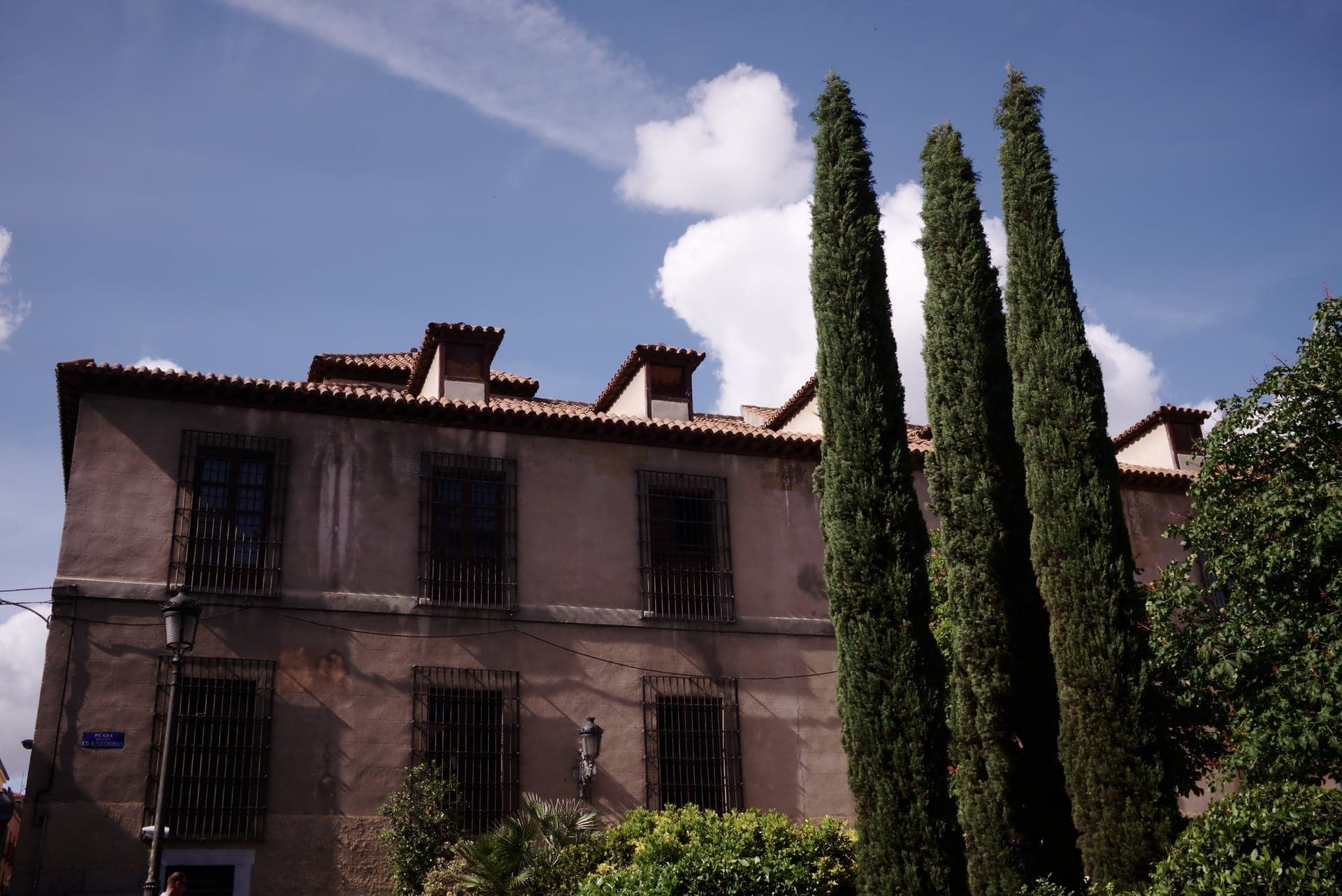
- Plaza de las Comendadoras (desde la calle de Amaniel) - Fachada al edificio del Convento de las Comendadoras de Santiago — Tamorlan, CC BY-SA 3.0 · source
- East façade of the Church of Our Lady of Montserrat in Madrid (Spain). — Luis García (Zaqarbal), CC BY-SA 3.0 ES · source
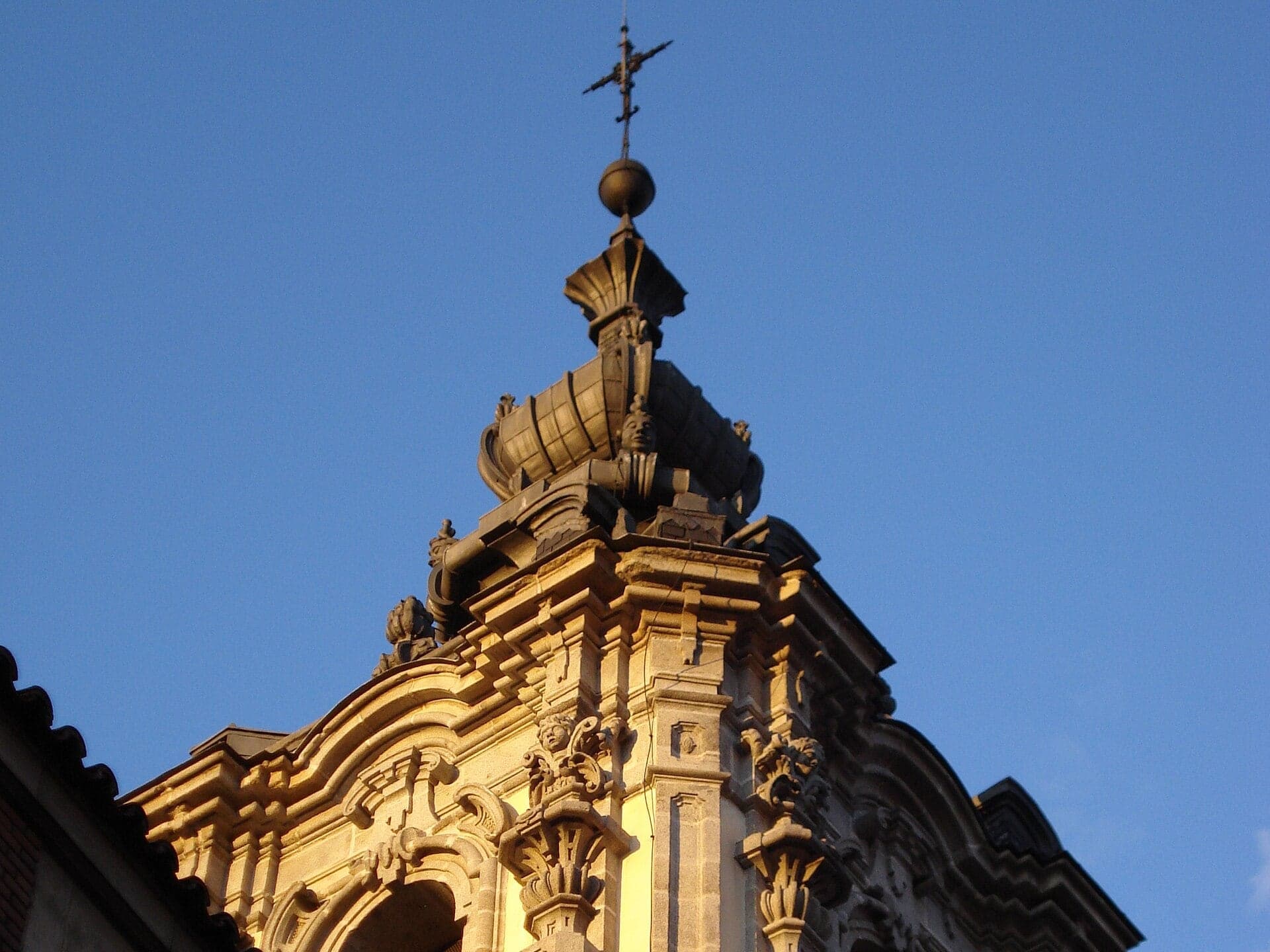
- Detail of the Iglesia de Nuestra Señora de Montserrat ("Church of Our Lady of Montserrat") in Madrid (Spain). Building was projected in 1668 — losmininos, CC BY-SA 2.0 · source
- La Plaza del Dos de Mayo, centre névralgique de la vie trépidante du quartier de Malasaña. — Vsieger, CC BY-SA 4.0 · source
- Farmacia Juanse (1898) — Felipe Gabaldón, CC BY 2.0 · source
- Farmacia Juanse (1898) rq — Felipe Gabaldón, CC BY 2.0 · source
- 12 escudos alegóricos del siglo XVIII labrados en piedra en la fachada principal del del antiguo Real Hospicio del Ave María y San Fernando — Basilio, CC BY-SA 4.0 · source
- Entrance to Tribunal metro station in Madrid (Spain), at 81 Calle de Fuencarral (street) in Centro district. Background: History Museum. — Luis García (Zaqarbal), CC BY-SA 3.0 · source
- Fotografía de los Jardines del Arquitecto Ribera. — Isabel Costa, CC BY-SA 4.0 · source
- South-east façade of the Museum of Romanticism in Madrid (Spain). — Luis García (Zaqarbal), CC BY-SA 3.0 · source
- Exterior view of the Longoria Palace, Madrid (Spain). — Javier Perez Montes, CC BY-SA 4.0 · source
- Palace of Longoria, Madrid, Spain. — Carlos Delgado, CC BY-SA 3.0 · source
- This is a photo of a monument listed in the Spanish heritage register of Bienes de Interés Cultural under the reference RI-51-0004359. — ECsonka, CC BY-SA 3.0 ES · source
- Calle de AugustoFigueroa, desde la calle Barbieri, Mercado de San Antón — Malopez 21, CC BY-SA 4.0 · source
Images may be cropped or resized. Other photos via Unsplash and Pexels.