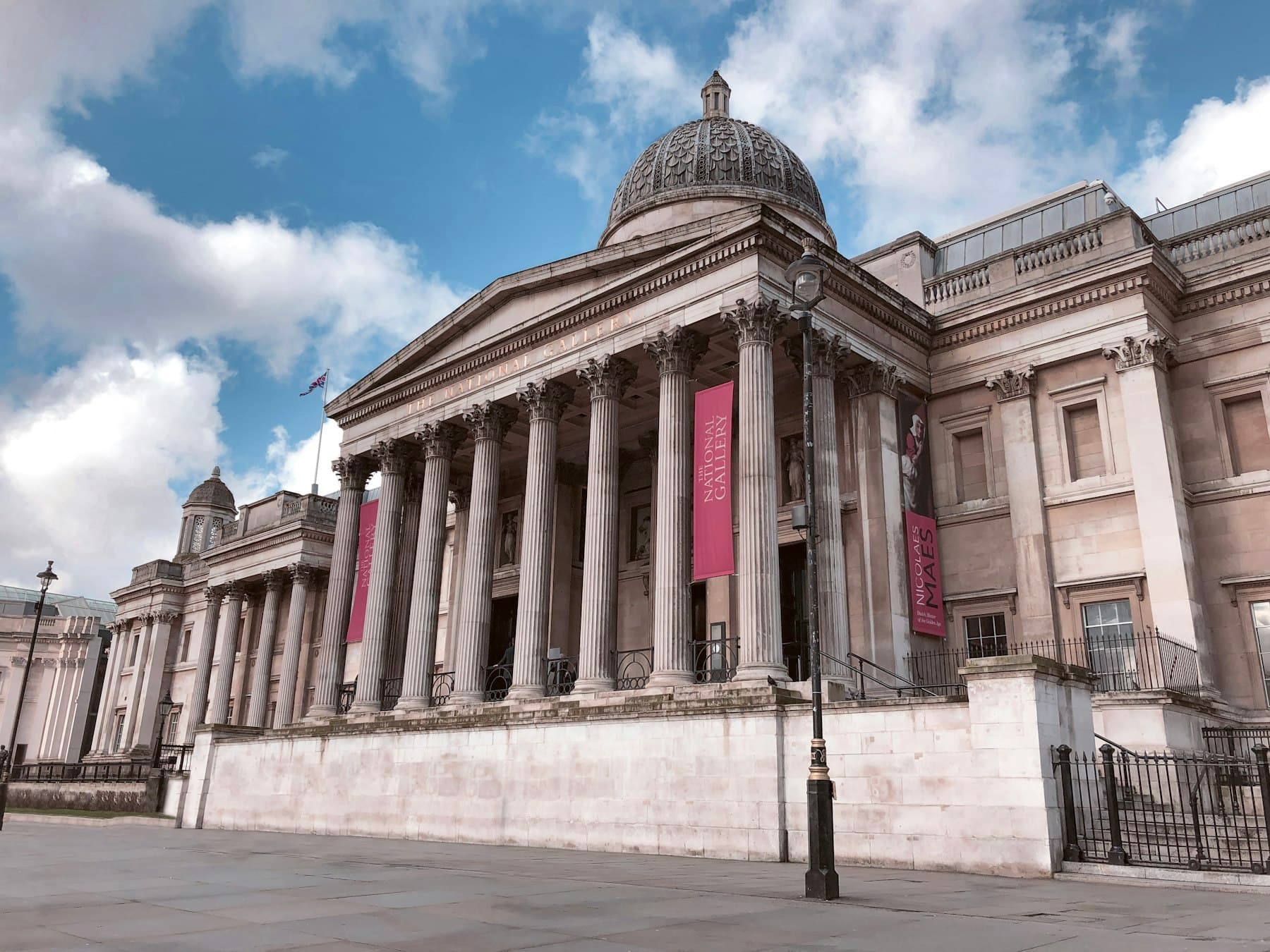
Plan about two hours for the highlights of the National Gallery in London. Start in the Sainsbury Wing with Leonardo's Virgin of the Rocks and Van Eyck's Arnolfini Portrait, then cross to the main building for Holbein's Ambassadors and Velázquez's Rokeby Venus. Finish on the east side with Stubbs's Whistlejacket, Turner's Fighting Temeraire, Van Gogh's Chair and Monet's Water-Lily Pond. Entry to the collection is free.
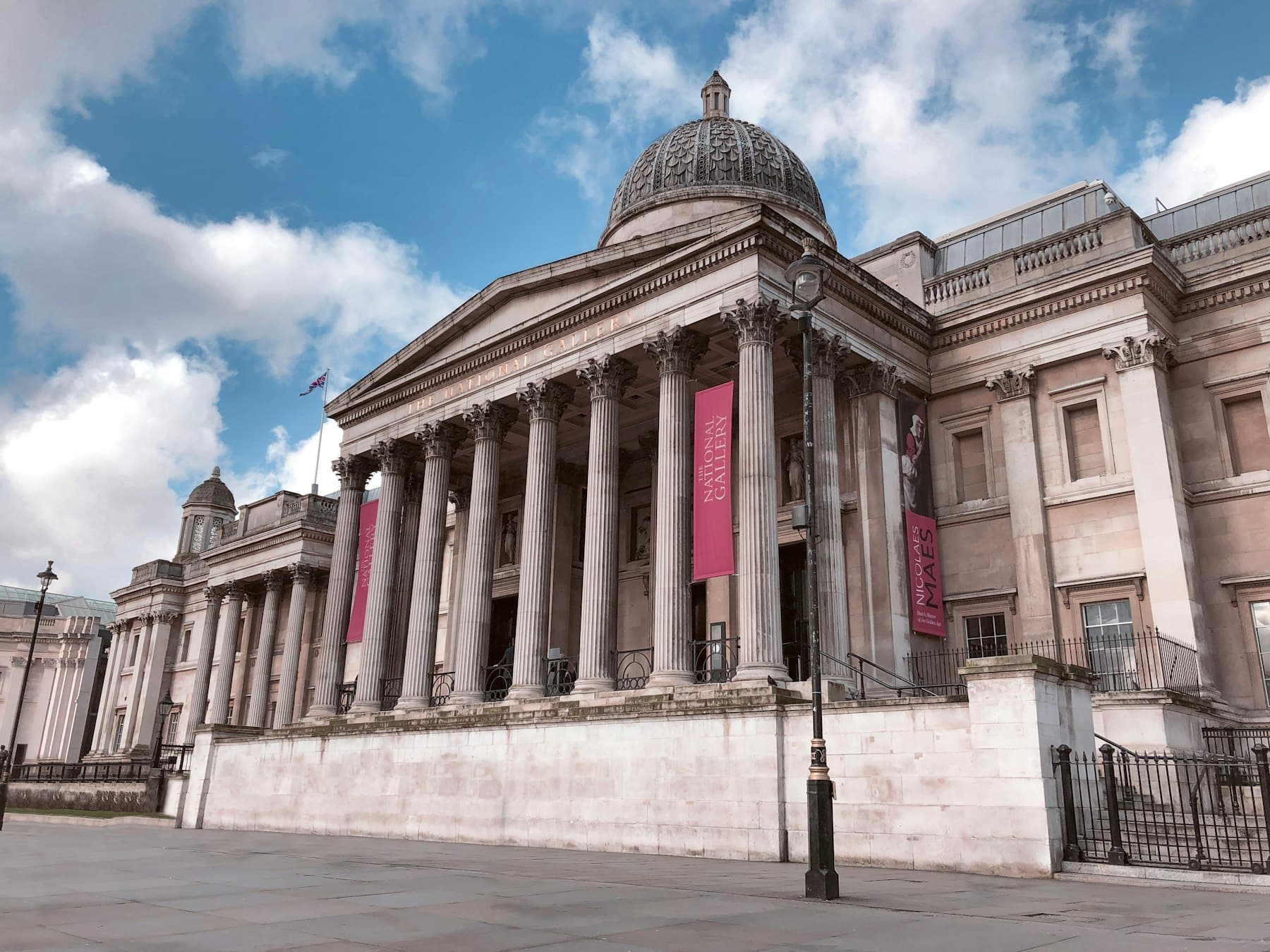
The National Gallery stands on the north side of Trafalgar Square, and it is one of the easiest great museums in the world to plan, because of a single fact: everything on show hangs on one floor, in time order. Walk from west to east and you walk from gold-backed altarpieces of the 1300s to Monet's lily pond. How long does it take? Plan about two hours for the highlights. Entry to the collection is free; some exhibitions charge.
How the gallery began
The collection started small. In 1824 the British government bought thirty-eight paintings from the heirs of the banker John Julius Angerstein, and they went on show in his old house on Pall Mall. Hogarth's six-part satire Marriage A-la-Mode was among them, and all six scenes still hang together in Room 34. The building you see from the square, with its portico and dome, opened in 1838. The Sainsbury Wing, designed by Robert Venturi and Denise Scott Brown, was added to the west across Jubilee Walk in 1991.
The way in is the Sainsbury Wing, on the Trafalgar Square corner by Pall Mall and Whitcomb Street. Bags are checked there, and the stairs take you straight up to the oldest paintings. That makes the order of a visit almost automatic: start old, walk east, get newer.
The building, period by period
Hear a stop from this walk
Victoria Tower Gardens: Pankhurst at Parliament's Door
The gallery's own map divides the main floor into five stretches. Room numbers are the easiest way to find your way: they are on the map and above the doorways.
Medieval and Early Renaissance: the Sainsbury Wing, Rooms 51 to 66
At the top of the stairs, Room 51 works as a sampler of what painting could do. It holds Leonardo da Vinci's Virgin of the Rocks, nearly two metres tall. It is his second version of the picture; the first is in the Louvre. Conservators found that he left it unfinished when he fled Milan in 1499 and came back to it in 1506. In the same room is the Wilton Diptych, two small hinged panels made for the private prayers of King Richard II around the late 1390s. Look at the angels: they wear Richard's own badge, a white hart. Next door, Room 51a holds a single drawing, Leonardo's Burlington House Cartoon, which a man fired a shotgun at in 1987.
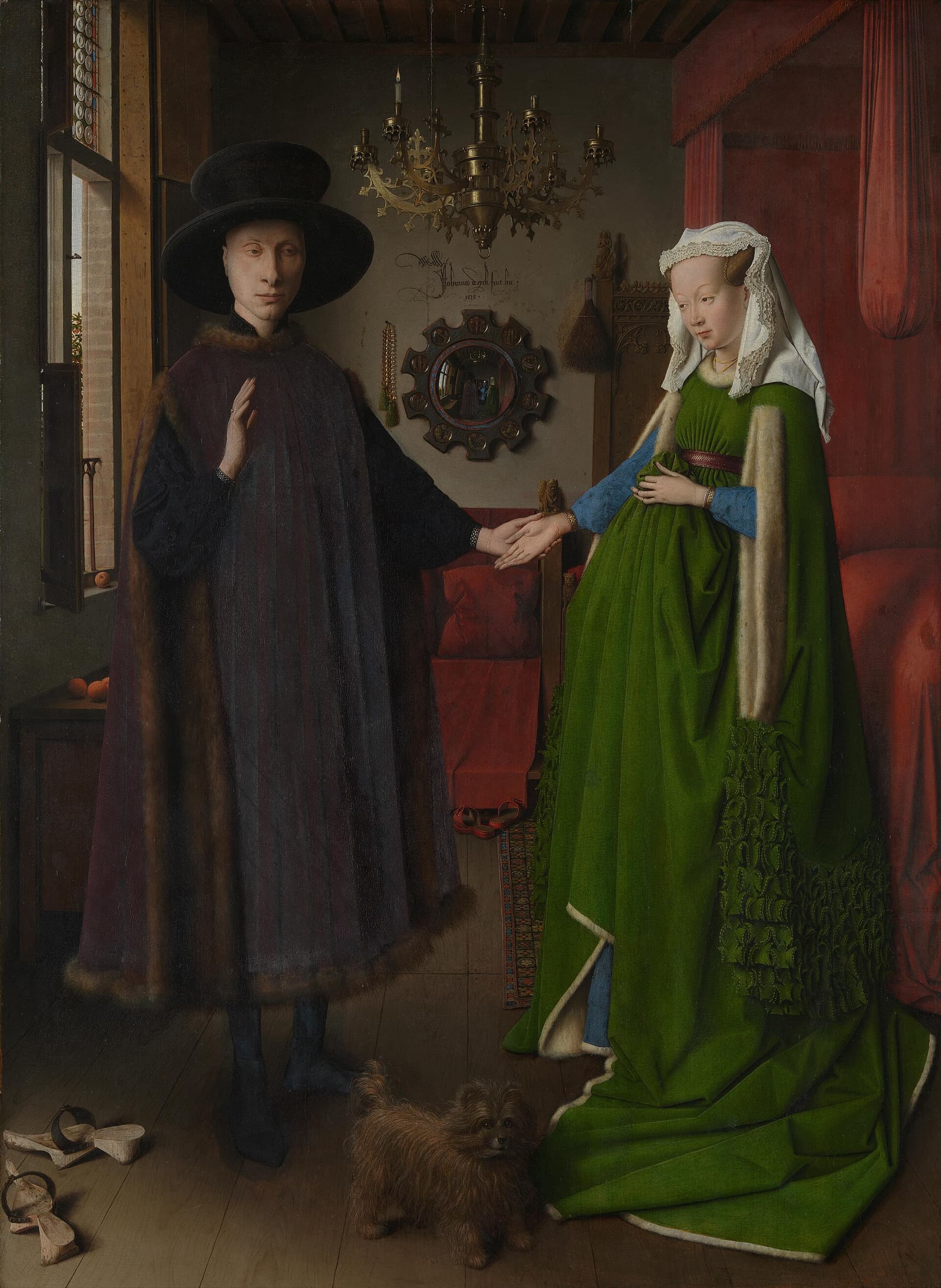
Room 52 is where oil paint learned to fool the eye, with Jan van Eyck's Arnolfini Portrait and its round mirror. Room 54 has Quinten Massys's Ugly Duchess, a satire of old people who dress as if they were young, thought to be a source for John Tenniel's Duchess in Alice's Adventures in Wonderland.
Further in, Room 62 is the Florentine family palace room. Botticelli's Venus and Mars shows the god of war asleep while little satyrs steal his armour and blow a conch shell into his ear. Opposite is Paolo Uccello's Battle of San Romano, where the broken lances on the ground are laid out in a neat grid, an early experiment with perspective. The wing ends in Room 66 with Piero della Francesca's Baptism of Christ, his earliest surviving work, so still that the river seems to stop at Christ's feet.
Renaissance: Rooms 2 to 14
A link from the Sainsbury Wing brings you into the main building and the 1500s. The star is in Room 4: Hans Holbein's The Ambassadors, with the stretched skull across the floor that only snaps into shape from one side. Holbein's full-length portrait of Christina of Denmark, painted for Henry VIII when he was looking for a new wife, hangs in the same room.
Room 2 is about power and patronage in Florence and Rome. Here is Bronzino's Allegory with Venus and Cupid, a cold, enamel-bright puzzle probably sent as a gift to King Francis I of France, and Michelangelo's unfinished Entombment, with an empty space where the Virgin was never painted. Raphael's portrait of Pope Julius II shows the warrior pope tired and bearded. He grew the beard in 1510 and shaved it in 1512, which dates the picture to those months. Rooms 10, 11 and 14 belong to Venice: Titian, Veronese and Tintoretto, ending with Titian's late, loosely painted Death of Actaeon, which a public appeal kept in Britain in 1972.
Baroque: Rooms 15 to 32
North of the Renaissance rooms comes the 1600s. Room 19 is Spanish painting, and the reason most people come is Velázquez's Rokeby Venus, the only female nude by him that survives, slashed by a suffragette in 1914. Room 21 holds Van Dyck's huge portrait of Charles I on horseback, more than three and a half metres high. Room 22 is Rembrandt: Belshazzar's Feast, painted when he was about 30, and the Self Portrait at the Age of 63, one of three he made in the months before he died in 1669.
Room 25 is the most playful room in the building. Vermeer's Young Woman standing at a Virginal looks straight out at you. Carel Fabritius's tiny View of Delft bends its street like a wide-angle lens, and Samuel van Hoogstraten's Peepshow is a painted box you were meant to look into through a hole. Room 32, the Italian Baroque room, holds Caravaggio's Supper at Emmaus, painted in 1601, with a basket of fruit about to topple off the table. Nearby is Artemisia Gentileschi's Self Portrait as Saint Catherine of Alexandria, which the gallery bought in 2018.
Rococo to Romanticism: Rooms 33 to 37 and the Central Hall
The 1700s fill the east side. The Central Hall is lined with full-length portraits from three and a half centuries, ending with Klimt's Hermine Gallia of 1904, which the gallery says is the only Klimt in a British public collection. Room 33 is Venice again, through Canaletto's Stonemason's Yard, a shabby square at sunrise rather than a festival. Room 34 is British painting. George Stubbs's Whistlejacket is a life-size horse on a canvas almost three metres tall, with no rider and no landscape. Hogarth's Marriage A-la-Mode is in the same room. In Room 36, Turner's Dido building Carthage hangs beside Claude, exactly as Turner asked in his will.
Towards Modernism: Rooms 38 to 46
The last stretch carries you past 1800. Room 38 has Paul Delaroche's Execution of Lady Jane Grey, life-size and staged like theatre; it was long thought lost in the Thames flood of 1928, until it turned up in a basement at the Tate in 1973. Goya's Duke of Wellington, stolen from the gallery in 1961 and returned in 1965, hangs there too.
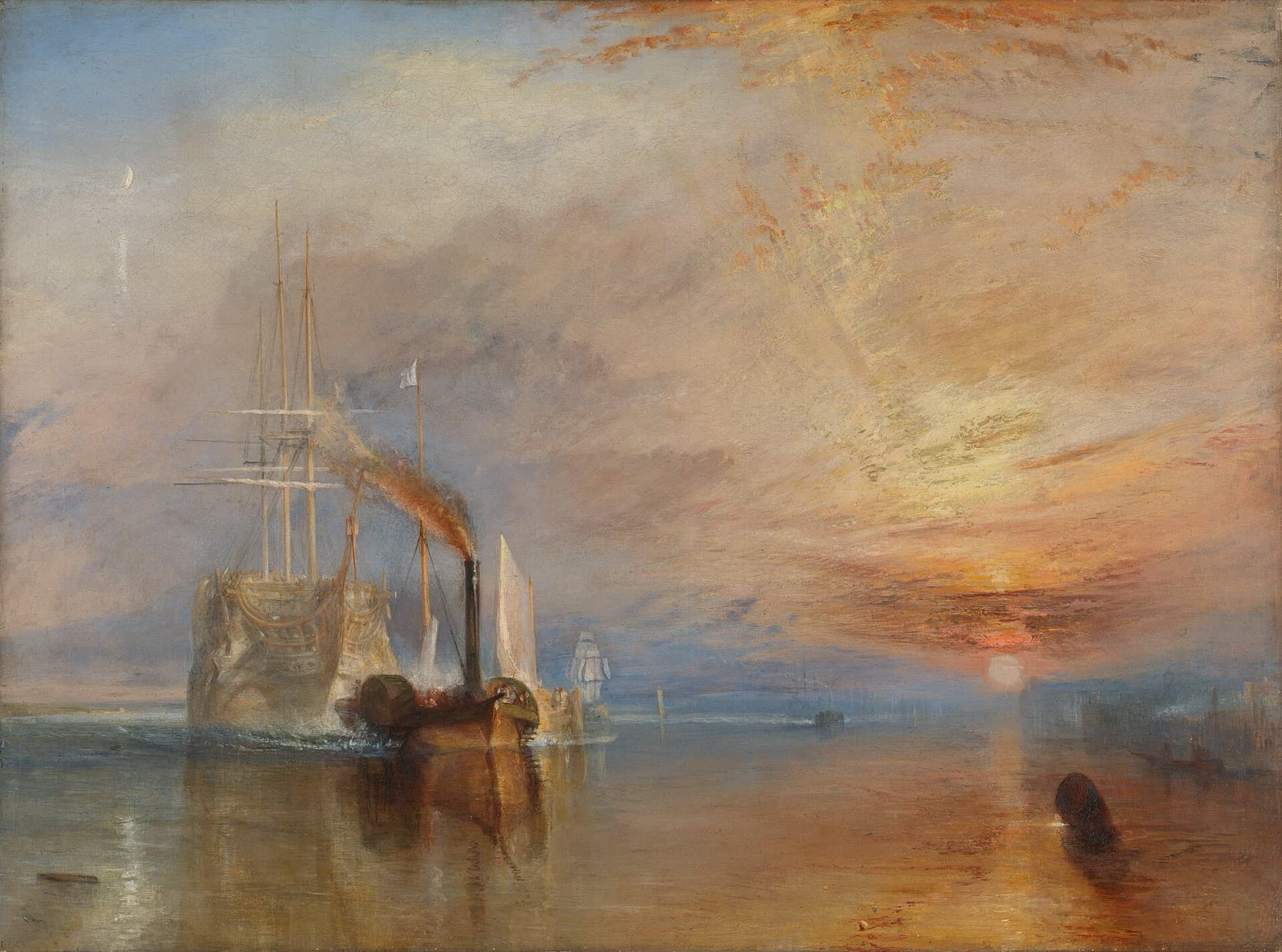
Room 40 is Turner and Constable. It holds Turner's Fighting Temeraire and his Rain, Steam, and Speed, a train crossing Brunel's Maidenhead bridge with a hare, now almost invisible, running ahead of it. Room 41 has Manet's Execution of Maximilian, cut into pieces after his death and reassembled from fragments that Degas collected. In Room 43 is Van Gogh's Chair, painted in Arles in 1888 as one of a pair with Gauguin's chair, now in Amsterdam. Room 44 has Seurat's Bathers at Asnières, his first major painting, rejected by the Salon. The walk ends in Room 46 with Monet. The Water-Lily Pond of 1899 shows the Japanese bridge he built in his garden at Giverny, cut off at both edges so it seems to float.
What to see in two hours
This is the Roamer guide's two-hour route, seventeen paintings in the order the building hangs them. It keeps backtracking low, with one loop through the Central Hall.
- Sainsbury Wing (35 minutes). Leonardo's Virgin of the Rocks (Room 51), the Arnolfini Portrait (52), the Ugly Duchess (54), Uccello's battle (62) and Piero's Baptism (66).
- Renaissance (20 minutes). Take the link to the main building for The Ambassadors (Room 4) and Bronzino's allegory next door (Room 2).
- Baroque north (25 minutes). The Rokeby Venus (Room 19), Rembrandt at 63 (Room 22) and Vermeer (Room 25).
- Back through the Central Hall (20 minutes). Lady Jane Grey (Room 38), Caravaggio's Supper at Emmaus (Room 32) and Whistlejacket (Room 34).
- The modern end (20 minutes). Van Gogh's Chair (Room 43), Seurat's bathers (Room 44), the Fighting Temeraire (Room 40) and Monet's lily pond (Room 46).
Skip anything that does not hold you. The minutes are a guide, not a timetable.
Five ready-made routes
The Roamer guide also groups the gallery into short themed routes. Each one works as a plan on its own.
The National Gallery in an Hour. Eight paintings, the most famous on each stretch of the building: the Virgin of the Rocks, the Arnolfini Portrait, Venus and Mars, The Ambassadors, the Rokeby Venus, Whistlejacket, the Fighting Temeraire and Monet's Water-Lily Pond. If your question is which paintings you must see, this is the answer.
The National Gallery in Two Hours. The seventeen-painting plan above.
Tricks of the Eye. About 45 minutes and six paintings that play games with your eyes: the Arnolfini mirror that shows two people you would otherwise never see, Uccello's battlefield laid out like graph paper, the Ambassadors skull, the blurred face in the Rokeby Venus's mirror, and the two Room 25 oddities, Van Hoogstraten's peepshow box and Fabritius's bulging street in Delft.
Women at the Easel. About 45 minutes, five paintings by four women, from the 1610s to the 1780s. Elisabeth Vigée Le Brun's Self Portrait in a Straw Hat (Room 15), Judith Leyster's mischievous Boy and a Girl with a Cat and an Eel (Room 23), Rachel Ruysch's Flowers in a Vase, painted when she was about 21 (Room 28), Artemisia Gentileschi as Saint Catherine (Room 32), and Vigée Le Brun again with her portrait of a little girl, Alexandrine-Emilie Brongniart (Room 35).
Attacked, Stolen, Rescued. About an hour and seven paintings that were shot at, stolen, slashed or cut apart, and survived. Leonardo's cartoon (Room 51a) was hit by a shotgun blast in 1987. Uccello's Saint George and the Dragon (Room 62) was taken by the Nazis in 1939, and a Cranach in Room 64 once belonged to Hitler. Poussin's Adoration of the Golden Calf (Room 29) was sprayed with paint in 2011. Then come the Rokeby Venus (Room 19), the stolen Goya (Room 38) and the reassembled Manet (Room 41).
What is away in October 2026
Paintings travel and rooms close for maintenance, so check the gallery's floorplan on the day. In October 2026 three famous works were not on the walls:
- Van Gogh's Sunflowers was on loan to the Philadelphia Museum of Art.
- Constable's The Hay Wain was listed as not on display.
- Gainsborough's Mr and Mrs Andrews was listed as not on display.
Van Gogh's Chair, Whistlejacket and Constable's Cornfield in Room 40 make good company in the meantime.
Tips for the visit
- Start at the top of the Sainsbury Wing stairs and walk east. The hang follows time, so the order takes care of itself.
- Stand back first, then go close. Many of these paintings work at two distances: the Ambassadors skull from the side, the Arnolfini mirror from a few centimetres, Whistlejacket from across the room.
- Do not try to finish. Pick one route and let the rest be a reason to come back. Entry is free, so a second visit costs nothing.
- If you have time after, Roamer's Covent Garden and Soho walk starts outside on Trafalgar Square.
How this fits the Roamer guide
Roamer has an independent audio guide to the National Gallery that works room by room. Open any room and play its story, or follow one of the five routes above with directions from room to room. There is no group and no schedule, and every story is short enough to skip. You can find it here: the National Gallery guide.
Cover photo: Lucia Hatalova on Unsplash.
Ready to experience it?
Westminster: The Rebels at Parliament's Gates
90 min · 2.9 km · easy
More from London
Explore more at your own pace.
British Museum: What to See, Floor by Floor
The Arnolfini Portrait: The Mirror, the Meaning and the Myths
The Fighting Temeraire: Turner's Last Voyage of a Trafalgar Ship
The Lewis Chessmen: Kings, Queens and Berserkers in Room 40
The Parthenon Sculptures: What Is in Room 18 and How It Got There