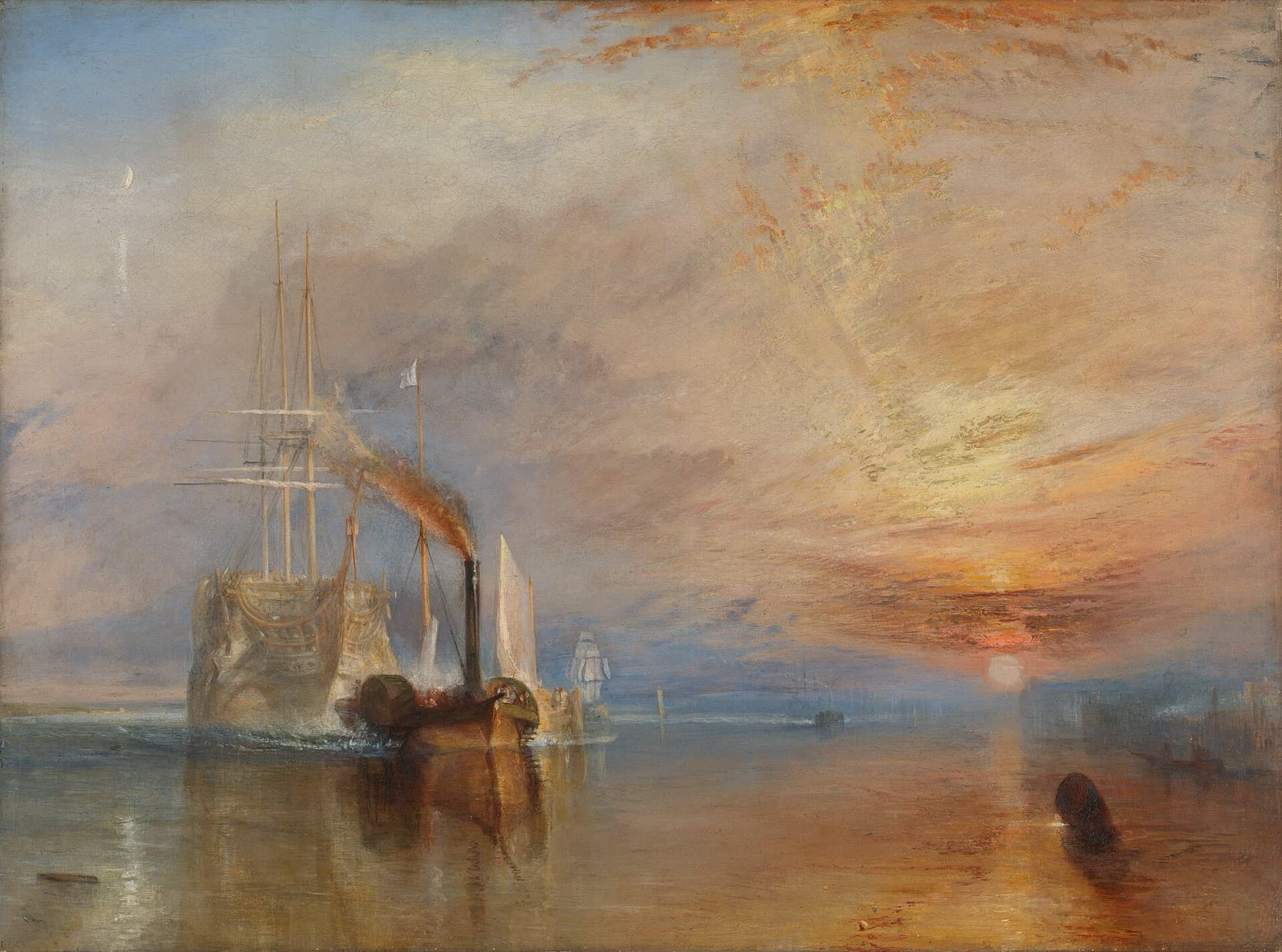
The Fighting Temeraire is an 1839 oil painting by J. M. W. Turner. It shows HMS Temeraire, a 98-gun warship that fought at Trafalgar in 1805, being towed by a steam tug up the Thames to Rotherhithe in 1838 to be broken up. Turner changed the scene for effect, called the painting his Darling and kept it until he died. It hangs in Room 40 of the National Gallery, London.
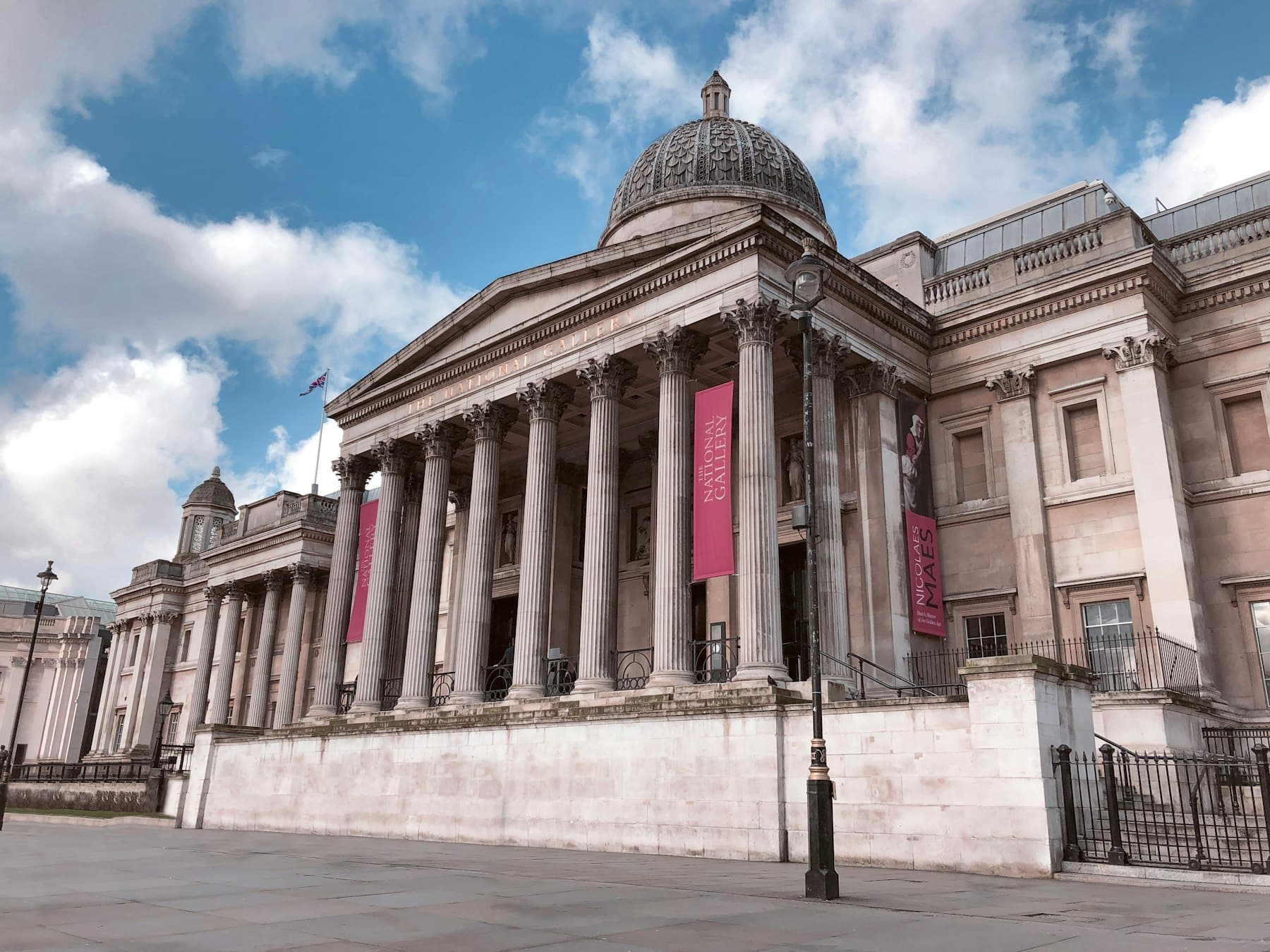
If you are asking where The Fighting Temeraire is: it hangs in Room 40 of the National Gallery in London, beside Turner's Rain, Steam, and Speed. It came to the gallery in 1856 with the Turner Bequest, and it has been in the national collection ever since.
If you are asking what it shows: an old warship, pale and ghostly, being towed up the River Thames by a small, dark steam tug, under a huge sunset. The ship is the Temeraire, which fought at the Battle of Trafalgar in 1805. In 1838 she was on her way to a shipbreaker's yard at Rotherhithe to be taken apart for her timber. Turner's full title says it plainly: The Fighting Temeraire tugged to her last berth to be broken up, 1838.
The real ship
HMS Temeraire was launched at Chatham Dockyard in 1798. She was a three-decker with 98 guns, and the gallery says she was built from the wood of more than five thousand oaks.
At Trafalgar, on 21 October 1805, she sailed directly behind Nelson's flagship, HMS Victory, and fought to defend her. During the battle she took on two French ships, the Redoutable and the Fougueux. Wikipedia notes that her crew called her the "Saucy" Temeraire; the "Fighting" is Turner's.
After the wars she was put to quieter work. From 1820 she was moored off Sheerness in Kent, mostly as a supply ship. In June 1838 the Admiralty ordered her sold. She was over forty years old and worth little more than her timbers. John Beatson, a shipbreaker and timber merchant at Rotherhithe, bought her for £5,530. The navy first stripped out anything useful, including her masts.
Two paddle-wheel steam tugs towed her from Sheerness up the Thames. The trip took about two days, and she reached Beatson's wharf on 6 September 1838.
What Turner changed
Hear a stop from this walk
Victoria Tower Gardens: Pankhurst at Parliament's Door
Turner probably did not see the tow. The gallery thinks it unlikely, and says he worked from reports. What he made is not a record but a reimagining, and the changes are where the meaning lies.
The colours of the ship. The real Temeraire was painted black and yellow. Turner made her white and gold, so she glows like a ghost against the darker water.
The masts. By the time of the tow her masts had been removed. Turner gives her three lower masts with the sails furled, which, the gallery suggests, keeps her dignity.
The tug. There were two tugs. Turner shows one pulling the ship, with the second only just visible in the distance. He also moved the tug's black funnel in front of its mast, so its smoke streams back across the old ship. The gallery reads it as a deliberate change: steam power taking over from sail. The gallery adds that Turner was furious when a later engraving "corrected" the tug.
The sunset. A ship heading up the Thames to London is travelling west, so the sun could not be setting behind her. Turner put the blazing sunset on the right anyway, where it fills about a third of the canvas, with copper clouds around a white sun. The placement started an argument in The Times. A pale crescent moon rises at the top left, so the picture holds sun and moon, an end and a beginning, at once.
What it means
The usual reading is the one Turner seems to have built in: day is ending, and so is the age of sail. A great wooden warship, a symbol of national pride, is being hauled to her death by a small machine that runs on coal. The gallery calls it a memorial to the ship's heroic past as well as a record of her last journey.
Careful, though, about reading it as a protest against steam. The gallery points out that Turner was not simply against modern industry. He painted modern life, and he travelled regularly on steamships and on the new railways. Five years later he painted Rain, Steam, and Speed, a train charging across a bridge, which hangs in the same room. The Fighting Temeraire is a farewell, not a complaint.
When it was shown at the Royal Academy in 1839, Turner paired it with lines adapted from Thomas Campbell's poem Ye Mariners of England, saying the flag was no longer hers. Reviewers loved it. William Makepeace Thackeray, writing about the exhibition, called it about as grand a picture as had ever hung on an academy wall.
His Darling
Turner never sold it. He kept the painting he called his "Darling" in his own possession, despite offers to buy it, until he died in 1851. It came to the National Gallery with the rest of the Turner Bequest in 1856, after years of argument over his will, and it was among the first of his bequeathed pictures to go on show.
Its fame has only grown. In 2005 a national poll run by BBC Radio 4's Today programme voted it the greatest painting in Britain. In 2012 it played a part in the James Bond film Skyfall, where it stands for Bond's own age and place in MI6. And since 2020 it has appeared on the Bank of England's £20 note, behind Turner's own self-portrait.
Seeing it in the gallery
The canvas is about 91 by 122 centimetres. It hangs in Room 40, where Turner and Constable share the walls. Both set out to paint the truth of weather and light, and they went about it in completely different ways. Stand back first and let the two halves of the picture work on you: the cool ship on the left, the burning sky on the right. Then go close to the tug and its smoke, and find the crescent moon.
The painting is on the Roamer guide's one-hour and two-hour routes. For the rest of the building, read what to see at the National Gallery. If you want more stories from the same routes, read about the mirror in the Arnolfini Portrait, the skull in The Ambassadors and the 1914 attack on the Rokeby Venus.
How this fits the Roamer guide
Roamer's independent audio guide to the National Gallery has a short story for The Fighting Temeraire in Room 40, and one for Rain, Steam, and Speed beside it. Listen in front of the painting, at your own pace, with no group to keep up with. You can find it in the National Gallery guide.
Cover image: J. M. W. Turner, The Fighting Temeraire, 1839, National Gallery, London (NG524), public domain, via Wikimedia Commons.

Ready to experience it?
Westminster: The Rebels at Parliament's Gates
90 min · 2.9 km · easy
More from London
Explore more at your own pace.
British Museum: What to See, Floor by Floor
The Arnolfini Portrait: The Mirror, the Meaning and the Myths
The Lewis Chessmen: Kings, Queens and Berserkers in Room 40
The Parthenon Sculptures: What Is in Room 18 and How It Got There
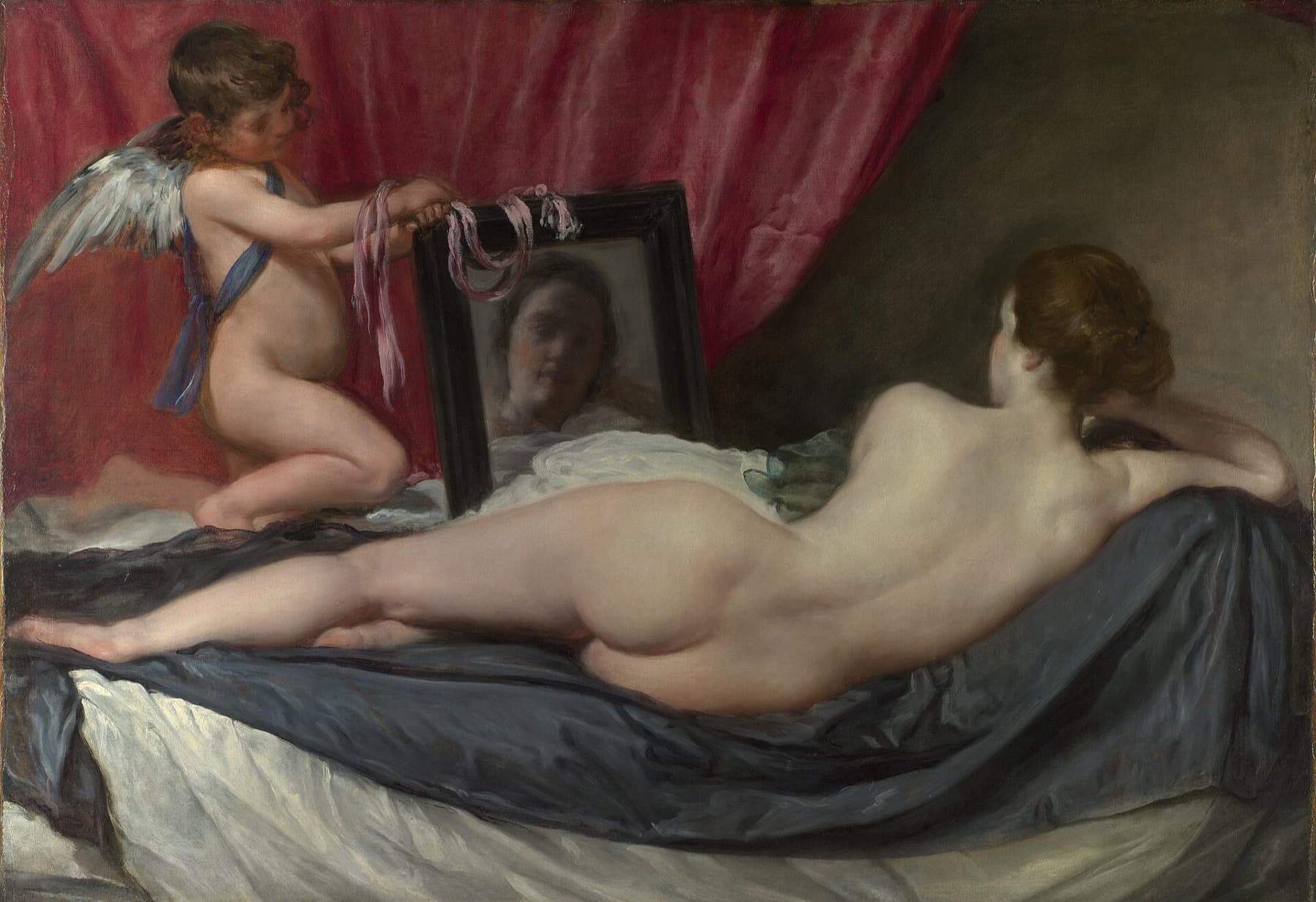
The Rokeby Venus: Velázquez's Mirror and the 1914 Attack