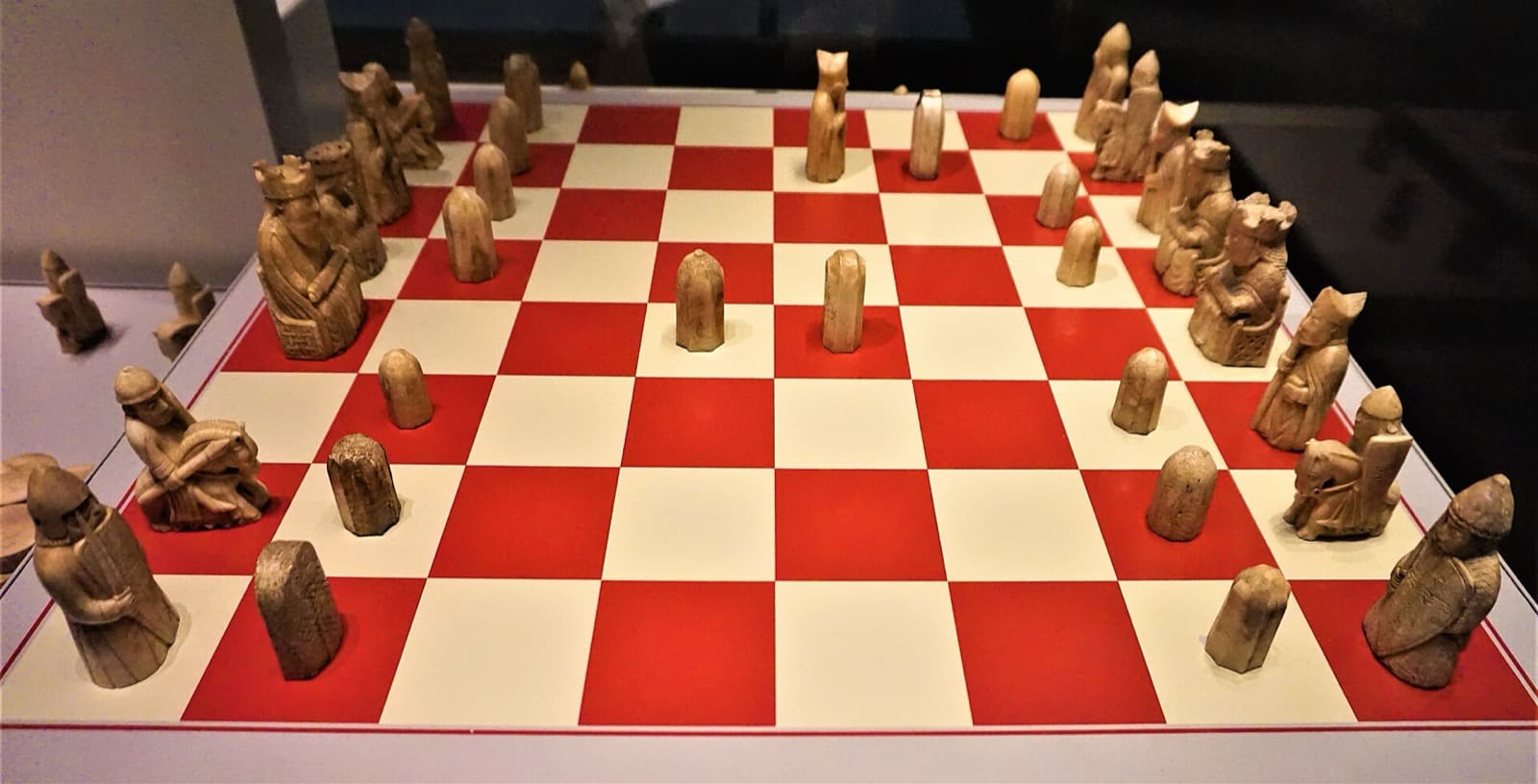
The Lewis Chessmen are medieval chess pieces carved mostly from walrus ivory between about 1150 and 1200, probably in Norway. They were found on the Isle of Lewis in Scotland in 1831. The British Museum owns 82 pieces and shows them in Room 40, Medieval Europe, on the upper floor; 11 more are in the National Museum of Scotland in Edinburgh.
Upstairs in the British Museum, in Room 40, Medieval Europe, a case holds a crowd of small, pale figures with wide, staring eyes and very serious expressions. These are the Lewis Chessmen, among the best known objects in the museum.
What you are looking at
Most of the pieces are carved from walrus ivory, and a few from whale teeth. They were made between about 1150 and 1200, probably in Norway, and every type of chess piece is here.
The kings sit on carved thrones with their swords across their knees.
The queens sit too, each resting her right hand on her cheek. It is the pose people remember.
Then come the bishops and the knights.
The warders, which do the job of our rooks, are foot soldiers with helmets, swords and shields. Look for the ones biting their shields. They are shown as berserkers, warriors in a battle fury.
The pawns are simple slabs, and they are a clue. There are 19 of them, in very different sizes, which suggests the pieces come from several sets rather than one.
Found on Lewis, 1831
Hear a stop from this walk
Victoria Tower Gardens: Pankhurst at Parliament's Door
The pieces were found in 1831 in the parish of Uig, on the west coast of the Isle of Lewis, in the Outer Hebrides off the west coast of Scotland. Most accounts place the find at Uig Bay, though some researchers argue for a site called Mealista, about ten kilometres further south in the same parish. Early accounts name no finder; the name Malcolm MacLeod first appears in 1863.
The hoard held 78 chess pieces, 14 tablemen and a belt buckle. It was soon split up. The British Museum bought 82 pieces from T. A. Forrest for 80 guineas, on the initiative of Frederic Madden, who published a paper on them in 1832. Eleven others ended up in what is now the National Museum of Scotland in Edinburgh.
Should they go home?
In 2007, Scottish National Party politicians in the Western Isles called for the pieces to return to where they were found. The UK culture minister of the time, Margaret Hodge, rejected the idea. Bonnie Greer, then the museum's deputy chairman, said she believed the main collection should stay in London.
Since 2015, six of the British Museum's pieces have been on long-term loan to Museum nan Eilean, a museum on Lewis itself.
A trip to Normandy
The chessmen are also part of a bigger exchange. Under the agreement signed in July 2025 that brought the Bayeux Tapestry to the British Museum, the museum said it would lend a selection of the Lewis Chessmen, along with the Sutton Hoo treasures and other pieces, to France. In June 2026 the French Ministry of Culture named museums in Rouen and Caen as the hosts. When we checked in October 2026, no dates for the chessmen's loan had been published, so if you are travelling to see them, check the museum's website before you go.
What to look for
The queen's hand. Find a queen resting her right hand on her cheek, and the king beside her with his sword across his knees.
A berserker. Among the warders, find a soldier with his teeth on the rim of his shield.
The pawn sizes. Line up the pawns in your head, tallest to smallest, and you can see why the experts think this was more than one set.
Nearby in the same room are two more of the museum's medieval treasures: the Royal Gold Cup, solid gold with scenes in translucent red enamel, made for the French royal family around 1370 to 1380, and the Dunstable Swan Jewel, a gold and white enamel badge only about three and a half centimetres tall.
The Lewis Chessmen, in short
- What they are: medieval chess pieces of walrus ivory and whale tooth, about 1150 to 1200, probably made in Norway.
- Where they were found: the parish of Uig, Isle of Lewis, Scotland, 1831.
- Who has them: 82 pieces in the British Museum, 11 in the National Museum of Scotland, six of London's on loan to Museum nan Eilean on Lewis.
- Where to see them in London: Room 40, Medieval Europe, on the upper floor.
How this fits the Roamer guide
Roamer's independent audio guide to the British Museum tells the chessmen's story in Room 40, and they are a stop on "The British Museum in Two Hours" route, between the Portland Vase and the Sutton Hoo helmet. You can find it in the British Museum guide. For the rest of the museum, floor by floor, read what to see at the British Museum.
Cover photo: Joyofmuseums, CC BY-SA 4.0, via Wikimedia Commons.

Ready to experience it?
Westminster: The Rebels at Parliament's Gates
90 min · 2.9 km · easy
More from London
Explore more at your own pace.
A Cathedral to Nature: Reading the Natural History Museum Building
British Museum: What to See, Floor by Floor
Hope the Blue Whale: The Story of the Skeleton in Hintze Hall
The Giant Sequoia at the Natural History Museum: 1,341 Years in One Slice
The Parthenon Sculptures: What Is in Room 18 and How It Got There