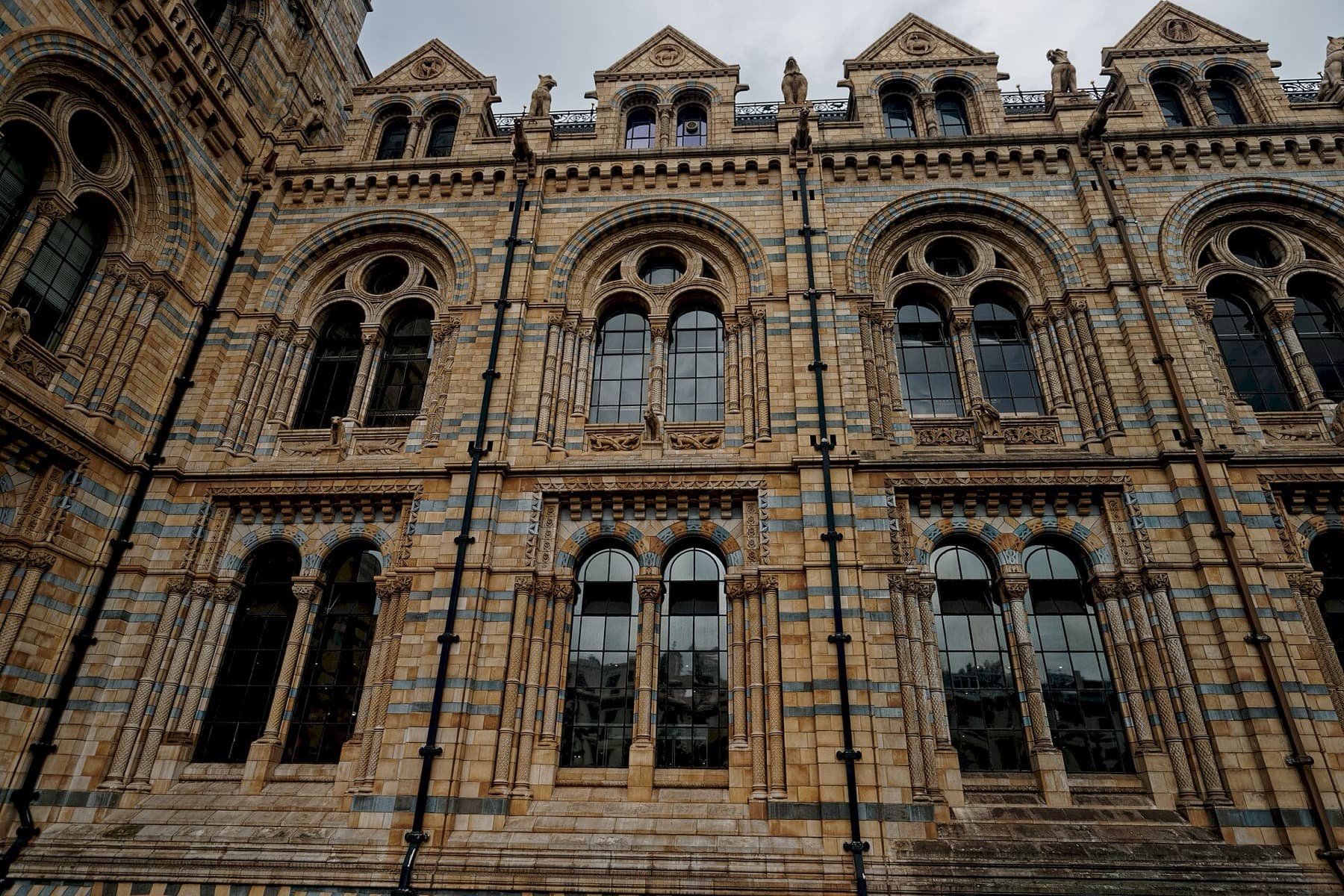
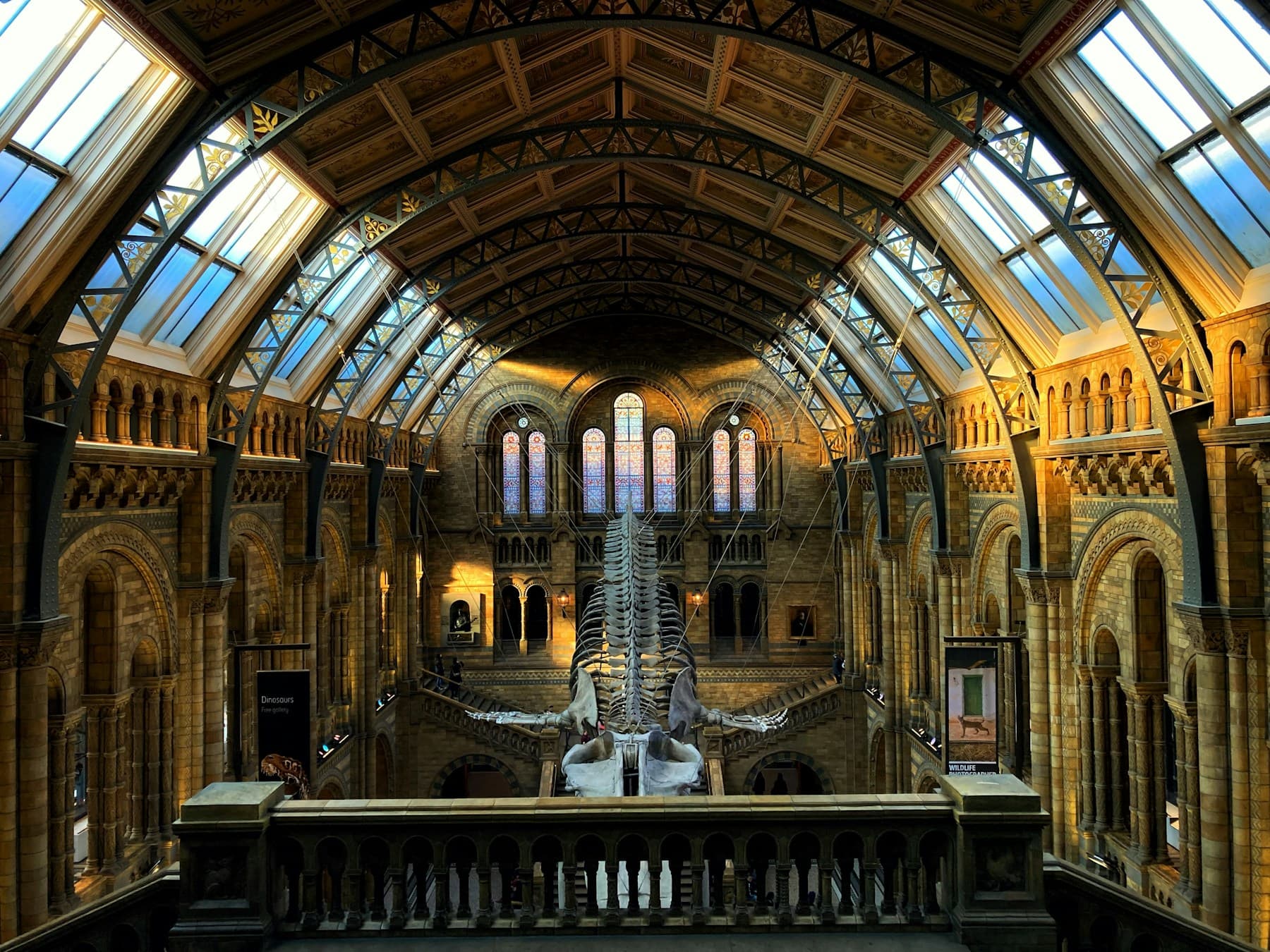
The Natural History Museum building in London was designed by Alfred Waterhouse and opened on 18 April 1881. It mixes Romanesque rounded arches with Gothic Revival ideas, iron and glass, and is clad in moulded terracotta: living species on the west wing, extinct ones on the east. The ceiling of Hintze Hall has 162 hand-painted, gilded panels of plants.
Natural History Museum audio guide
London · 3 floors · stories room by room
The first exhibit at the Natural History Museum is the building itself. Its long front on Cromwell Road, covered in moulded animals and plants, tells you what is inside before you reach the door. Richard Owen, the scientist who fought for it, wanted a cathedral to nature.
How old is the building?
The museum opened to visitors on 18 April 1881, so the building is about 145 years old. Its story starts earlier. In 1859 Richard Owen, superintendent of the natural history collections of the British Museum, sketched a rough plan he called "Idea of a Museum of Natural History." He spent years persuading the British Museum's trustees that the specimens needed a building of their own, and won approval in 1863.
A design competition followed, and in 1864 the contract went to Francis Fowke, who also designed the Royal Albert Hall. Fowke died the next year. Alfred Waterhouse, a Liverpool-born architect then known for Gothic Revival buildings in Manchester, was appointed in his place. Building work began in the 1870s, and Owen retired in 1883 after the collections were installed.
What style is it?
Hear a stop from this walk
Victoria Tower Gardens: Pankhurst at Parliament's Door
Waterhouse mixed the Gothic Revival style he was known for with twelfth-century Romanesque architecture: rounded arches, groin vaults and heavily decorated columns. He paired them with modern iron and glass, so daylight pours into Hintze Hall from the roof.
He did not chase perfect symmetry. The museum says he wanted the building to feel as varied as nature itself, and the patterns on many columns were inspired by the surfaces of fossilised tree trunks. Stand in Hintze Hall and the plan of a church is easy to read: the central hall as a nave, the arched bays down each side like side chapels.
Why terracotta?
The whole building is clad in terracotta, baked clay cast in moulds. Waterhouse had good reasons. In a city black with coal smoke, terracotta was thought more hygienic than stone and better at resisting soot, and it was quicker and cheaper to produce than carved stone.
Making it was a chain of specialists. Owen supplied specimens and drawings of animals and plants. Waterhouse turned them into designs, and the museum's scientists checked them for accuracy. The approved designs went to the modelling firm Farmer and Brindley, and Waterhouse worked closely with a French sculptor, Dujardin, to turn them into models. The pieces were then cast by Gibbs and Canning, a sanitary-pipe factory in Staffordshire. The elaborate figures, like the gargoyles, were cast once each. Simple leafy patterns were cast many times and repeated around the building.
Living on the west, extinct on the east
The decoration carries an argument. Owen insisted that living and extinct species be kept apart, in the displays and on the walls. So the west wing is decorated with living animals, such as wolves and lions, and the east wing with extinct ones, such as a pterosaur and a scimitar-toothed lion. A gargoyle of Palaeotherium, an extinct relative of the horse, guards the eastern side of the front.
The timing is the twist. Just as Owen was setting this division in clay, Charles Darwin's theory of evolution was showing that the living and the extinct are linked in one story. One scholar of Victorian culture, speaking in the museum's own audio guide, describes the building as something like a fossil of a scientific world view.
Above the main entrance once stood a statue of Adam, the figure in Genesis who names the animals. It presided over the creatures of the facade until the Second World War.
The monkeys on the arches
Inside, look closely at the pillars and arches of Hintze Hall. Terracotta monkeys climb up them, one of the details most visitors walk straight past. Animals and plants are moulded along the walls and columns all around you.
The ceiling of Hintze Hall
Look straight up. The ceiling of Hintze Hall is made of 162 hand-painted panels, gilded with gold leaf so the hall seems to glow.
It nearly never happened. The botanical ceiling was cut from the plans to save money and was put back only because Waterhouse insisted. A Manchester firm, Best and Lea, was charged with making the panels, and experts think the artist Charles James Lea scaled up the drawings and painted the plaster panels in place, working from scaffolding.
The plants were chosen for their importance to Britain. Over the main hall, each tree spreads across a block of six panels so it seems to grow towards the roof. Over the landing at the south end, above the main entrance, each panel shows a different plant. Among them are crops that built the empire's economy, such as tobacco, cotton and tea, along with coffee, cacao and opium poppies, native trees like the English oak and the Scots pine, and Banksia, the Australian shrub named after Sir Joseph Banks. Some panels honour people, including Banks, Sir Hans Sloane and Graman Kwasi.
The panels were cleaned and repaired before Hintze Hall reopened in summer 2017, without changing the colour scheme.
Darwin on the stairs
At the north end of Hintze Hall, on the landing of the grand staircase, sits Charles Darwin in white marble, carved by Joseph Edgar Boehm with his long legs crossed and his outdoor cape across his lap. When Darwin died in 1882, his friends started a memorial fund, and more than 650 people contributed. The statue was unveiled on this landing on 9 June 1885.
In 1927 Darwin was moved away and a bronze of Richard Owen took his place. In 2008 Darwin came back, in time for his two-hundredth birthday the following year. The man whose idea the terracotta argued against once again greets everyone who comes into Owen's cathedral.
What to look for
Outside, compare the two ends of the front. Living animals on the west, extinct ones on the east. Look for the Palaeotherium on the east side.
In Hintze Hall, find a monkey. Then look along the columns for the patterns taken from fossil tree bark.
Climb to the balconies. From the first floor the ceiling panels are close enough to read, and from the top balcony at the south end, beside the giant sequoia, you are right under the landing panels where each plant has its own frame.
How this fits the Roamer guide
Roamer's independent audio guide to the Natural History Museum treats the building as an exhibit, with stories for Hintze Hall, its balconies and the Darwin statue. The route "A Cathedral to Nature" follows it in about 45 minutes, from Darwin on the stairs to the ceiling, the terracotta, Archaeopteryx in Treasures and the giant sequoia. You can find it in the Natural History Museum guide. For the rest of the museum, read what to see at the Natural History Museum.
Cover photo: Txllxt TxllxT, CC BY-SA 4.0, via Wikimedia Commons.

Ready to experience it?
Westminster: The Rebels at Parliament's Gates
90 min · 2.9 km · easy
More from London
Explore more at your own pace.
British Museum: What to See, Floor by Floor
Hope the Blue Whale: The Story of the Skeleton in Hintze Hall
The Giant Sequoia at the Natural History Museum: 1,341 Years in One Slice
The Lewis Chessmen: Kings, Queens and Berserkers in Room 40
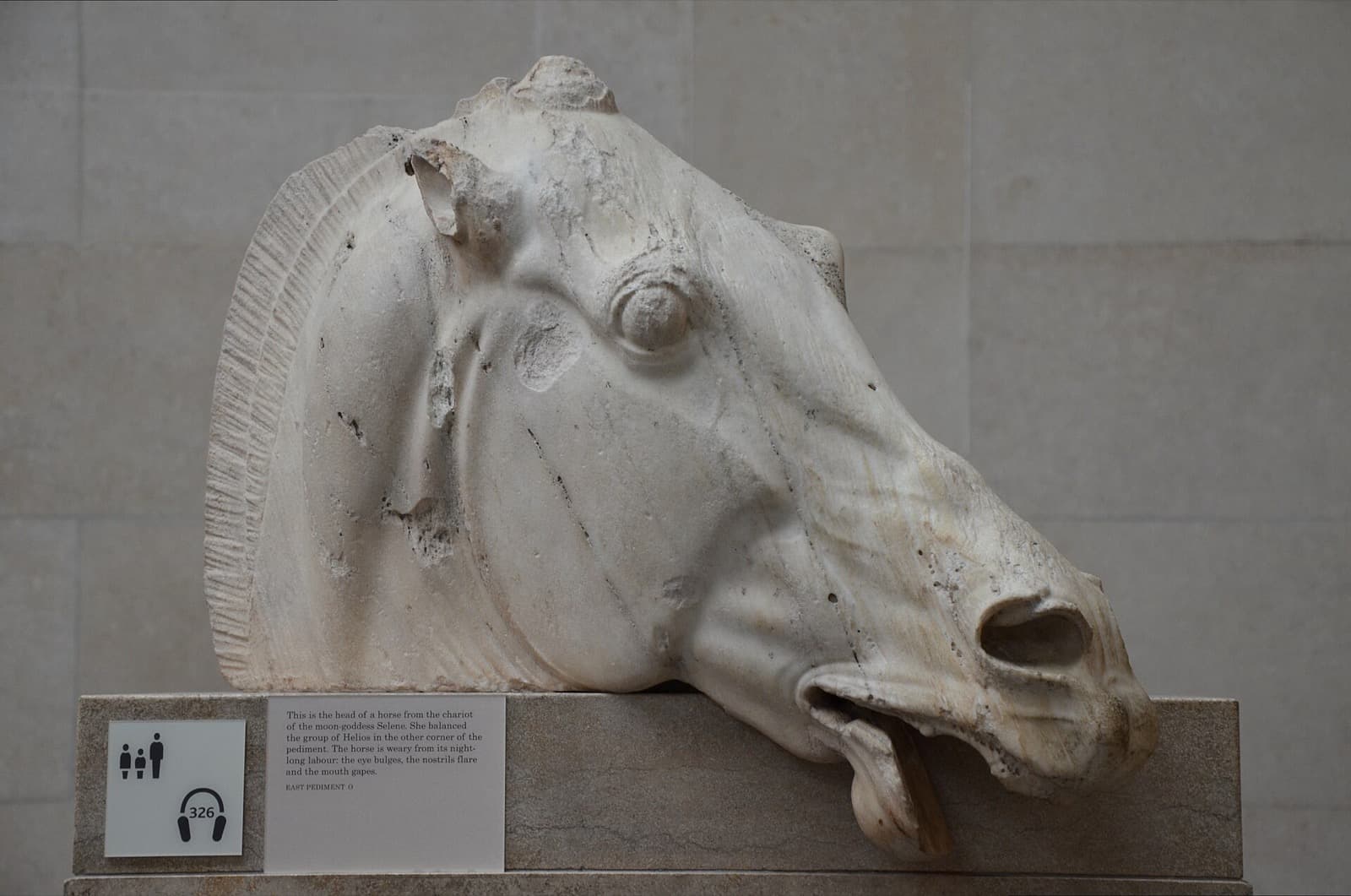
The Parthenon Sculptures: What Is in Room 18 and How It Got There