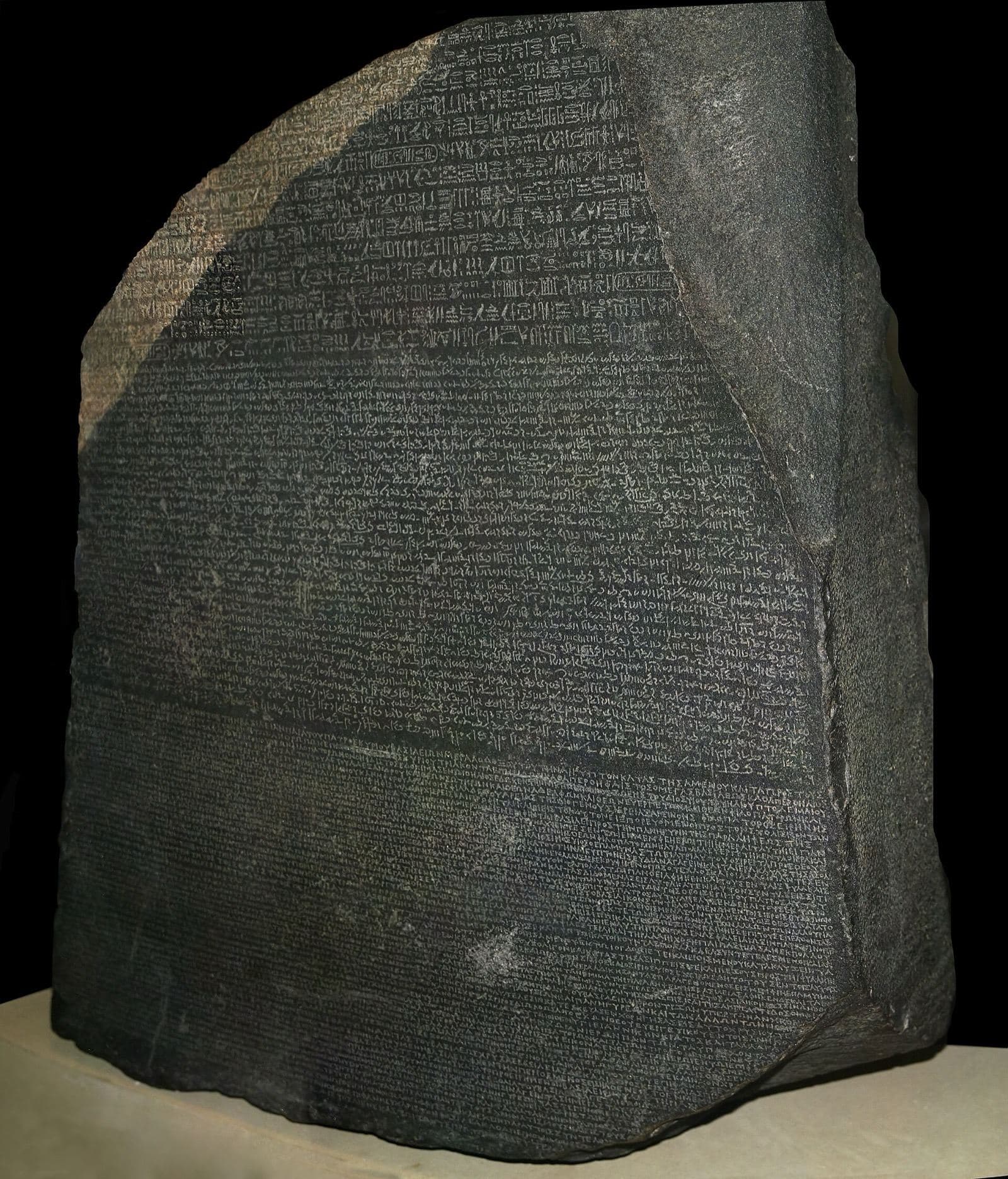
The Rosetta Stone is a broken granodiorite slab carved in 196 BC with one decree in three scripts: hieroglyphs, Demotic and Greek. Because scholars could still read the Greek, it became the key to deciphering hieroglyphs, which Jean-François Champollion announced in 1822. It is on display in Room 4, the Egyptian sculpture gallery on the ground floor of the British Museum.
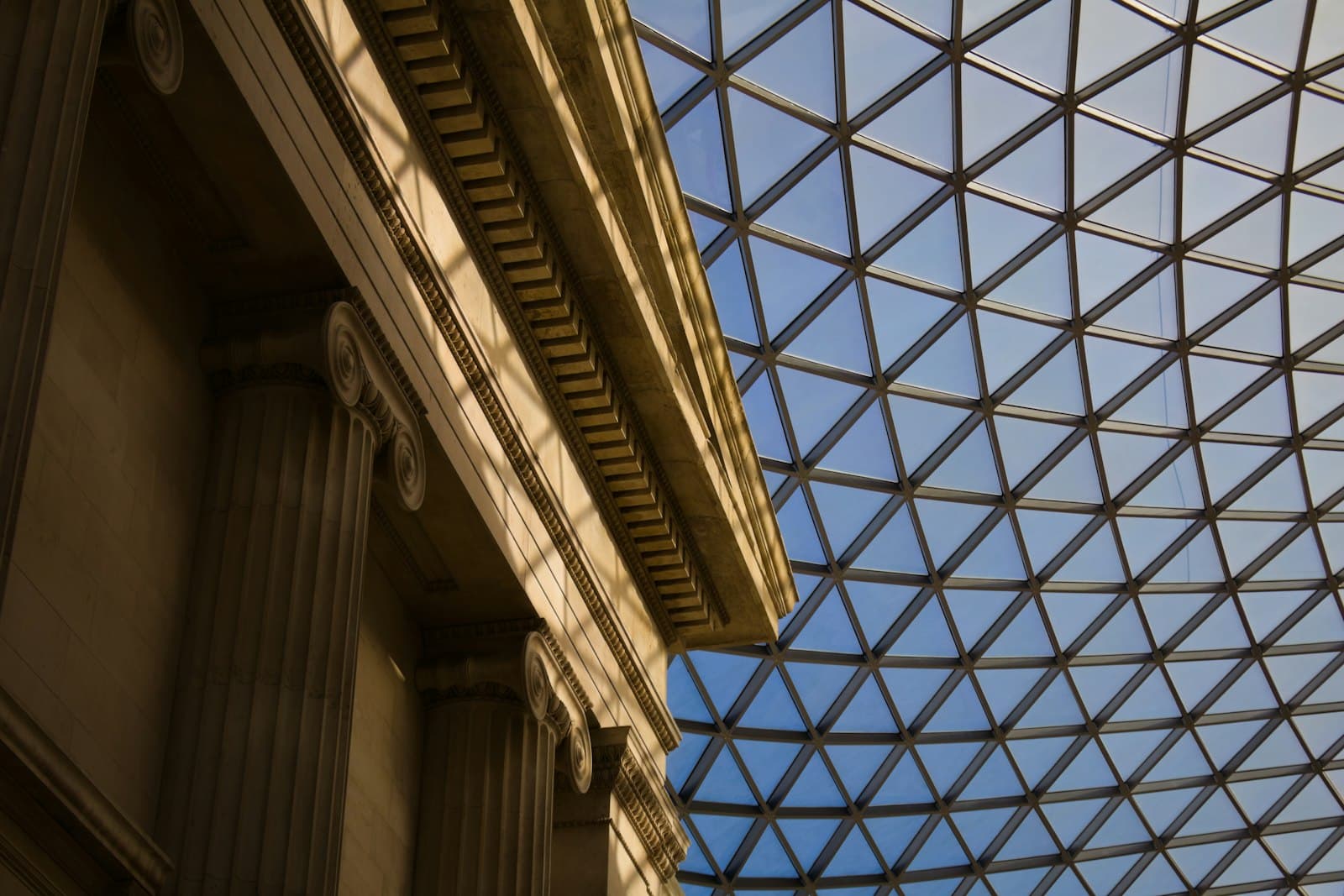
Walk into the British Museum's Great Court, turn into the long gallery of Egyptian sculpture on its west side, and you are in Room 4. The dark slab in the case is the Rosetta Stone, one of the most famous objects in the museum.
It is smaller than many people expect: about 112 centimetres high, 76 wide and 28 thick. And it is broken.
What you are looking at
The Rosetta Stone is a fragment of a taller slab, a kind of stone notice board the Egyptians called a stela. Its top is broken away, and a diagonal break takes off the lower right corner.
Look closely and you will see three bands of writing:
- At the top, 14 lines of hieroglyphs, the sacred picture-signs suited to a priestly decree. Only part of this text survives.
- In the middle, 32 lines of Demotic, the everyday cursive script of Egypt. Its name means "language of the people".
- At the bottom, 54 lines of Greek, the language of the Greek-speaking Macedonian kings who had ruled Egypt since Alexander the Great's conquest.
All three carry the same text. Notice the colour, too. The stone is dark grey granodiorite with a pink vein running through it. For a long time it looked black, because in London it was coated with wax and its letters were filled with white chalk. Both were cleaned off in 1999.
What the decree says
Hear a stop from this walk
Victoria Tower Gardens: Pankhurst at Parliament's Door
The text is a decree passed by a council of priests in 196 BC, on the first anniversary of the coronation of King Ptolemy V, who was 13 years old. The priests, meeting at Memphis, confirmed the young king's status as a divine ruler, even though his family was Macedonian rather than Egyptian.
It is not a one-off. The decree itself says a copy should be set up in every sizeable temple in Egypt, and much of its wording repeats a model composed about a century earlier, with names and dates changed. The museum counts 29 stones carrying decrees like this found across Egypt, starting with this one in 1799, and 22 of them remain in Egypt. Yet it also records real events of Ptolemy V's reign, including a long Egyptian uprising against his family's rule.
What makes this copy special is not the message. It is that the message is written three times.
How it unlocked hieroglyphs
Soon after the end of the 4th century AD, hieroglyphs went out of use, and the knowledge of how to read them was lost for some 1,400 years. When the stone was found, nobody could read them. But scholars could read Greek, so here was the same text with a translation attached.
The English physicist Thomas Young was one of the first to show that some of the hieroglyphs on the stone wrote the sounds of a royal name: Ptolemy. In the hieroglyphs, that name sits inside an oval ring called a cartouche, and you can find it in the Greek, too, as ΠΤΟΛΕΜΑΙΟΣ.
The French scholar Jean-François Champollion went further. He worked out which hieroglyphs were used to spell the names of foreign rulers, and he announced his discovery in Paris, at the Académie des Inscriptions et Belles-Lettres, on Friday 27 September 1822. His English rival Young was in the audience. Champollion then realised that the same sound-signs were used for Egyptian names as well, and with his knowledge of Coptic, the late form of the Egyptian language, he could begin to read hieroglyphic inscriptions in full.
How it came to London
The stone takes its name from Rashid, a port on the Nile Delta that the French called Rosetta. In July 1799, during Napoleon's campaign in Egypt, French soldiers digging the foundations of an addition to a fort near the town found it built into an old wall. The officer in charge, Pierre-François Bouchard, saw that it mattered.
The French did not keep it. When their army in Egypt surrendered in 1801, Article 16 of the Capitulation of Alexandria made the antiquities they had collected public property at the disposal of the generals of the combined British and Ottoman army. The stone was shipped to England, landed at Portsmouth in February 1802, and was presented to the museum by George III that July. The museum's floors were not yet strong enough for it, so it first stood in a temporary shelter in the grounds.
It has been on display ever since, with one break. In 1917, fearing bombing in the First World War, the museum moved it to a station on the Post Office's tube railway, 50 feet below Holborn, where it spent the next two years.
Calls for its return
Egyptian archaeologists have campaigned for the stone to go back to Egypt. Zahi Hawass, a former antiquities minister, called for its return in 2003 and again in 2022. In 2022 two petitions circulated: one started by the archaeologist Monica Hanna, which called it a spoil of war, and one by Hawass that gathered more than 100,000 signatures. In late 2025, after the Grand Egyptian Museum opened, Mohamed Ismail Khaled, secretary-general of Egypt's Supreme Council of Antiquities, told The Telegraph that Egypt wants it back. Press reports described this as stopping short of a formal government demand.
The museum's position is that the 1801 treaty carries the signature of an Ottoman admiral, representing those who ruled Egypt at the time. In 2022 it said Egypt's government had not submitted a request for the stone's return. A law of 1963, the British Museum Act, also bars the trustees from disposing of objects in the collection except in narrow cases.
Where to find it
- Room: Room 4, Egyptian sculpture, on the ground floor. Enter the Great Court from the main entrance and turn left into the gallery on its west side.
- Nearby: in the same gallery, the colossal bust of Ramesses II and the sarcophagus of Nectanebo II, Egypt's last native pharaoh.
- The touchable copy: a replica you are allowed to touch stands in Room 1, Enlightenment, on the east side of the Great Court.
The Rosetta Stone, in short
- What it is: a broken granodiorite stela carved in 196 BC.
- The writing: one decree in hieroglyphs, Demotic and Greek.
- Why it matters: the Greek let Young and Champollion decipher hieroglyphs; Champollion announced his breakthrough in 1822.
- Where it came from: found near Rashid (Rosetta) in 1799, passed to the British under the 1801 surrender, in the museum since 1802.
How this fits the Roamer guide
In Roamer's independent audio guide to the British Museum, the Rosetta Stone has its own story in Room 4, and it is the first stop of four of the guide's five routes, including "The British Museum in an Hour" and "How They Came Here". You can find it in the British Museum guide. For the rest of the museum, floor by floor, read what to see at the British Museum.
Cover photo: Hans Hillewaert, CC BY-SA 4.0, via Wikimedia Commons.

Ready to experience it?
Westminster: The Rebels at Parliament's Gates
90 min · 2.9 km · easy
More from London
Explore more at your own pace.
A Cathedral to Nature: Reading the Natural History Museum Building
British Museum: What to See, Floor by Floor
Hope the Blue Whale: The Story of the Skeleton in Hintze Hall
The Giant Sequoia at the Natural History Museum: 1,341 Years in One Slice
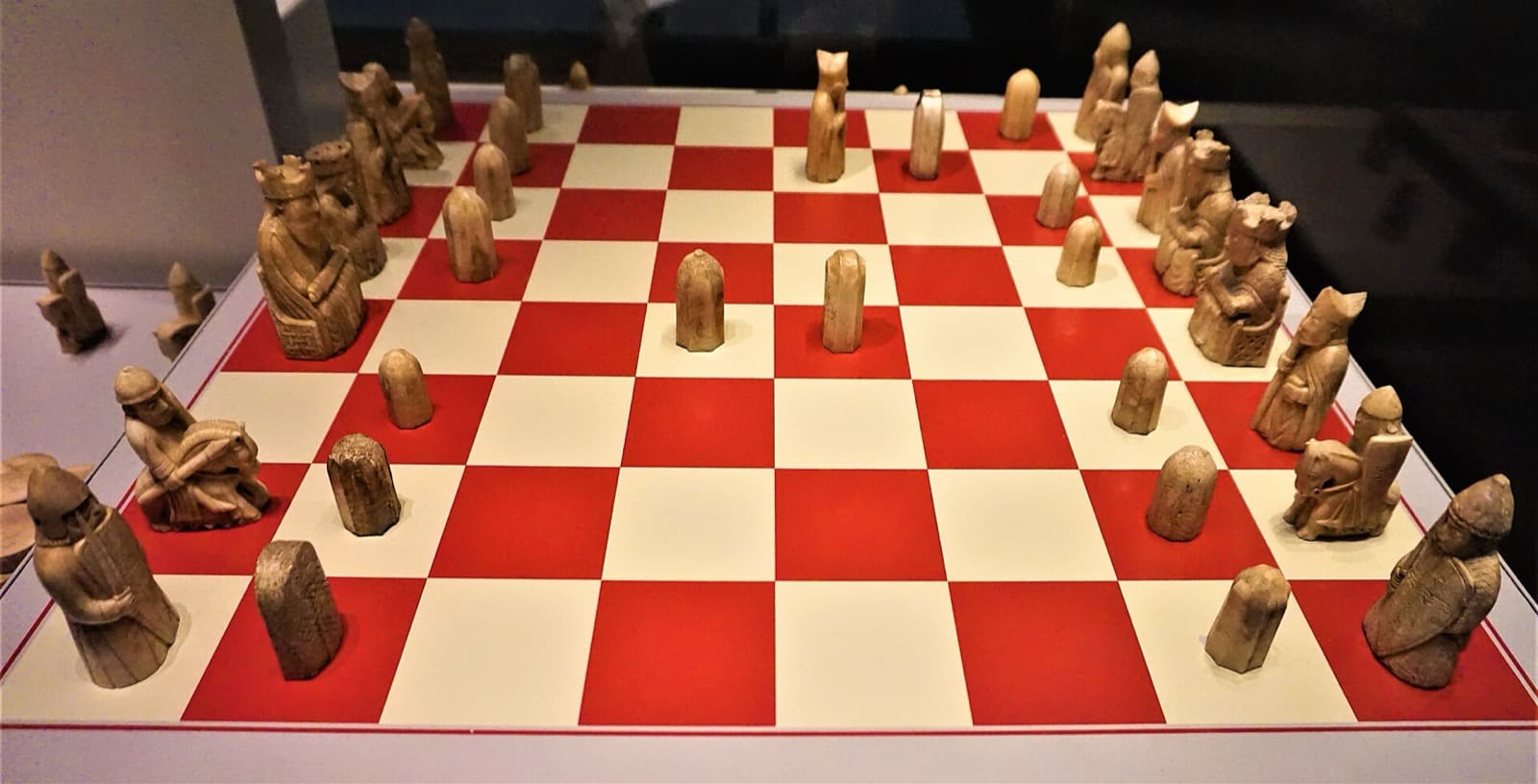
The Lewis Chessmen: Kings, Queens and Berserkers in Room 40