The Parthenon sculptures, also called the Elgin Marbles, are in Room 18 of the British Museum: 15 metopes, 17 figures from the pediments and about 75 metres of the frieze, carved for the temple of Athena in Athens between about 447 and 432 BC. Lord Elgin's agents removed them between 1801 and 1805, and Parliament bought them in 1816. Greece has formally asked for their return since 1983; the museum says they were acquired legally.
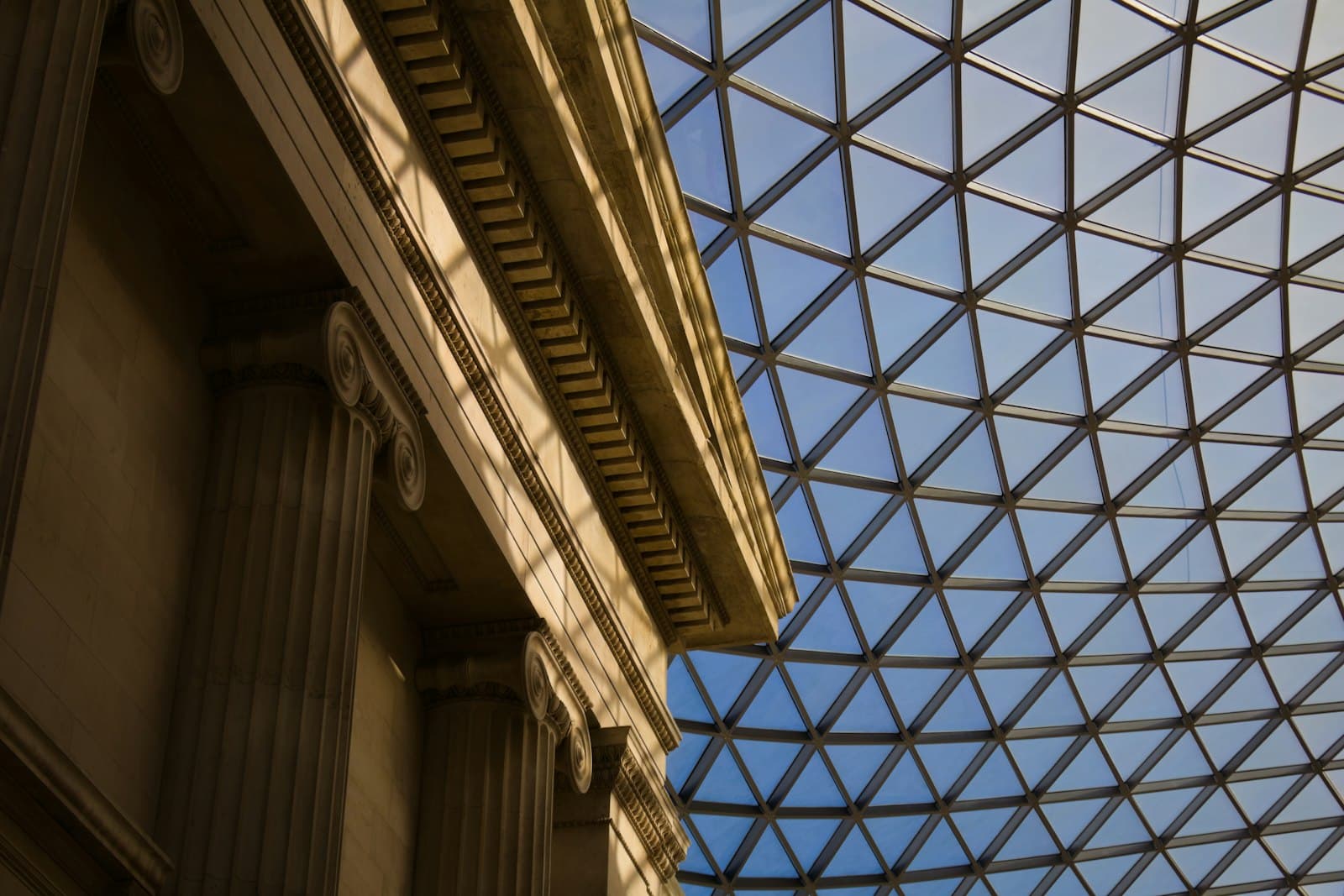
Room 18 of the British Museum is a long, high gallery on the ground floor, west of the Great Court, called the Duveen Gallery. Round its walls runs a band of carved marble riders, and at each end stand battered figures of gods. They come from the Parthenon, the temple of the goddess Athena on the Acropolis of Athens, and they were carved between about 447 and 432 BC.
People also know them as the Elgin Marbles, after the man whose agents took them down. The museum calls them the Parthenon sculptures.
Three kinds of sculpture
The Parthenon carried sculpture in three places, and Room 18 shows all three.
The frieze. A carved band about 160 metres long ran right round the temple's inner building. It shows a procession. About 75 metres of it are in London, set along both long walls of the gallery. Sixty horsemen fill each long side, and the museum links them to the cavalry of Athens, which the statesman Perikles enlarged to a thousand men.
The metopes. Square panels, 92 of them in all, ran round the outside of the temple. The museum holds 15, all from the south side, and all showing one legend: a wedding feast where the Centaurs, half man and half horse, got drunk and fought their hosts, the Lapiths.
The pediments. The two triangular gables at the ends of the temple held groups of large statues. The east pediment, over the entrance, showed the birth of Athena. The museum has 17 figures from the pediments, shown at the two ends of the gallery.
All this is about half of what survives. Of the original sculpture, about half survives at all, and of that, about half is in the British Museum and half in Athens.
What to look for in Room 18
Hear a stop from this walk
Victoria Tower Gardens: Pankhurst at Parliament's Door
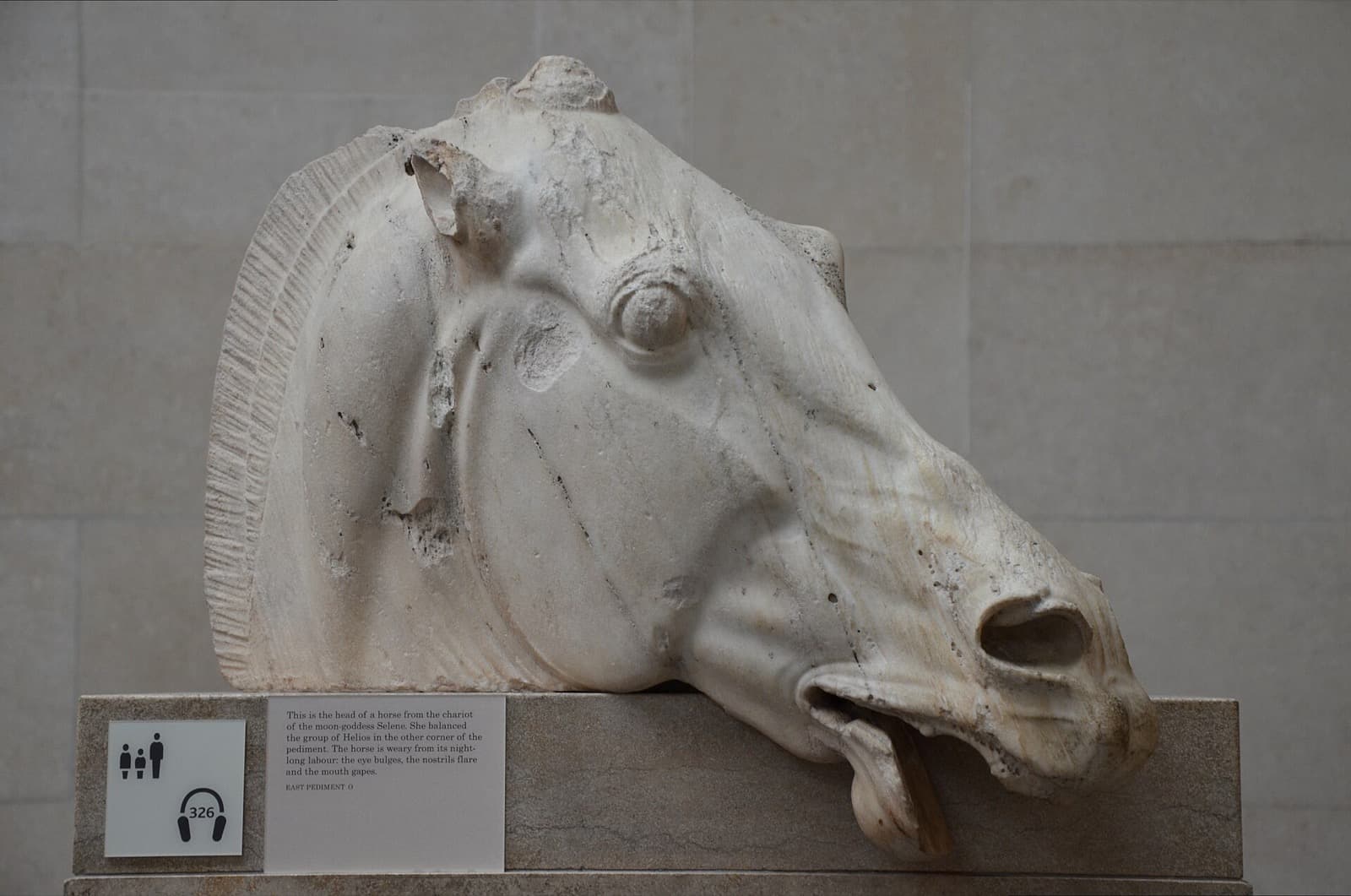
The horse of Selene. In one corner of the east pediment, the horses of the moon goddess Selene, or perhaps of Night, sink below the horizon at the end of the night. Look at the strain in this head: the eye bulges, the nostrils flare, the mouth gapes, and the veins stand out. The museum calls it perhaps the best loved of all the Parthenon sculptures. In the opposite corner, the sun god Helios rises from the sea with his horses. Two more of Selene's horses and the goddess herself are in the Acropolis Museum in Athens.
The reclining god. A young man lies back on a rock spread with a cloak and an animal skin. He is probably Dionysos, god of wine, though some scholars prefer Herakles or Theseus. He is the only figure from the pediments that still has his head.
The river god. From the corner of the west pediment, a figure pushes himself up from the ground, perhaps the river Ilissos rising onto its bank. Walk behind him: the drapery becomes a stream over his left arm and along his back, carved with care on a side nobody was meant to see. In 2014 he went to the Hermitage in St Petersburg, the first time the museum had lent any of its Parthenon sculptures.
Riders of the frieze. Nobody rides with a saddle or stirrups. Look for small drill holes, where bronze reins and bridles were once fixed. In a block from the west side, the leading horseman twists to look back over his shoulder with his arm raised.
The heifer. On the south frieze, a young man leads a heifer to sacrifice as the animal lifts its head in protest. The scene is thought to have inspired John Keats's line about a heifer lowing at the skies in his Ode on a Grecian Urn.
A metope from the south side. A Centaur presses a hand to a wound in his back and tries to break away, while a Lapith holds him and draws back for the final blow. The Lapith's cloak fans out behind them like a curtain.
Next door, in Room 19, stands one of the six caryatids, female figures that held up the roof of a porch on another Acropolis temple, the Erechtheion. Her five sisters are in the Acropolis Museum. A side room, 18b, shows casts of the parts of the frieze that stayed in Athens.
How they came to London
Thomas Bruce, Lord Elgin, was Britain's ambassador to the Ottoman Empire, which then ruled Athens. Between 1801 and 1805, the museum says, his agents removed about half of the sculptures that remained on the ruined Parthenon; his whole operation on the Acropolis, including other buildings and the shipping, ran on to 1812.
Elgin said he acted under a permit from the Ottoman authorities, issued in 1801. The original is lost. It survives only in an Italian translation, which the museum holds, and an English one given to Parliament, and historians still dispute what kind of document it was and whether it allowed sculpture to be taken from the buildings.
In 1816 a House of Commons Select Committee looked into the acquisition and found it legal. Parliament voted that June to buy the collection, for £35,000, and passed it to the British Museum.
Greece's request and the museum's position
Greece made its first formal request for the permanent return of all the Parthenon sculptures in 1983. Melina Mercouri, the Greek Minister of Culture, led a long campaign for their return.
The museum's position is that Elgin's actions were investigated by Parliament in 1816 and found entirely legal. Its trustees say they would consider a loan if the borrower acknowledged the museum's ownership, and that having the sculptures in two museums, in London and Athens, is a public benefit. A 1963 law, the British Museum Act, also lets the trustees dispose of objects only in narrow cases, such as duplicates or objects damaged beyond use.
Talks between the museum and Greece resumed in late 2022, with the museum's chair, George Osborne, meeting Greek officials. In December 2024 he said the two sides were still some distance from an agreement. In September 2026, British newspapers, citing the Daily Telegraph, reported that the talks had broken down. A museum spokesperson replied that its position and its willingness to reach an agreement remained unchanged, and its own website still described the discussions as ongoing. Greece's prime minister, Kyriakos Mitsotakis, wrote in an article in The Guardian that Greece could not accept any arrangement that required recognising the museum's ownership.
The Parthenon sculptures, in short
- What they are: marble sculpture from the Parthenon in Athens, carved about 447 to 432 BC.
- In London: 15 metopes, 17 pediment figures and about 75 metres of the frieze.
- Where to see them: Room 18, the Duveen Gallery, on the ground floor, with casts in Room 18b and a caryatid in Room 19.
- How they came here: removed by Lord Elgin's agents from 1801, bought by Parliament in 1816.
- Today: Greece asks for their return; the museum says they were acquired legally.
How this fits the Roamer guide
Roamer's independent audio guide to the British Museum tells the story of Room 18 and of each of the sculptures above. The horse of Selene is a stop on "The British Museum in an Hour" and "In Two Hours" routes, and the frieze is a stop on "How They Came Here", which sets out how each object reached London and who has asked for it back, without taking sides. You can find it in the British Museum guide. For the rest of the museum, floor by floor, read what to see at the British Museum.
Cover photo: Carole Raddato, CC BY-SA 2.0, via Wikimedia Commons.
.jpg)
Ready to experience it?
Westminster: The Rebels at Parliament's Gates
90 min · 2.9 km · easy
More from London
Explore more at your own pace.
A Cathedral to Nature: Reading the Natural History Museum Building
British Museum: What to See, Floor by Floor
Hope the Blue Whale: The Story of the Skeleton in Hintze Hall
The Giant Sequoia at the Natural History Museum: 1,341 Years in One Slice
The Lewis Chessmen: Kings, Queens and Berserkers in Room 40