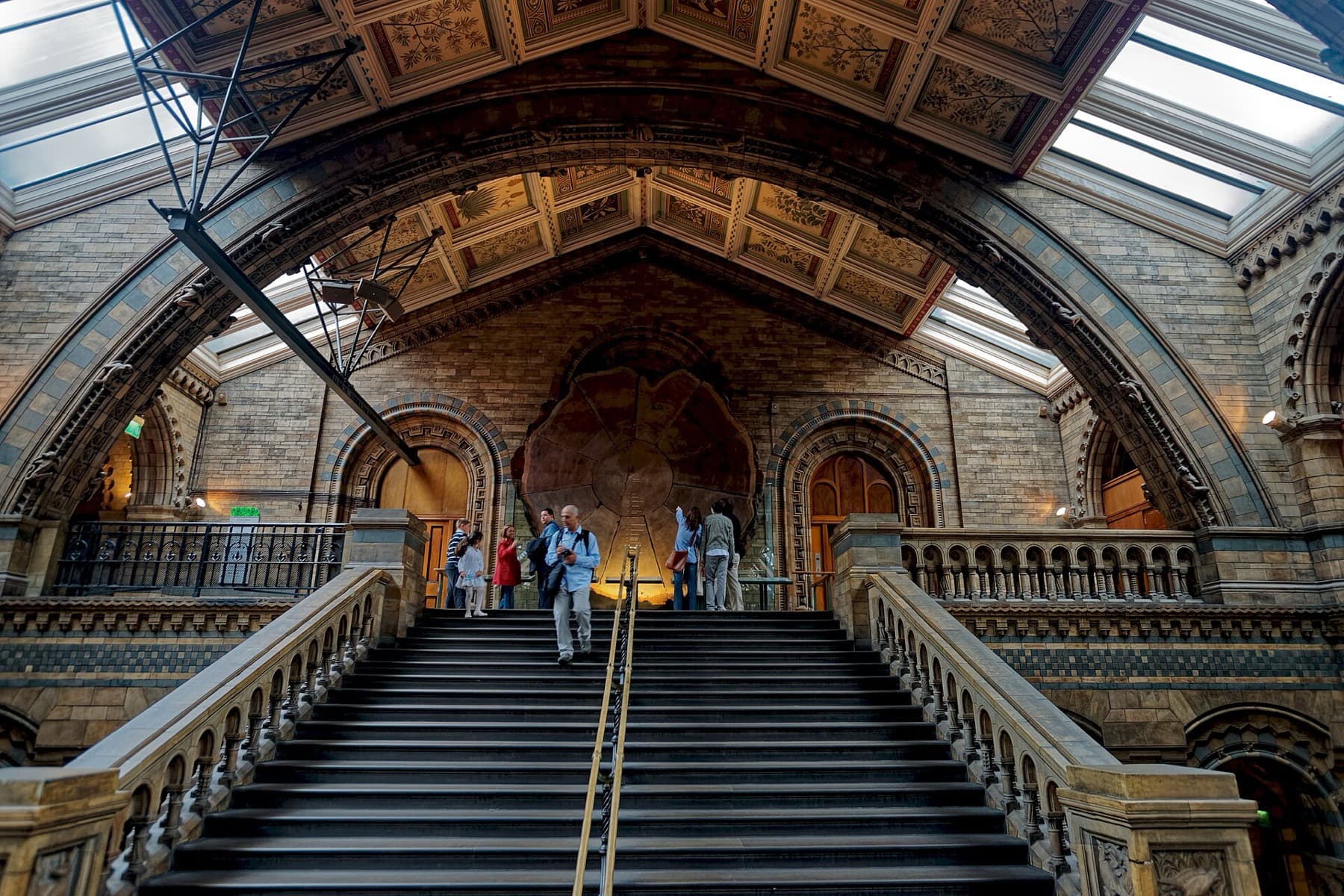
The giant sequoia at the Natural History Museum in London is a slice of a tree felled in 1891 in what is now Kings Canyon National Park, California. The tree was 1,341 years old. The slice reached London in twelve pieces in 1893 and has stood on the second-floor balcony of Hintze Hall since 1971.
Natural History Museum audio guide
London · 3 floors · stories room by room
Climb to the top of the great staircase in the Natural History Museum's Hintze Hall, and at the south end of the upper balcony, above the main entrance, you meet a wall of wood. It is a slice through the trunk of a single giant sequoia, wider than a person is tall, its rings running out from the centre to the bark.
When the tree was cut down in California in 1891, it had been growing for 1,341 years.
A tree that began around the year 550
Subtract 1,341 from 1891 and you reach the year 550. This tree was already centuries old when the Normans crossed to England in 1066. Each ring in the slice records one season of growth, so the whole history of medieval and modern Europe is laid out across its face.
The museum's conservators give its size when felled as about 101 metres tall and just over 5 metres across. That height is the museum's figure; it is greater than the tallest giant sequoia measured today, which is about 95 metres.
Felled for a museum
Hear a stop from this walk
Victoria Tower Gardens: Pankhurst at Parliament's Door
The tree grew in the Sierra Nevada, in what is now Kings Canyon National Park. The details match the tree known as the Mark Twain Tree, in the Big Stump area of the park: a giant sequoia 1,341 years old, felled in 1891 as an exhibition tree for the American Museum of Natural History in New York, with sections sent to New York and to London. Two lumbermen, Bill Mills and S. D. Phips, took thirteen days to bring it down. Its stump is still there.
Why cut down such a tree for a museum? Getting to the groves was hard, and many people simply doubted that trees so large existed. Sections of giant sequoias were shown in cities and at international exhibitions, where crowds could see the size for themselves.
Two sections were cut from the trunk. The bottom one, slightly larger, went to New York. The upper one came to London. It was far too big to ship in one piece, so it was cut into twelve parts, a central disc and eleven wedges, and put back together on arrival. It reached South Kensington in April 1893.
A slice that moved around the building
The section went on display in 1894 in one of the bays of the central hall, the space now called Hintze Hall. In 1902 it was moved to stand against the wall between the north and central halls, and in 1971 it went up to the second-floor balcony, where it still stands.
By 2016 it needed help. Dust had settled on the bark, and an old coat of lacquer had discoloured, clouded and cracked so badly that it hid the growth rings. Conservators mapped its condition, dry-cleaned it, lifted the old varnish with a solvent gel, strengthened the bark, and gave the wood a fresh protective coat. The work took twelve weeks, and the rings show clearly again.
What is a giant sequoia?
The giant sequoia, Sequoiadendron giganteum, grows naturally only in a limited stretch of the western Sierra Nevada in California, in 81 groves. Most mature trees are 50 to 85 metres tall. The oldest known by ring count lived more than 3,200 years.
Measured by the volume of its trunk, a giant sequoia called General Sherman is the largest single tree known. The trees owe some of their survival to thick bark, which can reach 90 centimetres at the base and resists fire. Fire even helps them: its heat dries the cones in the canopy so they open and drop their seeds onto freshly cleared ground.
The logging years
The London slice comes from the age when people cut down the biggest trees on Earth. Giant sequoias were logged in many groves from the 1880s into the 1920s, even though it barely paid. The huge trunks often shattered when they hit the ground, and much of the wood that did reach the mills went into shingles, fence posts and matchsticks. Public outcry over the logging helped bring most of the groves under protection.
Seen that way, the slice on the balcony is two things at once: a record of a living tree's 1,341 years, and a record of the moment people decided such trees were worth more standing.
What to look for
Find the centre. The slice comes from a section cut above the base of the trunk, so its centre is not the seedling itself, but it is the oldest wood in front of you.
Trace the joins. Look for the lines where the eleven wedges meet the central disc. They are the reason the slice could cross the Atlantic.
Read the rings. Run your eye from the centre to the bark. Every ring is a year of growth, more than thirteen centuries of them.
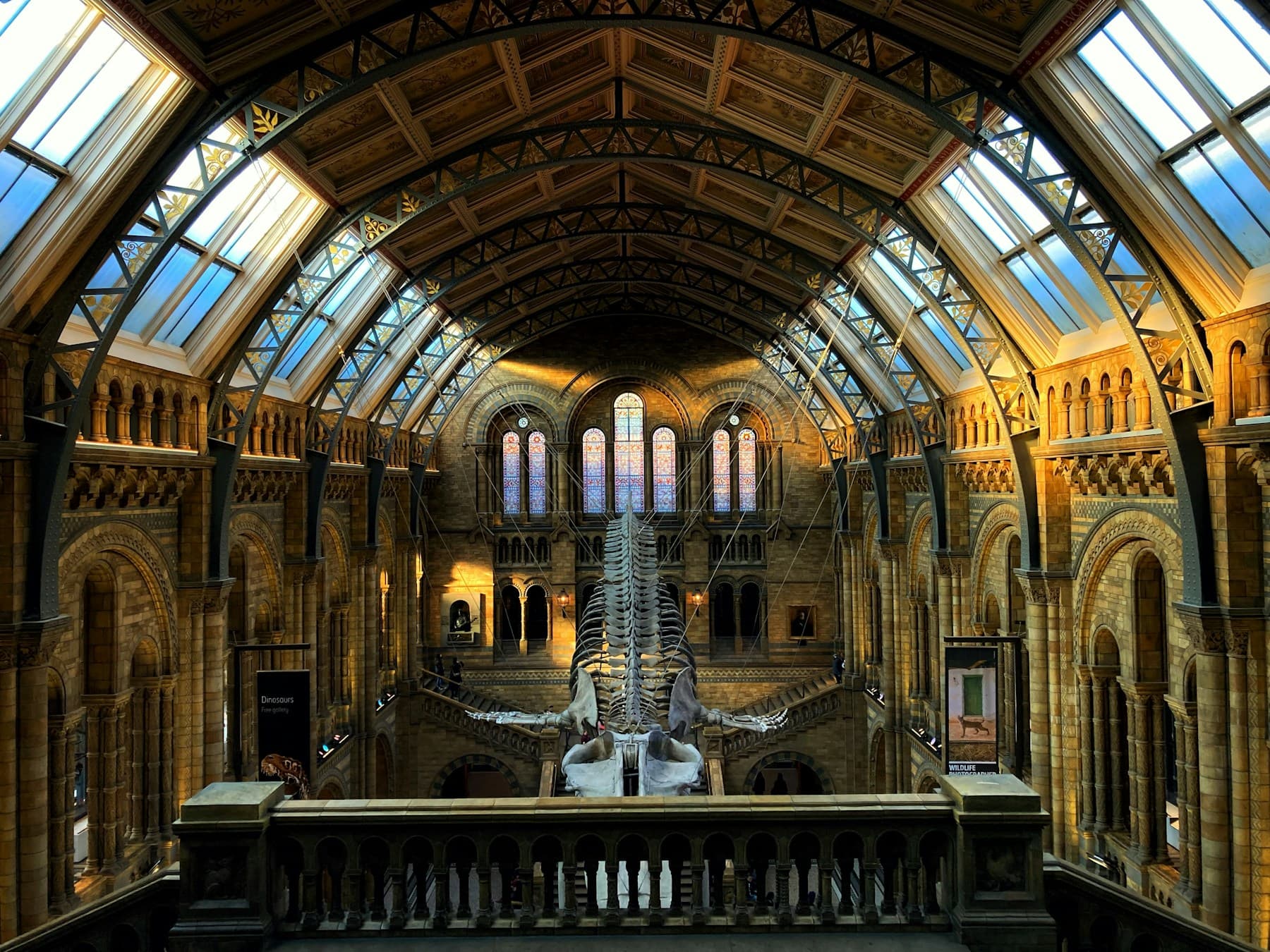
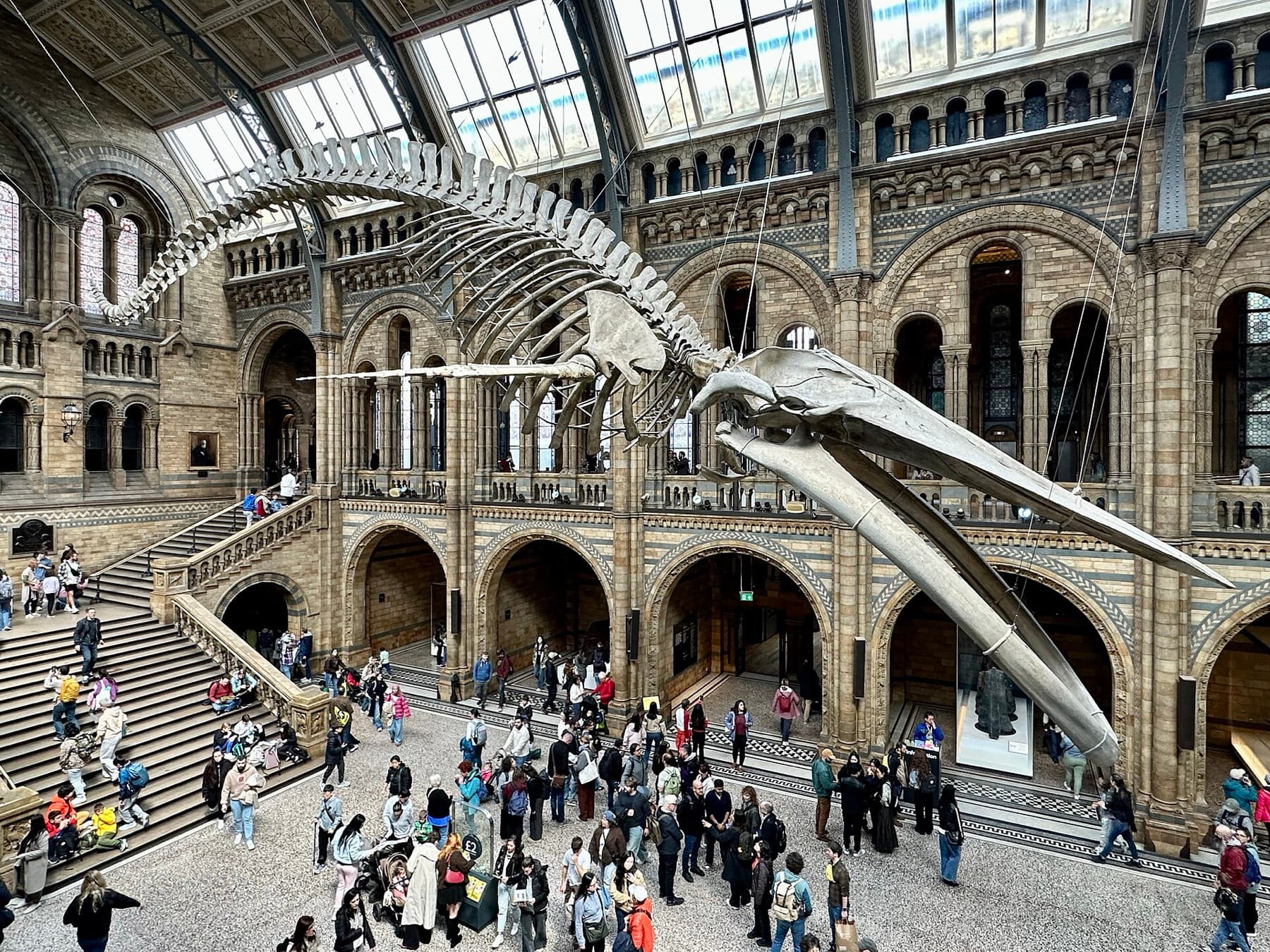
Turn around. From this top balcony you look across at Hope the blue whale instead of up at her. Above the landing nearby, each panel of the painted ceiling shows a different plant, part of the building's own story.
The giant sequoia slice, in short
- What: a section of the trunk of one giant sequoia.
- Where it grew: what is now Kings Canyon National Park, California.
- Age when felled: 1,341 years, in 1891.
- Size when felled: about 101 metres tall and just over 5 metres across, by the museum's figures.
- Where to see it: the second-floor balcony at the south end of Hintze Hall, since 1971.
How this fits the Roamer guide
Roamer's independent audio guide to the Natural History Museum includes a story for the giant sequoia on the Hintze Hall balconies, and it is a stop on both "The Giants" and "A Cathedral to Nature" routes. You can find it in the Natural History Museum guide. For the rest of the museum, read what to see at the Natural History Museum.
Cover photo: Txllxt TxllxT, CC BY-SA 4.0, via Wikimedia Commons.

Ready to experience it?
Westminster: The Rebels at Parliament's Gates
90 min · 2.9 km · easy
More from London
Explore more at your own pace.
A Cathedral to Nature: Reading the Natural History Museum Building
British Museum: What to See, Floor by Floor
Hope the Blue Whale: The Story of the Skeleton in Hintze Hall
The Lewis Chessmen: Kings, Queens and Berserkers in Room 40
The Parthenon Sculptures: What Is in Room 18 and How It Got There