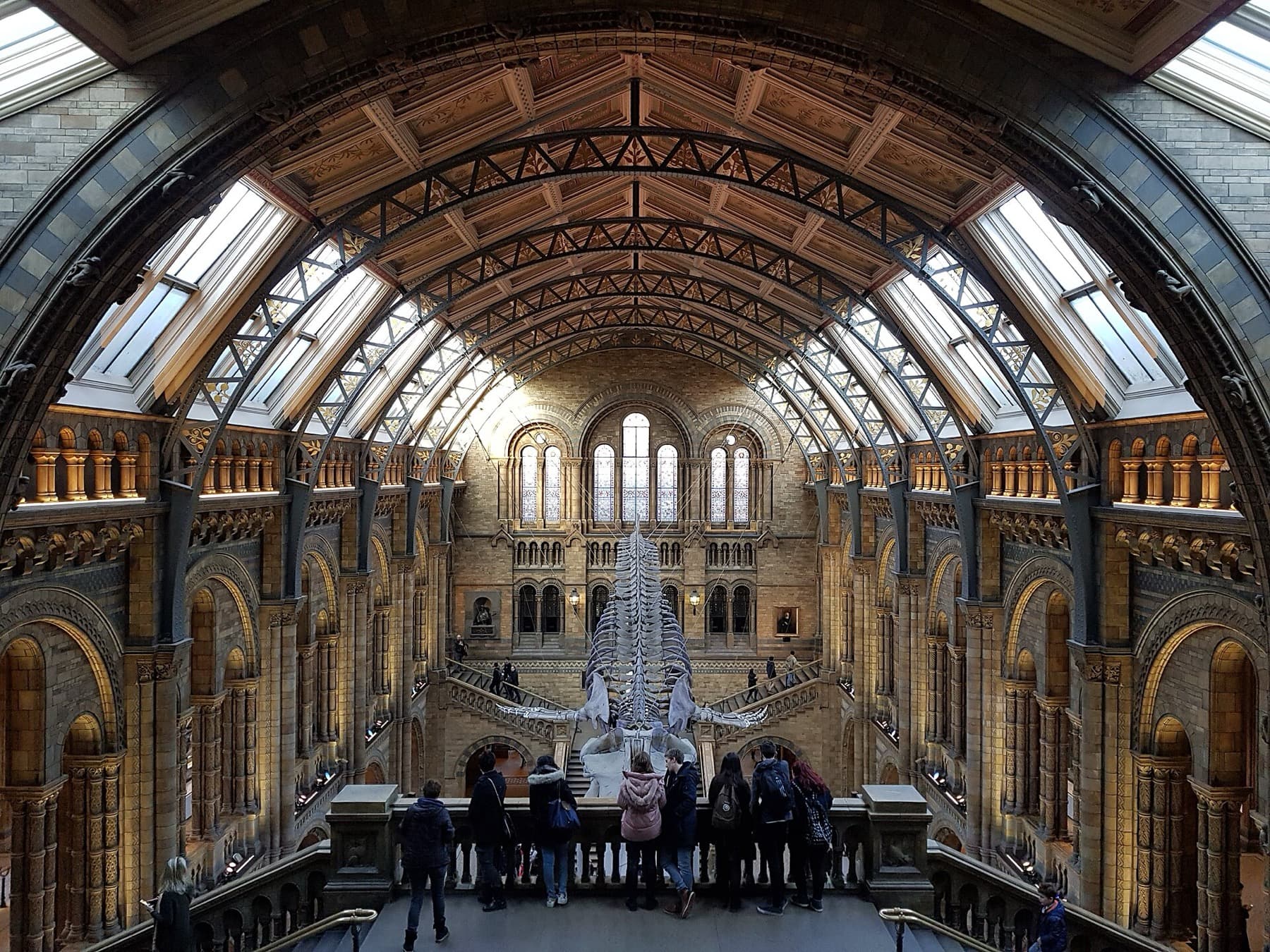
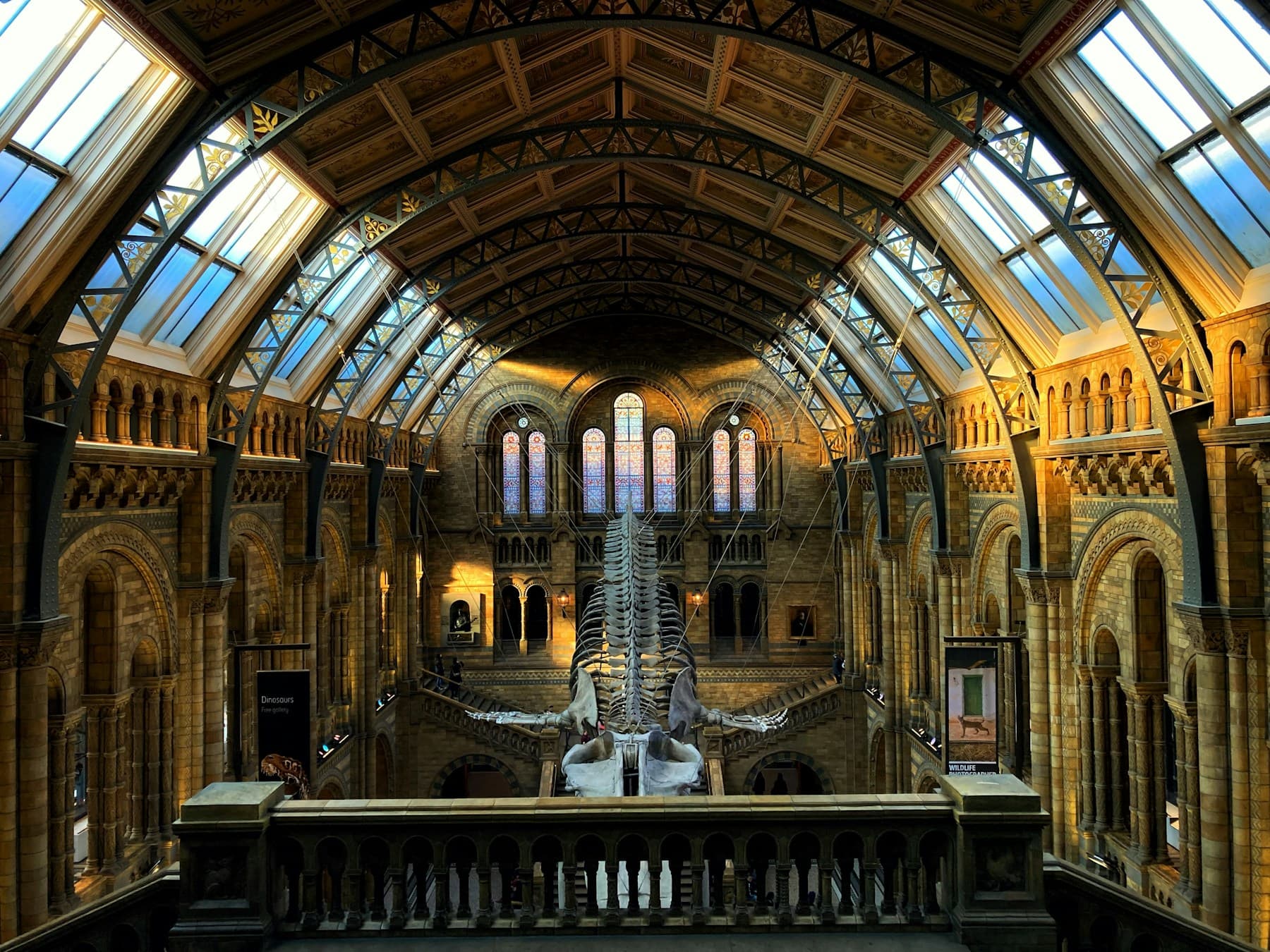
Plan about two hours for the highlights of the Natural History Museum in London. Start under Hope, the blue whale skeleton in Hintze Hall, then see the moving T. rex in Dinosaurs, the life-size blue whale model in the Mammals Hall and Mary Anning's fossils in Fossil Marine Reptiles. In the East Wing, find Sophie the Stegosaurus and ride the escalator through the Earth to the Kobe earthquake room.
Natural History Museum audio guide
London · 3 floors · stories room by room
The Natural History Museum sits on Cromwell Road in South Kensington, and the first thing to know is that nobody sees all of it. The museum looks after more than 80 million specimens. How long does it take? Plan about two hours for the highlights. Admission to the permanent galleries is free; some temporary exhibitions charge.
Three buildings in one
The museum you walk into is really three buildings from three different centuries.
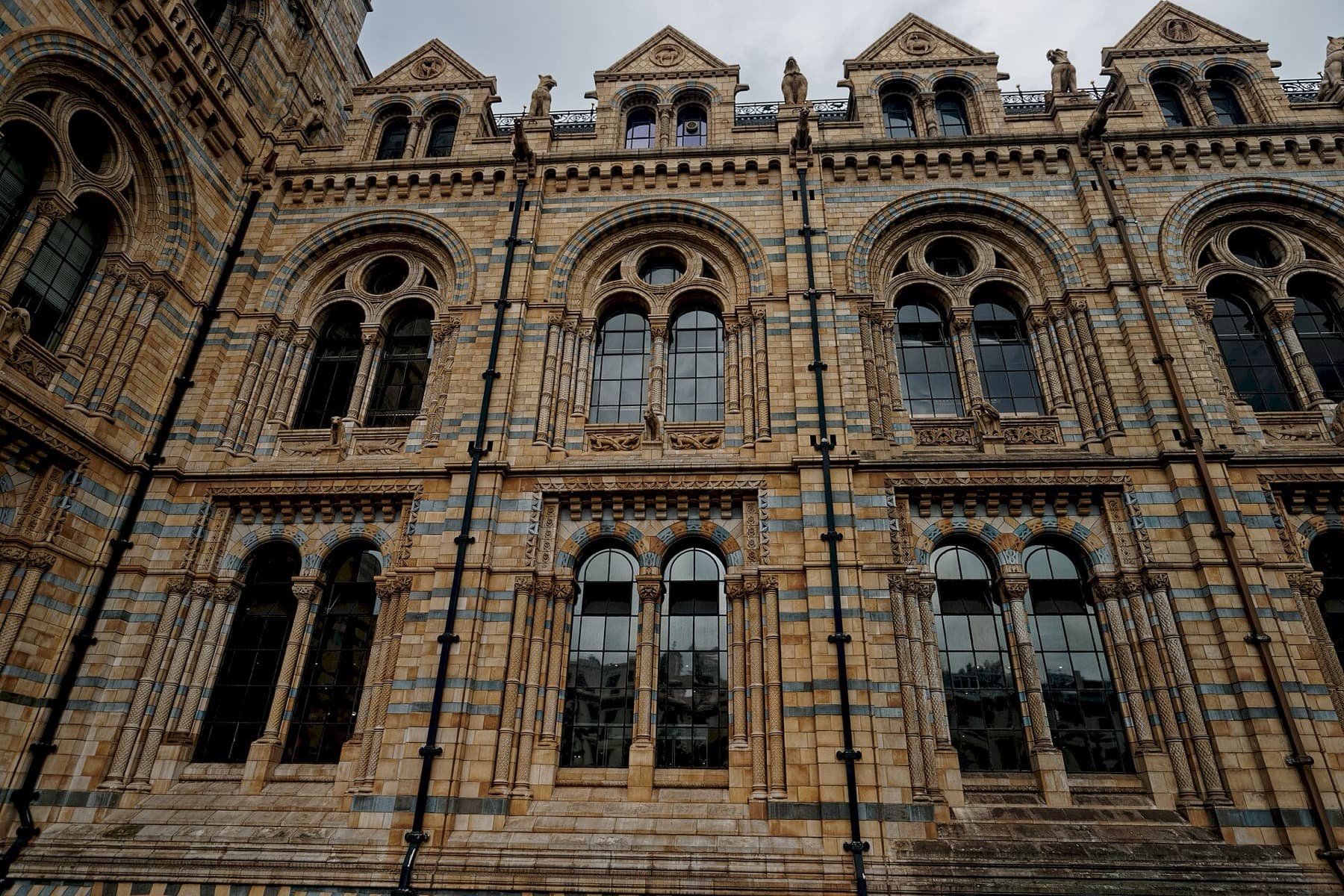
The oldest is Alfred Waterhouse's building on Cromwell Road, opened on 18 April 1881. Richard Owen, who ran the natural history collections, wanted a cathedral to nature, and Waterhouse gave him one: rounded Romanesque arches, iron and glass to let in daylight, and a skin of moulded terracotta animals and plants. The museum's own map calls this the Central Building.
Behind it, the North Wing grew in the 1930s, when a new whale hall was built. It is now the Mammals Hall.
On the east side, along Exhibition Road, is the old Geological Museum. It moved into that building in 1935, and its galleries passed to the Natural History Museum in the 1980s. The map calls it the East Wing. On the west side is the Darwin Centre, opened in two stages in 2002 and 2009, which the map calls the West Wing.
The map no longer uses the coloured zones some older guides mention. It groups everything by those four wings, mostly on a ground floor and two upper floors.
How the floors are laid out
Hear a stop from this walk
Victoria Tower Gardens: Pankhurst at Parliament's Door
- Ground floor, Central Building: Hintze Hall in the middle. The Dinosaurs gallery runs west from it and Fossil Marine Reptiles runs east, with Mammals, Birds and other galleries branching north.
- Ground floor, North Wing: the Mammals Hall with its blue whale model, plus Fishes, Amphibians and Reptiles.
- Ground floor, East Wing: Earth Hall with Sophie the Stegosaurus, Lasting Impressions and Human Evolution.
- Floor 1: the Hintze Hall balcony, Treasures, and the long Minerals gallery ending in the Vault. In the East Wing, Earth's Treasury, From the Beginning and the Earth Hall mezzanine.
- Floor 2: the top balcony with the giant sequoia, the new Nature and Us gallery, and in the East Wing, Volcanoes and Earthquakes and Restless Surface.
- West Wing: the Cocoon, a concrete shell eight storeys tall inside the Darwin Centre.
Two galleries in older guides are shut. Human Biology closed in 2021, and its space now holds Fixing Our Broken Planet. Creepy Crawlies is closed while the space becomes a new gallery for young families.
The must-see exhibits, wing by wing
Hintze Hall. Look up first. Hope, the skeleton of a young blue whale stranded at Wexford in Ireland in 1891, dives head first above you, 25.2 metres long. The bays along the hall hold star specimens: a slice of the Imilac meteorite more than 4.5 billion years old, an American mastodon once built into a fake monster by a showman, and Mantellisaurus from the Isle of Wight. At the far end, Charles Darwin sits in marble on the staircase landing.
Dinosaurs. The gallery runs west from Hintze Hall. Real fossils here include a Triceratops skull collected in Wyoming in 1909, the armoured Scolosaurus from Alberta, and the lower jaw of the first Tyrannosaurus rex skeleton ever found, discovered by Barnum Brown in 1900. At the west end waits the robot T. rex that moves and roars.
The Mammals Hall. In the North Wing hangs a life-size blue whale model, about 28 metres long, built inside the hall in view of visitors and finished in 1938. Around it, whale skeletons hang from the roof, and giraffes, hippos and a giant elk stand on the floor.
Fossil Marine Reptiles. This long corridor east of Hintze Hall is lined with ichthyosaurs and plesiosaurs, many from the coast at Lyme Regis. Find Mary Anning's Plesiosaurus, the first complete skeleton of its kind, which she found in December 1823. The great French anatomist Georges Cuvier at first suspected a fake. Look too for a female ichthyosaur with six unborn young, and for the giant ground sloth rearing up on its hind legs.
Birds. A gallery of glass cases with a Victorian dodo model, a tall cabinet holding at least a hundred hummingbirds, two passenger pigeons, and an egg row that runs from a hummingbird's egg to an elephant bird's.
Earth Hall, East Wing. The atrium of the old Geological Museum has walls of slate sand-blasted with stars and planets. Sophie the Stegosaurus stands in front of a giant metal globe, and an escalator climbs eleven metres straight through it. It was added in 1996 because few visitors were climbing the stairs to the upper floors.
Volcanoes and Earthquakes. At the top of the escalator, one long gallery tells the story of volcanoes, moving plates and earthquakes. Look for casts of victims from Pompeii and a heat suit made for working near lava. At the far end, step into a room dressed as a Japanese supermarket that shakes to recreate the 1995 Kobe earthquake.
Treasures, Minerals and the Vault. Back in the Central Building, the first floor holds three rooms of precious things. Treasures shows 22 objects, among them the first Archaeopteryx skeleton ever found, a first edition of On the Origin of Species and Guy the gorilla from London Zoo. The Minerals gallery still uses its original 1881 oak cases. At its end, the Vault keeps a pyramid of 296 naturally coloured diamonds, an uncut emerald of more than 1,380 carats and a piece of the Winchcombe meteorite, which fell on Gloucestershire in 2021.
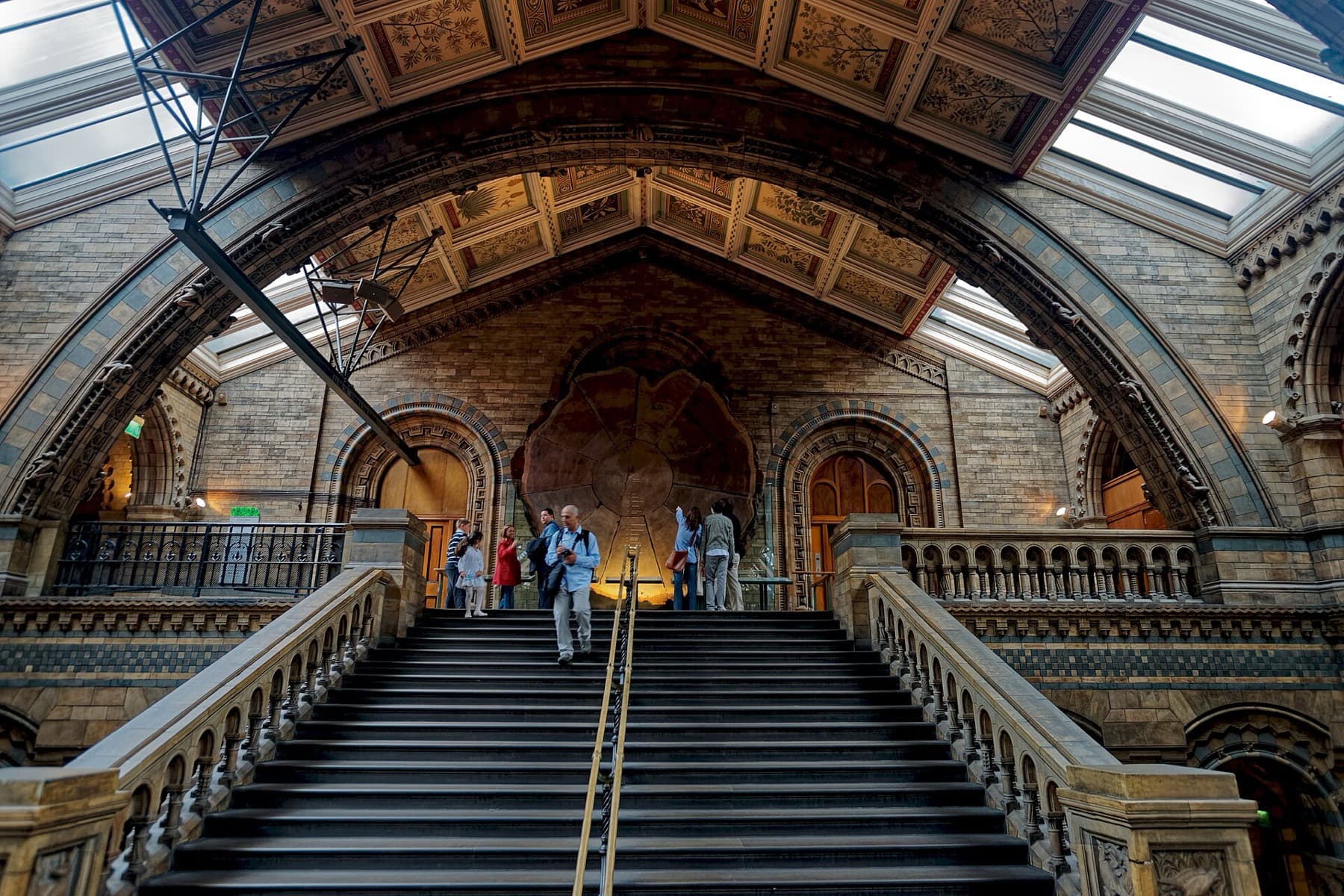
The giant sequoia. On the top balcony of Hintze Hall stands a slice of a giant sequoia felled in California in 1891, when it was 1,341 years old.
The Cocoon. In the West Wing, an eight-storey shell of sprayed concrete inside a glass atrium holds about 17 million insects and 3 million plants.
What to see in two hours
This plan keeps backtracking low and stops only for things with a story you can use in front of the glass.
- Hintze Hall (15 minutes). Hope, the mastodon and the meteorite slice.
- Dinosaurs (20 minutes). Walk west to the T. rex, taking in the Triceratops skull on the way.
- Mammals and the Mammals Hall (15 minutes). The blue whale model and the giant elk.
- The staircase and floor 1 (20 minutes). Darwin on the landing, then Archaeopteryx in Treasures and the coloured diamonds in the Vault.
- The top balcony (5 minutes). The giant sequoia, and the best view down on Hope.
- Fossil Marine Reptiles and Birds (20 minutes). Mary Anning's fossils, the ground sloth, the dodo.
- East Wing (25 minutes). Through Lasting Impressions to Sophie in Earth Hall, then the escalator through the globe to the Kobe earthquake room.
Four ready-made routes
The Roamer guide groups the museum into four short themed routes. Each works as a plan on its own.
The Natural History Museum in an Hour. Six stops for a short visit: Hope, the T. rex, the blue whale model, Mary Anning's plesiosaur, Sophie and the Kobe earthquake simulator. If your question is what you must see, this is the answer.
The Giants. About 75 minutes, all about size: Hope and the American mastodon, the giant sequoia, the Triceratops skull and the T. rex, the blue whale model and the giant elk, the giant ground sloth and Sophie.
A Cathedral to Nature. About 45 minutes where the building is the exhibit: the Darwin statue, the painted ceiling, the terracotta animals and plants, Archaeopteryx in Treasures, Sir Hans Sloane's curiosities in the Minerals cases, and the giant sequoia.
Small Wonders. About 45 minutes for the things that are easy to walk past: the duck-billed platypus, the Surinam toad, the hummingbird cabinet, the Sunday Stone in Lasting Impressions, the small dinosaur Enigmacursor on the Earth Hall mezzanine, and the earliest signs of life in From the Beginning.
Tips for the visit
- Climb at least one staircase in Hintze Hall. From the balconies you look across at Hope instead of only up, and the painted ceiling is close enough to read panel by panel.
- The museum has two main public entrances: the Central Entrance on Cromwell Road opens into Hintze Hall, and the East Entrance on Exhibition Road leads up into Earth Hall. If you start in the East Wing, reverse the plan above.
- Do not try to finish. Pick one of the routes and let the rest be a reason to come back.
How this fits the Roamer guide
Roamer has an independent audio guide to the Natural History Museum that works room by room: open any gallery and play its story, or follow one of the four routes above with directions from room to room. You can find it here: the Natural History Museum guide.
Cover photo: Iridescent, CC BY-SA 4.0, via Wikimedia Commons.

Ready to experience it?
Westminster: The Rebels at Parliament's Gates
90 min · 2.9 km · easy
More from London
Explore more at your own pace.
A Cathedral to Nature: Reading the Natural History Museum Building
British Museum: What to See, Floor by Floor
The Giant Sequoia at the Natural History Museum: 1,341 Years in One Slice
The Lewis Chessmen: Kings, Queens and Berserkers in Room 40
The Parthenon Sculptures: What Is in Room 18 and How It Got There