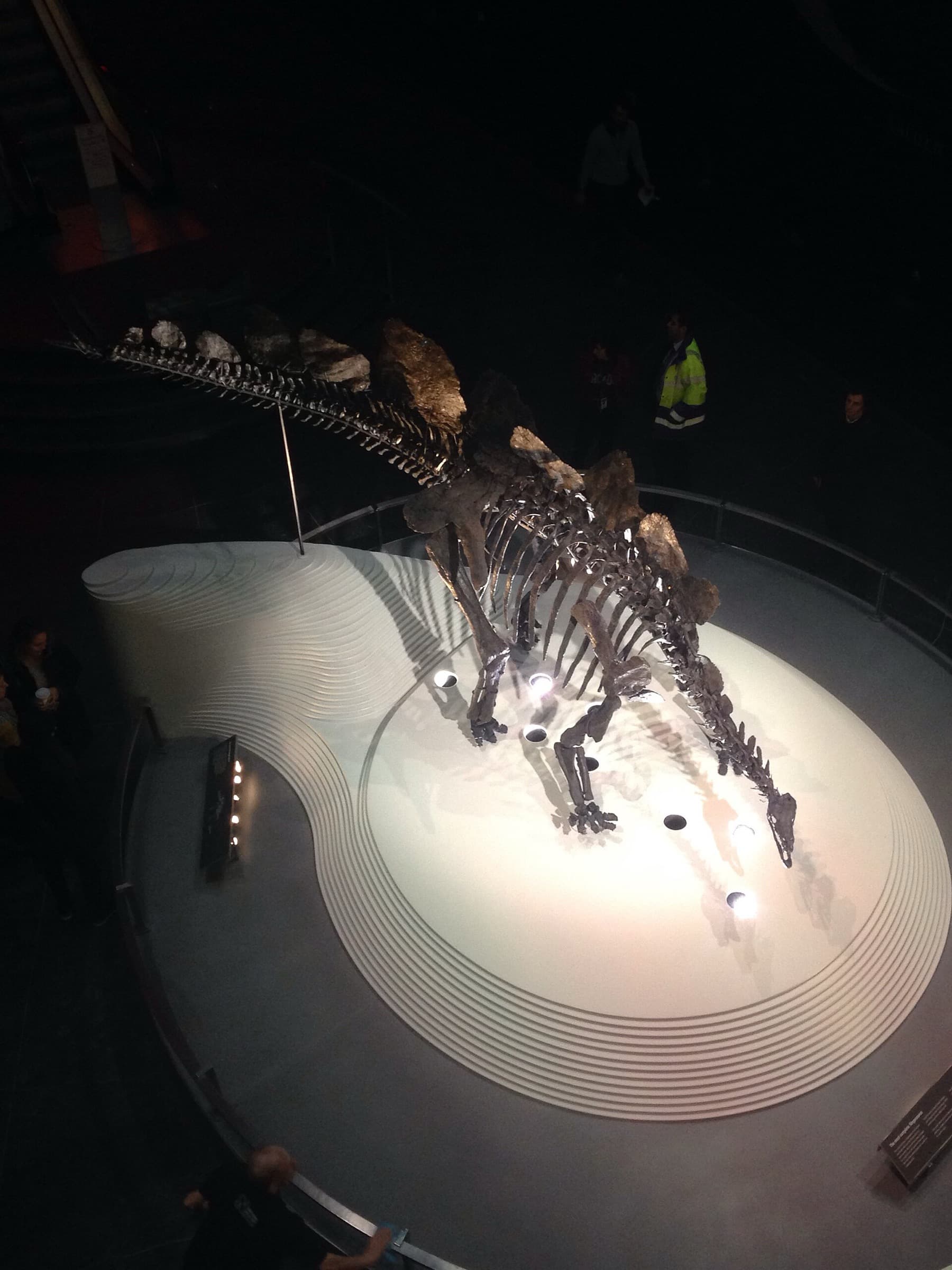
Sophie is a Stegosaurus stenops skeleton about 150 million years old, found in 2003 on the Red Canyon Ranch in Wyoming. She is 5.6 metres long and 2.9 metres tall, roughly the size of a four-by-four car, with more than 300 bones. She stands in Earth Hall, inside the Exhibition Road entrance of the Natural History Museum in London.
Natural History Museum audio guide
London · 3 floors · stories room by room
Come into the Natural History Museum from Exhibition Road and you reach Earth Hall, the tall atrium of the old Geological Museum. In front of a giant metal globe stands a dinosaur with a double row of tall plates down its back and four spikes on its tail. This is Sophie, a Stegosaurus stenops that lived about 150 million years ago.
When the museum put her on show in December 2014, it announced her as the world's most complete Stegosaurus skeleton.
How big is Sophie?
Sophie is 5.6 metres long and 2.9 metres tall. The museum compares her to a four-by-four car, and standing next to her that feels right: long and bulky, but not towering. Her skeleton has more than 300 bones.
Along her back are 19 plates, and on the end of her tail are four spikes. Together they make the most complete set of Stegosaurus plates and spikes ever found, all on one animal.
She was not elderly when she died. Scientists judge that she was a young adult.
Real bone, nearly complete
Hear a stop from this walk
Victoria Tower Gardens: Pankhurst at Parliament's Door
Many of the dinosaurs you see in museums are casts. Sophie is real fossil bone, apart from a few replica pieces. When the museum unveiled her, its then director contrasted her with Dippy, the famous cast of a Diplodocus that once filled Hintze Hall.
She was found almost whole. The parts missing were her left arm and the base of her tail. Even the bones of her skull survived as separate, three-dimensional pieces instead of being crushed flat together. That matters because separate skull bones can tell scientists what she ate and how hard she could bite.
Found on a Wyoming hilltop
Sophie came out of the ground in spring 2003 on the Red Canyon Ranch in Wyoming, in the United States. Bob Simon, who ran a dinosaur quarry on the ranch, found her while he was expanding it. She lay at the top of a hill, her skeleton still almost fully joined together. Digging her out took three weeks.
She reached the museum in December 2013 from private facilities in Switzerland and the United States. Her purchase was paid for by 70 donors. At the time, the museum called her its most significant dinosaur acquisition since the 1980s, and the only Stegosaurus in a public collection outside the United States.
Why is she called Sophie?
Sophie is named after Sophie Herrmann, the daughter of Jeremy Herrmann, the donor the museum singled out for making the purchase possible.
The name does not tell you the animal's sex. Nobody knows whether this Stegosaurus was male or female. The museum's scientists only say she was a young adult.
What scientists did with her
Before she went on display, the museum's team measured and photographed every part of her, made laser surface scans and took CT scans. The aim was to build up a series of studies on how stegosaurs lived: how they evolved and behaved, and, from the separate skull bones, what they ate and how hard they could bite.
What to look for
Count the plates. Walk the length of her back and count to 19.
Find the spikes. At the end of the tail are four long spikes, the complete set. Picture the tail swinging.
Step back to the globe. Sophie stands in front of the giant metal Earth that the Earth Hall escalator climbs through. The escalator rises eleven metres and was added in 1996, because few visitors were climbing the stairs to the upper floors. Ride it after you have seen her and you arrive at Volcanoes and Earthquakes.
Then go up to the mezzanine. On the first-floor mezzanine above Earth Hall is a much smaller dinosaur, Enigmacursor, named as a new species in 2025. It was a two-legged plant-eater about half a metre tall that lived on the same kind of North American river plains where Stegosaurus like Sophie roamed.
The hall around her
Sophie's setting is a museum within the museum. Earth Hall was the entrance of the Geological Museum, which moved into this building on Exhibition Road in 1935 and whose galleries passed to the Natural History Museum in the 1980s. The tall walls are lined with slate, sand-blasted with the brightest stars and planets, so the hall reads like a night sky.
Along the walls, small round porthole cases hold rocks and fossils. One of them, on the right as you come in from Exhibition Road, holds a piece of the Moon collected on the Apollo 16 mission in 1972 and lent by the United States government. Nearby stands a glass artwork based on William Smith's geological map of 1815, which the museum describes as Britain's first.
Sophie in time
About 150 million years old puts Sophie in the Late Jurassic. Triceratops, whose real skull is in the museum's Dinosaurs gallery, lived between about 68 and 66 million years ago, so more time separates Sophie from Triceratops than separates Triceratops from us.
Sophie the Stegosaurus, in short
- Species: Stegosaurus stenops, about 150 million years old.
- Size: 5.6 metres long, 2.9 metres tall, more than 300 bones.
- Found: spring 2003, Red Canyon Ranch, Wyoming.
- Where: Earth Hall, East Wing, inside the Exhibition Road entrance, on show since 4 December 2014.
- Named for: Sophie Herrmann, daughter of the donor Jeremy Herrmann.
How this fits the Roamer guide
Roamer's independent audio guide to the Natural History Museum includes a story for Sophie in Earth Hall, and she is a stop on both "The Natural History Museum in an Hour" and "The Giants" routes. You can find it in the Natural History Museum guide. For the rest of the museum, read what to see at the Natural History Museum, or the story of Hope the blue whale.
Cover photo: Tommybrock, CC BY-SA 4.0, via Wikimedia Commons.

Ready to experience it?
Westminster: The Rebels at Parliament's Gates
90 min · 2.9 km · easy
More from London
Explore more at your own pace.
A Cathedral to Nature: Reading the Natural History Museum Building
British Museum: What to See, Floor by Floor
The Giant Sequoia at the Natural History Museum: 1,341 Years in One Slice
The Lewis Chessmen: Kings, Queens and Berserkers in Room 40
The Parthenon Sculptures: What Is in Room 18 and How It Got There