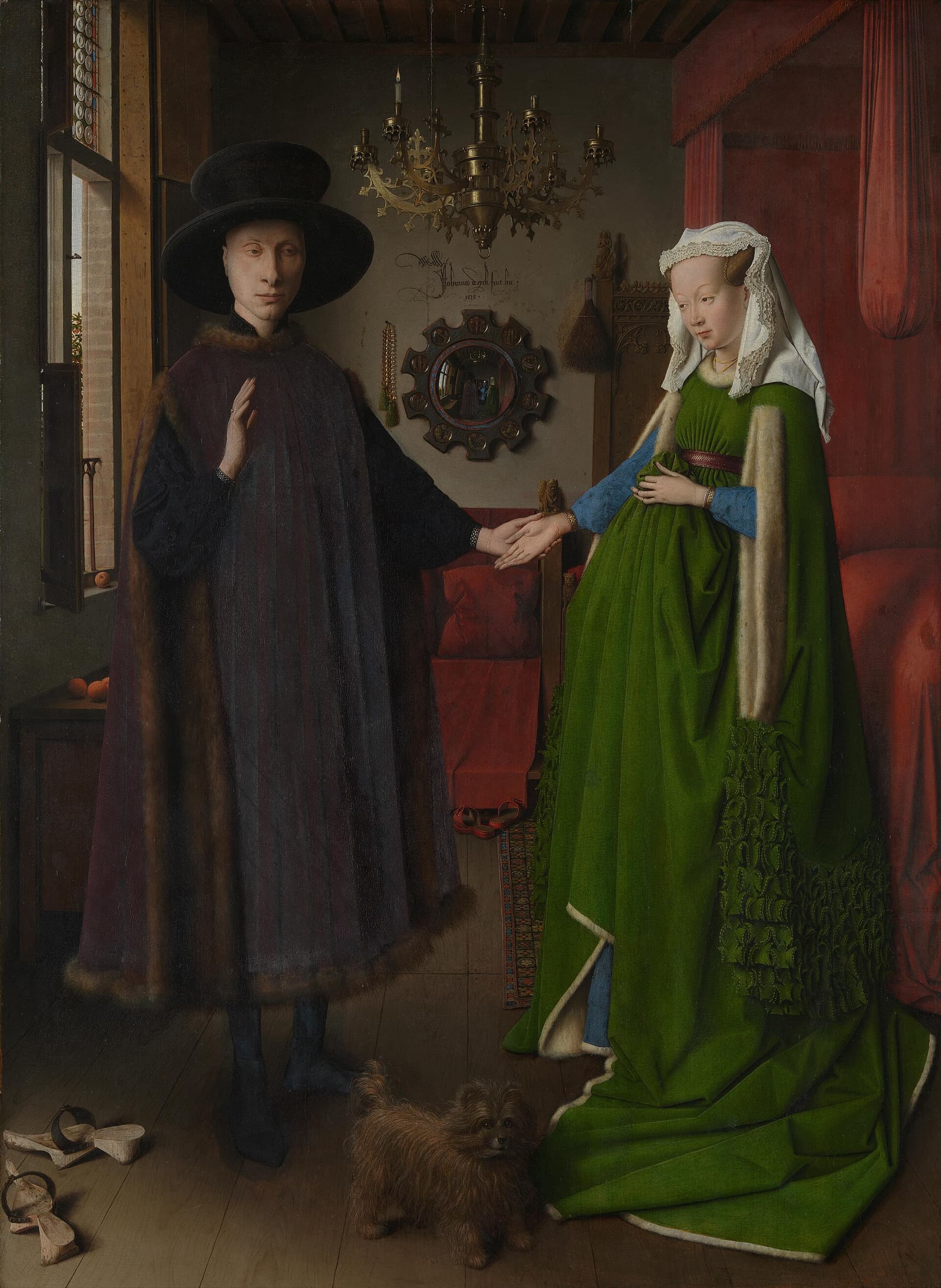
The Arnolfini Portrait is a 1434 oil painting by Jan van Eyck of a merchant, probably Giovanni di Nicolao Arnolfini, and his wife in a room in Bruges. The convex mirror on the back wall reflects the couple from behind and two men in the doorway, one perhaps the painter. It is no longer read as a wedding record, and the woman is not pregnant. It hangs in Room 52 of the National Gallery, London.
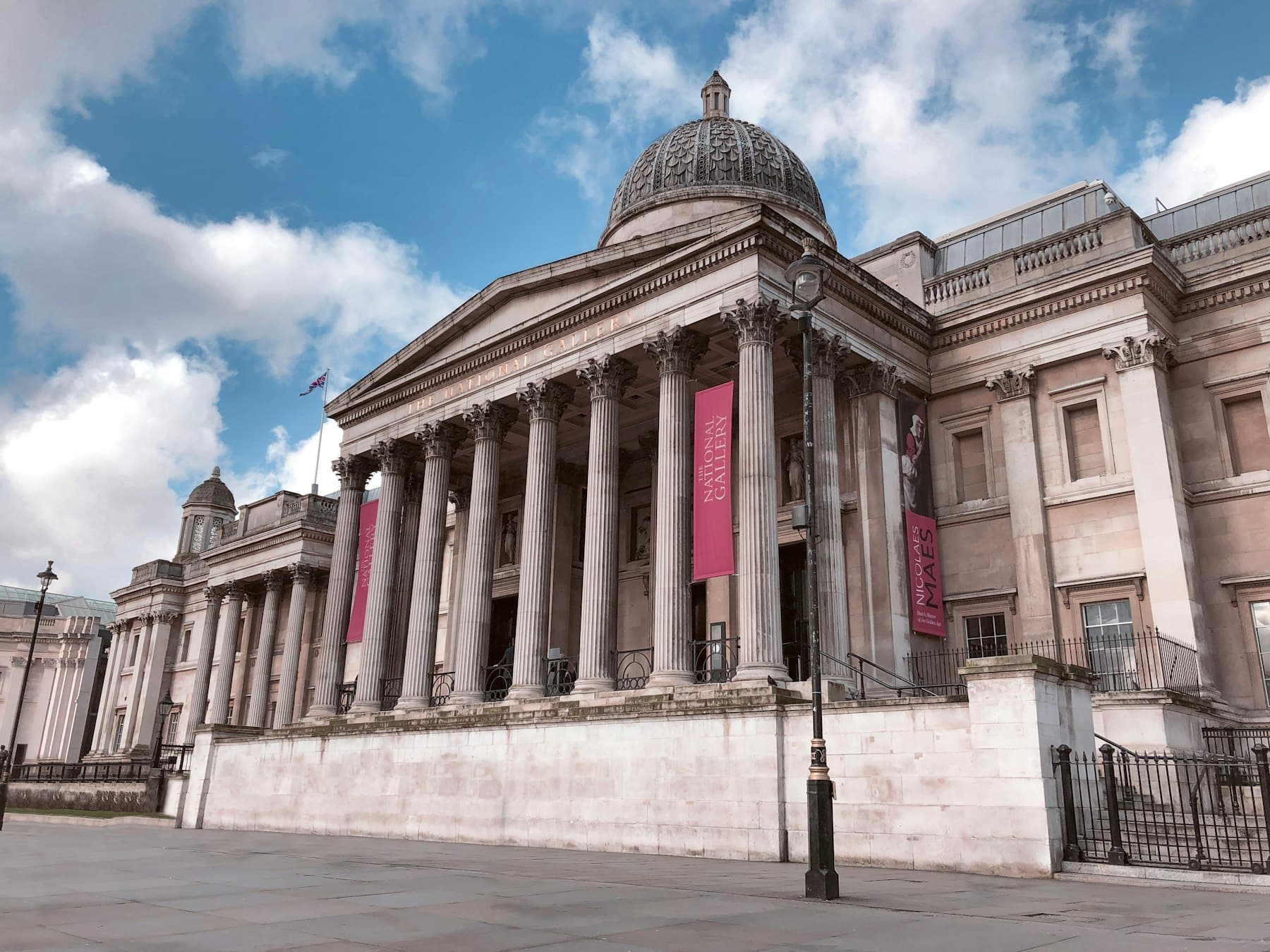
If you are asking where the Arnolfini Portrait is: it hangs in Room 52 of the National Gallery in London, in the Sainsbury Wing. The gallery bought it in 1842, and it was the first Netherlandish painting to enter the collection.
If you are asking what it shows: a richly dressed man and woman stand in a room in Bruges in 1434. The National Gallery says they are probably Giovanni di Nicolao di Arnolfini, an Italian merchant living in Bruges, and his wife. The panel is small, about 82 by 60 centimetres, and it is painted in oil on wood, probably oak. Most of what people come to see is in the middle of the back wall.
The mirror
Hanging between the couple is a round convex mirror, and it is the reason this painting is famous. In it you see the backs of the couple, the window, the bed, and two more men standing in the doorway, roughly where you stand to look at the picture. One of them seems to raise an arm. The gallery asks the obvious question: are they van Eyck and a servant? Nobody can prove it, though the figure in red is usually presumed to be the painter.
Now look at the frame of the mirror. It has ten small roundels, each a tiny scene from the Passion of Christ. You need to stand close to make them out.
The gallery also points out that the mirror is impossibly large. A convex mirror of that size could not have been made in the 1430s. Van Eyck enlarged it because it is doing a job: it turns a two-person portrait into a room with an audience, and it puts you, the viewer, inside it.
"Jan van Eyck was here"
Hear a stop from this walk
Victoria Tower Gardens: Pankhurst at Parliament's Door
Directly above the mirror, painted in large letters as if written on the wall, is a Latin inscription: Johannes de eyck fuit hic 1434, "Jan van Eyck was here. 1434."
Van Eyck writes his presence into the room itself, just above the mirror that shows two visitors at the door. The signature and the reflection seem to answer each other.
Is it a wedding picture?
For much of the twentieth century, the standard answer was yes. In 1934 the art historian Erwin Panofsky argued that the painting was a kind of legal record of a marriage. In his reading the two men in the mirror were witnesses, the inscription was the painter's sworn statement that he was present, and almost every object carried a hidden religious meaning.
That reading has not held. The National Gallery says plainly that the painting was understood for many years as a marriage ceremony, but is not any more. Wikipedia notes that Panofsky's marriage claim is not accepted by all art historians, though his reading of the symbols is more widely shared. Other scholars have offered alternatives: a betrothal rather than a wedding, a document giving the wife authority in her husband's business, or simply a portrait with some unusual details.
The identity of the couple is also less settled than it once was. Nineteenth-century writers named them as Giovanni di Arrigo Arnolfini and his wife Jeanne Cenami, but a document found in 1997 showed that couple married in 1447, years after van Eyck died in 1441. The gallery now names his cousin, Giovanni di Nicolao, as the more likely sitter. The gallery thinks the woman is probably his second wife. One recent proposal goes further: that the painting is a memorial to his first wife, Costanza Trenta, who seems to have died by 1433. It remains a proposal, not a consensus.
She is not pregnant
This is the most common question about the picture, and the gallery answers it directly: she is not pregnant, though she might look it. She is holding up the heavy front of a long, fashionable green gown, as ladies of the time did, so that she could stand and walk. Some later inventories did describe her as pregnant, which helped the idea take hold.
The gallery adds one more detail from infrared photographs of the underdrawing: van Eyck first drew her looking up at her husband, then lowered her head.
The symbols, object by object
Almost everything in the room has been read as a symbol.
The single candle. The brass chandelier has six branches, but only one candle is lit. It has been read as a reference to a Flemish marriage custom, or as the eye of God. The gallery also notes that there is not really enough room in the space for the chandelier at all.
The dog. A small brown dog stands between the couple. Dogs were a common symbol of faithfulness in marriage. Infrared photographs show that the dog was added at a late stage of the underdrawing. Wikipedia suggests it is an early form of the Affenpinscher.
The oranges. Oranges lie on the windowsill and on the chest below it. Whatever else they meant, they meant money: such fruit was very expensive in Bruges.
The shoes. The man's muddy wooden overshoes, called pattens, lie on the floor at the left. Some writers have given them a religious or marital meaning, but that is speculation.
The bed. The large bed covered in red wool was probably the most expensive piece of furniture in the house. The gallery describes the room as a reception room rather than a bedroom.
The colours of her dress. Green may stand for hope, and the brightness of the dye for wealth. The fur trim is white, possibly ermine or squirrel.
The honest summary: the room is full of signs of wealth and devotion, and nobody can be sure how far van Eyck meant each object as a code.
How it was made
You might expect slow, invisible brushwork. The gallery found the opposite. Van Eyck painted quickly and freely in places, using brush handles and his fingers as well as brushes, and there is a thumbprint by the shadow of the dog's leg. His pigments were ordinary. The realism comes from skill, not from new materials. He also changed his mind as he went: the underdrawing shows that he altered both figures, especially the man.
The room is not a literal record either: the chandelier would not fit, the bed is too short for its place, and the mirror is too big. For more on how he and his Bruges contemporaries pushed oil paint this far, read where oil painting came of age.
How it reached London
The painting's first recorded owner was a Spanish nobleman, Don Diego de Guevara, who gave it to Margaret of Austria, Regent of the Netherlands. It appears in her inventory of 1516. It passed to her niece, Mary of Hungary, then to King Philip II of Spain, and stayed in the Spanish royal collection.
How it left Spain is unknown. By 1816 it belonged to James Hay, a Scottish soldier who had served in the Peninsular War. The National Gallery bought it in 1842 and first showed it in March 1843.
Seeing it in the gallery
The Arnolfini Portrait hangs in Room 52, a room of Netherlandish painting from 1420 to 1480. Van Eyck's Portrait of a Man in a red headdress, very probably a self portrait, is in the same room. Take two looks. From a step back, see the couple and the room. Then go close to the mirror and find the two men, the ten tiny roundels and the signature.
The painting is the second stop on the Roamer guide's one-hour route and the first on its Tricks of the Eye route, followed by the skull in The Ambassadors and the mirror in the Rokeby Venus. For the rest of the building, read what to see at the National Gallery.
How this fits the Roamer guide
Roamer's independent audio guide to the National Gallery includes a short story for the Arnolfini Portrait in Room 52, and you can play it standing in front of the painting, at your own pace. You can find it in the National Gallery guide.
Cover image: Jan van Eyck, The Arnolfini Portrait, 1434, National Gallery, London (NG186), public domain, via Wikimedia Commons.

Ready to experience it?
Westminster: The Rebels at Parliament's Gates
90 min · 2.9 km · easy
More from London
Explore more at your own pace.
British Museum: What to See, Floor by Floor
The Fighting Temeraire: Turner's Last Voyage of a Trafalgar Ship
The Lewis Chessmen: Kings, Queens and Berserkers in Room 40
The Parthenon Sculptures: What Is in Room 18 and How It Got There
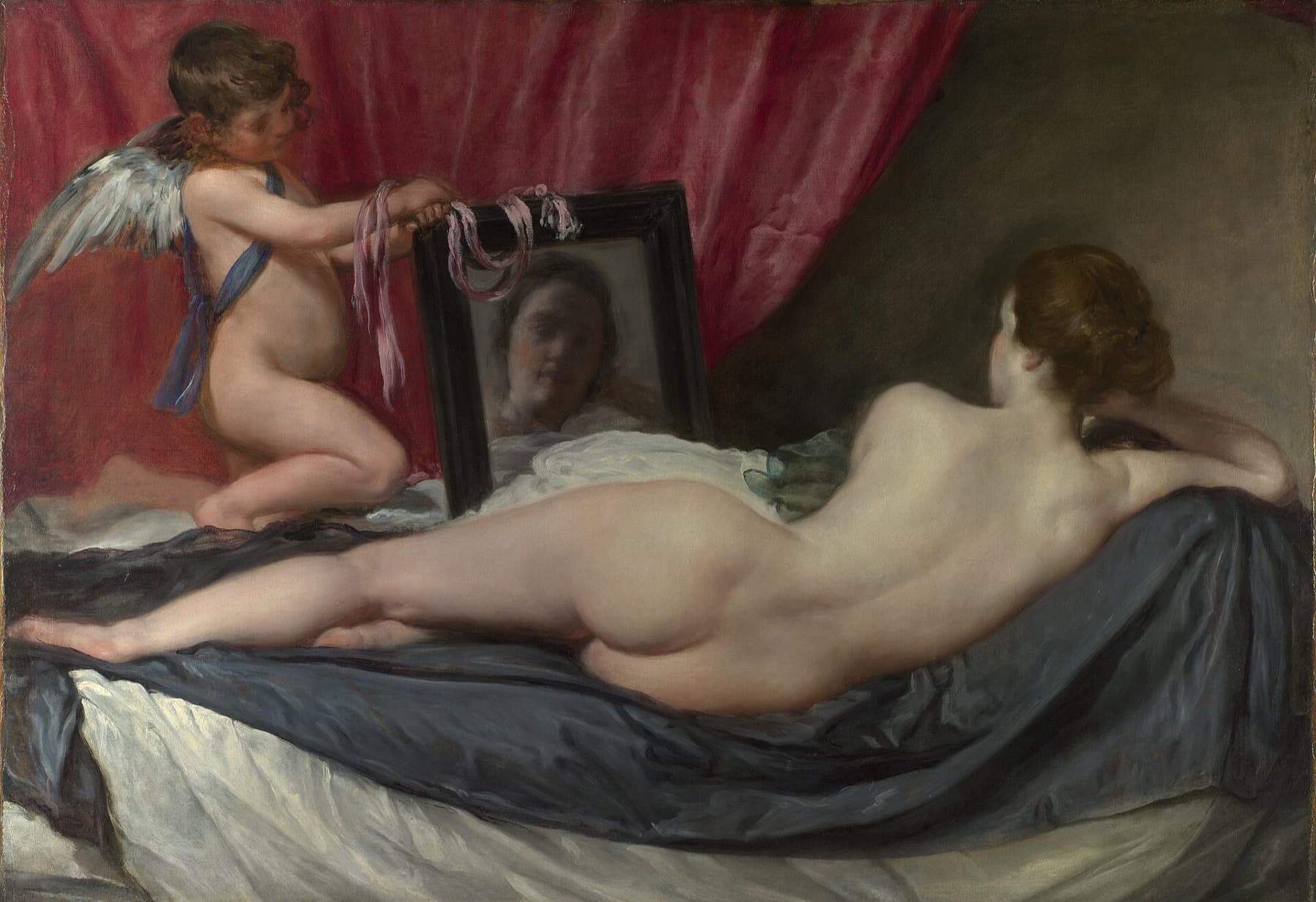
The Rokeby Venus: Velázquez's Mirror and the 1914 Attack