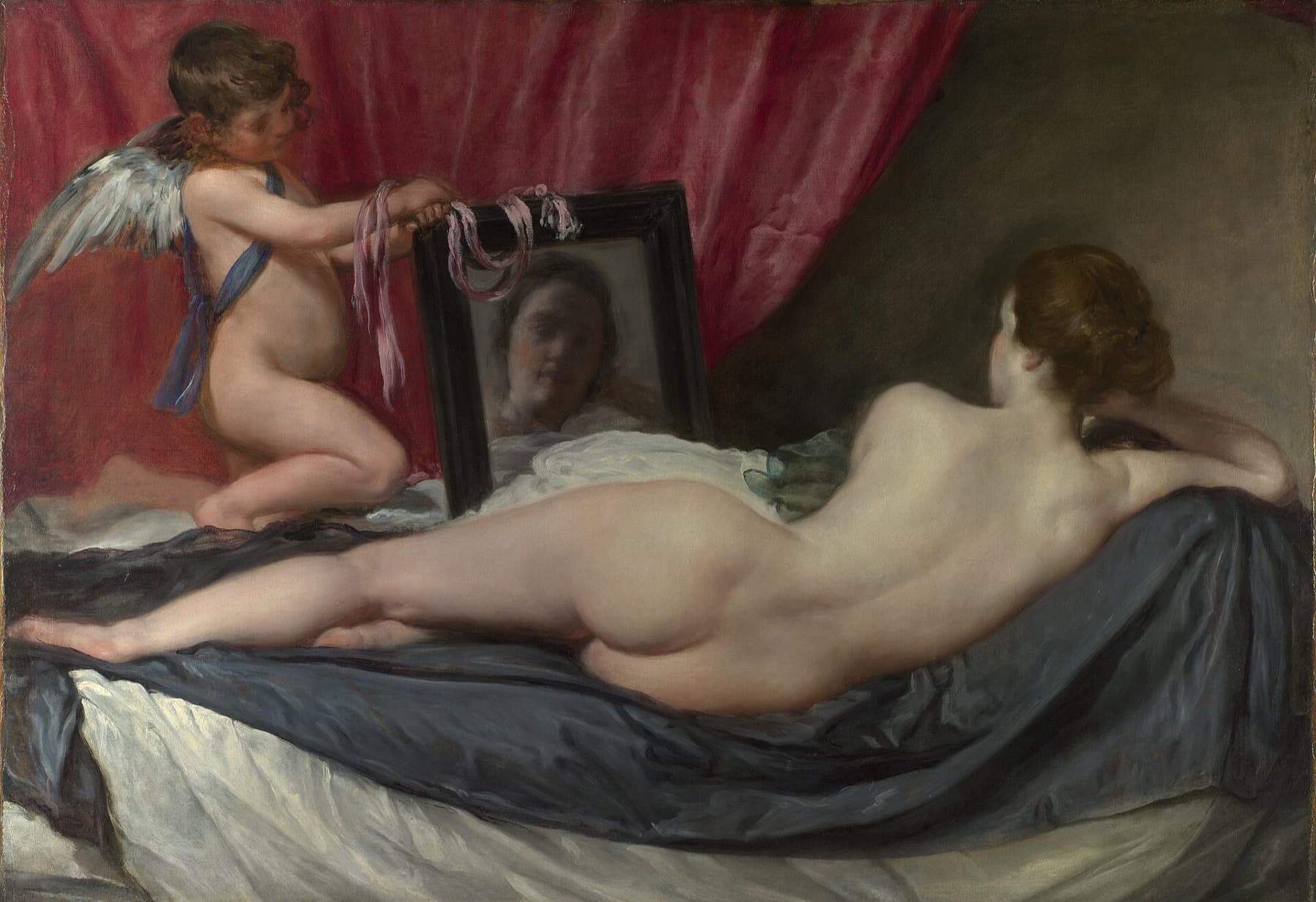
The Rokeby Venus, properly The Toilet of Venus, is an oil painting by Diego Velázquez made between 1647 and 1651. It shows Venus from behind, with Cupid holding up a mirror that reflects a deliberately blurred face. On 10 March 1914 the suffragette Mary Richardson slashed the canvas in protest at the government's treatment of Emmeline Pankhurst. It was repaired and hangs in Room 19 of the National Gallery, London.
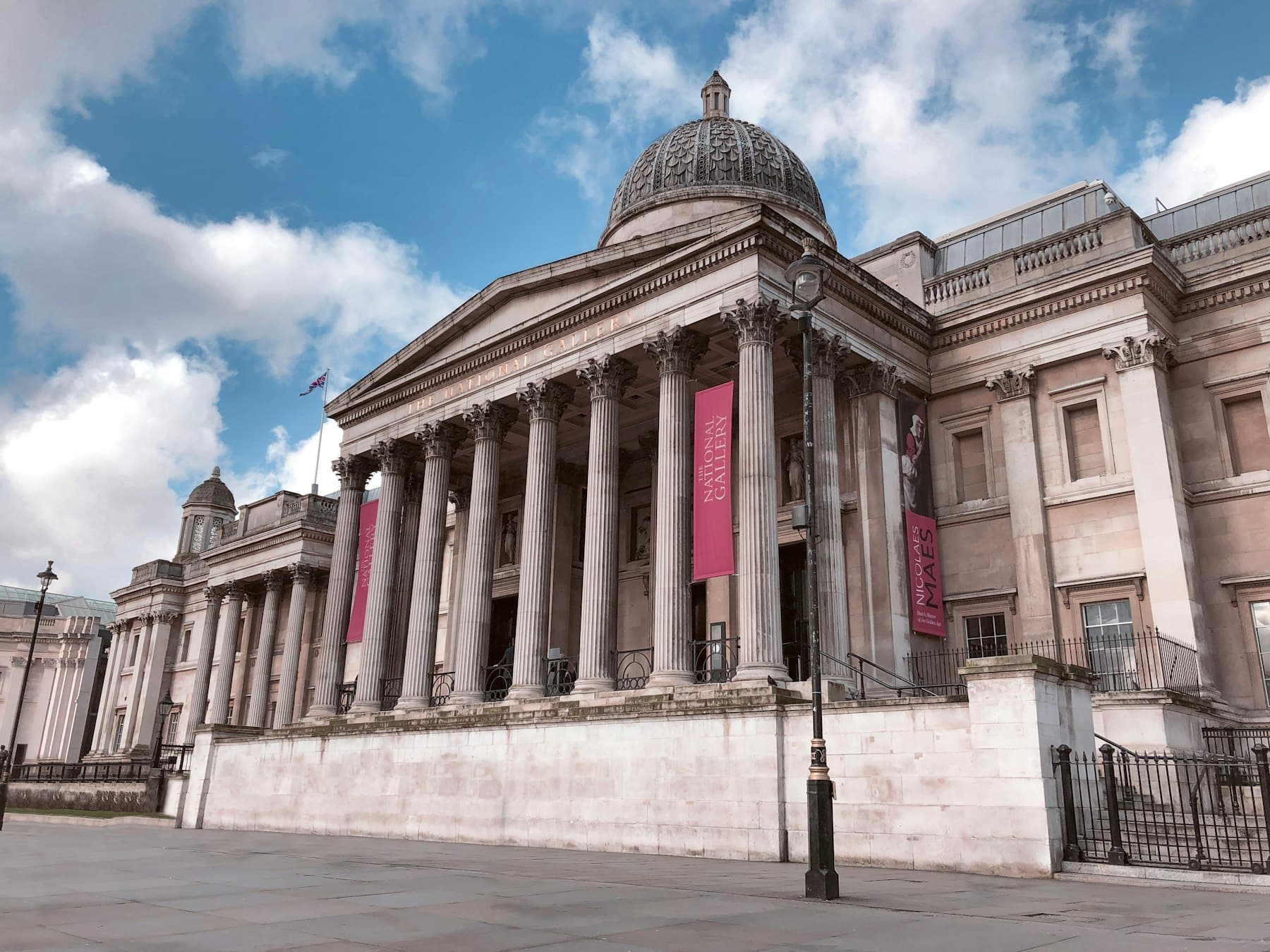
If you are asking where the Rokeby Venus is: it hangs in Room 19 of the National Gallery in London, the room of Spanish painting from the 1600s. Its full title is The Toilet of Venus, and it came to the gallery in 1906.
If you are asking why it was slashed: on 10 March 1914 the suffragette Mary Richardson walked into the gallery with a blade hidden on her and cut the canvas several times. It was a protest at the government's treatment of the suffragette leader Emmeline Pankhurst. The cuts were repaired, and Venus went back on the wall.
What the painting shows
Venus, goddess of love, lies on a bed with her back to us. The long curve from her shoulder to her hip is the whole subject, and the folds of the sheet beneath her echo it. The fabric under her now looks grey, but the gallery says it was originally more purple; the colour has faded.
Her son Cupid holds up a mirror to her. Pink silk ribbons are knotted at the top of its frame. The gallery says they were there to hang the mirror on a wall, and that the ribbons looped over Cupid's wrist may also hint at a blindfold, or at the bonds that tie lovers together. Cupid himself is painted loosely, almost sketchily, so that your eye stays on Venus. Behind them a red curtain sweeps across the top of the picture.
The canvas is about 1.2 metres high and 1.8 metres wide. It is dated 1647 to 1651, and the gallery says nobody knows exactly when or where Velázquez painted it: before, during or after his second visit to Italy, between 1649 and 1651.
The face in the mirror
Hear a stop from this walk
Victoria Tower Gardens: Pankhurst at Parliament's Door
Here is the puzzle that makes the painting famous. Look at the mirror. You might expect a clear reflection of the goddess. Instead the face is a soft blur.
The gallery's reading is that Velázquez did not want Venus to be anyone in particular: an ideal, not a portrait of a real woman who could be named. He also changed his mind as he worked. He first painted her head more in profile, with her nose visible, then turned it away.
The reflection does not work as optics either. Wikipedia points out that the face in the glass is much larger than a real reflection would be. The mismatch lets her seem to look out at us through the mirror while her body stays turned away, an effect sometimes called the Venus effect.
A rare subject in Spain
This is the only female nude by Velázquez that survives. In seventeenth-century Spain the subject was rare, because the Catholic Church disapproved of openly sensual images. The king and the rich collectors around him did own mythological nudes, including works by Titian and Rubens, and kept them in private rooms.
The painting's first owners fit that pattern. The gallery's records trace it to a 1651 inventory of the collection of Domingo Guerra Coronel, where it is described only as "a nude woman", and soon after to Gaspar de Haro, 7th Marqués del Carpio. It later passed to the Dukes of Alba. In the early 1800s the King of Spain, Charles IV, had the family sell it to his minister Manuel Godoy.
How it got its name
The nickname comes from Rokeby Park, a country house in the north of England. The painting reached England in 1813 and was bought by John Morritt, who hung it at Rokeby, where it stayed for most of the nineteenth century.
When the Morritt family sold it in 1905, a young charity stepped in. The National Art Collections Fund, founded in 1903 and known today as the Art Fund, bought it and presented it to the gallery in 1906. Wikipedia records that King Edward VII gave £8,000 toward the price, anonymously. The gallery's credit line still reads "Presented by the Art Fund, 1906".
10 March 1914: the attack
On 10 March 1914, Mary Richardson entered the National Gallery carrying a blade and attacked the Rokeby Venus. Wikipedia counts seven cuts, mostly across the figure's back between the shoulders. Press reports at the time called the weapon a hatchet, Wikipedia calls it a meat cleaver; the guide simply says a blade.
At her trial she explained the attack as a protest against the government for its treatment of Mrs Pankhurst. She said she had tried to destroy the picture of the most beautiful woman in mythology as a protest against the government for destroying Mrs Pankhurst. She was sentenced to six months in prison, which Wikipedia notes was the most the law allowed for damaging a work of art. The London Museum holds a photograph of her leaving for the police court on the day of the attack.
Years later, in a 1952 interview, Richardson added another reason: she had disliked the way male visitors gaped at the painting all day.
The repair
The cuts were repaired by the gallery's restorers. Wikipedia names Helmut Ruhemann, the chief restorer, as the man who did the work.
Seeing it in the gallery
The Rokeby Venus hangs in Room 19 with seven other paintings by Velázquez, from the hard, careful pictures of his early years in Seville to the loose flicks and dabs of his royal portraits. His portrait of Philip IV in brown and silver is in the same room. Stand back first and follow the curve of the body. Then go to the mirror, and try to read the face. You cannot, and that is the point.
The painting is on three of the Roamer guide's routes: the one-hour and two-hour plans, Tricks of the Eye (with the mirror in the Arnolfini Portrait and the skull in The Ambassadors), and Attacked, Stolen, Rescued, which visits seven paintings that were shot at, stolen, slashed or cut apart. For the rest of the building, read what to see at the National Gallery. Emmeline Pankhurst's statue in Victoria Tower Gardens, beside Parliament, is the last stop of Roamer's Westminster walk.
How this fits the Roamer guide
Roamer's independent audio guide to the National Gallery has a short story for the Rokeby Venus in Room 19, from the blurred mirror to the morning in 1914. Play it in front of the painting, at your own pace, and skip ahead whenever you like. You can find it in the National Gallery guide.
Cover image: Diego Velázquez, The Toilet of Venus ('The Rokeby Venus'), 1647 to 1651, National Gallery, London, public domain, via Wikimedia Commons.

Ready to experience it?
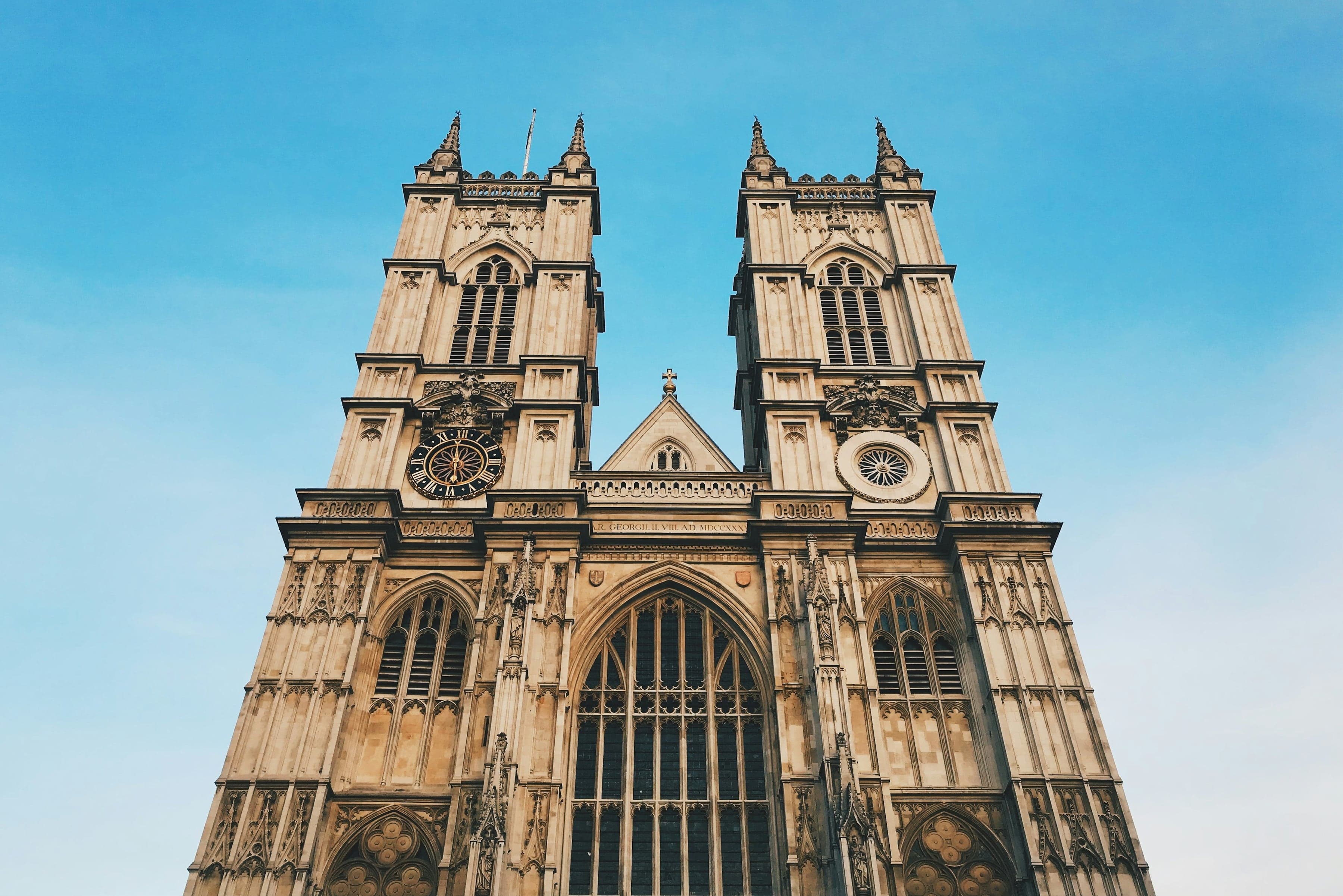
Westminster: The Rebels at Parliament's Gates
90 min · 2.9 km · easy
More from London
Explore more at your own pace.
British Museum: What to See, Floor by Floor
The Arnolfini Portrait: The Mirror, the Meaning and the Myths
The Fighting Temeraire: Turner's Last Voyage of a Trafalgar Ship
The Lewis Chessmen: Kings, Queens and Berserkers in Room 40
The Parthenon Sculptures: What Is in Room 18 and How It Got There