Markt: The Two Squares That Ran a Medieval City
50 min · 0.7 km · easy
Bruges kept its medieval fabric because it fell poor and slept for four centuries. In the fifteenth century this was the richest market city of northern Europe, the northern seat of the Dukes of Burgundy, where the wool of England, the wine of France, and the spices of the East changed hands. Then the tidal inlet that linked it to the sea silted up around fifteen hundred, trade moved to Antwerp, the harbour emptied, and the city grew too poor to rebuild and too quiet to modernise. That long sleep is the reason the golden age is frozen here intact. The boom and the ruin are the same story told from two ends, and you can read both at your own pace on foot.
The wealth froze because the water left
Everything in Bruges begins and ends at a harbour that stopped working. The city reached the North Sea not directly but through the Zwin, a tidal inlet, and when the Zwin began silting up around fifteen hundred the ships could no longer reach the quays. Trade shifted to Antwerp, and through the seventeenth century Bruges grew impoverished. That poverty is the preservative. Too poor to knock down and rebuild, the city held its medieval stone frozen for four hundred years, until it became one of the world's early tourist destinations in the later nineteenth century. UNESCO inscribed the Historic Centre of Bruges as a World Heritage Site in the year two thousand, an outstanding example of a medieval settlement that kept its old fabric where wealthier cities lost theirs.
You feel the switch most plainly on the old Hanseatic waterfront. On the Church of Our Lady art walk, the route ends at Jan van Eyck Square, once the beating financial quay of the richest city in northern Europe, ringed by the Poortersloge (the Burghers' Lodge, built about fourteen seventeen) and the old Tolhuis (the toll house rebuilt about fourteen seventy-seven, where port tolls were levied). The canal and Beguinage walk reaches the same water from the other side, at the Spiegelrei, where German, Italian, and Spanish merchants once tied up three and four deep. Stand there now and the quay is broad and silent. The stillness you enjoy is the sound of a great port that stopped.
Two squares ran the city: commerce and power
Hear a stop from this walk
The Burg and the Town Hall: The Square of Power
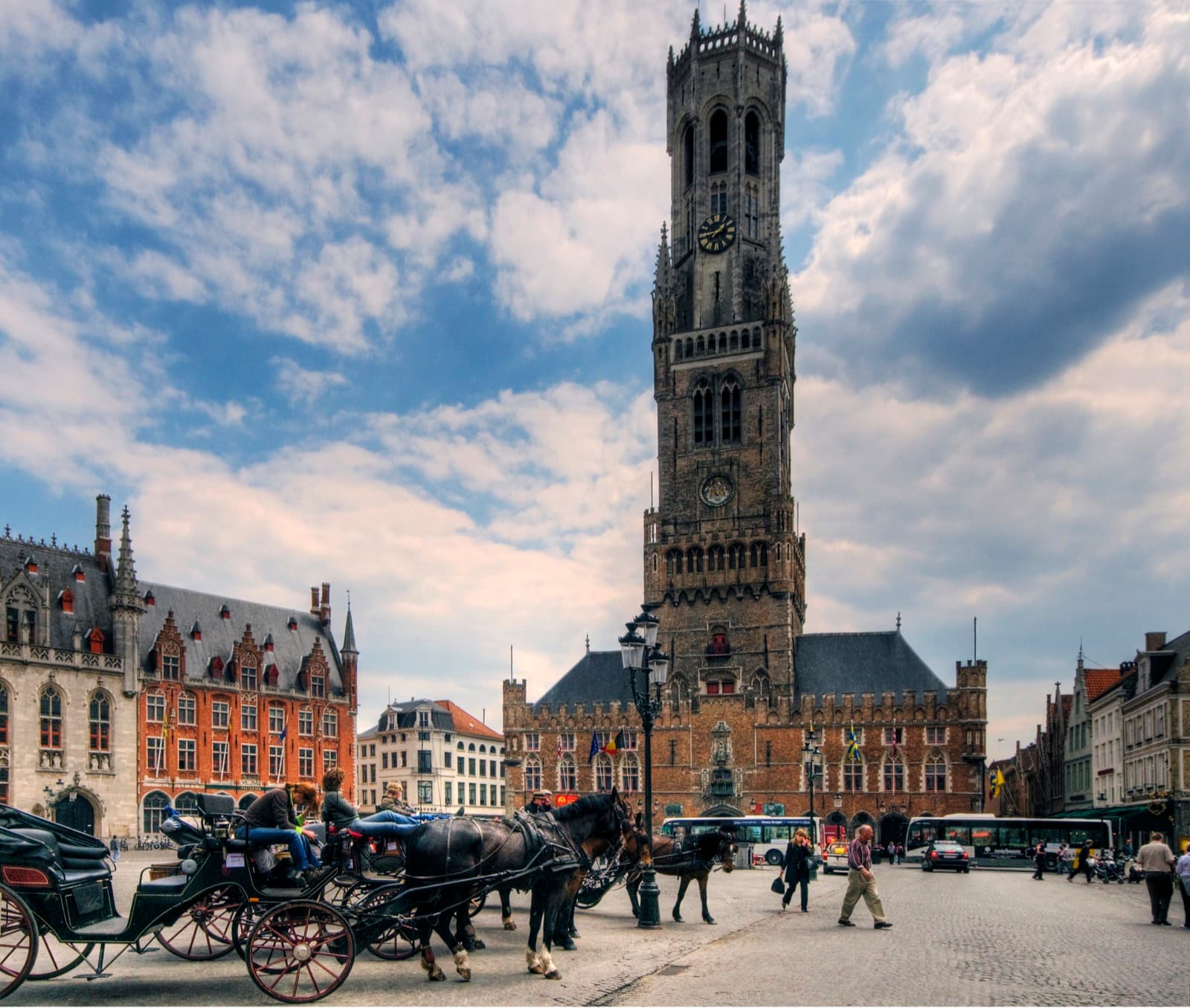
The old town is still ordered by the two squares that once governed it, and the Markt historic-center walk reads Bruges through both. The Markt was the square of commerce, dominated by the Belfry, about eighty-three metres of brick leaning roughly eighty-seven centimetres to the south-east, its octagonal crown built between fourteen eighty-three and fourteen eighty-seven. Beneath the tower stood the Hallen, the cloth halls, where the city kept its charters and treasury in a strong-room. The Belfry was a safe as much as a bell tower, and its carillon, forty-seven bells today, once rang the working day of the whole city.
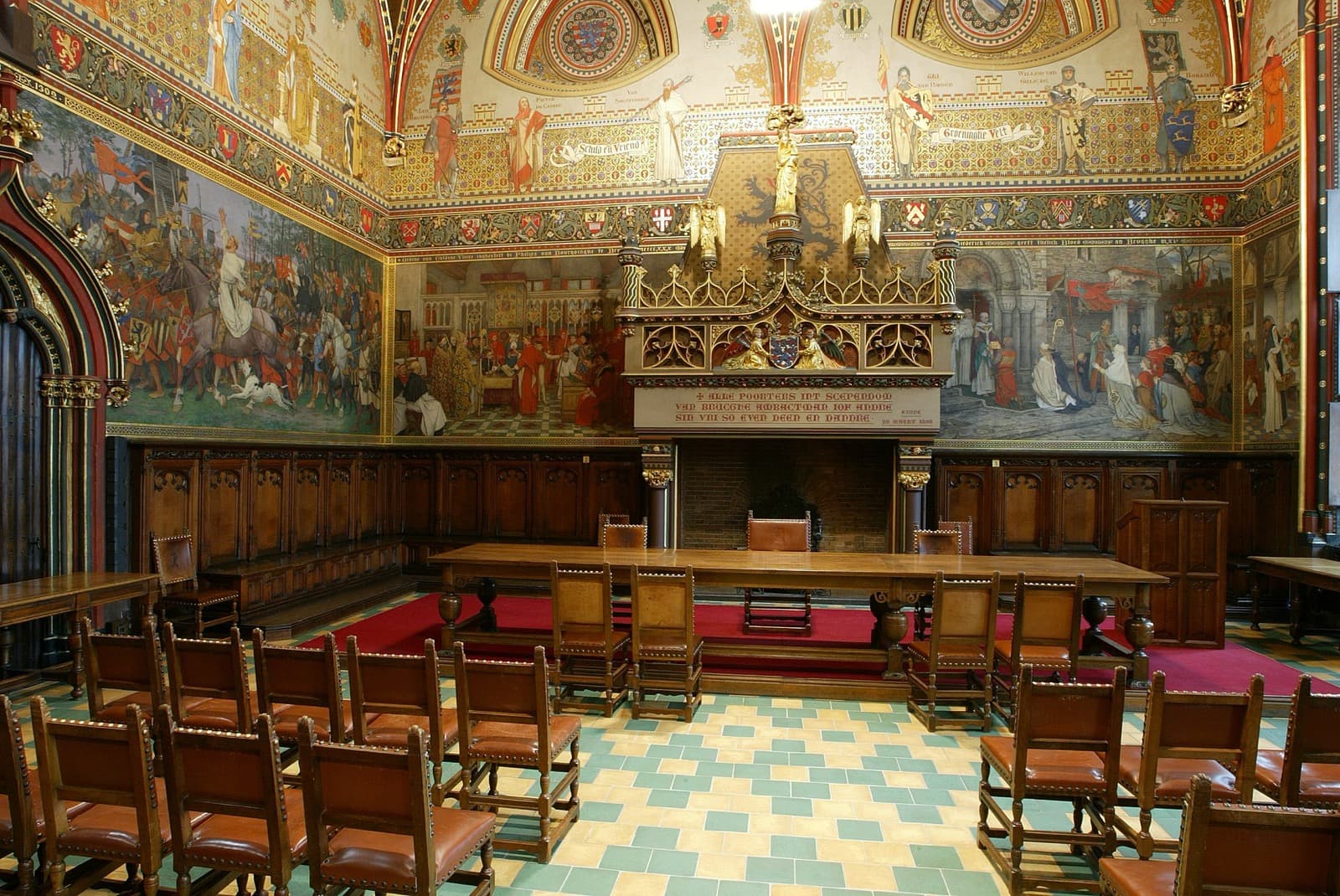
A few hundred metres away is the Burg, the square of power, the old fortress of the counts of Flanders. Its Town Hall, the Stadhuis, is one of the oldest in the former Burgundian Netherlands: Count Louis of Male laid the foundation stone in thirteen seventy-six and it was finished in fourteen twenty-one. In a corner stands the Basilica of the Holy Blood, two churches stacked one on the other, a plain Romanesque lower chapel built between eleven thirty-four and eleven forty-nine beneath an ornate Gothic upper chapel that keeps a phial said to hold cloth stained with the blood of Christ. Each spring on Ascension Day the relic is carried through the streets in the Procession of the Holy Blood. This was a merchant city that could also jail its own prince: in February fourteen eighty-eight the guilds held Archduke Maximilian of Austria, the future Holy Roman Emperor, prisoner in the Cranenburg House on the Markt for weeks, a standoff that ended with the Peace of Bruges.
The money bought a golden age of art
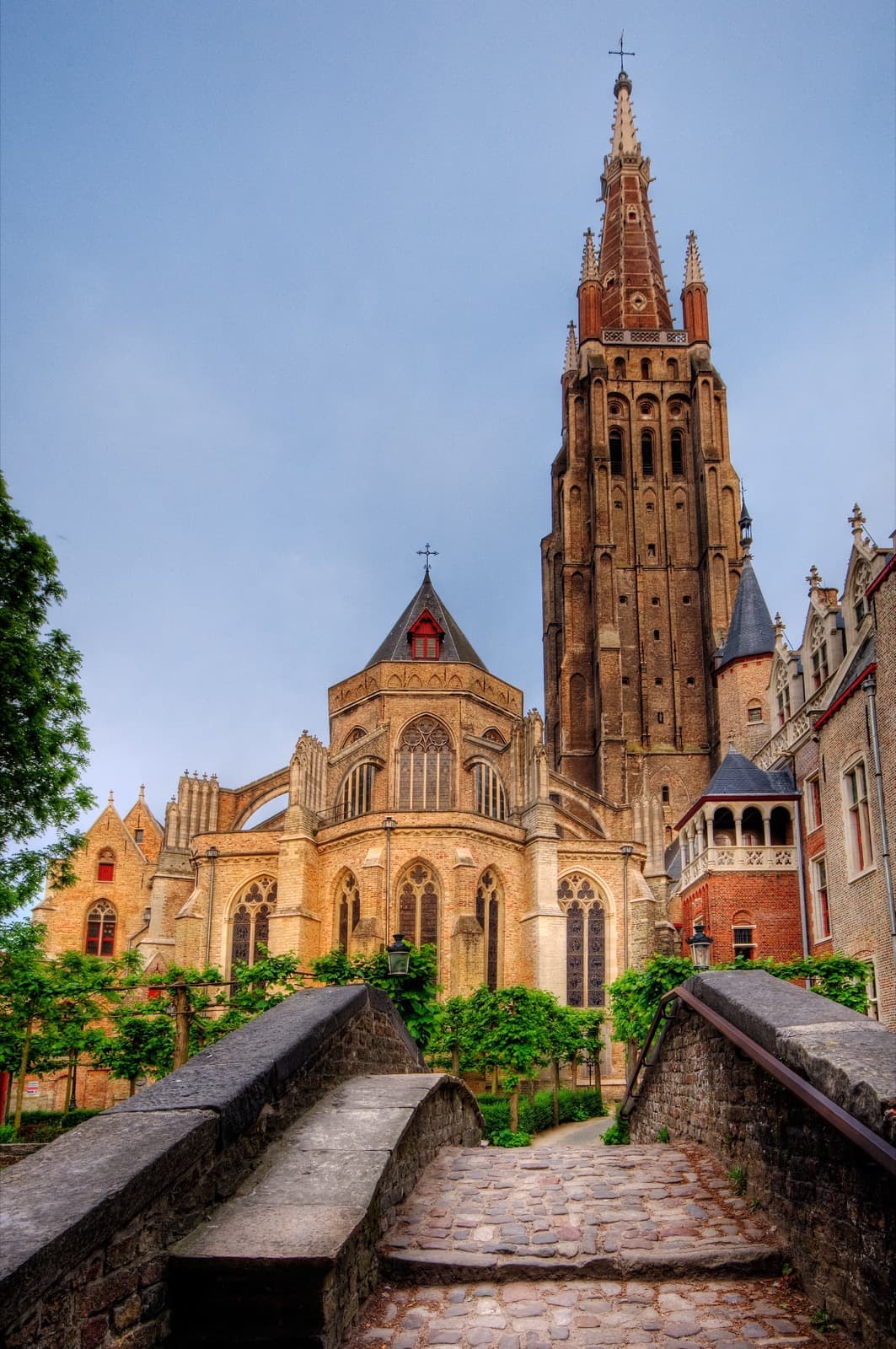
The wealth that flowed through those squares drew painters and sculptors, and it is the reason a Flemish market town holds work of the first rank. The clearest single fact sits in the Church of Our Lady, whose brick tower, about one hundred fifteen metres, is the tallest structure in the city. Inside stands the Madonna of Bruges, a marble Virgin and Child carved by Michelangelo around fifteen oh four to fifteen oh six. It is the only sculpture Michelangelo let leave Italy during his lifetime, and it came not as a princely gift but because two Bruges merchant brothers, Jan and Alexander Mouscron, bought it in Italy with trading money and installed it about fifteen fourteen. A young genius in Florence, and enough wealth in a Flemish town to reach across a continent and buy his work.
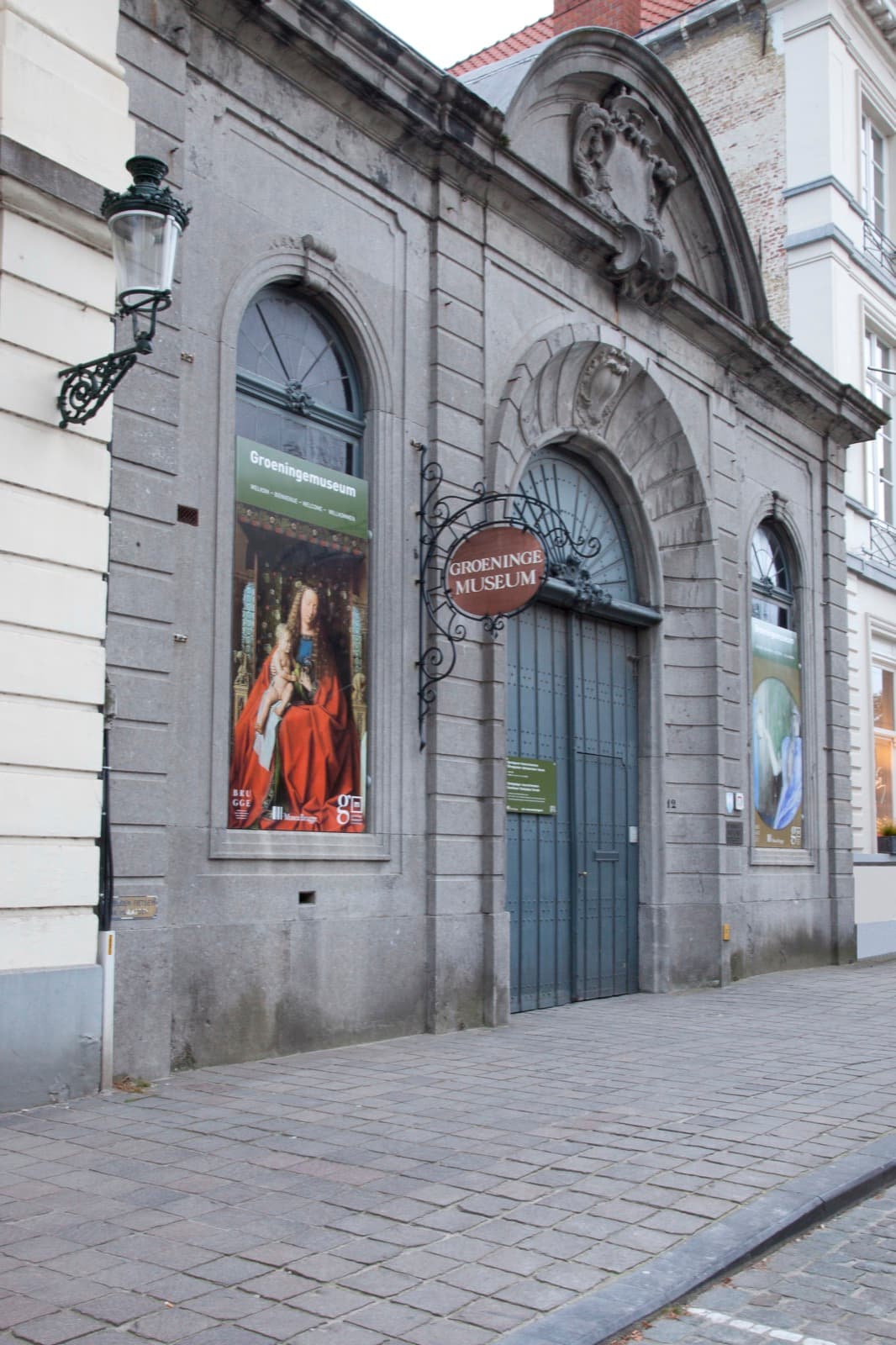
The painters left even more. At the Groeningemuseum on the Dijver hangs Jan van Eyck's Virgin and Child with Canon van der Paele, made about fourteen thirty-four to fourteen thirty-six, where velvet has weight and armour throws real reflections. Van Eyck did not invent oil painting, but here you can see him carry it to a height no one had reached. The museum also holds Gerard David and Hans Memling, the Flemish Primitives whose city this was. At the Old Saint John's Hospital, one of the oldest surviving hospital complexes in Europe and a working hospital until nineteen seventy-seven, the medieval wards keep six Memling masterpieces, several painted for the hospital itself. The centrepiece is the Shrine of Saint Ursula, a wooden reliquary shaped like a Gothic chapel, made about fourteen eighty-two to fourteen eighty-nine. A rich city did not only buy Michelangelos: it filled a hospital for the poor with paintings of the first rank, and they stayed because the city grew too poor to sell them.
Even the machinery of the boom survives. On the modest Beursplein stands the Huis ter Beurze, the inn of the Van der Beurze family, whose coat of arms bore three purses. From that shield came the word bourse, still used across Europe for a money exchange. The grandest claim, that this was the first stock exchange, is genuinely contested, and the purpose-built Antwerp exchange of fifteen thirty-one is often called the first of its kind. The fairest thing to say is that this quiet corner is a widely cited ancestor of the modern exchange.
The Venice of the North kept its hush
The canals, the reien, are why the city is called the Venice of the North, and they carry the same lesson: the calm is survival, not decoration. On the water walk the leafiest, least crowded canals, the Dijver and the Groenerei, run past step-gabled houses that lean their reflections into still green water. The Meebrug over the Groenerei is a fourteenth-century bridge the city describes as probably the oldest in town. At the southern edge sits the Minnewater, the Lake of Love, once the inner harbour where trading barges moored on their way to the sea, now the stillest water in Bruges.
The deepest quiet is the Begijnhof, the Princely Beguinage Ten Wijngaerde, founded about twelve forty-four by Margaret of Constantinople, a walled court of about thirty whitewashed houses around a green of poplars. Beguines were laywomen who lived a religious, near-silent life without taking permanent vows; they could keep their property and, in principle, leave. UNESCO inscribed the court in nineteen ninety-eight as one of thirteen Flemish Beguinages, and Benedictine nuns have kept the silence since nineteen twenty-seven. Out on the green eastern rampart, four windmills stand along the old wall, and the Sint-Janshuismolen, dating to seventeen seventy, is the only one that still grinds grain. From the Lake of Love to the windmills on the wall, the whole water city stays quiet because its harbour switched off. Read the frozen golden age slowly. For more, see all Bruges walking tours.
Sources
- UNESCO World Heritage Centre, Historic Centre of Brugge (inscribed 2000), whc.unesco.org
- UNESCO World Heritage Centre, Flemish Béguinages (inscribed 1998), whc.unesco.org
- Musea Brugge, Groeningemuseum, Gruuthuse, and Sint-Janshospitaal collections, museabrugge.be
- Visit Bruges official city tourism, the Belfry, the Burg, the Beguinage and the canals, visitbruges.be
- Church of Our Lady Bruges, the Madonna of Bruges by Michelangelo, museabrugge.be
Frequently asked questions
- Why is Bruges so well preserved?
- Bruges reached the sea through the Zwin tidal inlet, which began silting up around fifteen hundred. Trade moved to Antwerp and the city grew impoverished through the seventeenth century. Too poor to rebuild and too quiet to modernise, Bruges kept its medieval fabric frozen intact for about four hundred years until it became a tourist destination in the later nineteenth century.
- Is there really a Michelangelo sculpture in Bruges?
- Yes. The Madonna of Bruges, a marble Virgin and Child carved by Michelangelo around fifteen oh four to fifteen oh six, stands in the Church of Our Lady. It is the only sculpture Michelangelo let leave Italy during his lifetime. Two Bruges merchant brothers, Jan and Alexander Mouscron, bought it in Italy with trading money and installed it about fifteen fourteen.
- When was Bruges made a UNESCO World Heritage Site?
- The Historic Centre of Bruges was inscribed as a UNESCO World Heritage Site in the year two thousand, recognised as an outstanding example of a medieval settlement that retained its historic fabric. Separately, the Bruges Beguinage was inscribed in nineteen ninety-eight as one of thirteen Flemish Beguinages.
- Why is Bruges called the Venice of the North?
- A web of canals called the reien threads the old town, doubling the step-gabled houses in still green water, which earned Bruges the nickname Venice of the North. The canals were once working transport corridors that connected the medieval port to the North Sea. When trade left, the water fell quiet, which is why the canals feel so calm today.
- What two squares are at the center of medieval Bruges?
- The Markt was the square of commerce, dominated by the Belfry over the cloth halls where the city's charters and treasury were kept. The Burg, a few hundred metres away, was the square of power, holding the Town Hall begun in thirteen seventy-six and the Basilica of the Holy Blood. Together they governed the medieval city.
Ready to experience it?
Markt: The Two Squares That Ran a Medieval City
50 min · 0.7 km · easy
More from Bruges
Explore more at your own pace.
The Church of Our Lady in Bruges: A Michelangelo Madonna and the Frozen Golden Age
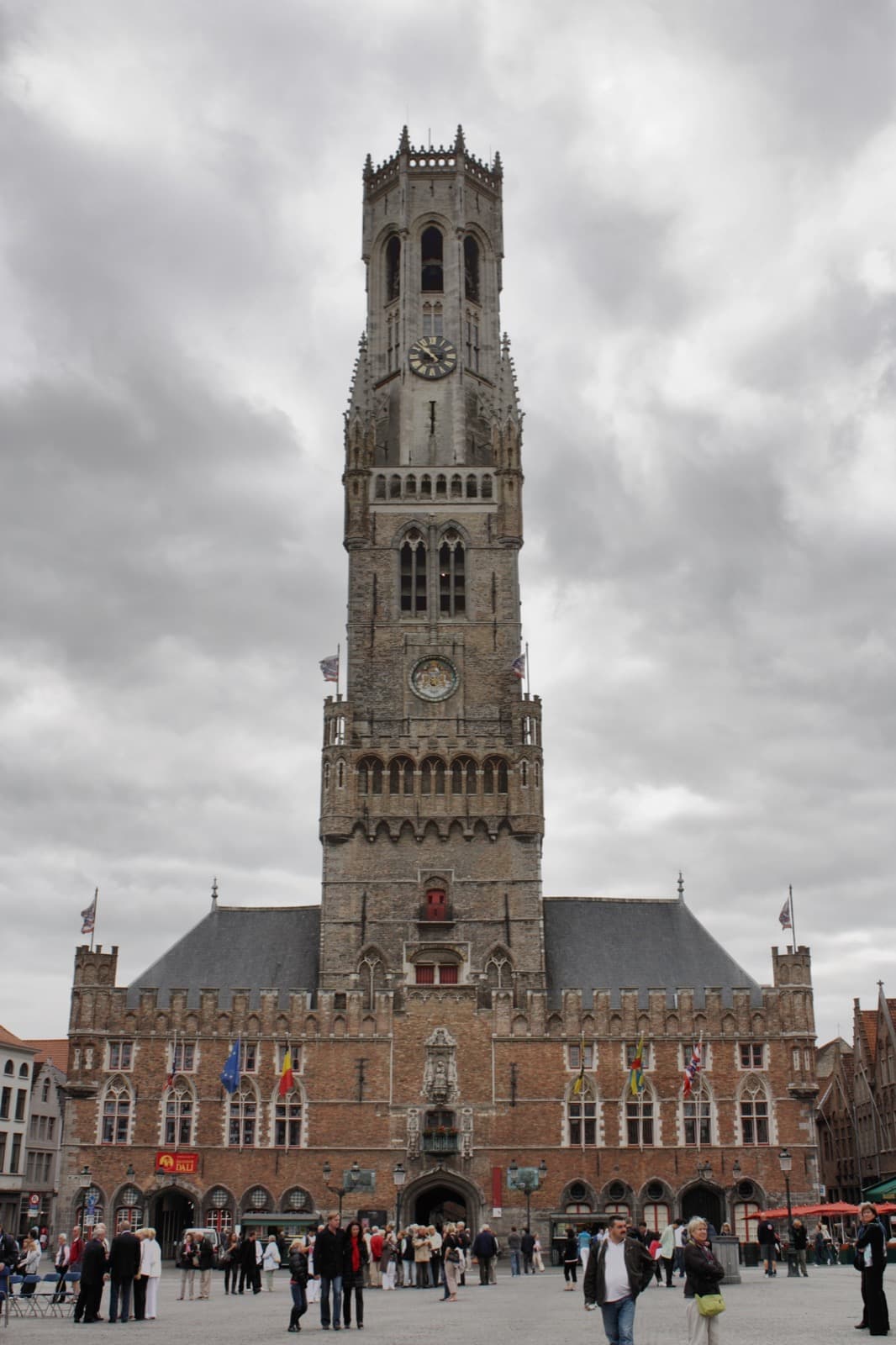
The Markt and the Belfry: How Two Squares Ran Medieval Bruges
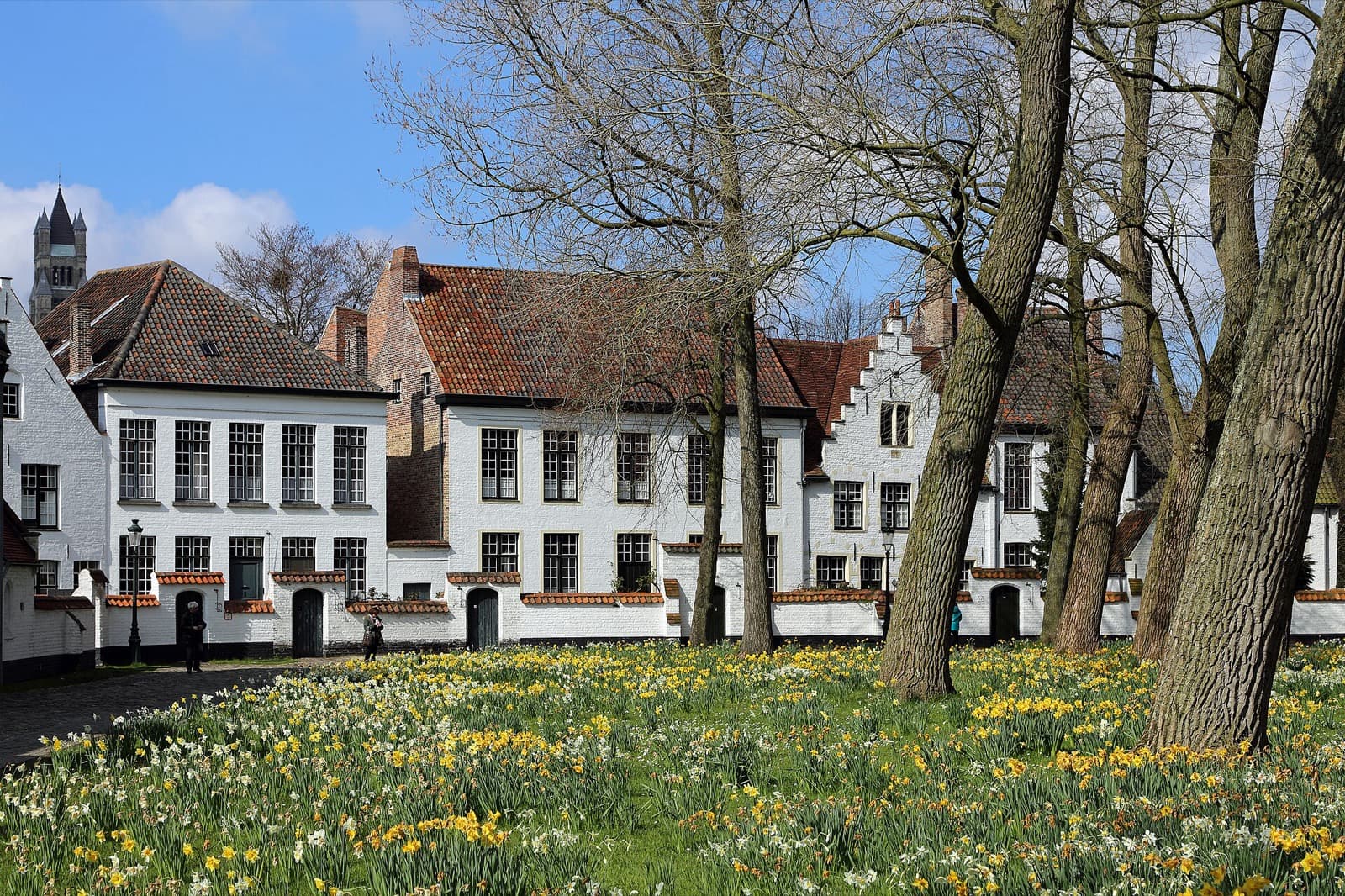
The Silent Beguinage: How an Emptied Harbour Preserved Bruges
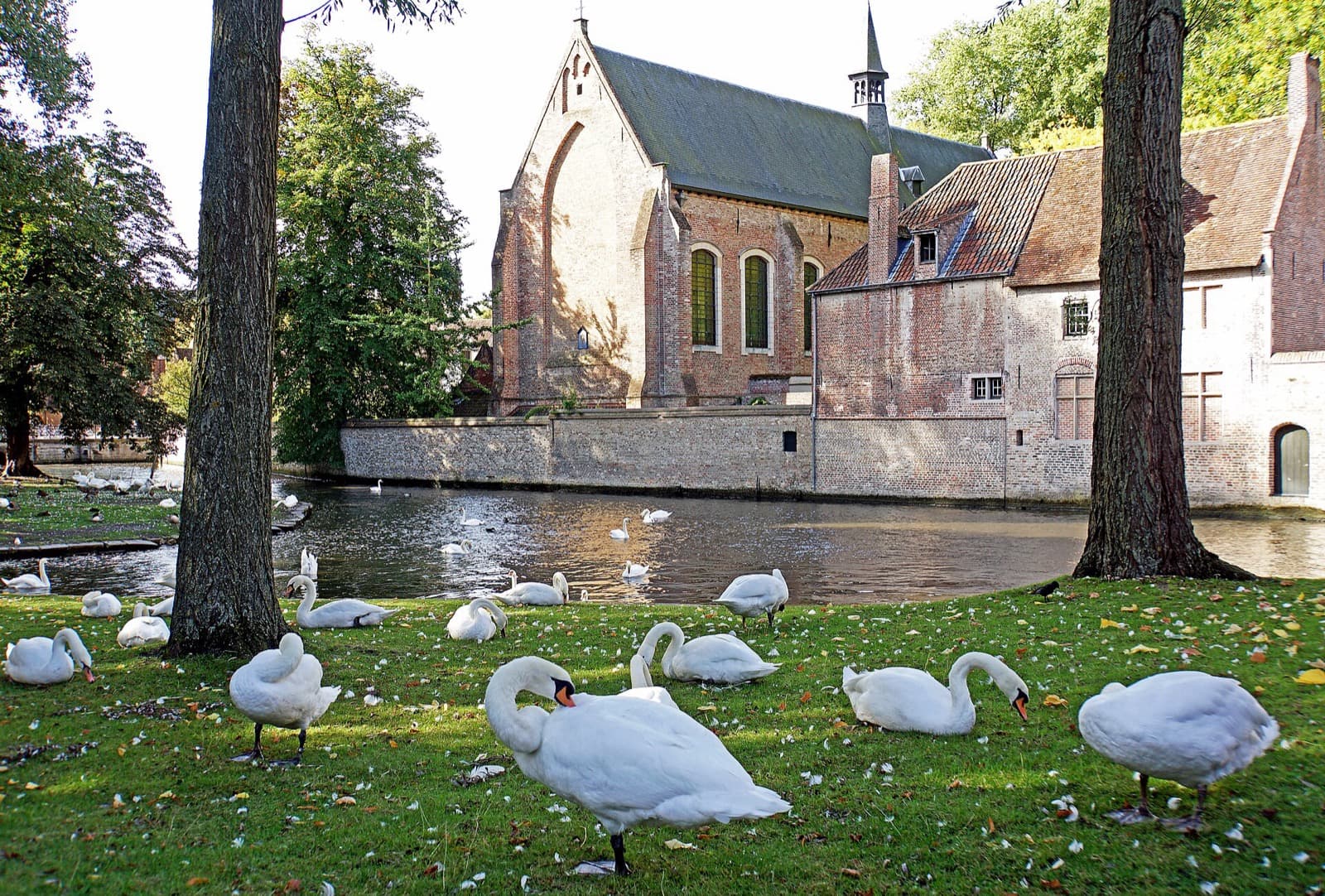
Minnewater in Bruges: The Lake of Love That Was Once a Harbor
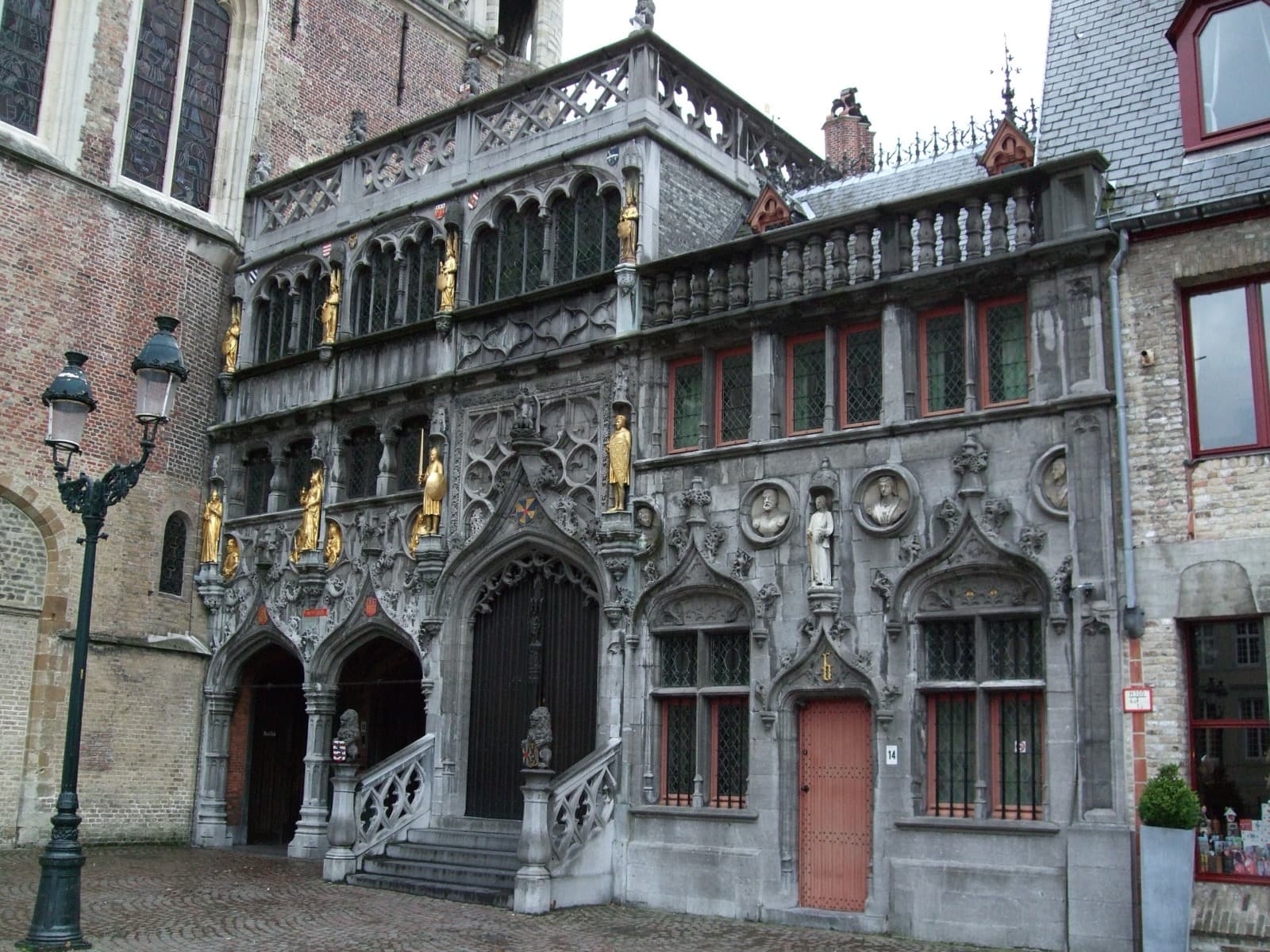
The Basilica of the Holy Blood in Bruges: One Church, Two Chapels, One Relic