Bruges preserves its golden age not despite its collapse but because of it, and the clearest place to feel that paradox is the Church of Our Lady, where a marble Madonna carved by Michelangelo sits inside a merchant town that fell silent for four centuries. The church anchors a walk that reads the wealth, the painters, the boom and the ruin as one continuous story. You start at the tallest thing in Bruges and end at a dead harbour, and the wealth that summoned a Michelangelo north is the same wealth whose disappearance froze the medieval city in place. That is the argument the whole route is built to prove, and the Church of Our Lady is where it begins.
A marble Madonna in a brick tower
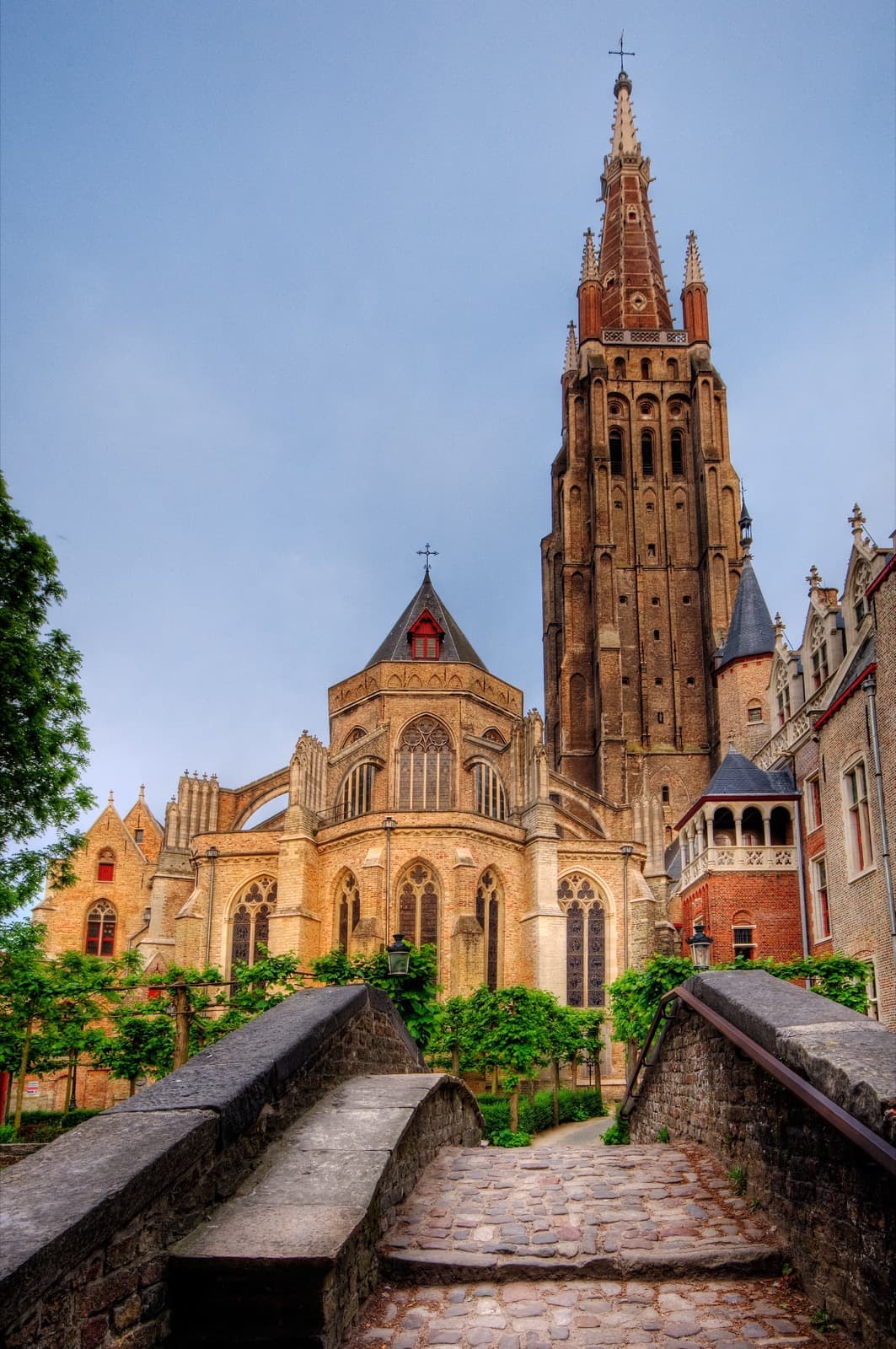
The Church of Our Lady, the Onze-Lieve-Vrouwekerk, carries a brick tower rising about one hundred fifteen metres, the tallest structure in the city and one of the tallest brick church towers in the world. That detail matters more than it first seems. Bruges had no natural stone to boast with, so it built its great vertical statement out of fired clay. The tower is a merchant town flexing in the only material it had.
Inside, in a chapel of its own, stands the Madonna of Bruges, a marble Virgin and Child carved by Michelangelo around fifteen oh four. It is the only sculpture Michelangelo let leave Italy during his lifetime. And here is the fact that holds the entire tour together: it did not arrive as a princely commission or a gift from the church. Two Bruges merchant brothers, Jan and Alexander Mouscron, bought it in Italy with trading money and installed it here about fifteen fourteen. A young genius working in Florence, and a Flemish market town with enough money to reach across a continent and simply purchase his work.
Behind the high altar lie the tombs of Charles the Bold, the last Valois Duke of Burgundy, and his daughter Mary of Burgundy, their gilded bronze effigies resting where the dukes ruled the north. The heart of Philip the Handsome is interred here too. So the anchor stop is doing double duty: it is an art shrine and a Burgundian mausoleum, wealth and power in one dim brick room. Stand as close to the Madonna as the rope allows, and let the scale of that reach settle on you. This is the promise the rest of the walk pays off.
Why the wealth was here at all
Hear a stop from this walk
The Old Saint John's Hospital: A Medieval Ward Full of Memling
To understand the Madonna, you need the city that could afford her. In the fifteenth century Bruges was the richest and most sophisticated market city of northern Europe, the northern seat of the Dukes of Burgundy, where the wool of England, the wine of France and the spices of the East changed hands. That commerce is the engine behind every stop.
The route makes the point in ways you would never guess. Beside the church stands the Gruuthuse, and its fortune came from something almost comic: a monopoly on gruut, the blend of dried herbs used to flavour and preserve beer before hops became standard. The building started in the thirteenth century as a plain herb warehouse. Around fourteen seventy-two Louis de Gruuthuse added a private oratory, a small window connecting the house directly to the choir of the Church of Our Lady next door, so the family could hear Mass without leaving home. Wealth built on beer herbs, reaching straight into the sacred heart of the city. If you want to plan the fuller picture of the medieval town, the Bruges walking tours hub sets this route against the rest of the old centre.
The painters the money paid for
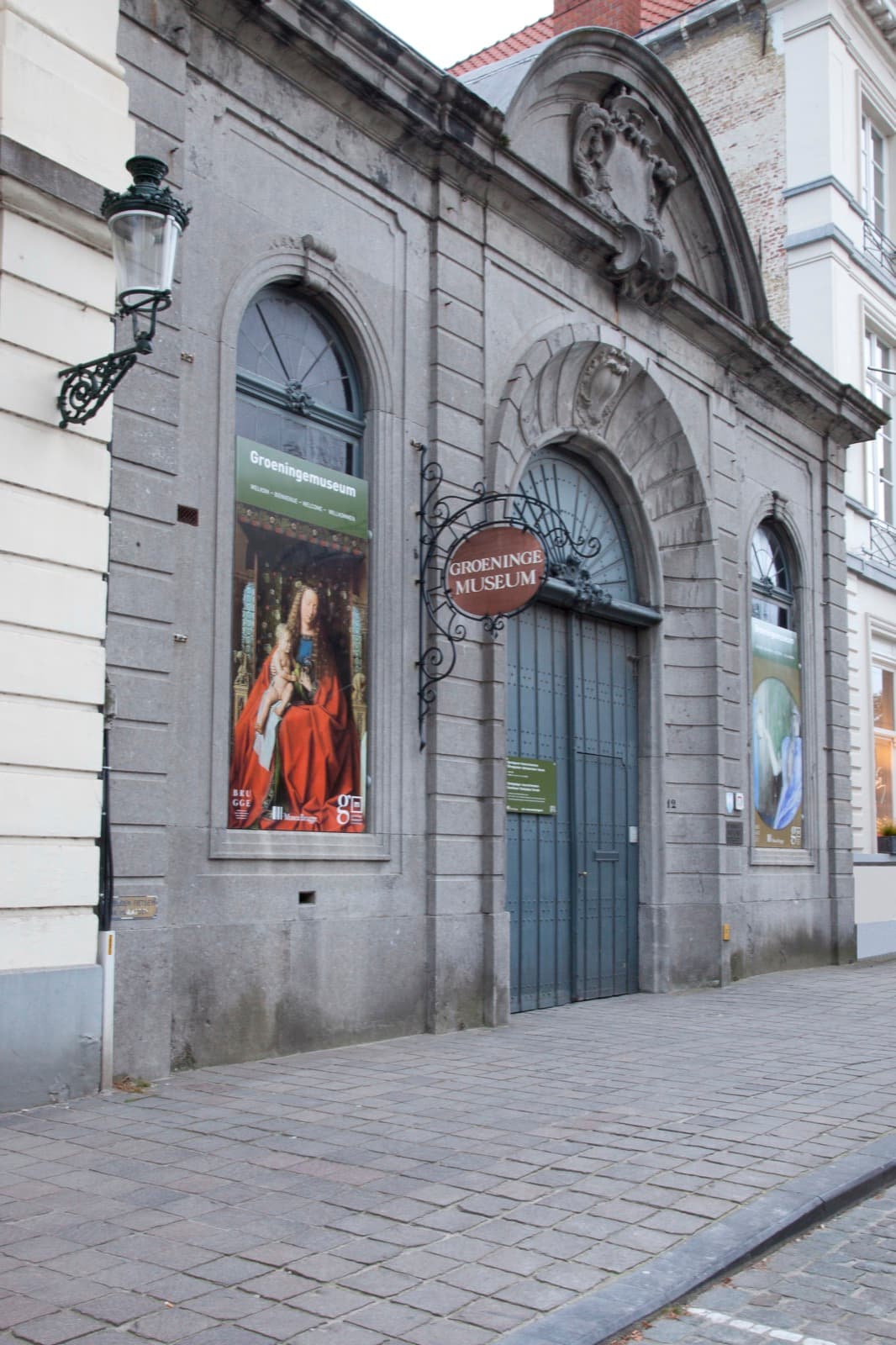
The wealth bought paintings, and the walk carries you to the room where oil painting came of age. The Groeningemuseum, on the Dijver canal and opened in nineteen thirty, holds Jan van Eyck's Virgin and Child with Canon van der Paele, made about fourteen thirty-four to thirty-six. Stand in front of it and the case for oil paint makes itself. The velvet has weight, the carpet has pile, the old canon's stubbled chin and the reflections in the armour are rendered with a precision that had not existed before. Van Eyck did not invent oil painting, but here you watch him carry it to a height no one had reached. The same rooms gather Hans Memling and Gerard David, whose stark Judgment of Cambyses dates from fourteen ninety-eight.
Then the walk turns from wealth to care. The Old Saint John's Hospital, founded in the mid-twelfth century, is among the oldest surviving hospital complexes in Europe, and it nursed the sick and pilgrims until nineteen seventy-seven. Its medieval wards now hold six masterpieces by Hans Memling, several made for the hospital itself. The centrepiece is the Shrine of Saint Ursula, a wooden reliquary painted in the shape of a Gothic chapel about fourteen eighty-two to fourteen eighty-nine, its long sides telling the legend of Saint Ursula and the eleven thousand virgins in six small scenes. A rich city did not only buy Michelangelos. It filled a hospital for the poor with paintings of the first rank, and the paintings stayed because the city later grew too poor to sell them.
The boom, the ruin, and the reason it survives
The last stops close the loop. Saint Saviour's is the oldest parish church in Bruges, its Gothic brick fabric of the thirteenth and fourteenth centuries, yet it became a cathedral only in eighteen thirty-four, after French Revolutionary occupiers destroyed the earlier Saint Donatian's cathedral on the Burg. The Van Eyck you just saw was originally made for that lost church. Even the cathedral of Bruges is a survivor.
The Exchange Square gives Europe a word. The Van der Beurze family, whose arms bore three purses, ran the inn where merchants gathered to trade, and from buerzen came bourse, the term for a money exchange. The story is often told too grandly. You will hear this called the first stock exchange in the world, but the dates are contested and the purpose-built Antwerp exchange of fifteen thirty-one is often called the first of its kind. The honest claim is that this modest square is an ancestor of the modern exchange, not the undisputed first.
The walk ends at Jan van Eyck Square, the Hanseatic financial heart, where the Burghers' Lodge of about fourteen seventeen and the old toll house rebuilt about fourteen seventy-seven still stand. Bruges reached the sea through the Zwin tidal inlet, which began silting up around fifteen hundred. The ships could no longer reach the city, trade shifted to Antwerp, and Bruges grew poor and quiet. That poverty is exactly why everything you have walked survives. Too poor to rebuild, too quiet to modernise, the city kept its medieval fabric frozen for four hundred years, and UNESCO inscribed its Historic Centre as World Heritage in the year two thousand.
Walk it slowly, in order, at your own pace. The Michelangelo Madonna and the dead harbour are the same story told from both ends, and you can find the full route and the rest of the city on the Bruges page.
Sources
- Church of Our Lady, Bruges (Wikipedia): the brick tower, the Michelangelo Madonna, and the Burgundian tombs behind the high altar.
- Madonna of Bruges (Wikipedia): the only Michelangelo sculpture to leave Italy in his lifetime, purchased by the Mouscron brothers.
- Groeningemuseum and Virgin and Child with Canon van der Paele (Wikipedia): Van Eyck's oil technique and the Flemish Primitive collection.
- St. Ursula Shrine and Old St. John's Hospital (Wikipedia): the Memling reliquary and the medieval hospital that became a museum.
- The origins of the stock exchange (National Bank of Belgium Museum): the Van der Beurze inn and the disputed birth of the bourse.
Ready to experience it?
Church of Our Lady: Van Eyck, Michelangelo and the Frozen Golden Age
65 min · 2 km · moderate
More from Bruges
Explore more at your own pace.
Bruges Travel Guide 2026: Days, Transport, Timing, Safety, Budget
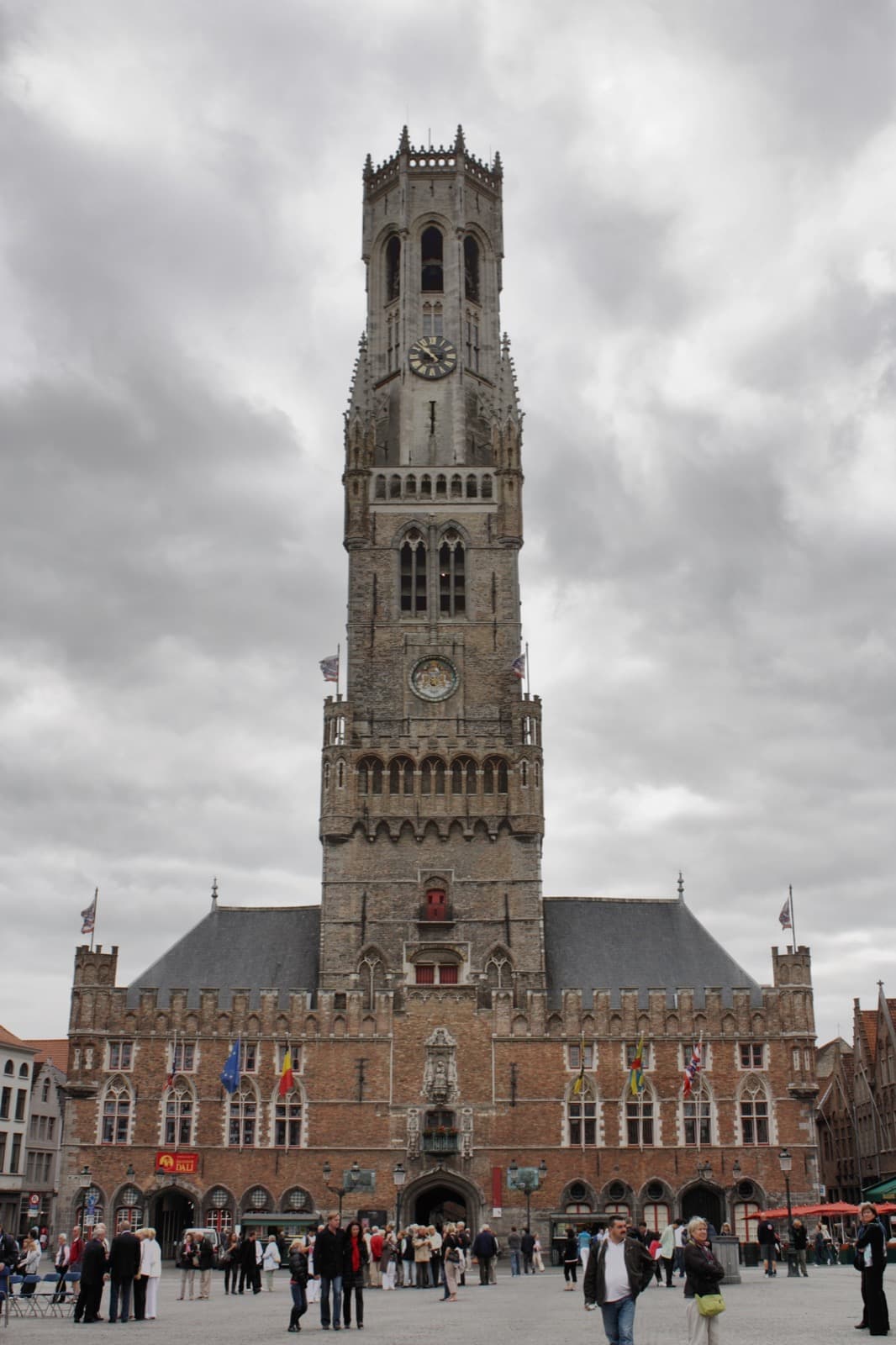
The Markt and the Belfry: How Two Squares Ran Medieval Bruges
The Silent Beguinage: How an Emptied Harbour Preserved Bruges
Minnewater in Bruges: The Lake of Love That Was Once a Harbor
The Basilica of the Holy Blood in Bruges: One Church, Two Chapels, One Relic