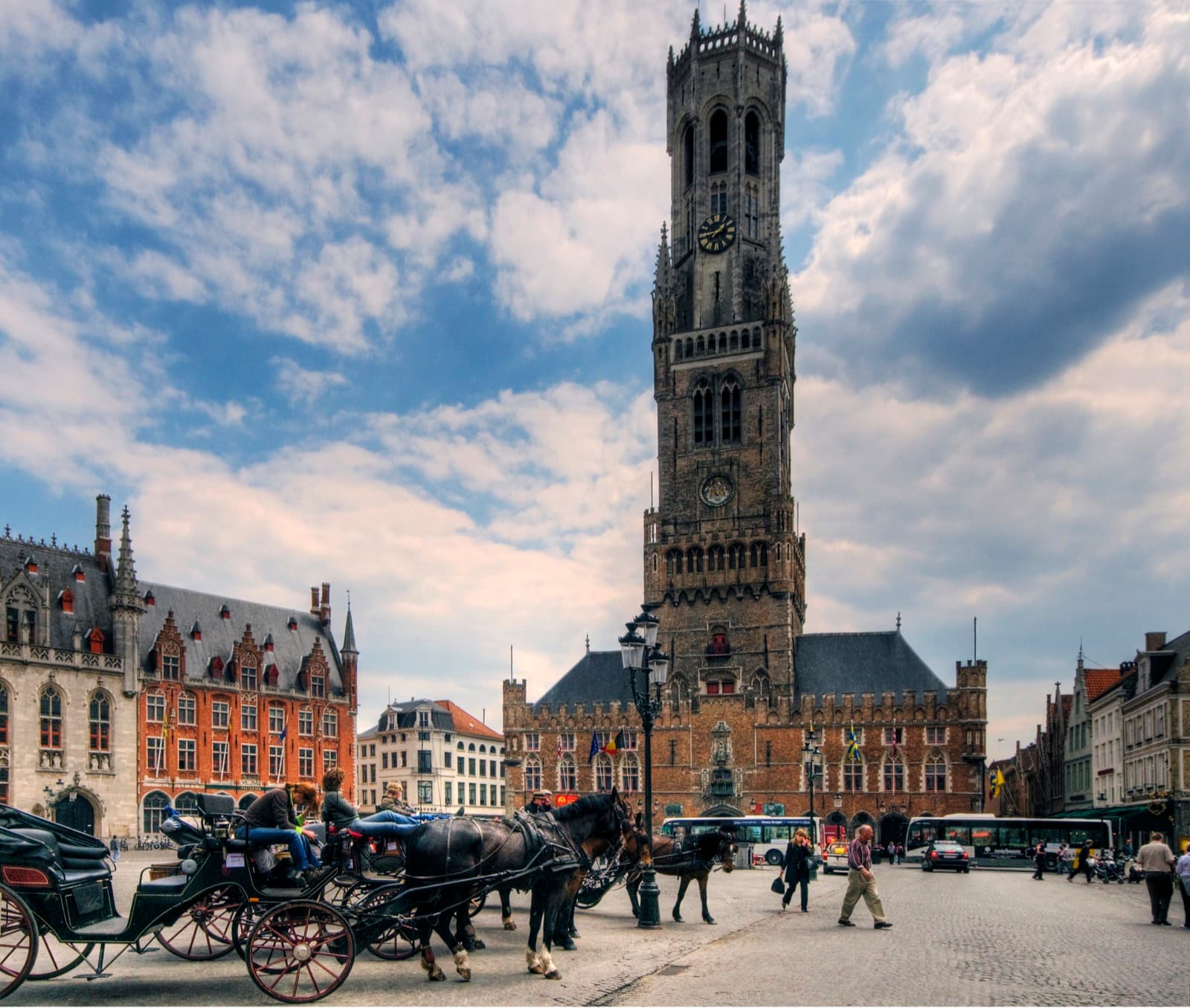
Bruges once ran itself from two squares, and you can still read the whole medieval city by walking between them. The Markt was the square of commerce, weighing and taxing cloth under the leaning Belfry. The Burg was the square of power, seat of the counts of Flanders and their painted Town Hall. Stand under the Belfry on the Markt and you are standing at the start of that argument, in the commercial heart of a city that was one of the richest in fourteenth-century Europe and that kept its medieval stone when wealthier cities lost theirs.
The tower that ruled the cloth trade
The Markt has been the city's market since the tenth century, a square of about one hectare. The first international annual fair was held here around twelve hundred, wooden merchant halls went up in the twelve twenties, and after a fire in twelve eighty the halls were rebuilt in stone. Above them rises the Belfry, roughly eighty-three metres of brick that leans about eighty-seven centimetres to the south-east, a tilt you can pick out against the sky. Its octagonal upper stage was built between fourteen eighty-three and fourteen eighty-seven, so the crown is late fifteenth-century work sitting on an older base.
What matters is what the tower was for. Beneath it stood the Hallen, a great rectangular market building around an inner courtyard where cloth was traded and where the city kept its charters and treasury in a strong-room. The Belfry was a safe as much as a bell tower. Its carillon, forty-seven bells today weighing around twenty-seven tonnes, rang the working day of the whole city: the hours of trade, of alarm, of curfew. This is the reason to begin here rather than at any single monument. The Markt is the room of stone where wealth was weighed and stored, ruled by the clock in the tower, and once you have understood that logic, the rest of the route reads as a sequence rather than a list of sights. If you want to see the full shape of the old town before you commit, the Bruges walking tours hub lays out how the squares, canals, and art quarter connect.
From the square of commerce to the square of power
Hear a stop from this walk
The Burg and the Town Hall: The Square of Power
The Markt does not only hold the tower. At its centre stands a bronze of Jan Breydel and Pieter de Coninck, the guildsmen the city remembers for its great revolt. In the early fourteenth century Flanders was under French military occupation. On the eighteenth of May thirteen oh two the militia of Bruges rose in the night and killed many of the French garrison, an uprising remembered as the Bruges Matins. On the eleventh of July that year, Flemish militias met the mounted French knights near Kortrijk and defeated them at the Battle of the Golden Spurs, so named because roughly five hundred pairs of gilded spurs were stripped from the fallen and hung as trophies. The statue itself is modern, unveiled in eighteen eighty-seven and opened by King Leopold the Second, a nineteenth-century monument raised over a fourteenth-century fight. De Coninck was a weaver and Breydel a butcher, ordinary guildsmen, which is part of why the city keeps their names.
The east side of the square carries the same lesson about appearances. The tall neo-Gothic Provincial Court looks medieval but was rebuilt in eighteen eighty-seven after a fire, standing on the site of the old Waterhall where river boats once slid in under cover to unload. Nearby is the Cranenburg House, where in February fourteen eighty-eight the citizens held Archduke Maximilian of Austria, a future Holy Roman Emperor, prisoner for weeks. Officials loyal to him were executed while he was confined. The same merchant city that traded cloth under the Belfry could jail its own prince a few steps away, and the standoff ended with the Peace of Bruges of fourteen eighty-eight.
A few hundred metres on, the Burg answers the Markt. This was the fortress of the counts of Flanders, developed by Count Arnulf the First into an administrative centre. Dominating it is the Town Hall, its foundation stone laid in thirteen seventy-six by Count Louis of Male and the building finished in fourteen twenty-one, one of the oldest in the former Burgundian Netherlands. Upstairs, the Gothic Hall carries murals painted between eighteen ninety-five and nineteen oh five, medieval-looking but modern. In a corner stands the Basilica of the Holy Blood, two churches stacked: a plain Romanesque lower chapel of Saint Basil, built between eleven thirty-four and eleven forty-nine, beneath an ornate Gothic upper chapel keeping a phial said to hold a cloth stained with the blood of Christ. The relic is processed through the city each spring on Ascension Day.
Down the arched lane to the water
The walk does not end in a square. It slips out of the Burg through the Blinde-Ezelstraat, the Blind Donkey Street, under an arched gallery strung between the Town Hall and the Old Civil Registry, and drops toward the canal. Ahead is the Vismarkt, a low colonnaded fish market designed in eighteen twenty by city architect Jean-Robert Calloigne and opened in eighteen twenty-one, moved off the Markt because of the smell and considered the oldest preserved fish market in Belgium. Fish is still laid on its stone slabs in the mornings.
Then the route comes to rest at the Rozenhoedkaai, the Rosary Quay, where the Dijver meets the Groenerei and the Belfry rises again over step-gabled houses reflected in the water. This was a working canal that carried the cloth and the wine and the wealth, and the tower closing the view is the same one that opened the walk. Commerce, power, faith, and trade fold into a single reflection under the leaning tower. That circularity is the point of the anchor stop: begin under the Belfry, end looking back at it across the water.
Seven stops, about fifty minutes to an hour, roughly three-quarters of a kilometre, entirely on foot and entirely at your own pace. The squares are free; the Belfry climb and the Town Hall's Gothic Hall are ticketed, so carry a little cash and go early when the tower queue is thin. To see how this route sits alongside the canals and the golden-age art quarter, start from the Bruges city page and pick the walk that fits your morning.
Sources
- Belfry of Bruges, Wikipedia: height, the octagonal upper stage of the fourteen eighties, the carillon, and the halls beneath.
- Battle of the Golden Spurs, Wikipedia: the Bruges Matins of thirteen oh two, the Kortrijk battle, and the golden spurs taken as trophies.
- Bruges City Hall and Burg, Wikipedia: the Town Hall begun in thirteen seventy-six and finished in fourteen twenty-one, and the counts' fortress square.
- Basilica of the Holy Blood, official site and Wikipedia: the double Romanesque and Gothic chapels, the relic, and the Ascension Day procession.
- Vismarkt (Fish Market), Visit Bruges: the eighteen twenty-one market by Jean-Robert Calloigne, oldest preserved in Belgium.
Ready to experience it?
Markt: The Two Squares That Ran a Medieval City
50 min · 0.7 km · easy
More from Bruges
Explore more at your own pace.
Bruges Travel Guide 2026: Days, Transport, Timing, Safety, Budget
The Church of Our Lady in Bruges: A Michelangelo Madonna and the Frozen Golden Age
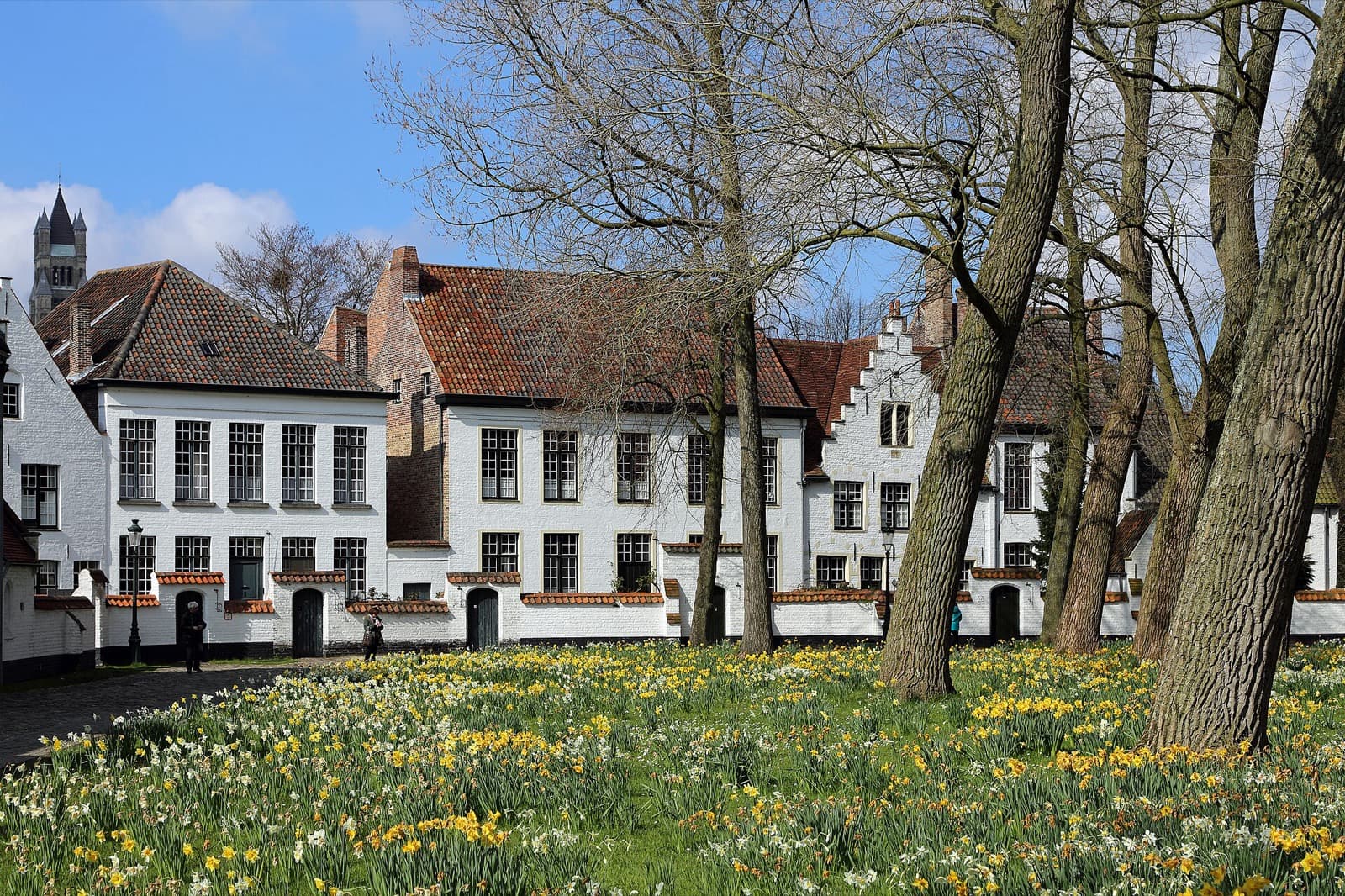
The Silent Beguinage: How an Emptied Harbour Preserved Bruges
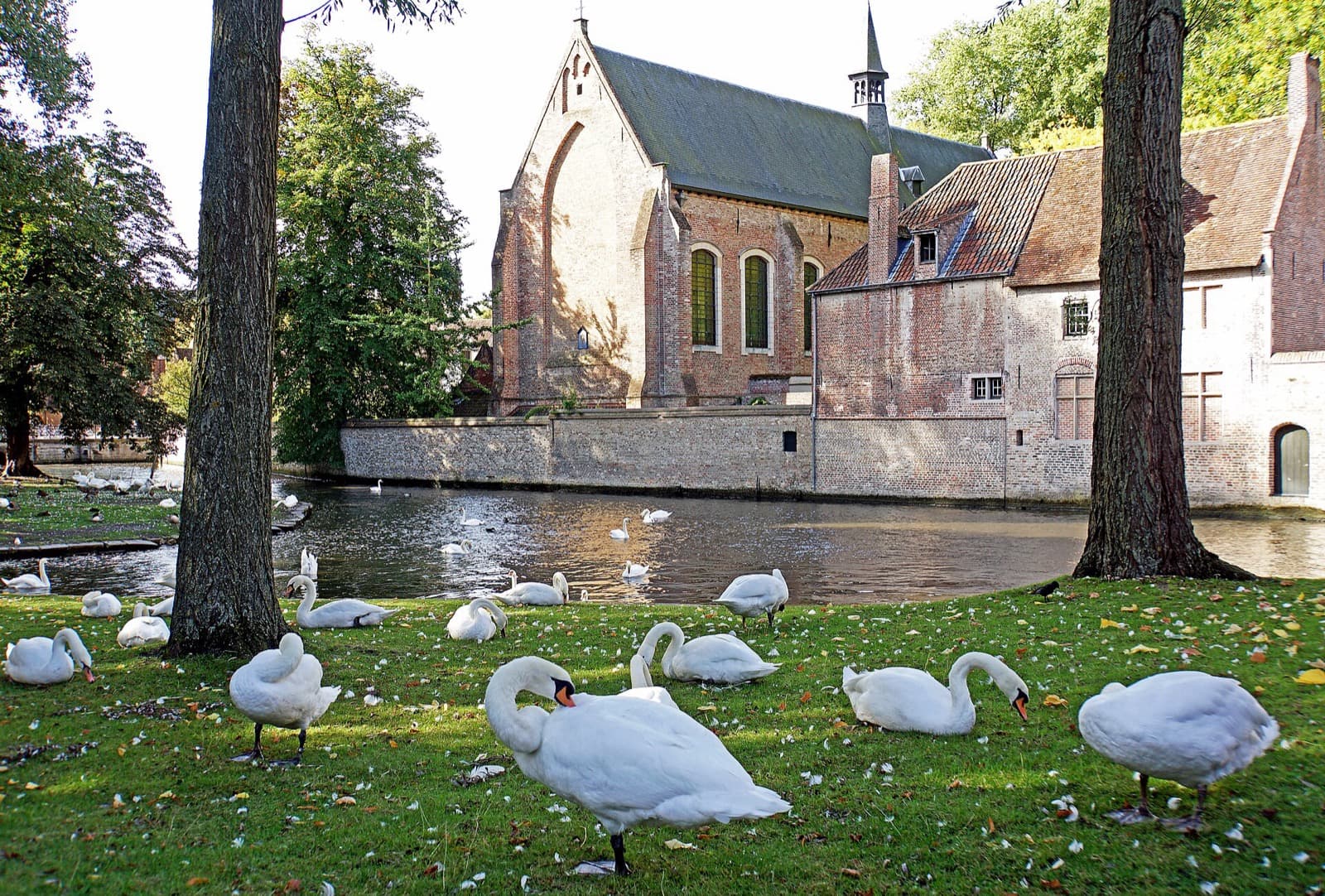
Minnewater in Bruges: The Lake of Love That Was Once a Harbor
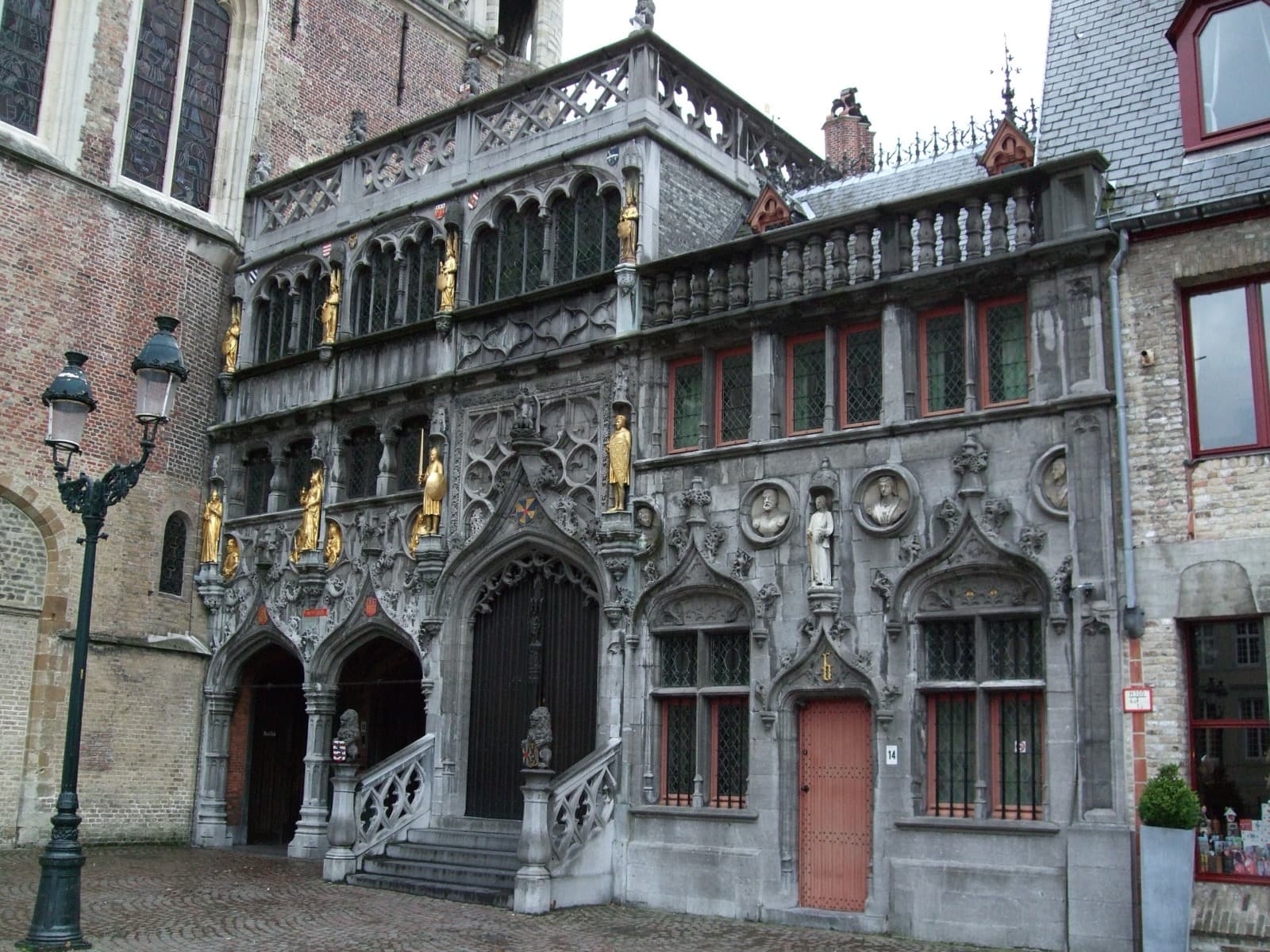
The Basilica of the Holy Blood in Bruges: One Church, Two Chapels, One Relic