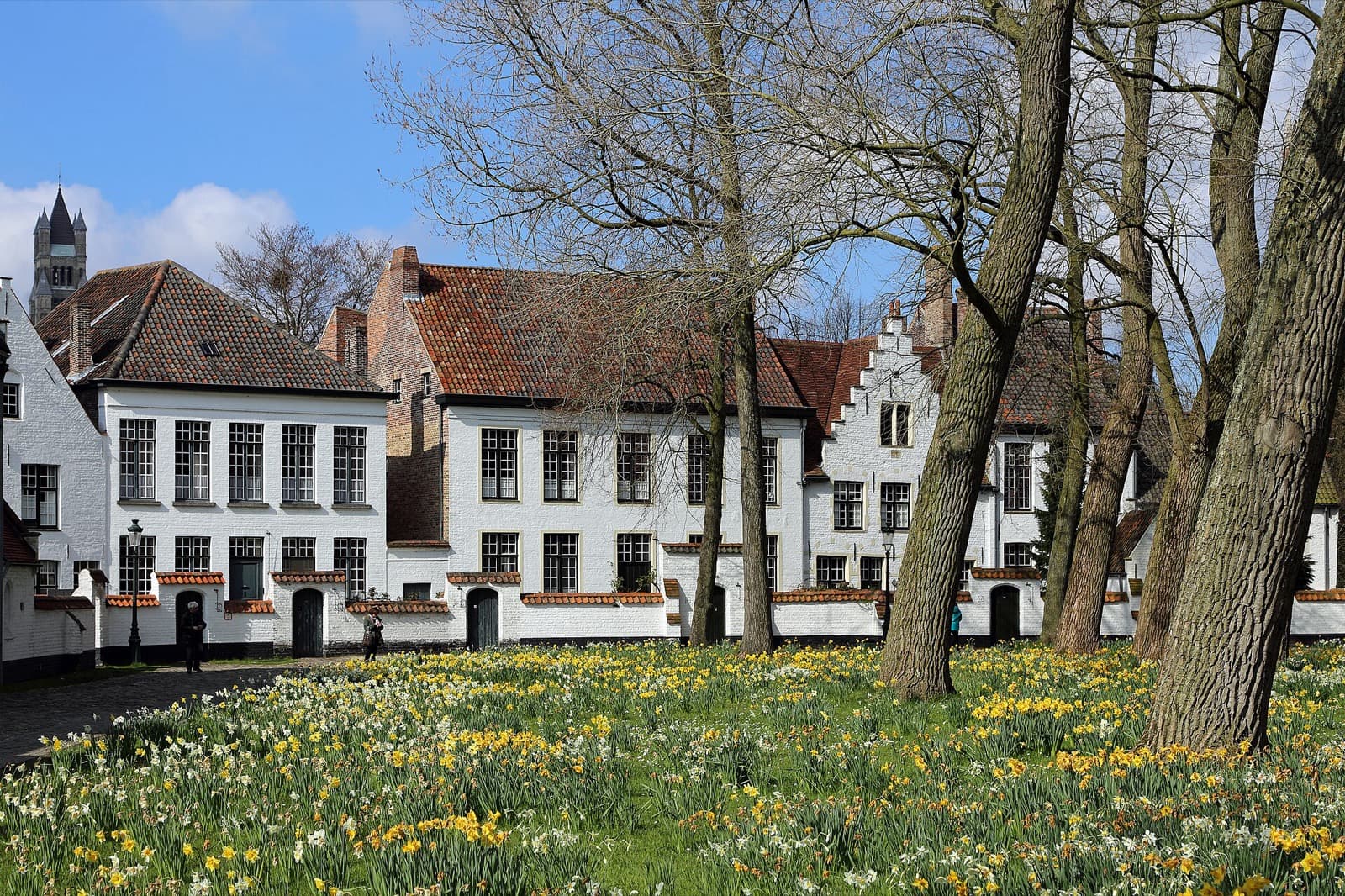
Walk through the gate of the Princely Beguinage Ten Wijngaerde and the city goes quiet, and that quiet is the argument the whole tour makes about Bruges: this is a place that survived because its water stopped working. About thirty whitewashed houses stand around a green planted with tall poplars, a Gothic church at one side, and the loudest sound most days is the wind in the trees. Stand in the middle of that court with no group at your back, and you understand what the rest of the route is trying to show you. Bruges is calm today because the harbour it was built around emptied centuries ago, and the emptiness is exactly why the medieval city was never torn down.
The court that explains the whole city
The Beguinage was founded around twelve forty-four by Margaret of Constantinople, Countess Margaret the Second of Flanders. It was recognized as an independent parish in twelve forty-five, then placed under royal protection as a Princely Beguinage in twelve ninety-nine, when it came under the direct authority of King Philip the Fair. The women who lived here were beguines: single or widowed laywomen who led a religious, near-silent life without taking permanent monastic vows. They kept their own property. They could, in principle, leave. It was a distinctly medieval, northern European way for a woman to live a spiritual life on her own terms, inside a wall but not behind a cloister's locked door. UNESCO inscribed the court in nineteen ninety-eight as one of thirteen Flemish Beguinages recognized together as a serial World Heritage site.
The silence here is not a museum effect. Since nineteen twenty-seven the houses have sheltered a community of Benedictine nuns, so the hush is a living tradition rather than a preserved one. The courtyard, garden, and church cost nothing to enter. Only the small Beguine's House museum charges a couple of euros, if you want to see how one of these lives was arranged. Keep your voice low, and stand in the court a while before you reach for a camera.
Why the water fell still
Hear a stop from this walk
The Ramparts and the Windmills: The Green Wall on the Edge of the Water City
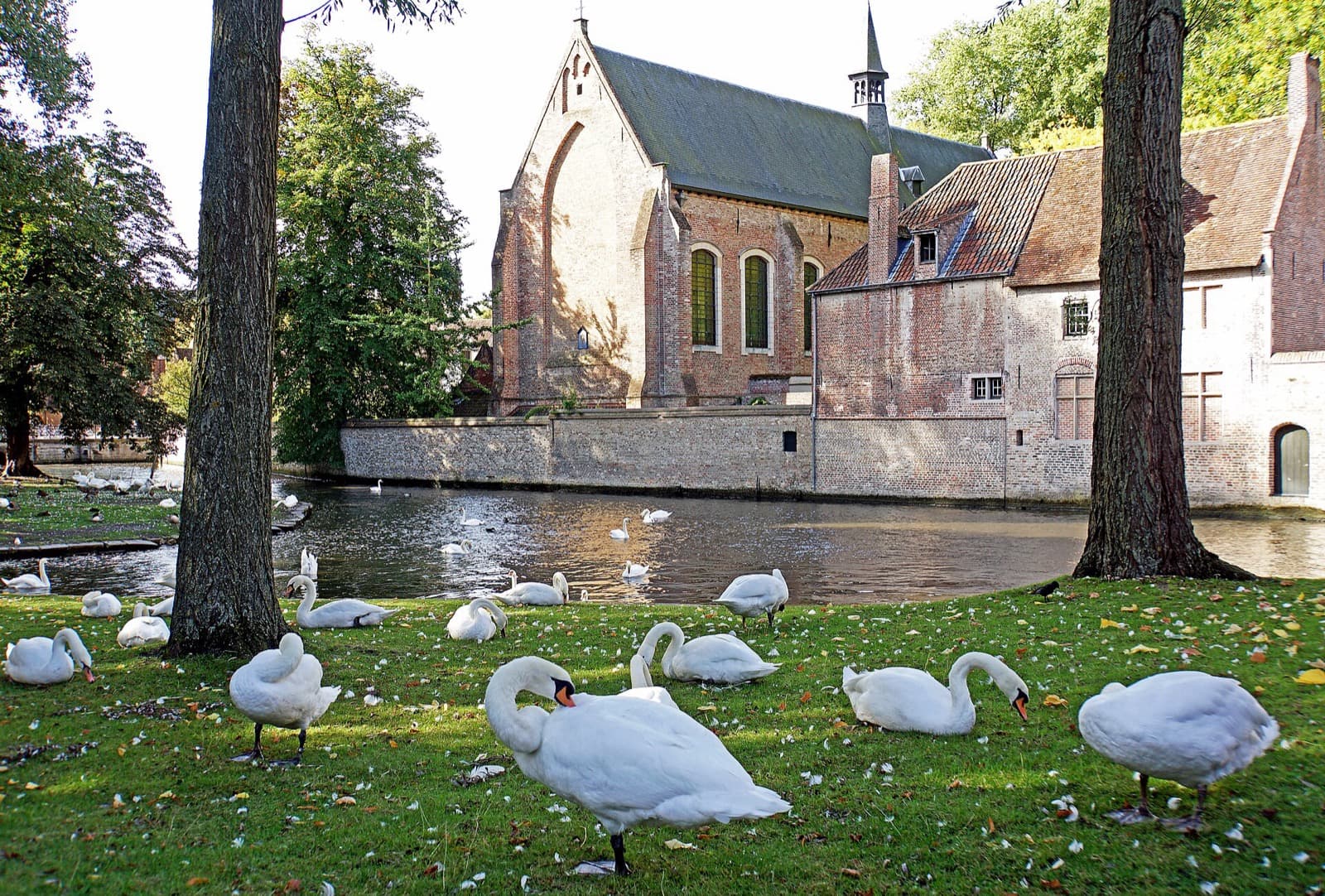
To read the Beguinage properly, you have to know what happened to the water outside its wall. Bruges grew where a tidal inlet reached inland, and a web of canals, the reien, once carried the ships and barges that made it one of the busiest ports of northern Europe. This tour begins one bridge south, at the Minnewater, the Lake of Love, which today is a broad still basin with a lock house and leaning willows. People market it, fairly, as a romantic corner. But before it belonged to lovers it was working water, an inner harbour where trading barges moored on their way to and from the North Sea. The name carries the folklore of the swans, tied by legend to fourteen eighty-eight, when a swan-crested official of Maximilian of Austria named Pieter Lanchals was executed and Maximilian is said to have ordered the city to keep swans on its waters forever. That story is legend, not record. What is documented is quieter: the harbour emptied when the trade left, and that emptiness is the reason all of this survived.
The reflection, the bridges, and the honest surprise
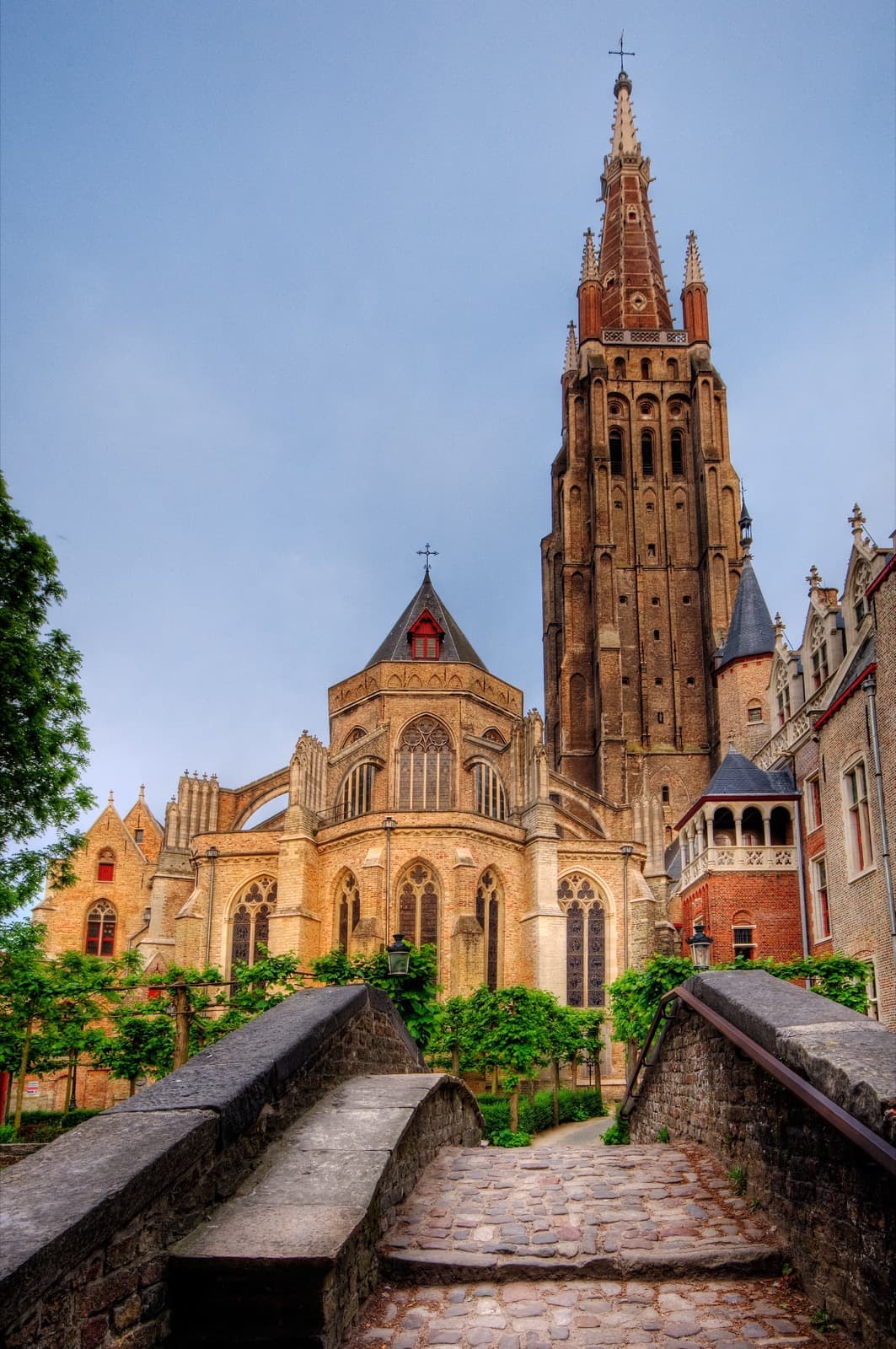
From the Beguinage the route follows the leafiest, least crowded canals in the old town. Just outside the gate is the Wijngaardplein, a small square with an old stone horse trough, and a step away sits one of the most photographed corners in Bruges: the Bonifacius bridge, a tiny arched footbridge between the Church of Our Lady and the Gruuthuse mansion. It looks impossibly old. It is one of the youngest bridges in the city, built in nineteen ten and deliberately designed to blend into its ancient surroundings, named for Saint Boniface, an English Benedictine monk. There is a lesson on that bridge worth carrying through the rest of the walk: in a city this perfectly kept, the beautiful is not always the ancient, and it does not have to be.
The Dijver comes next, a tree-lined quay where the little canal boats set off and, on weekends, an open-air antiques market spreads under the trees. The thing to do there needs no ticket at all: stand where the paving meets the water and watch the still canal hang the medieval facades upside down. Then the Groenerei, the Green Canal, the greenest and stillest stretch of all, hung with ivy and lined with seventeenth-century mansions and almshouses. Two hump-backed stone bridges cross it. The Meebrug is fourteenth-century and, the city says, probably the oldest bridge in Bruges; the Peerdenbrug, the Horse Bridge, is seventeenth-century, and the classic view lines the two arches up over the green water. The almshouse De Pelikaan, from seventeen fourteen, wears the pelican, an old symbol of Christian charity.
Out to the vanished port and the turning mills
The last two stops close the argument. The Spiegelrei and Jan van Eyck Square were the waterfront of the Hanseatic quarter, the centre of international trade in northern Europe across the thirteenth to fifteenth centuries. Ships tied up here three and four deep, and foreign merchant nations kept nation houses nearby. The Poortersloge, the Burghers' Lodge, was built between thirteen ninety-five and fourteen seventeen; the Tolhuis, the old toll house, was rebuilt in fourteen seventy-seven by Pieter van Luxemburg; a statue of Jan van Eyck was set up on the square in eighteen seventy-eight. Stand at that broad, quiet water and you are looking at a great port that stopped, because the Zwin inlet that linked it to the sea silted shut.
The route ends on the Kruisvest, the green eastern rampart, where four windmills stand along the old wall. The Sint-Janshuismolen dates to seventeen seventy, stands on its original site, and is the only one of the four where grain is still actually ground, open to climb inside in season for around six euros. The other three were brought in from elsewhere in Flanders in the twentieth century. From the Lake of Love to the mills on the wall it is about three kilometres and roughly ninety minutes at an easy pace, all of it free and outdoors except two small optional tickets. You set the clock, linger on any bridge you like, and let the water do the talking. For more routes through the city, see Bruges walking tours, or start from the Bruges city page.
Sources
- Ten Wijngaerde (Begijnhof Brugge), Wikipedia. Founding around twelve forty-four, parish status in twelve forty-five, Princely status under King Philip the Fair in twelve ninety-nine, and Benedictine-nun continuity since nineteen twenty-seven.
- Flemish Beguinages, UNESCO World Heritage List (inscribed 1998). The thirteen-site serial inscription and the definition of beguines.
- Visit Bruges official tourism site (Bonifaciusbrug, Groenerei, Meebrug and Peerdenbrug, Jan van Eyckplein, Tolhuis, Poortersloge). Dates, descriptions, and heritage notes for the canal-side stops.
- Musea Brugge, Sint-Janshuismolen page. The mill dating to seventeen seventy on its original site and still grinding grain, the only one of the four rampart mills that does.
- World Heritage Journeys of Europe, "The legend of the swans." The Minnewater swan folklore tied to fourteen eighty-eight.
Ready to experience it?
The Canals: Venice of the North and the Silent Beguinage
80 min · 3.1 km · easy
More from Bruges
Explore more at your own pace.
Bruges Travel Guide 2026: Days, Transport, Timing, Safety, Budget
The Church of Our Lady in Bruges: A Michelangelo Madonna and the Frozen Golden Age
The Markt and the Belfry: How Two Squares Ran Medieval Bruges
Minnewater in Bruges: The Lake of Love That Was Once a Harbor
The Basilica of the Holy Blood in Bruges: One Church, Two Chapels, One Relic