Everything at St Mark's was rebuilt, borrowed or moved, and the city made it all look as if it had always stood. A garden laid over the Republic's granaries, a Napoleonic wing built on the site of a Sansovino church, a brick basilica dressed in marble from Constantinople, horses that went to Paris and back, a clock that took a row of houses, a bell tower that fell and returned, a lion that may have begun in China: the most famous square in Venice is a collection of second lives. Roamer's walk through it is ten stops over about one kilometer, roughly forty-five minutes, flat but for three bridges with steps. Every stop works from outside, so the ticketed interiors stay optional and you set the pace.
A square built over other things
The walk starts at the Giardini Reali on the waterfront. From the fourteenth century this ground held the Republic's granaries. A decree of Napoleon in January 1807 made the long building behind them a royal palace, the granaries came down, and the ground became its garden. The iron gate dates from 1816; the garden reopened in 2019.
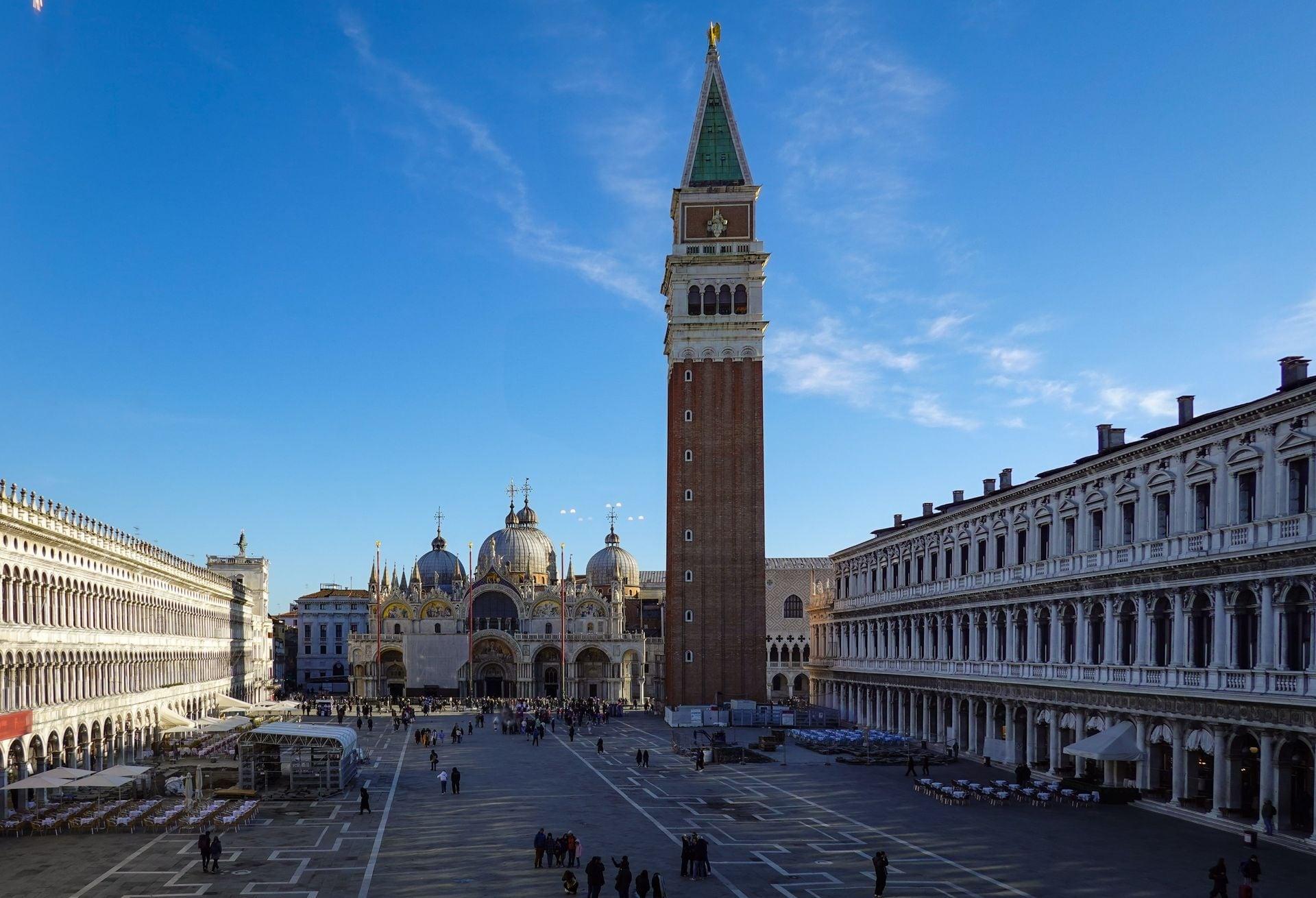
Through a dark passage you step into Piazza San Marco itself, and the building you just came through is the newest thing in view. The Napoleonic wing was built on the site of the church of San Geminiano, which Jacopo Sansovino had rebuilt in the sixteenth century and which came down so a palace wing could close the square. Ahead rises the Campanile, nearly 99 meters of brick. On 14 July 1902 it fell straight down on itself into a square that had been cleared and guarded. Nobody died. Venice rebuilt it com'era, dov'era, as it was, where it was, and opened it on 25 April 1912, Saint Mark's day.
Borrowed skins and travelling bronzes
Hear a stop from this walk
Riva degli Schiavoni: Looking Back
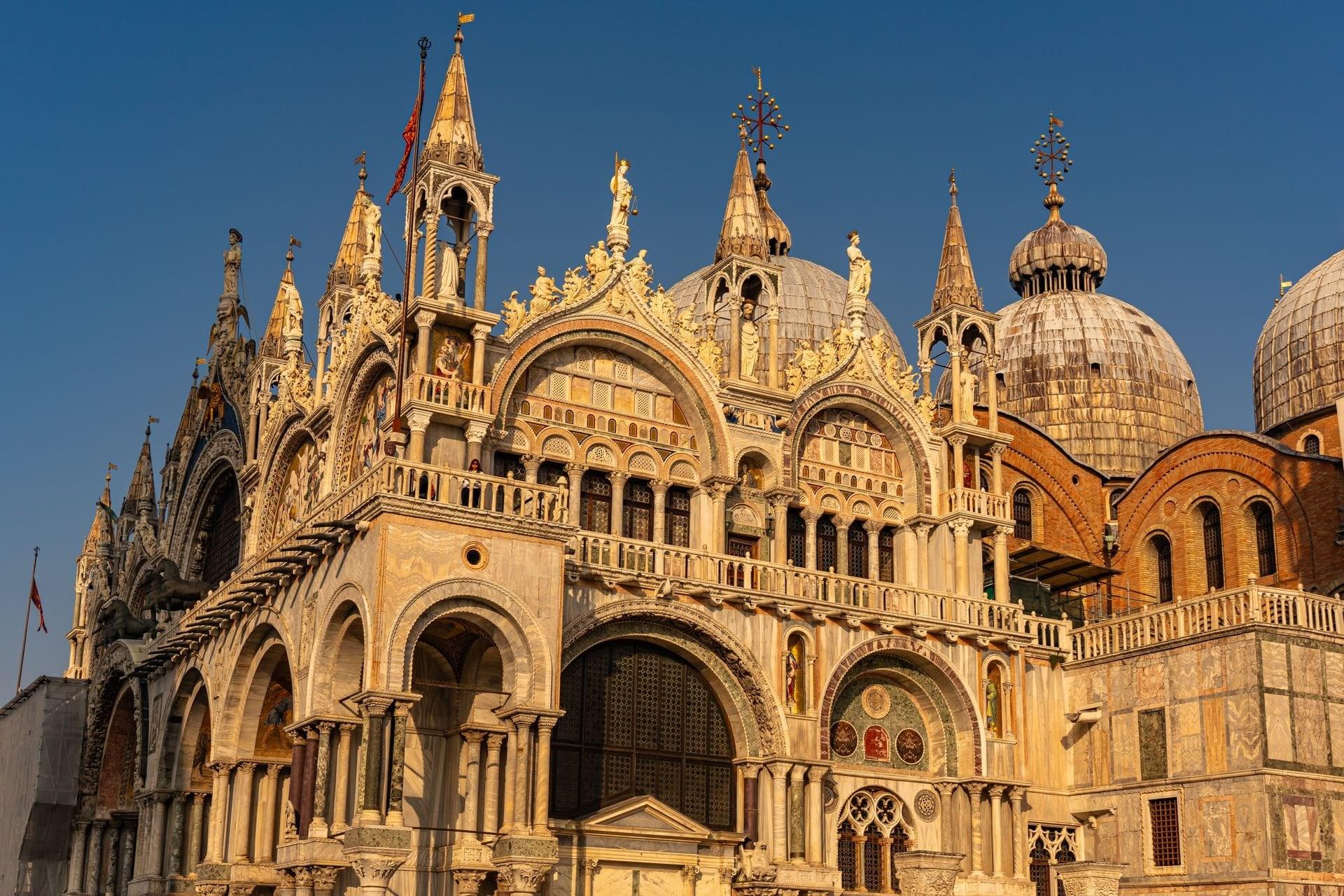
The Basilica closes the far end. Look at its lower front: five great arches, gold mosaics, columns and panels of colored stone. The church behind is brick. After the crusade that took Constantinople in 1204, Venice dressed it in eastern marble. The four bronze horses over the central arch are copies; the originals, thought to come from Constantinople's Hippodrome, came down in 1977 and have been in the church's museum since 1982. Napoleon had them taken to Paris in December 1797, and after his fall Antonio Canova was charged with bringing them back.
Round the church's corner, four porphyry emperors, the Tetrarchs, came with the same loot. One is missing part of a foot, and a fragment found in Istanbul in the 1960s is thought to be that very piece. The two carved pillars nearby were long called the pillars of Acre; the Basilica says they came from Constantinople too.
The Clock Tower across the square needed a different kind of taking. In June 1496 the Republic began knocking down the houses at the mouth of the Merceria, the main shopping street, to lay its foundations, and the clock was uncovered on 1 February 1499. Its bronze Moors, cast in 1497, strike the hour on the roof, and the works inside were rebuilt by Bartolomeo Ferracina in the 1750s.
Fallen, rebuilt, retold
At the foot of the Campanile, Sansovino's little Loggetta was buried when the tower fell, and rebuilt from its recovered pieces by 1912. Across the Piazzetta, his Library lost its vaulted roof in December 1545, and he was put in prison for a time and made to pay for the rebuilding.
Out between the two columns on the waterfront, the city's old front door, the bronze lion of Saint Mark stands on its granite shaft. A recent University of Padua study traced the copper in its bronze to ore from China's lower Yangtze basin and argues it began as a tomb guardian of the Tang dynasty. Its own researchers admit nobody knows when it reached Venice or who reworked it.
The Doge's Palace, with its solid patterned wall standing on two rows of open arches, was rebuilt after fires in 1483, 1574 and 1577. From the Ponte della Paglia you see the Bridge of Sighs, built around 1600 to join the palace to the new prisons. Its name became famous through Lord Byron's poem of 1818; the sighing prisoners are a romantic story, not history.
The walk ends on the Riva degli Schiavoni, looking back at the whole waterfront. Very little of it stayed put. Venice kept rebuilding, borrowing and moving, and made every piece look as if it belonged.
This is St Mark's Square and the Doge's Palace: Borrowed and Rebuilt, ten stops from the Giardini Reali to the Riva degli Schiavoni. For two of its stops in depth, read about St Mark's Basilica and the Doge's Palace. See all routes on the Venice page.
Sources
- Basilica di San Marco, the Campanile: the fall of 14 July 1902 with no victims, the rebuilding "com'era e dov'era", the inauguration of 25 April 1912, the height of 98.6 meters.
- Teatro La Fenice, history: the motto com'era dov'era taken from the rebuilding of St Mark's bell tower.
- Musei Civici, Torre dell'Orologio: the Clock Tower, the Moors' terrace and the guided visit regime.
- Roamer's audited tour transcript and fact dossier for this walk: the Procuratoria di San Marco on the horses, the marble skin and the pillars; Venice Gardens Foundation on the Giardini Reali; the Biblioteca Nazionale Marciana on the Library; MUVE on the Doge's Palace, the prisons and the Clock Tower; the Antiquity study on the lion.
Ready to experience it?
St Mark's Square and the Doge's Palace: Borrowed and Rebuilt
45 min · 1 km · easy
More from Venice
Explore more at your own pace.
Castello and the Arsenale: Walking the Doge's Calendar Through Venice's Quiet East
La Fenice and Campo Santo Stefano: A Walk Through Venice's Fronts Built to Be Seen
La Fenice and San Maurizio: Giannantonio Selva's Two Fronts on One Venice Walk
San Francesco della Vigna: How Palladio Put Two Temples on One Church Front
Santa Maria del Giglio: The Venice Church Front Built for One Family