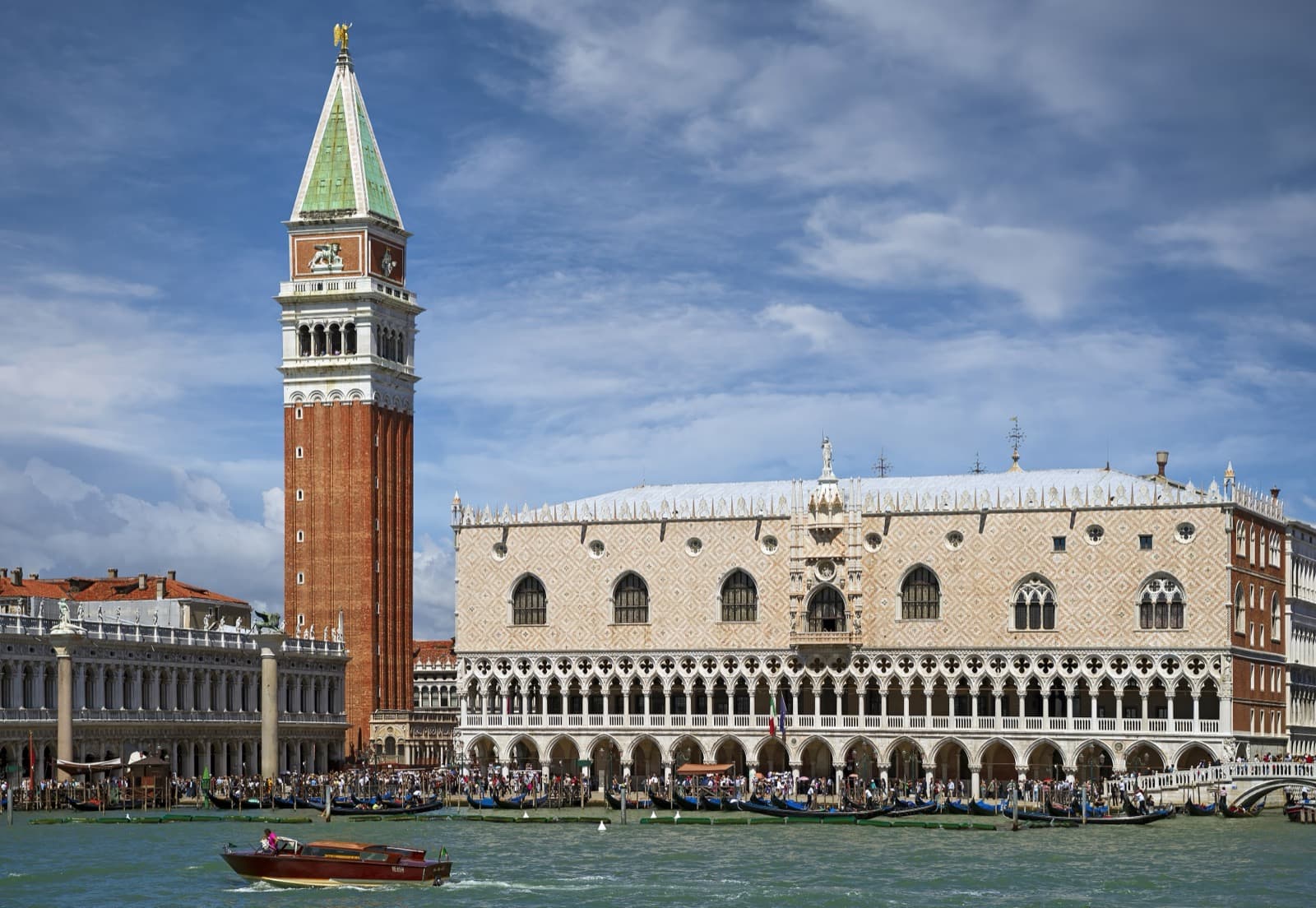
Most palaces house a monarch. The Doge's Palace housed a system. Behind its pink and white Gothic front, on the edge of the lagoon, sat the government offices of the Republic of Venice, its high courts, a jail, and the residence of the Doge, who was not a king but an elected official, the chosen head of a state run by committees. To read this building is to read how a merchant republic governed itself for centuries: openly on the ground floor, secretly in the rooms above, and severely in the cells at the back.
A palace that was a whole government
There has been a palace on this site for a very long time. A ducal residence stood here from around 810, when the seat of the young Venetian state settled beside the basilica. The building you see, though, is a later thing. The present palace was rebuilt from 1340 and extended over the following centuries, growing arm by arm into the vast Venetian Gothic structure that faces the water and the piazzetta today. Its lower colonnade and its pierced upper loggia are among the most recognizable pieces of architecture in Italy, a heavy mass of pink stone that seems to float on lace. It was not built to impress a visiting king. It was built to hold a government, and it did every job at once: council chamber, magistrate's court, civil service, prison and the home of the head of state.
The largest room and the longest painting
Hear a stop from this walk
St Mark's Basilica: The Church of Gold and Stolen Horses
The heart of the machine is the Chamber of the Great Council, the hall where the assembled nobility of Venice met to vote. It is enormous, measuring about 53 by 25 metres, which makes it one of the largest rooms in Europe. It was built at that scale because the Great Council could number well over a thousand men, and all of them had to sit in one room to make the Republic's decisions. One entire wall is filled by a single work, "Il Paradiso," painted by Tintoretto and his workshop between 1588 and 1592. It is the longest canvas painting in the world, a wall of crowded figures rising toward heaven, and it was meant to remind every voting patrician that they governed under the eyes of paradise. Stand at one end and look down the length of it, and the scale of the room and the painting together tell you how seriously this state took the theater of its own government.
The Leads and the man who escaped them
Justice in this building did not stay upstairs. The palace also held prisons, and the most notorious were the Piombi, "the Leads," a set of cells built directly under the lead-plated roof, hot in summer and cold in winter. Their most famous inmate was Giacomo Casanova, the Venetian adventurer and writer, who was imprisoned in the Leads and then, in 1756, made a celebrated escape through the roof, an exploit he later wrote up in detail. The Piombi are the reason the palace has a reputation for menace as well as splendor: the same building that voted and judged also jailed, all under one continuous roof.
The Bridge of Sighs, and the story to distrust
Around the back, a small enclosed bridge of white Istrian limestone crosses a narrow canal, linking the palace's interrogation rooms and courts to the New Prisons on the far side. It was built shortly after 1600 and completed around 1603, designed by the architect Antonio Contin. Its romantic name, the "Bridge of Sighs," is worth treating with suspicion, because it is a later invention. The name is a 19th-century Romantic coinage, and the English form is usually credited to Lord Byron, said to have given it while translating the Italian. The story that goes with the name, that condemned prisoners sighed at their last glimpse of Venice through its stone lattice before execution, is a legend rather than history. The New Prisons across the bridge held ordinary offenders, not the condemned. Enjoy the view of the bridge, which is genuinely lovely, but hold the tragic story at arm's length.
How to visit it well
The palace is a paid ticket, around 30 euros in 2026, which takes you through the state rooms, the Great Council hall, the prisons and across the covered bridge from the inside. If you only want the architecture, the great Gothic facade is free to admire from the Piazzetta and the waterfront, and it is arguably at its best in the low light of early morning or late afternoon. The interior became a museum in 1923, so what you tour today is a preserved state building rather than a working one. Give yourself at least a couple of hours inside; the route is long and the rooms are dense.
This is the fourth stop on a walk through the ceremonial heart of Venice, right beside St Mark's Basilica, the church of gold and stolen horses. The Republic that governed from these rooms also engineered its whole city on water for trade and built Santa Maria della Salute as a plague church at the mouth of the Grand Canal. To plan the day, browse the Venice walking tours or start from Venice. Read the palace as a machine, and every room turns out to have a job.
Sources
- Doge's Palace, Wikipedia. The Venetian Gothic building housing government offices, a jail and the residence of the elected Doge; a palace on the site from around 810; the present building rebuilt from 1340 and extended over following centuries; the Chamber of the Great Council measuring about 53 by 25 metres with Tintoretto and workshop's "Il Paradiso" of 1588 to 1592 as the longest canvas painting in the world; the Piombi prison and Casanova's 1756 escape; and the palace becoming a museum in 1923.
- Bridge of Sighs, Wikipedia. The bridge built shortly after 1600 and completed around 1603, designed by Antonio Contin in white Istrian limestone, connecting the palace to the New Prisons; the "Bridge of Sighs" name as a 19th-century Romantic invention usually credited to Lord Byron; and the prisoner's-last-view story as legend.
- Roamer tour transcript, "Piazza San Marco" (venice-san-marco), fact-audited Doge's Palace stop.
Ready to experience it?
Piazza San Marco: The Drawing Room of Europe
90 min · 0.8 km · easy
More from Venice
Explore more at your own pace.
One Day in Venice: A Walkable Morning-to-Evening Itinerary
Venice: The City Engineered on Water for Trade
Venice's Rialto Market: The Engine Room That Paid for the Palaces
Where the Word Ghetto Was Born: A Walk Through Venice's Cannaregio
St Mark's Basilica: The Church of Gold and Stolen Horses