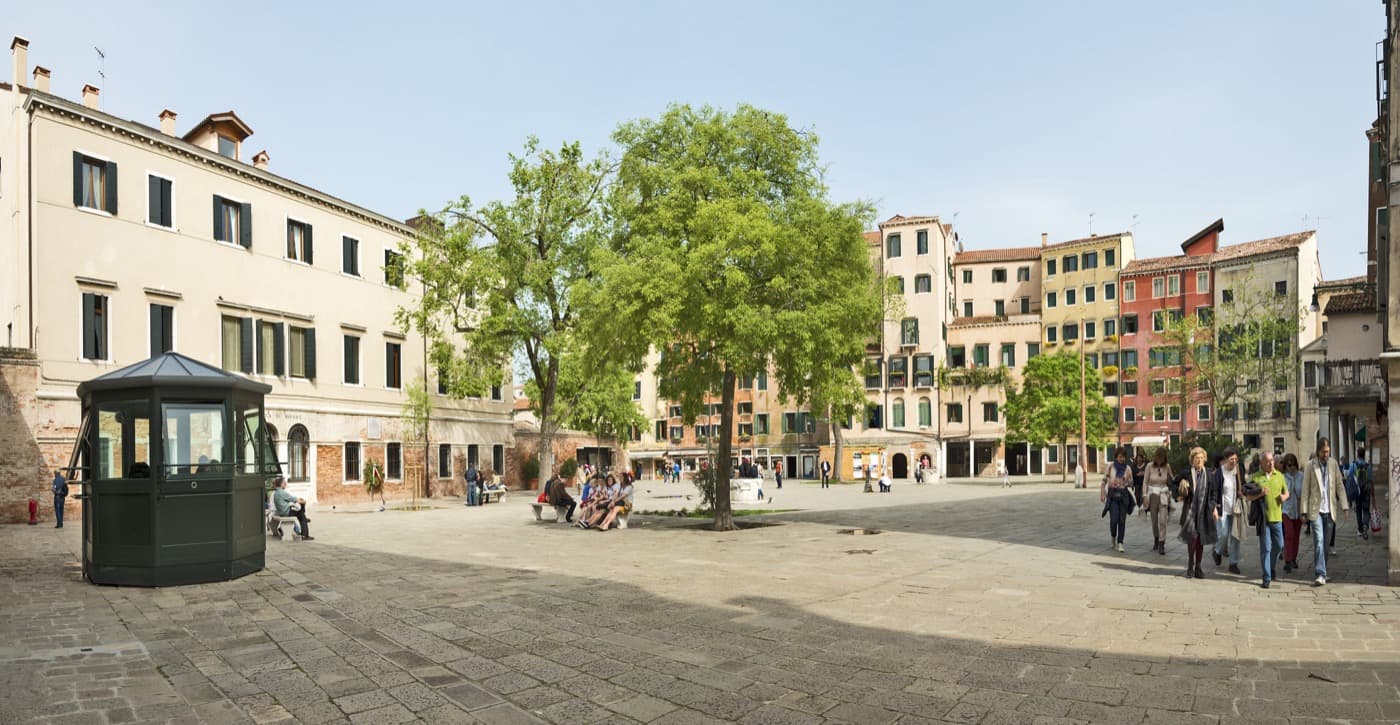
The word ghetto was born on one walled island in Cannaregio, and the story of how a confined Jewish community answered forced scarcity by building upward is still legible if you stand in the middle of Campo di Ghetto Nuovo and look straight up. This is the starting point of a self-guided walk that runs from that enclosure out to the open Grand Canal, and the campo is the key that explains everything that follows.
The campo that named a world
Nearly every language on earth carries a word that started here. Ghetto now means poverty and exclusion almost everywhere, but it began as the plain local name for a foundry, a place where metal was cast. This island had been an industrial site, and the Venetian term for a casting place, geto, is the most widely cited origin of the word, attaching itself to the ground long before it attached itself to people. Ghetto Nuovo means the new foundry, with an older one lying just beyond. The first residents were German-speaking Jews who pronounced the word with a hard g, and it is their pronunciation that traveled out into the world.
The date is precise. On March 29 in the year 1516, the Venetian Senate, under Doge Leonardo Loredan, ordered the city's Jewish residents to live on this single island. Two bridges linked it to the rest of Venice. The gates on those bridges opened at the morning bell of Saint Mark's belfry and were closed at midnight by Christian guards. The bitterest detail is a financial one: the Jewish residents were required to pay the salaries of the men who locked them in each night.
Now look up again. Forbidden to expand outward, the community expanded the only way left to it, straight up. The houses ringing this square rise six, seven, even eight stories, with low ceilings stacked close, while the grand palazzi elsewhere in Venice reached only three or four. These were the tall buildings of their time, and the vertical crowding is the single clearest piece of physical evidence on the whole route. By the early seventeenth century, as many as five or six thousand people lived within barely seven acres. Confinement, translated directly into architecture.
Reading the whole tour through one square
Hear a stop from this walk
Campo di Ghetto Nuovo: Ground Zero of a Word
Stand in this campo and you are reading the tour's argument in miniature. Everything the walk goes on to show is a variation on what this island forces you to see: scarcity turned to ingenuity, and a common word followed to its darkest meaning and back out into the everyday city.
The second stop stays on the campo and asks a question you cannot answer from the street: which of these ordinary buildings holds a synagogue? The Ghetto had five, called scole, one each for the German, Italian, Canton, Levantine, and Spanish communities, divided by language and rite. Nearly all are invisible from below, folded into the top floors of plain tenements. The oldest, the Scola Grande Tedesca, was completed in the year 1528 by the Ashkenazi German community and occupies the upper floors of the building that today houses the Jewish Museum of Venice. Part of the reason they sit in the rooftops is the brutal scarcity of space, and part is a tradition that nothing should stand between a synagogue and the sky. The English traveler Thomas Coryat walked through here in 1608 and published his account in London three years later, in his book Coryat's Crudities, the first known mention of the Venetian Ghetto in English.
The third stop turns to the brick wall of the same square, where the walk goes quiet. Bronze bas-relief plaques by the Lithuanian-American sculptor Arbit Blatas were installed on April 25 in the year 1980, Italy's national Liberation Day. Seven plaques, seven snapshots of the Holocaust. This was not distant history for Blatas: his mother died in the Stutthof camp, and his father survived Dachau. A companion work, The Last Train, was added in 1993, its wooden boards carved with the names of 246 Venetian Jews deported to Nazi camps. Of those 246 people, only about seven ever returned. The word we began with, followed all the way to its final meaning, and it is right that the arc closes on the very island where the word was born.
From enclosure to open water
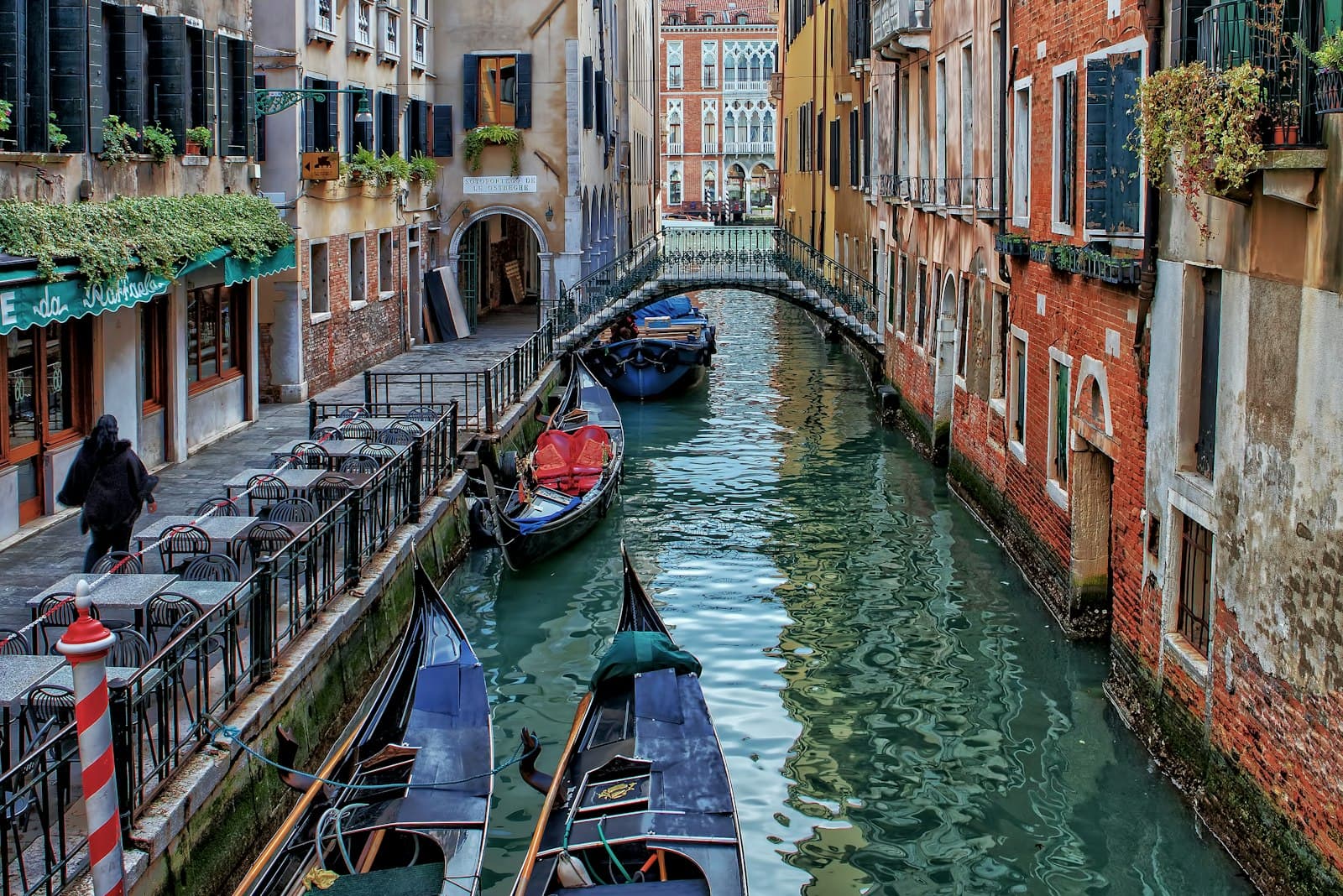
Then the walk releases you, and this is why the campo works as an overture rather than a destination. The fourth stop is a long canal-side quay, the Fondamenta della Misericordia, running beside the Rio della Misericordia. This is an intentional slow leg through working Cannaregio, the most populous of Venice's six sestieri, with more than thirteen thousand residents. Here the texture is ordinary life: laundry between windows, boats along the quay, and in the evening the bacaro, the small Venetian wine tavern where people stand shoulder to shoulder with a glass and a plate of cicchetti. There is no monument to hunt for. The point is the rhythm of a neighborhood that has kept its own life.
The fifth stop is the payoff of that quiet transect: the Madonna dell'Orto, a Gothic brick church that was the home parish of the painter Jacopo Robusti, known to the world as Tintoretto. He lived nearby, worshipped here, and is buried in the chapel to the right of the choir alongside two of his children. Founded in the mid-fourteenth century and first dedicated to Saint Christopher, the church was renamed after a Madonna statue was found in a nearby orto, a garden. Inside hang paintings Tintoretto made for his own neighbors, including The Last Judgement of the early fifteen sixties, in shadow and hush, far from the crowds.
The walk ends at the water, across the Grand Canal from the Ca' d'Oro, the House of Gold, widely regarded as the finest surviving example of Venetian Gothic domestic architecture. Built for the nobleman Marino Contarini by the architects Giovanni Bon and his son Bartolomeo Bon across the fourteen twenties and thirties, its facade once carried gold leaf and deep blue ultramarine, so it glittered above the canal. By around the year 1600 the gilding had weathered away, but the name held. You read it exactly as Venice always has, from across the water.
That is the transect, from a locked island to a gilded palace on open water, and it all opens from a single square. If you want to see how this walk sits alongside the rest of the city, browse our Venice walking tours or start from the Venice city page, then let the campo set your pace.
Sources
- Venetian Ghetto, Wikipedia. Foundation date of 1516 under Doge Leonardo Loredan, the two bridges and midnight gate closure, the guards paid by the Jewish residents, and the foundry etymology.
- The First Mention of the Jewish Ghetto of Venice in English, Library of Congress Law Blog. Thomas Coryat's 1608 visit, the 1611 publication of Coryat's Crudities, and its place as the earliest English reference.
- Monument to the Deported, Jewish Community of Venice. The Arbit Blatas memorial installed in 1980, The Last Train dedicated in 1993, and the deportation history.
- Madonna dell'Orto, Chorus Venezia. The church's original dedication to Saint Christopher, its renaming after the garden Madonna, and Tintoretto's burial in the apsidal chapel to the right.
- Ca' d'Oro, Venice Museum. The Marino Contarini commission, the Bon architects, the 1421 to 1437 construction, and the gilded facade that gave the palace its name.
Ready to experience it?
Jewish Ghetto of Cannaregio: The First Ghetto
90 min · 2 km · easy
More from Venice
Explore more at your own pace.
One Day in Venice: A Walkable Morning-to-Evening Itinerary
Venice: The City Engineered on Water for Trade
Venice's Rialto Market: The Engine Room That Paid for the Palaces
St Mark's Basilica: The Church of Gold and Stolen Horses
The Doge's Palace: Seat of an Elected Empire