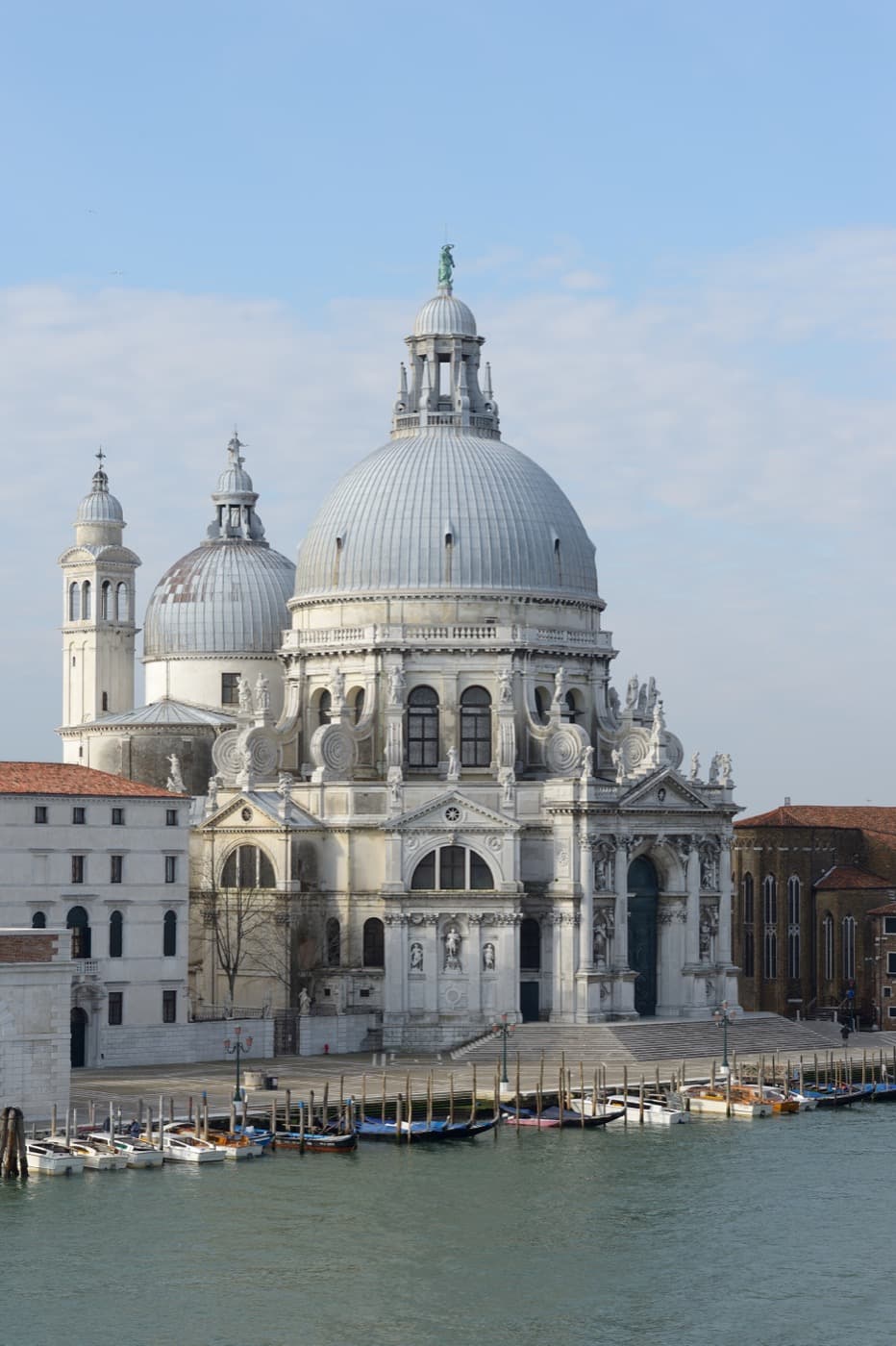
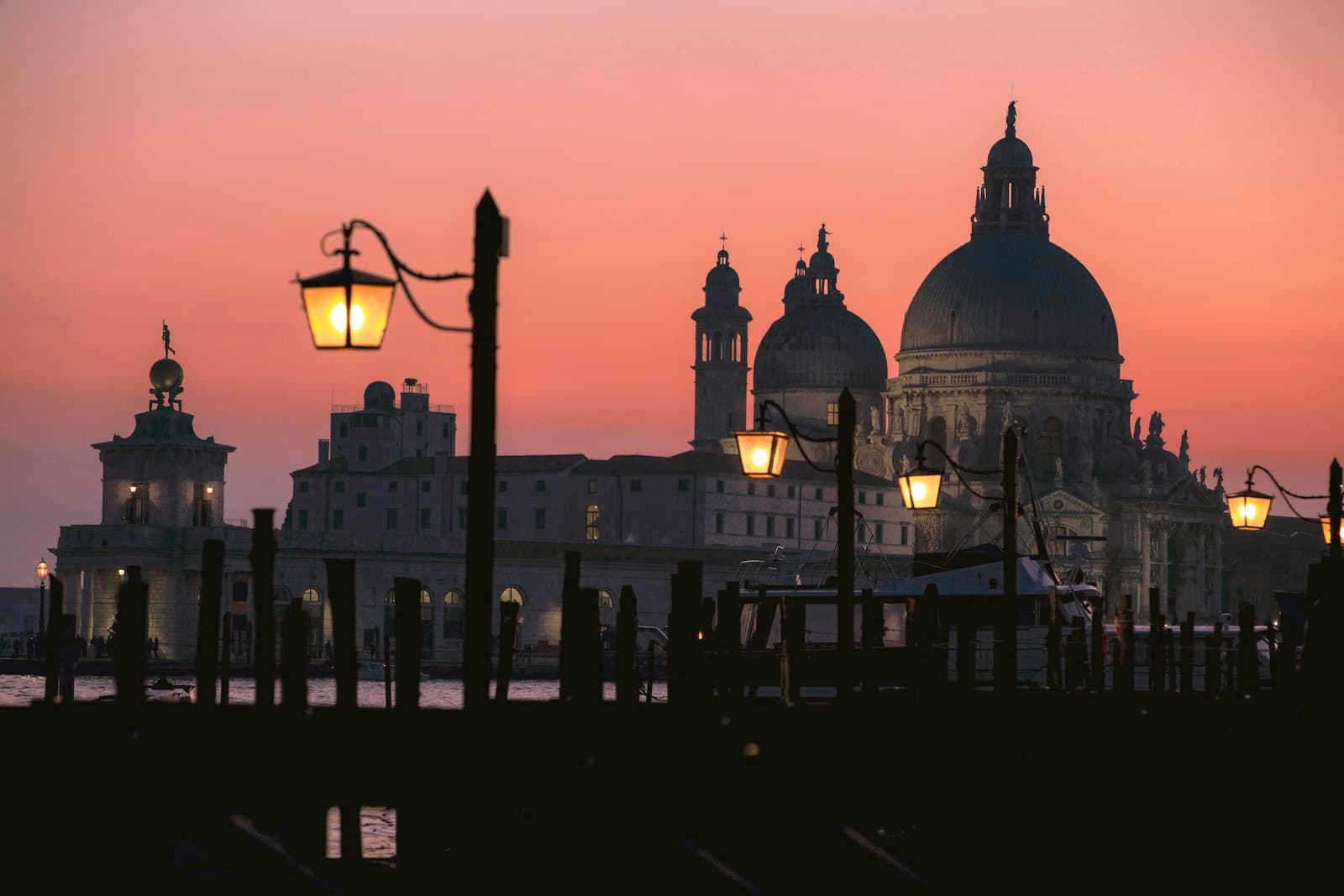
Santa Maria della Salute is a votive church that Venice built as thanks for the end of a plague, and its great white octagonal dome was designed to catch the lagoon light and throw it back at you from every side. Stand where the Grand Canal opens into the lagoon, at the eastern tip of the Dorsoduro sestiere, and the building reads as exactly what it is: a promise made in fear and kept in stone. The word Salute means health. This is not a church named for a saint. It is a church named for the thing a frightened city wanted most.
A vow made while the plague still raged
Between 1630 and 1631, an outbreak of plague killed roughly 46,000 people in Venice. On the twenty-second of October, 1630, with the sickness still spreading, the Venetian Senate met and vowed to build a church to the Virgin Mary if she would lift it. The dedication was deliberate. The Venetians chose Our Lady of Health, protector of the whole Republic, rather than one of the traditional plague saints. It was a civic promise as much as a religious one, and it made the Virgin the guardian of the entire state, not just of individual sufferers.
That decision explains why the building sits where it does. It is not tucked into a parish backstreet. It commands the mouth of the Grand Canal, the first thing arriving ships would see and the last thing departing ones would lose sight of. A promise made by the whole Republic needed to be visible to the whole Republic.
Longhena and the geometry of light
Hear a stop from this walk
Campo Santa Margherita: Where Dorsoduro Simply Lives
The commission went to a young architect named Baldassare Longhena, who was around twenty-six when he was chosen. His mentor was the architect Vincenzo Scamozzi, and the design Longhena produced broke sharply with Venetian tradition. Instead of the long rectangular naves the city knew, he built an octagon crowned by a dome, a centralized plan that turns the church into an object you can walk all the way around.
The most useful thing to understand while standing in front of it is what the shape does with light. The church is white, and it is round. Because it is round, there is always a face of it catching the sun off the water, and because it is white, that light bounces back at you rather than being absorbed. In a city where the whole tour of Dorsoduro is really a lesson in how light behaves on water, the Salute is the argument made in marble. The building does not simply sit in the light. It participates in it, brightening and dimming as the sun and the reflections shift across the canal through the day.
Longhena did not live to see his design completed. Groundbreaking came in 1631. The church was consecrated in 1681 and finished in 1687, more than half a century of building for a single act of thanks. That timeline is worth holding onto as you look. Almost no one who made the original vow in 1630 was alive when the last stone went in.
What the building keeps inside
The basilica is free to enter, and the interior rewards a few minutes if the dress code and services allow (shoulders and knees covered, voices low). The sacristy, which charges a small fee, holds paintings by Titian and Tintoretto, two of the painters who taught Europe how Venetian light falls on skin and cloth and water. In 1670 the sea captain Francesco Morosini brought a Byzantine icon of the Virgin to the church, which deepened its role as a Marian shrine and tied it further to Venice's identity as a maritime power looking east.
Just beside the church, at the sharp point where the Grand Canal meets the wide Giudecca canal, sits the old sea customs house, the Punta della Dogana, crowned by a golden globe and a spinning statue of Fortune. The two buildings together make the point of Dorsoduro one of the most concentrated views in the city: faith and commerce, health and luck, standing a few steps apart at the hinge of Venice.
A church the city still walks to
The Salute is not a monument that Venice finished with in 1687 and then forgot. Every year on the twenty-first of November, at the Festa della Salute, the city floats a temporary pontoon bridge across the Grand Canal so that people can walk out to the church on foot and light a candle. It is one of the few days a Venetian will cross the Grand Canal without a boat or one of the permanent bridges. The vow made in 1630 is, in a real and physical sense, still being kept.
That is the one thing to carry away while standing here. This is a place the city returns to on purpose, a piece of civic memory that has stayed alive for centuries rather than hardening into a photo backdrop. The white curves you are looking at were built by people who had just buried tens of thousands of their neighbors, and the annual bridge is how their descendants keep answering that grief.
Walk the light for yourself
Santa Maria della Salute is the opening stop of Roamer's self-guided audio walk through Dorsoduro, "The Long Light." From the white dome the route releases westward onto the sun-facing Zattere quay where mountain timber once landed, past the Gallerie dell'Accademia and its wooden bridge, the working gondola boatyard at San Trovaso, and finally into the lived-in expanse of Campo Santa Margherita. It is roughly ninety minutes at your own pace, about four kilometers of flat waterfront and narrow calli, and every stop but the museum interiors is free.
The Salute makes most sense in the late afternoon, when the low sun rakes across the water and the white marble glows. Plan the walk so you reach the dome as the light lengthens, then follow it inland. For the full route and more Venice ideas, see our guide to Venice walking tours and the wider Venice collection.
Sources
- Santa Maria della Salute, Wikipedia: architectural history, the 1630 Senate vow, Longhena's commission, and the consecration and completion dates.
- Punta della Dogana, Wikipedia: the neighboring customs house and its golden statue of Fortune at the tip of Dorsoduro.
- Roamer tour "The Long Light" (venice-dorsoduro), fact-audited tour transcript: the plague death toll, the Festa della Salute pontoon bridge, and the sacristy holdings.
Ready to experience it?
Dorsoduro: The Long Light
100 min · 4.1 km · moderate
More from Venice
Explore more at your own pace.
One Day in Venice: A Walkable Morning-to-Evening Itinerary
Venice: The City Engineered on Water for Trade
Where the Word Ghetto Was Born: A Walk Through Venice's Cannaregio
St Mark's Basilica: The Church of Gold and Stolen Horses
The Doge's Palace: Seat of an Elected Empire