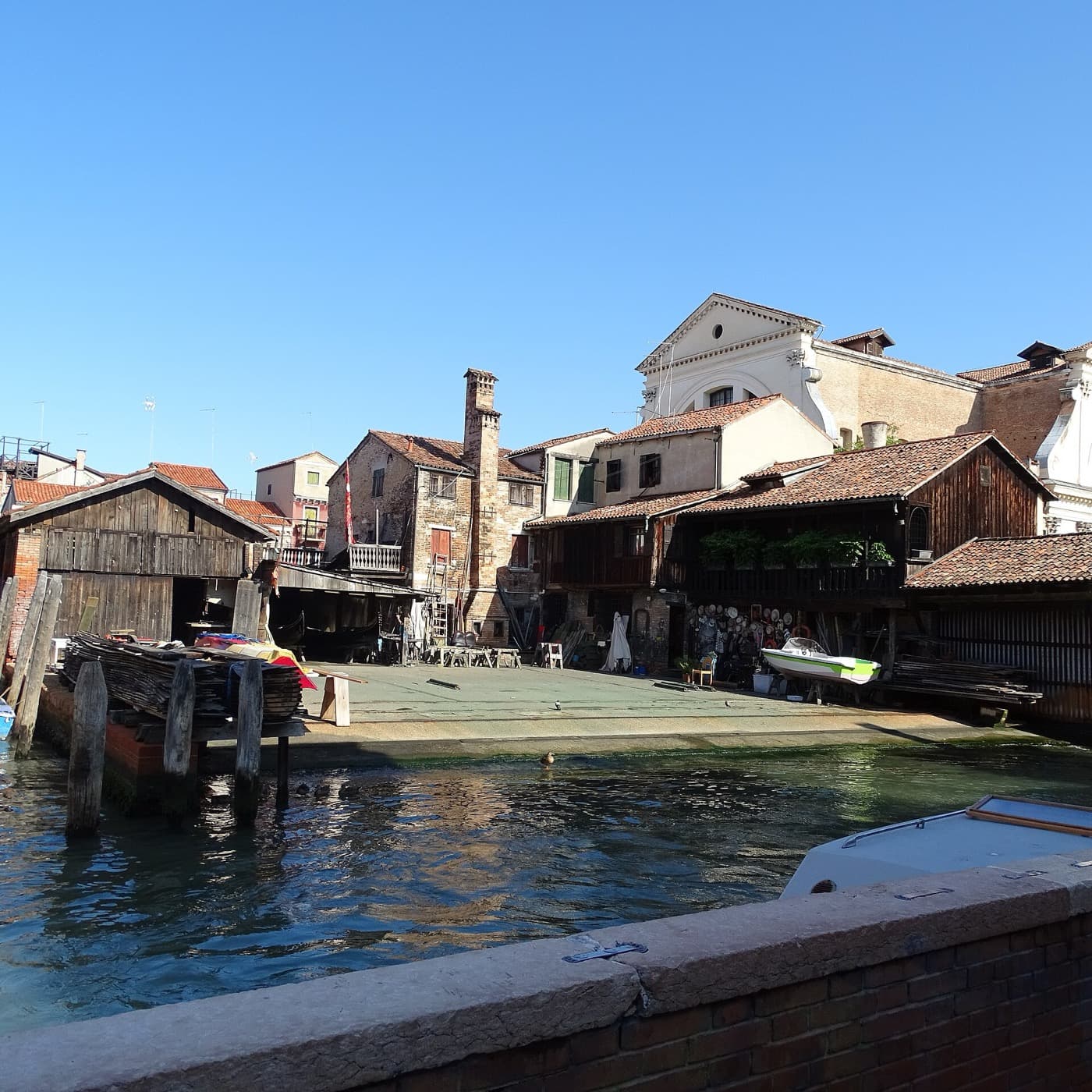
Across a small canal in Dorsoduro, the quiet southern back of Venice, a working gondola boatyard shapes black boats from about eight kinds of wood, and if you read it slowly it explains the whole neighborhood. The Squero di San Trovaso is where Venice's famous light on water stops being a subject for painters and becomes a thing carved into being by hand. Stand across the rio San Trovaso and watch, and you understand that the polished set pieces at the water's edge and this low wooden shed with its sloping roof are two halves of one idea.
A boatyard that looks like a mountain hut
The first thing you notice is that the buildings look wrong for Venice. Instead of stone palaces, you see low wooden structures with sloping roofs and open balconies, closer to an Alpine hut than a Venetian house. There is a reason, and it is the reason this whole walk holds together. The carpenters and the timber both came from Cadore, up in the Dolomites, and they built in the style of home. The yard was established in the seventeenth century and is described as one of the oldest surviving squeri in Venice. A squero is a boatyard where gondolas are built and repaired by hand, and only a handful of living ones remain rather than relics.
You watch from the opposite bank because the yard is a working site, not a museum, and it is not open to the public. That constraint is the point. The view from across the water is the whole experience, and it keeps the place honest.
Eight woods, one asymmetrical boat
Hear a stop from this walk
Campo Santa Margherita: Where Dorsoduro Simply Lives
A gondola is a strange and beautiful thing to build. It is flat-bottomed and slightly asymmetrical, curved so that it holds a straight line under a single oar worked from one side. It is traditionally made from about eight different kinds of wood, among them fir, oak, walnut, cherry, and larch, each species chosen for a specific part of the hull. That is not decoration. It is engineering worked out over centuries, each timber picked for how it bends, floats, or resists the water.
Only around ten brand-new gondolas are built in Venice in a typical year. Everything else at the Squero di San Trovaso is repair, the slow and patient upkeep that keeps the black boats on the water. Think of the yard as the workshop behind the paintings you pass earlier on the walk. The great gallery holds the finished vision of Venice. This is where a piece of that vision, the gondola gliding across reflected light, is quite literally shaped from raw wood.
Why this stop opens the whole tour
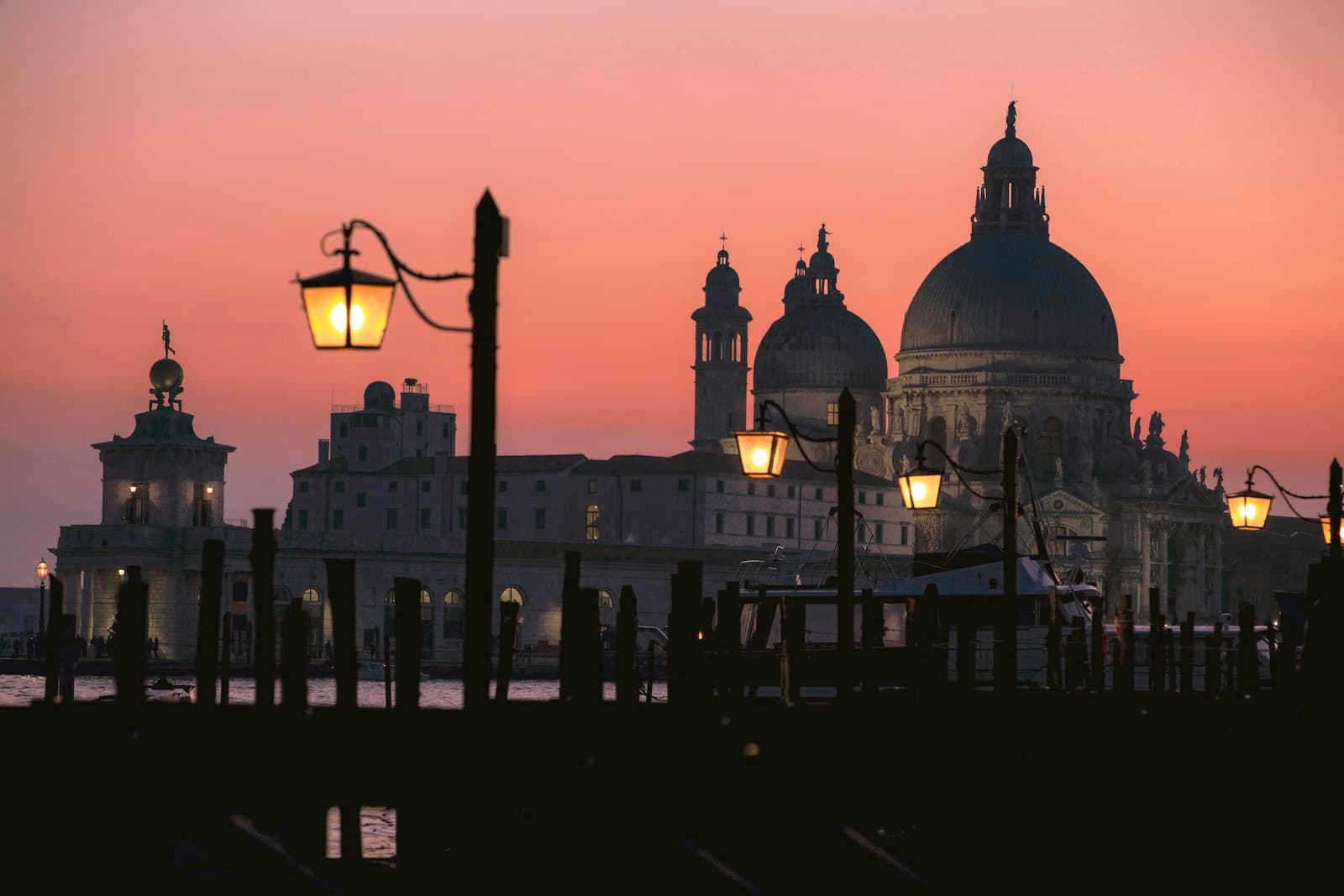
The Dorsoduro walk is a slow reading of light on water, and the boatyard sits at its climax because it turns an abstract idea into something you can see being made. The route begins at the mouth of the Grand Canal, at the Basilica di Santa Maria della Salute, a vast white votive church the Venetian Senate vowed to build during the plague of sixteen thirty to sixteen thirty-one. The church is white and round on purpose, so it catches sun off the water on every side and throws it back at you. A few steps on, the Punta della Dogana, the old sea customs house, is crowned by a golden statue of Fortune that turns in the wind as a weathervane. A merchant city that lived by the wind put luck herself up there, spinning to show the breeze. It is one of the most honest self-portraits a trading city ever made.
Then the walk opens onto Le Zattere, the long stone quay along the southern edge of Dorsoduro. The name means rafts, after the log rafts floated down the rivers from the Dolomites and landed right here, along with cargoes of salt and coal. The pavement was completed around fifteen sixteen, and it faces almost due south, so sun pours across the water all day and warms the stones. There is no monument to tick off on the Zattere. The quay is the lesson: Venetian light is not a thing you look at, it is a thing you stand inside.
From the light itself the route steps inland to the painted results at the Gallerie dell'Accademia, where Giovanni Bellini, Giorgione, Titian, and Canaletto taught Europe how Venetian light behaves on water and skin and cloth. The academy was established in seventeen fifty, and its collections opened to the public on the tenth of August, eighteen seventeen. Beside it, the wooden Ponte dell'Accademia arches over the Grand Canal. A wooden bridge has spanned the canal here since nineteen thirty-three, and the current one dates to nineteen eighty-five. From its crown the canal bends toward the white dome of the Salute, and you are standing inside one of the most painted views on earth.
The boatyard follows because it closes the loop. You have seen the light on the church, felt it on the Zattere, and watched painters catch it on canvas. At the Squero di San Trovaso you finally see the object that carries that light across the water, being built one plank at a time from mountain wood, in a shed built by mountain carpenters. It is the connective tissue of the entire tour.
The end of the argument
The walk resolves a few minutes north at Campo Santa Margherita, a broad, lived-in square of roughly eight thousand square metres, ringed by houses from the fourteenth and fifteenth centuries and fed with students from the nearby Ca' Foscari University. There are no set pieces here. Children run across it, weekday market stalls sell produce and flowers, and the church that named the square, first built in the ninth century and deconsecrated in eighteen ten, later served as a university auditorium. In nineteen thirteen and nineteen fourteen local socialists jokingly proclaimed a Republic of Santa Margherita and even named fishermen as their doges. That mischief tells you what the campo is: the place where Dorsoduro stops performing and simply lives, the same lagoon light falling on people going about their day.
Walk the route east to west, starting around ten in the morning and finishing near sunset, so the low sun moves onto the south-facing Zattere as your afternoon goes on. You need no tickets. The church, the customs-house point, the quay, the bridge, the boatyard view, and the campo are all free from the outside. Wear flat, grippy shoes for the uneven stones and the stepped bridges, carry water for the shadeless waterfront, and let the light do the guiding.
If you are planning your visit, browse more Venice walking tours or start from the Venice city page. The Long Light tour turns this reading of Dorsoduro into a stop-by-stop walk with the boatyard as its quiet centerpiece.
Sources
- Squero di San Trovaso, Atlas Obscura: background on the seventeenth-century boatyard and its Cadore-style wooden buildings.
- Santa Maria della Salute, Wikipedia: the plague vow of 1630 to 1631, Baldassare Longhena, and the church's construction history.
- Gallerie dell'Accademia, Wikipedia: the academy's 1750 founding, its 1817 public opening, and the Venetian painters in its collection.
- Ponte dell'Accademia, Wikipedia: the wooden bridge's 1933 opening and 1985 rebuild across the Grand Canal.
- Campo Santa Margherita, Wikipedia: the square's medieval houses, its church, and the 1913 to 1914 Republic of Santa Margherita episode.
Ready to experience it?
Dorsoduro: The Long Light
100 min · 4.1 km · moderate
More from Venice
Explore more at your own pace.
One Day in Venice: A Walkable Morning-to-Evening Itinerary
Venice: The City Engineered on Water for Trade
Where the Word Ghetto Was Born: A Walk Through Venice's Cannaregio
St Mark's Basilica: The Church of Gold and Stolen Horses
The Doge's Palace: Seat of an Elected Empire