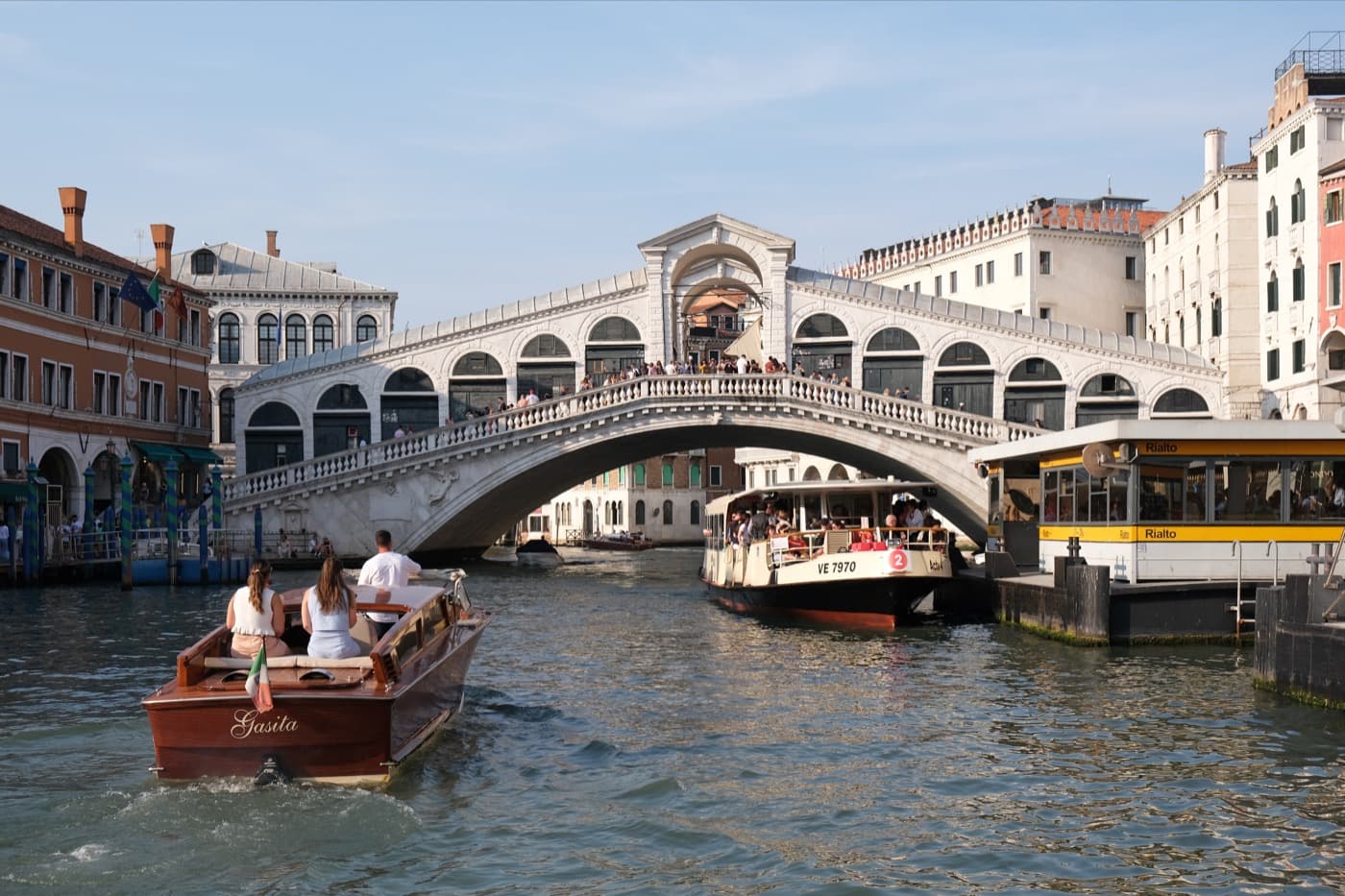
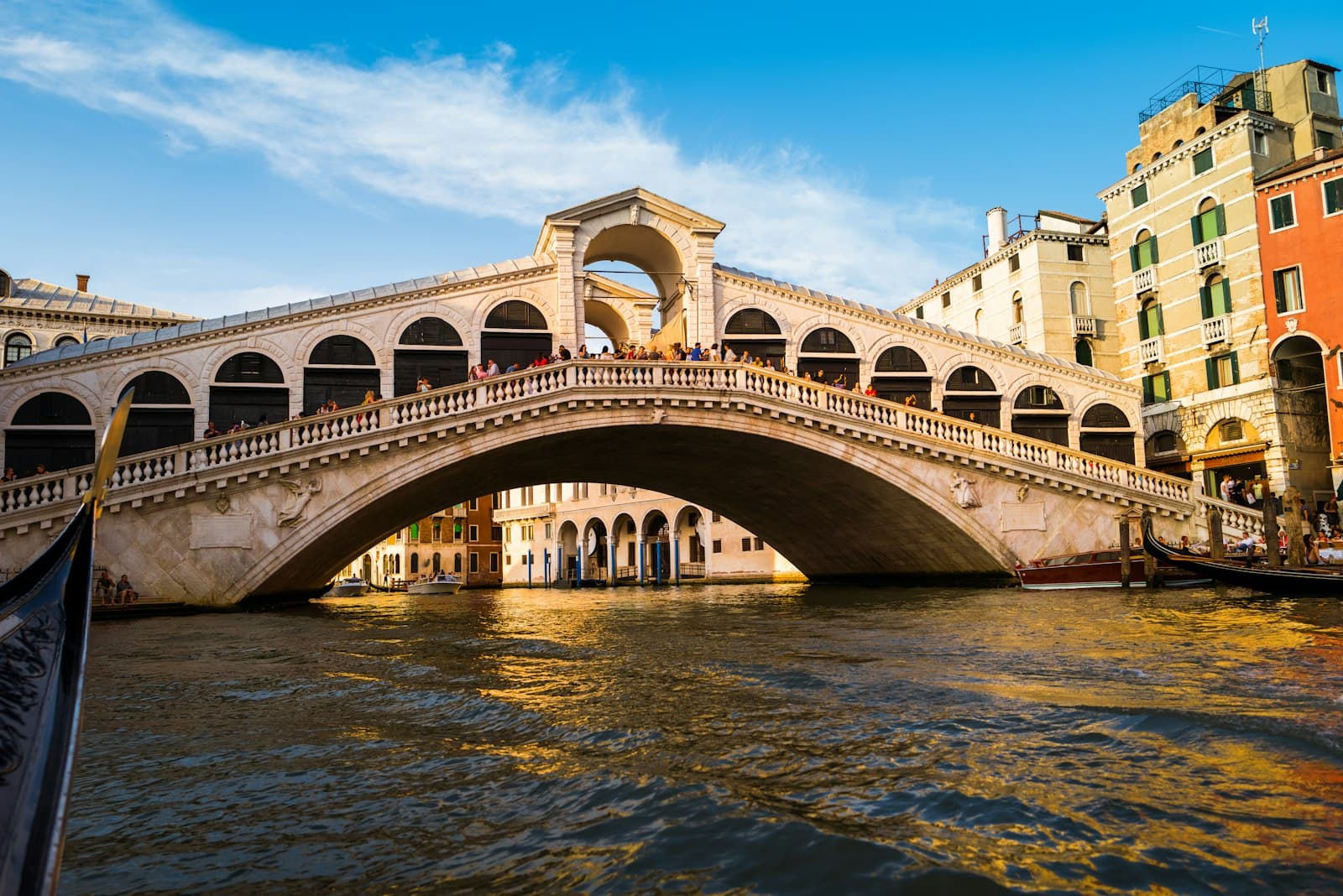
The Rialto Bridge was built as commercial infrastructure, and it was designed to pay for itself. Most visitors cross it for the postcard view: the Grand Canal opening beneath them, gondolas working the water, palaces stacked along both banks. That reading is not wrong, but it misses what the bridge actually is. Stand on the Ponte di Rialto and you are standing on the hinge of a machine. It was built to move goods and people to and from the market on the far bank, and the shops along its flanks were rented out to help fund the upkeep of the Republic's treasury. The bridge sold the space along its own back. Once you see that, you see Venice.
A crossing that kept failing
The stone bridge you cross today is the last in a long line, and the earlier ones share a theme: they broke. The first crossing here was a boat bridge, a pontoon strung across the canal in the year 1181 by an engineer named Nicolo Barattieri. A wooden bridge followed in 1255, and it had a run of bad luck that reads like a warning. It was partly burned in 1310 during a revolt against the state. It collapsed in 1444 under the weight of a crowd that had gathered to watch a wedding procession. It failed again in 1524.
By the late sixteenth century the Republic had run out of patience with timber. The Rialto had been the commercial center of Venice for centuries, and a permanent, high-capacity crossing was an economic necessity, not an ornament. So Venice held a competition, and it drew proposals from several leading figures of the age. The winner was the architect Antonio da Ponte, whose surname, fittingly, means "of the bridge." His solution was a single stone arch, and it was so audacious that a rival architect, Vincenzo Scamozzi, predicted the span would surely fall. Da Ponte built it anyway, between 1588 and 1591. It has stood ever since.
The shops are the point
Hear a stop from this walk
Ponte di Rialto: The Bridge That Sold Space
Now look at what runs along the sides of the bridge. Those are shops, two rows of them, built into the structure back in the fifteenth century and continued in the stone rebuild. They are not a later addition or a tourist afterthought. They are the reason the design made financial sense. The rents collected from those shops helped pay for the upkeep of the state treasury, which is the cold-blooded logic of Venice made physical. This was a city that monetized every usable surface in its market district, and it applied that habit to a public bridge without hesitation. The Ponte di Rialto is a piece of revenue-generating infrastructure that happens to be beautiful.
Hold that idea, because it is the thesis of the whole neighborhood. The palaces, the churches, the painted interiors that make Venice look like a dream were all paid for by exactly this kind of arithmetic. The romance floats on the ledger.
Why the bridge stands where it does
Cross to the far side and you arrive at the reason the bridge exists at all. The market moved to the Rialto in the year 1097, which makes this ground the commercial origin point of the entire Republic. That is nearly five centuries before da Ponte laid his single arch. The bridge did not create the market. The market created the need for the bridge. For almost a thousand years, produce and fish have been bought and sold here, and both markets still open at dawn. The Erberia handles produce under the open sky; the Pescaria handles fish beneath a hall that looks medieval but was built in 1907 in a deliberately antique Gothic style.
This is what a permanent high-capacity crossing was for. The Rialto district was once dense with warehouses, banks, insurance agencies, and tax offices, and every one of them depended on moving goods and people across the Grand Canal quickly and reliably. A pontoon that had to open for shipping, or a wooden span that collapsed under a wedding crowd, could not carry the traffic of the richest trading district in Europe. The stone bridge finally could.
What to notice standing there
Give yourself a few minutes before the midday crush arrives. First, find the single span and remember that a respected architect bet against it. The bridge you are leaning on won an argument that its designer's peers thought unwinnable. Second, walk the interior passages between the two rows of shops rather than only the outer balustrades where everyone photographs the canal. That inner corridor is where the commercial machine actually operated, and it still trades today. Third, look down at the canal traffic and picture it as freight rather than scenery. Barges, delivery boats, and the market's supply lines are the modern echo of the medieval reason this crossing was built.
The 1514 fire that leveled most of the surrounding district spared very little, which is why so much of what rings the market is later reconstruction. The bridge, built decades after that fire, was part of the Republic's long recovery and consolidation of its commercial heart. It is not a survivor of old Venice so much as a statement of confidence by a Venice that had rebuilt and meant to keep trading.
Walk the engine room
The Rialto rewards a slow reading, and the bridge is only the opening argument. The market halls, the oldest church in the city, the stone hunchback from which the Republic proclaimed its laws, the trading house that lodged and taxed foreign merchants, and the confraternity that turned merchant profit into a legendary painted interior all sit within a short, flat walk of the bridge. Together they trace the full life-cycle of Venetian capital: goods, money, law, foreign trade, community, and legacy.
Our self-guided audio walk, The Engine Room, follows exactly that arc through the San Polo district, starting on the Ponte di Rialto and reading the postcard city as the business it once was. You set the pace, and any stop you want to skip, you skip. For more routes across the city, browse our Venice walking tours, or start planning from the Venice city page. Begin on the bridge, then go find the market that gave it a reason to exist.
Sources
- Rialto Bridge, Wikipedia. Construction dates, da Ponte's design, the earlier boat and wooden bridges, and Scamozzi's failure prediction.
- Rialto Bridge, Wikidata (Q52505). Coordinates and structured identifiers for the bridge.
- Rialto, Wikipedia. History of the market district, the 1097 relocation of the market, and the 1514 fire.
- Roamer tour transcript, "The Engine Room" (venice-rialto). Fact-audited narration for the Ponte di Rialto and the surrounding San Polo commercial district.
Ready to experience it?
Rialto: The Engine Room
90 min · 1.9 km · easy
More from Venice
Explore more at your own pace.
One Day in Venice: A Walkable Morning-to-Evening Itinerary
Venice: The City Engineered on Water for Trade
Venice's Rialto Market: The Engine Room That Paid for the Palaces
Where the Word Ghetto Was Born: A Walk Through Venice's Cannaregio
St Mark's Basilica: The Church of Gold and Stolen Horses