Castello holds the Republic's working calendar: three churches the doge visited every year, Santa Maria Formosa in February, San Zaccaria at Easter and Santa Giustina on 7 October for Lepanto, and between them the shipyard that made the fleet, with the Lepanto saint on its gate. Venice's eastern district is the quiet half most visitors never reach, washing lines and neighborhood campi rather than queues. Roamer's walk through it is twelve stops over about 3.1 kilometers, roughly ninety minutes, with eleven bridges, almost all with steps. It suits a slow morning: no group to keep up with, and every stop works from outside.
Three appointments with the state
The procession calendar comes from Francesco Sansovino's guide to the city, first printed in 1581. Its pages record the doge leaving the palace on fixed days, with his council, to visit particular churches.
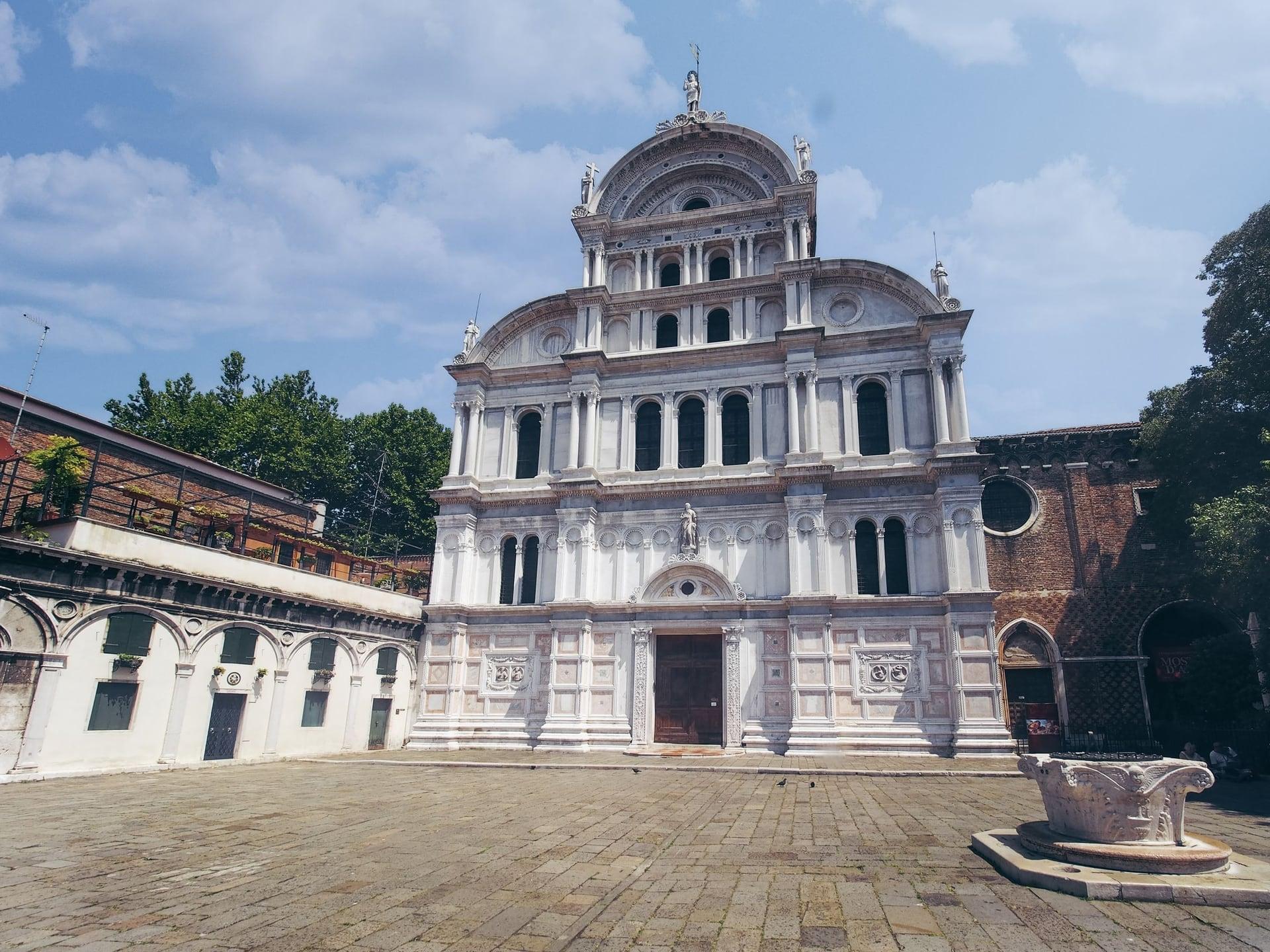
At San Zaccaria, stop 1, he came every Easter Day after the sermon in St Mark's, received by the nuns and their abbess. Sansovino gives three reasons for the visit and admits it is hard to judge which is true. The most practical, taken from a doge's own chronicle, is that the nuns' land was taken to enlarge St Mark's Square, and the doge bound himself to an annual visit in exchange. A square, paid for with farmland and a promise.
At Santa Maria Formosa, stop 2, he came on the eve of the Purification, in February. The reason Venetians gave is a legend Sansovino calls common report: brides seized by pirates in 943, rescued by the chest-makers of this parish, who asked only that the doge visit their church each year. Whether or not any raid happened, the visit did.
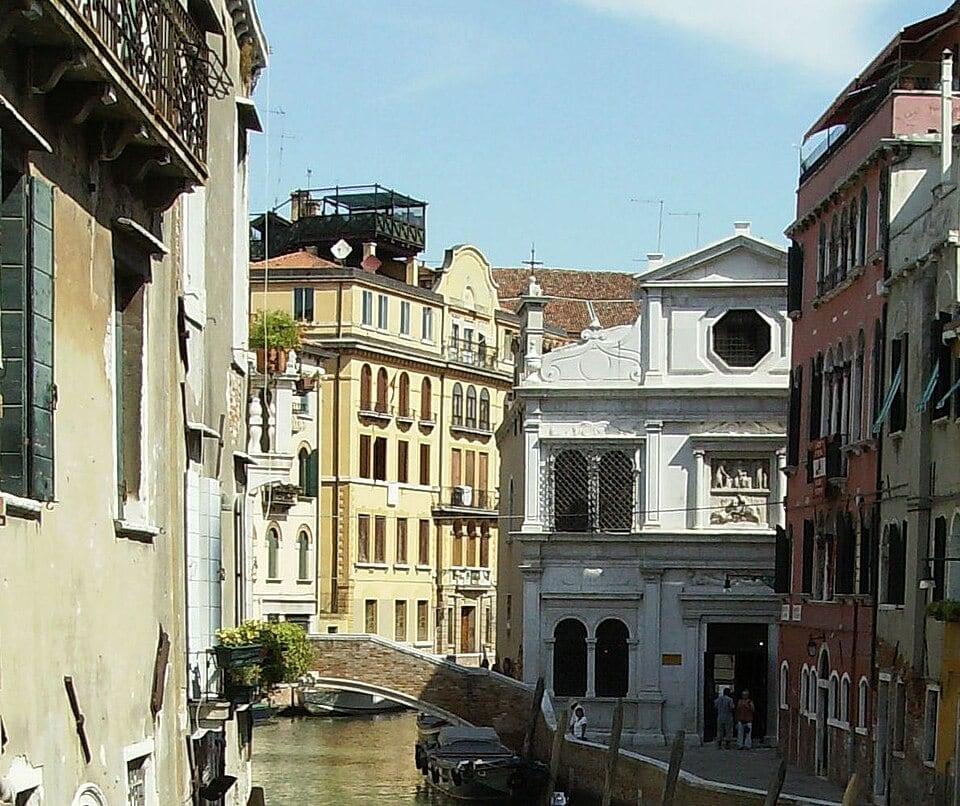
At Santa Giustina, stop 4, the reason is a battle. On 7 October 1571 the Venetian fleet, with the Pope's and King Philip's, broke the Ottoman fleet at Lepanto, and from 1572 the doge came here every year by water. The front faces the canal because the doge arrived by canal. The Republic even struck coins reading memor ero tui, Iustina virgo: I will remember you, virgin Justina. The church is a school today, and the front is the whole visit.
Between the churches, a working city
Hear a stop from this walk
Partisan Woman, Giardini: At the Waterline
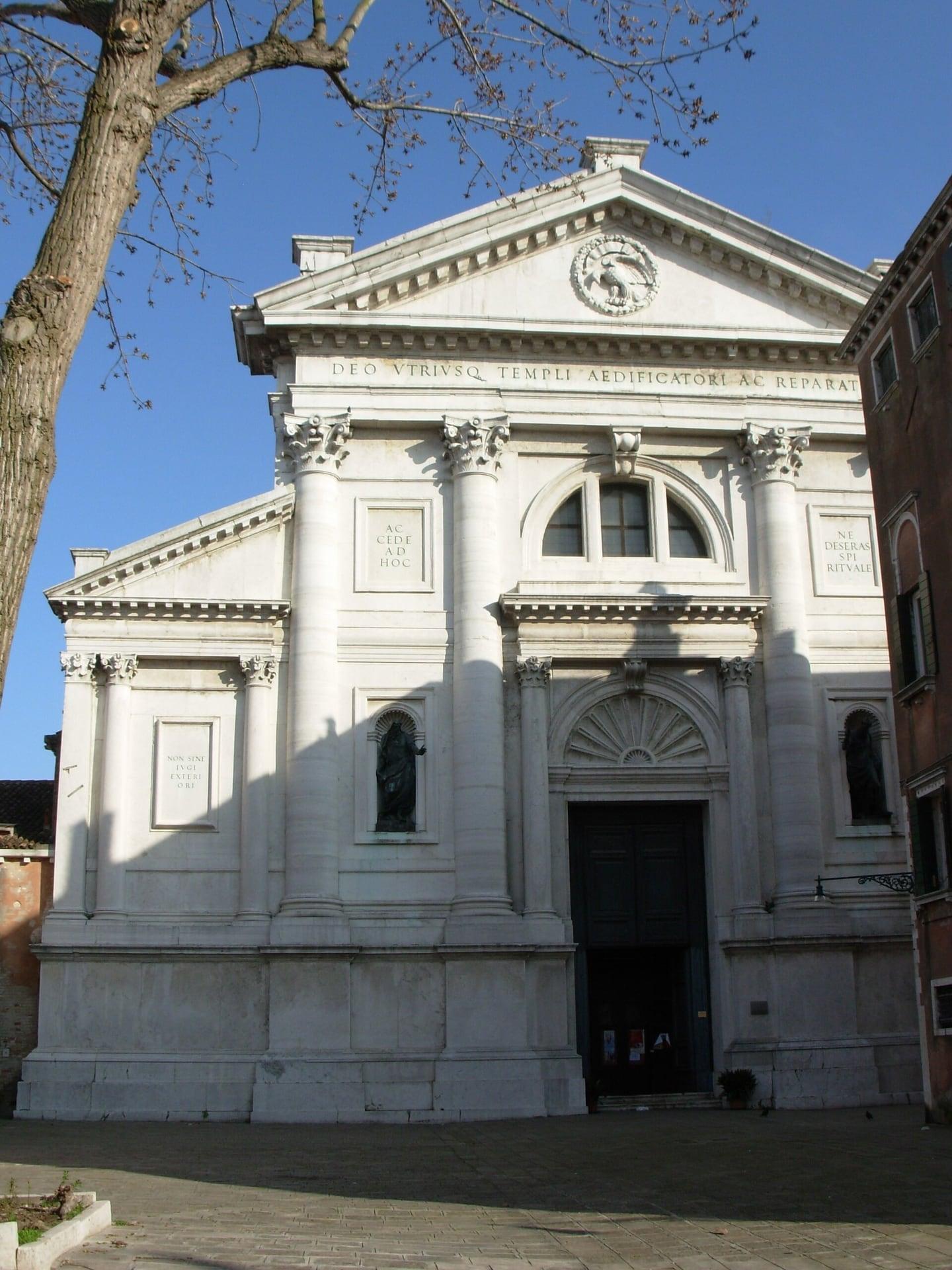
Two stops show how Castello's design worked. At Campo Santi Giovanni e Paolo, stop 3, the carved front of the old Scuola Grande di San Marco, now the entrance to the city hospital, has two lions standing in arches that seem to run deep into the wall. They do not. The depth is carved flat, a trick of perspective. At San Francesco della Vigna, stop 5, Andrea Palladio solved the problem of putting a temple front on a church with a tall nave and low aisles by setting two temple fronts on one wall, one inside the other.
Then the Scuola di San Giorgio degli Schiavoni, the Dalmatians' confraternity, and Campo Bandiera e Moro, where a plaque on San Giovanni in Bragora marks Antonio Vivaldi's baptism.
The shipyard and its saint
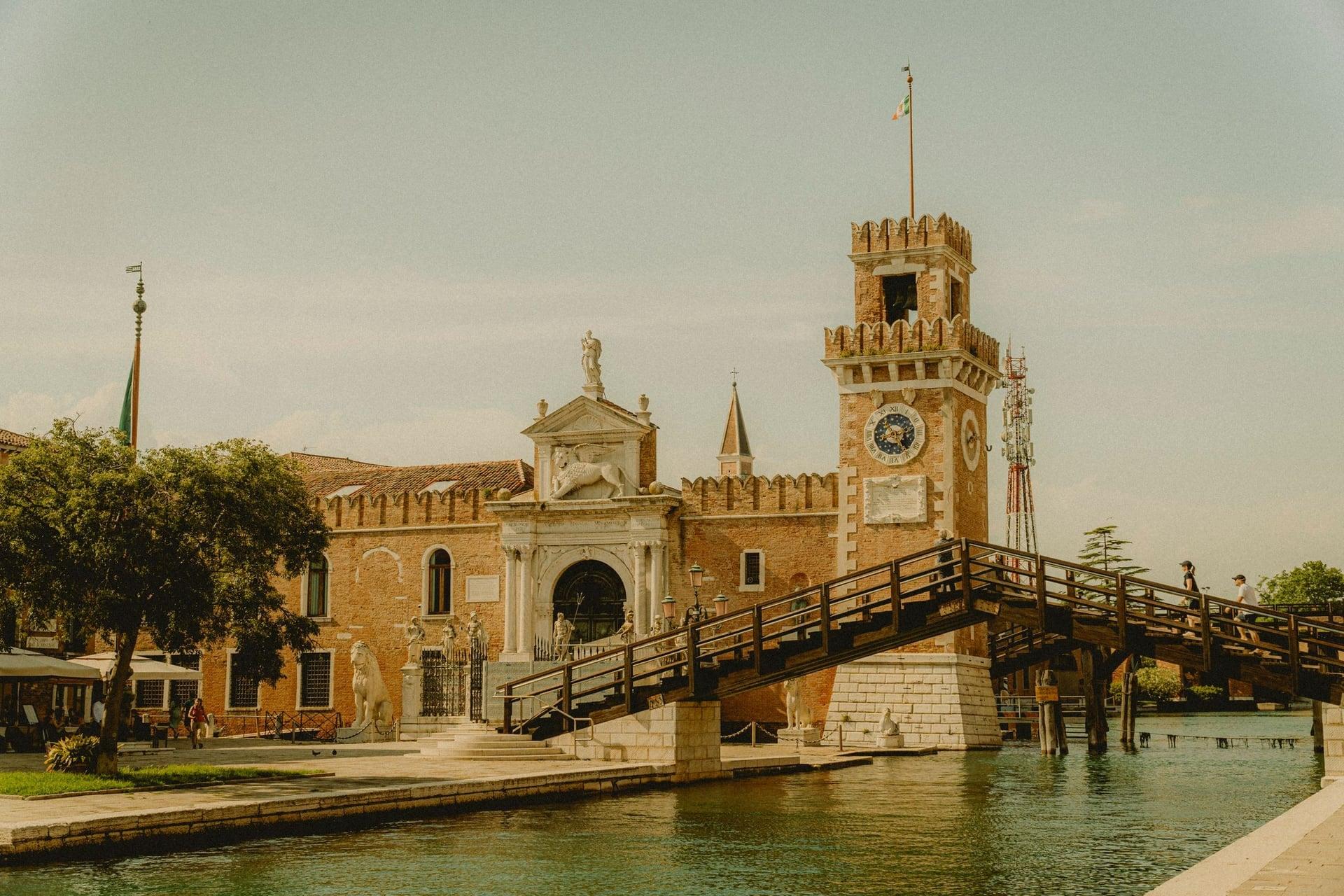
At stop 8 the land gate of the Arsenale rises over its campo, its inscription dated 1460. On the very top stands a marble Saint Justina, larger than life: the saint of the October procession, carried into the stone of the yard that built the fleet. The yard is Navy ground and closed, so this is a stop from outside, and the gate rewards it. Ca' Foscari University's guide says all four marble lions in front came from the Greek world. One stood in the port of Athens at Piraeus and came here in 1687. Its flanks carry runes that the Swedish History Museum reads as cut by Scandinavians serving Byzantium in the eleventh century.
Down the canal, at stop 9, the long wall of the Tana was the rope walk. La Biennale gives it as built in 1303 and rebuilt from 1579 to 1585 to a design by Antonio Da Ponte, the Rialto Bridge's architect, 317 meters long. A Castilian traveler in 1436 watched galleys towed past windows that handed out ropes, bread and weapons in turn. The popular line that the yard built a galley a day is not what historians find; the speed was in fitting out hulls built ahead.
A newer calendar
The last three stops trade the doge's year for Napoleon's city. Via Garibaldi was a canal, filled in under Napoleon to make a street. The tree-lined avenue beyond leads into the public gardens he wanted in 1807, most of them now the grounds of the Biennale, whose exhibitions keep this end of Castello's modern calendar. The walk ends at the lagoon's edge with Augusto Murer's bronze of a partisan woman, set by Carlo Scarpa so the tide washes over her.
This is Castello and the Arsenale: Where the Republic Built Its Fleet, twelve stops from San Zaccaria to the Giardini. See all routes on the Venice page.
Sources
- Francesco Sansovino, Venetia città nobilissima et singolare (1663 edition), Internet Archive: the doge's processions to San Zaccaria, Santa Maria Formosa and Santa Giustina, the Lepanto coins, the Arsenale gate and its Santa Giustina.
- La Biennale, Arsenale: up to 2,000 workers a day, the Corderie of 1303 rebuilt 1579 to 1585 by Antonio Da Ponte, 317 by 21 meters.
- Swedish History Museum, the Piraeus lion: the runes cut by Varangians in Byzantine service, dated to the eleventh century, and the lion at the Arsenale.
- ISE Venezia, San Francesco della Vigna facade: Palladio's front of 1564 to 1570 and its two orders.
- Roamer's audited tour transcript and fact dossier for this walk: the Ca' Foscari lion itinerary, Wilson and Favotto on the Arsenale, and the Musei Civici sheet on the Partisan Woman.
Ready to experience it?
Castello and the Arsenale: Where the Republic Built Its Fleet
90 min · 3.1 km · easy
More from Venice
Explore more at your own pace.
La Fenice and Campo Santo Stefano: A Walk Through Venice's Fronts Built to Be Seen
St Mark's Square and the Doge's Palace: Reading a Square That Was Borrowed and Rebuilt
La Fenice and San Maurizio: Giannantonio Selva's Two Fronts on One Venice Walk
San Francesco della Vigna: How Palladio Put Two Temples on One Church Front
Santa Maria del Giglio: The Venice Church Front Built for One Family