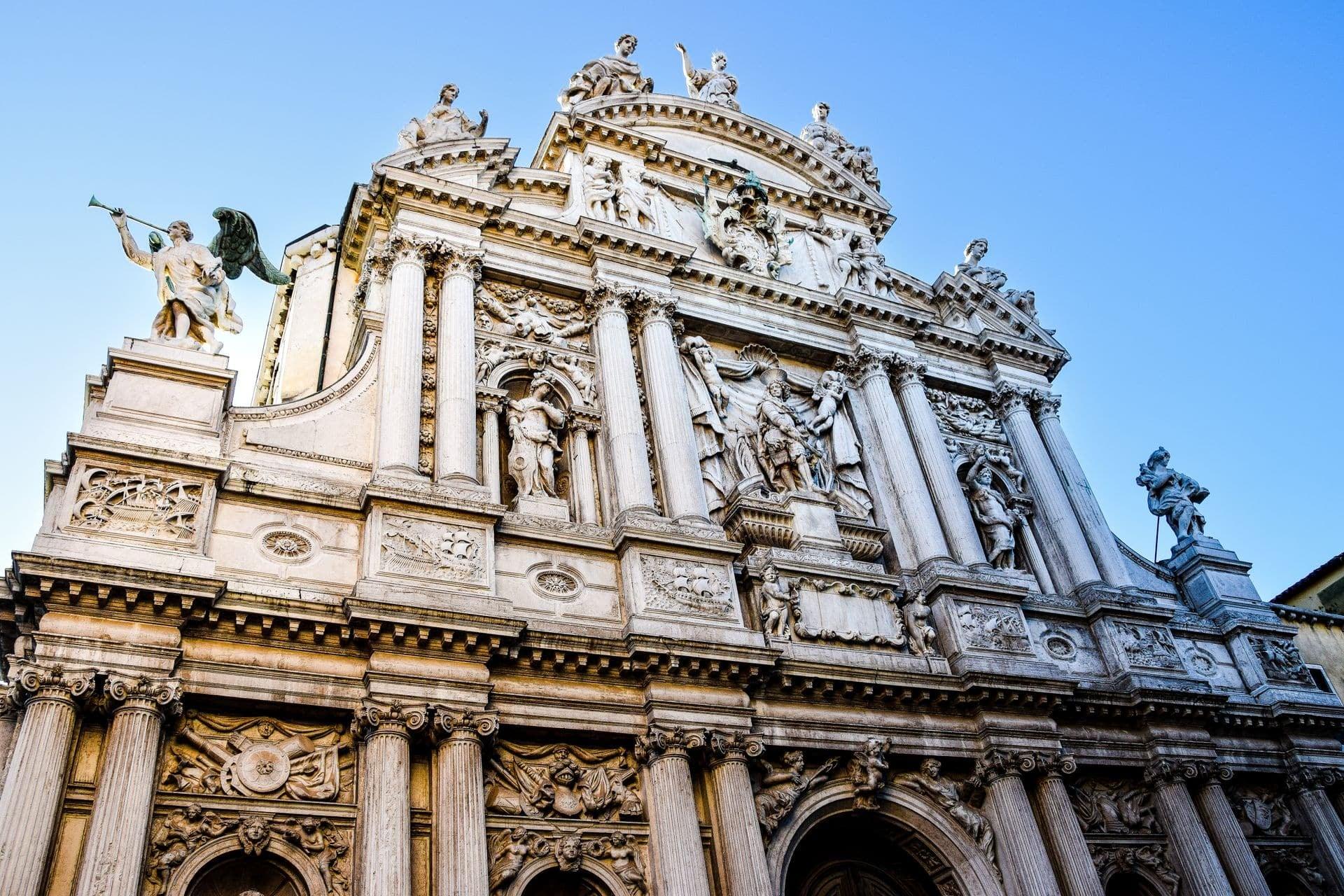
Santa Maria del Giglio's front is a church facade with almost no saints on it: Antonio Barbaro's bequest paid for a Baroque monument to one family, its men in the niches and its places of service carved in stone. Stand square-on to it in the campo and go looking for a holy figure. You will find a sea commander, his brothers and a set of virtues instead.
Thirty thousand ducats
The church is old, but what you see is late. Tradition says it was founded in the early tenth century at the cost of a family called Jubanico, which is where its Venetian name, Santa Maria Zobenigo, comes from. Fires damaged the first church, in 966 and in 1105 among others, and by the middle of the seventeenth century the building was unsafe, so it was pulled down and rebuilt. The architect Giuseppe Benoni finished the interior in 1680.
The front came from a will. Antonio Barbaro, a nobleman who served the Republic at sea, died in 1679 and left thirty thousand ducats for it. The church association that looks after the building says the architect Giuseppe Sardi was commissioned to design a facade celebrating the Barbaro family, and Antonio in particular. That brief is the whole key to what you are looking at.
Reading the front
Hear a stop from this walk
Campo San Vidal: At the Foot of the Bridge
The front has two stories of paired, fluted columns: Ionic below, Corinthian above, with an attic and a shallow curved pediment on top. Now read it from the middle out.
In the center of the upper story stands Antonio Barbaro's own funeral monument, showing him as Captain General of the Sea; the church association attributes it to Giusto Le Court. In the four niches between the lower columns stand his brothers, Giammaria, Marino, Francesco and Carlo, statues attributed to Heinrich Meyring. Beside the monument are figures of Honor and Virtue, and further out, at the edges, Fame and Wisdom. In the center of the attic sits the Barbaro coat of arms. The upper column bases carry battle scenes. The family has taken every place a facade normally gives to the saints.
Then look low. On the bases of the lower columns, carved in shallow relief, are plans of six cities: Zara, today Zadar; Candia, today Heraklion on Crete; Padua; Rome; Corfu; and Spalato, today Split. The church association reads them as a record of the family's political and military successes, not as a list of battles won at each place. The plan of Zara is dated 1678 to 1683. Up close they work like small maps, walls and harbors laid out in stone at eye level.
So the whole front is a document of service, and of a family's place in the Republic. The donor's family is the program.
A name with two meanings
The sign says Santa Maria del Giglio, Saint Mary of the Lily. Venetians still use the older name too, and it matters on this walk: Zobenigo was one of the two parishes in which the plot for La Fenice was bought, so the opera house a few minutes away grew partly out of this church's territory.
Inside, if it is open
The church is a working church, free to step into, Monday to Saturday. The church association lists a Madonna and Child with the young Saint John by Peter Paul Rubens, which it calls the Flemish painter's only work in Venice, and Jacopo Tintoretto's Four Evangelists, once the doors of the old organ. The interior is a single nave with a flat ceiling of large canvases by Antonio Zanchi. If a service is on, keep to the back.
But the front is the reason to stop. It answers a question that runs through this whole quarter of San Marco: who were these buildings for? Here the answer is carved in plain sight. A church, yes, and also a family's monument, paid for in ducats and set in Istrian stone on a public square.
Santa Maria del Giglio is stop 8 of La Fenice and Campo Santo Stefano: The Show Goes On, a walk from Goldoni's statue by the Rialto to the foot of the Accademia bridge, between La Fenice and Campo San Maurizio. See all routes on the Venice page.
Sources
- Chorus, Chiesa di Santa Maria del Giglio: Sardi's facade on Antonio Barbaro's bequest, the Rubens as the painter's only work in Venice, Tintoretto's Evangelists, Zanchi's ceiling, visiting hours (read from the dossier's saved copy, as the live site blocks automated access).
- Chorus, Facciata della chiesa di Santa Maria del Giglio: the Jubanico tradition, the fires of 966 and 1105, Benoni's interior of 1680, Barbaro's death in 1679 and the thirty thousand ducats, the orders, the six city plans, the brothers' statues attributed to Meyring, the monument attributed to Le Court, Honor, Virtue, Fame and Wisdom, the arms (saved copy).
- Chorus, Pianta di Zara: the Zara relief by Sardi, dated 1678 to 1683, and the 1679 commission (saved copy).
- Teatro La Fenice, history: the opera house founded in 1789 to 1792 a few minutes from the church.
Ready to experience it?
La Fenice and Campo Santo Stefano: The Show Goes On
60 min · 1.6 km · easy
More from Venice
Explore more at your own pace.
Castello and the Arsenale: Walking the Doge's Calendar Through Venice's Quiet East
La Fenice and Campo Santo Stefano: A Walk Through Venice's Fronts Built to Be Seen
St Mark's Square and the Doge's Palace: Reading a Square That Was Borrowed and Rebuilt
La Fenice and San Maurizio: Giannantonio Selva's Two Fronts on One Venice Walk
San Francesco della Vigna: How Palladio Put Two Temples on One Church Front