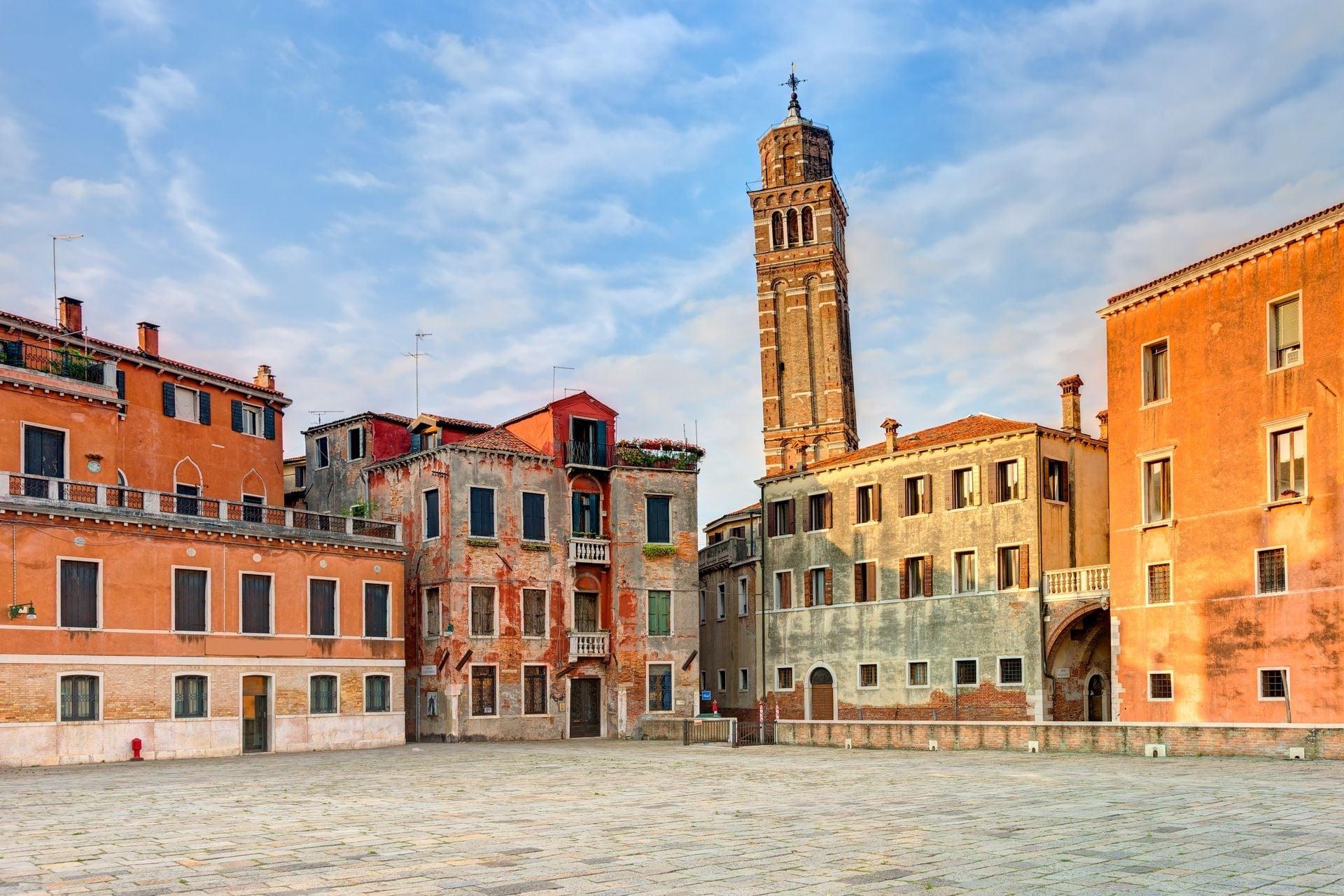
From Goldoni's statue by the Rialto along the Grand Canal to the town hall, the Bovolo staircase, a 1972 bank, La Fenice, a family's church front and Campo Santo Stefano, ending at the Accademia bridge.
Start · Campo San Bartolomeo: The Merchants' Playwright
DirectionsStops
- 1
Campo San Bartolomeo: The Merchants' Playwright
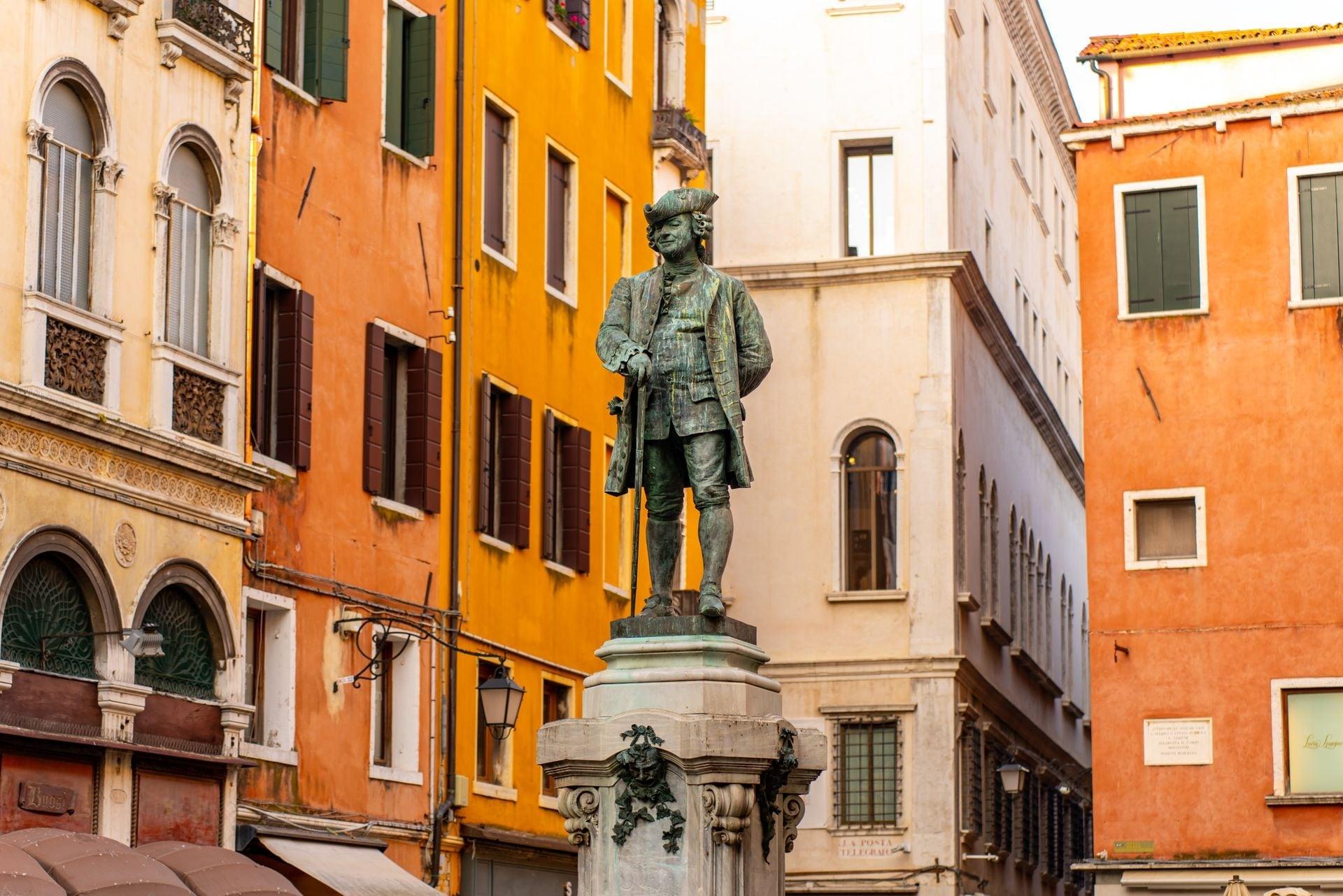
Goldoni in bronze stands among the shops. The square at the Rialto's land foot, where the playwright who gave Venetian merchants their dignity was put up in 1883.
- 2
Riva del Carbon: Warehouses Turned Town Hall
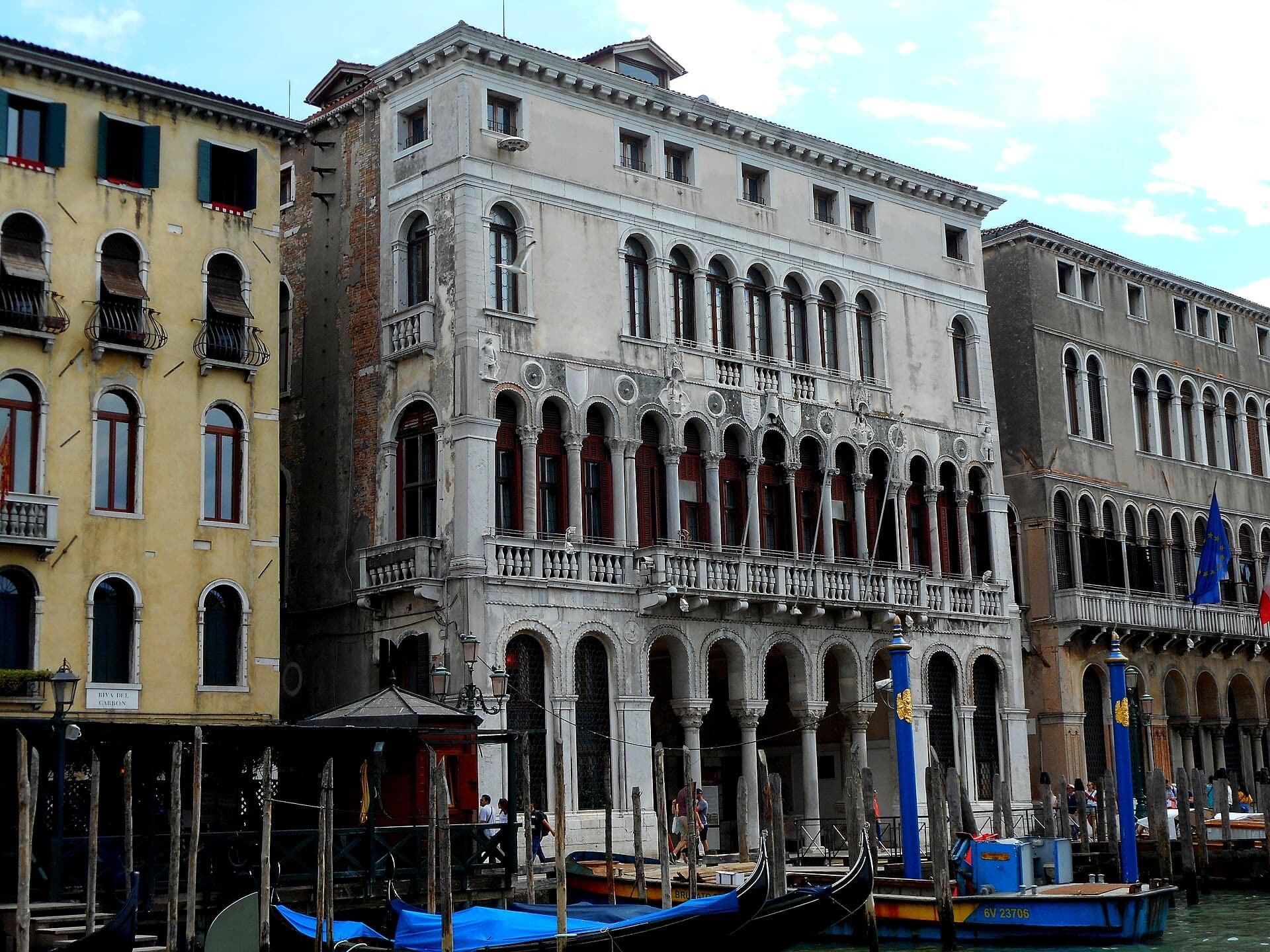
Two merchant houses became the town hall. Ca' Loredan and Ca' Farsetti, house-warehouses from around 1200 on the Grand Canal, have been Venice's city hall since the 1800s.
- 3
Campo San Luca: Goldoni's Theater Corner
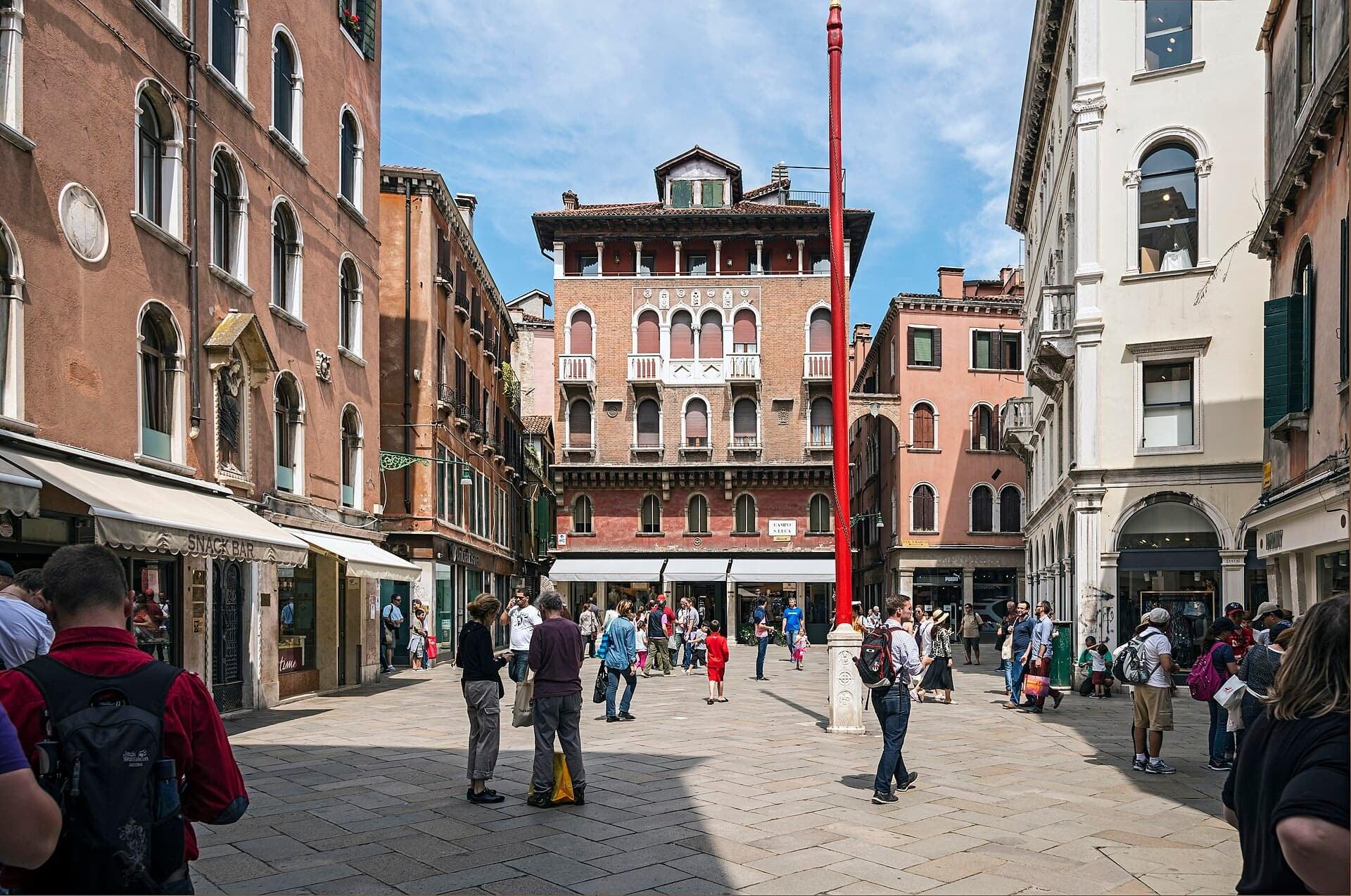
A crossroads near Goldoni's old theater. Five lanes meet in a small square, a few steps from the theater where he wrote for ten years.
- 4
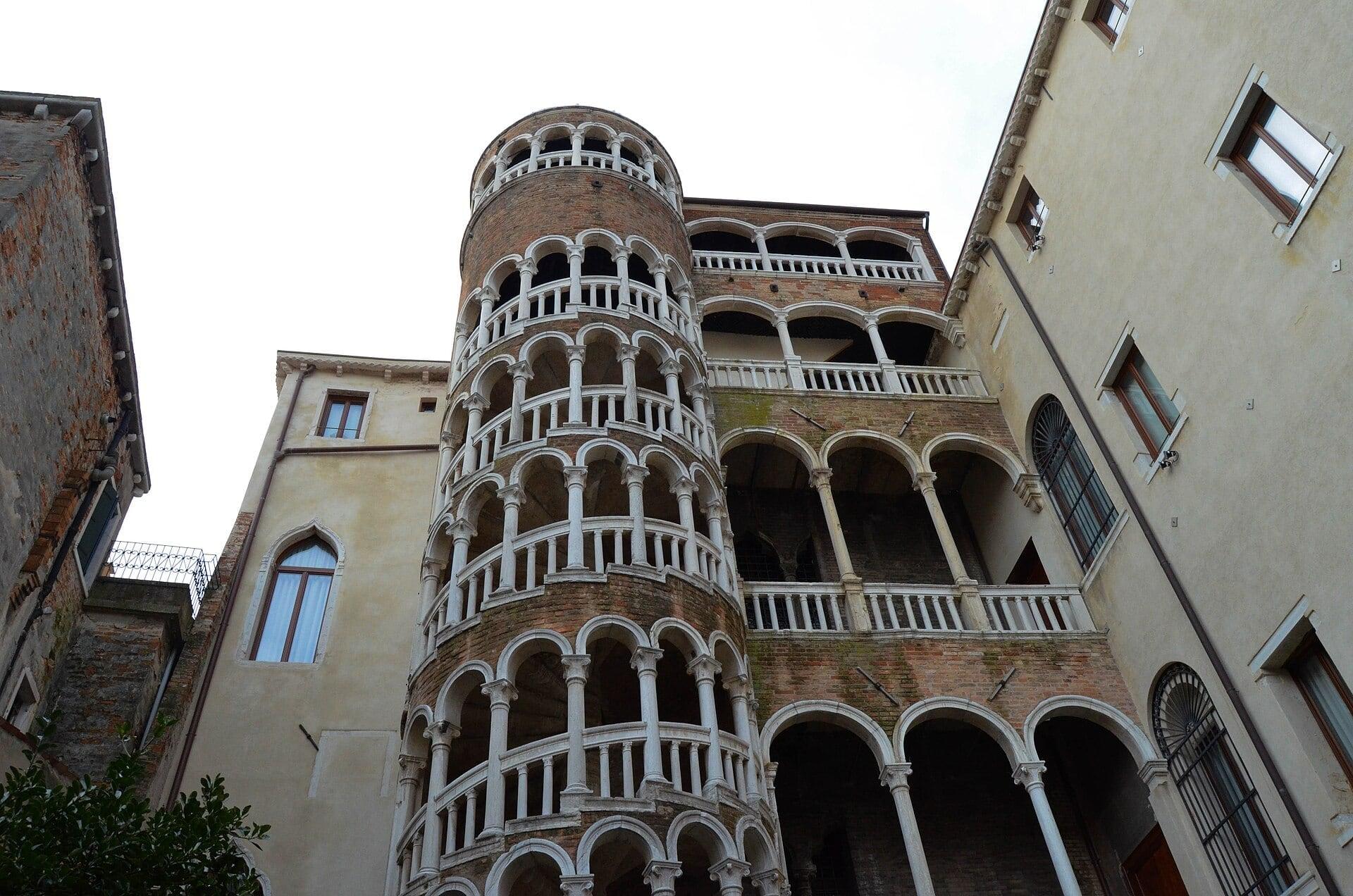
Scala Contarini del Bovolo: A Staircase for Show
A spiral staircase built to dress up a palace. Added in 1499 by Pietro Contarini, seen through the fence of its ticketed court.
- 5
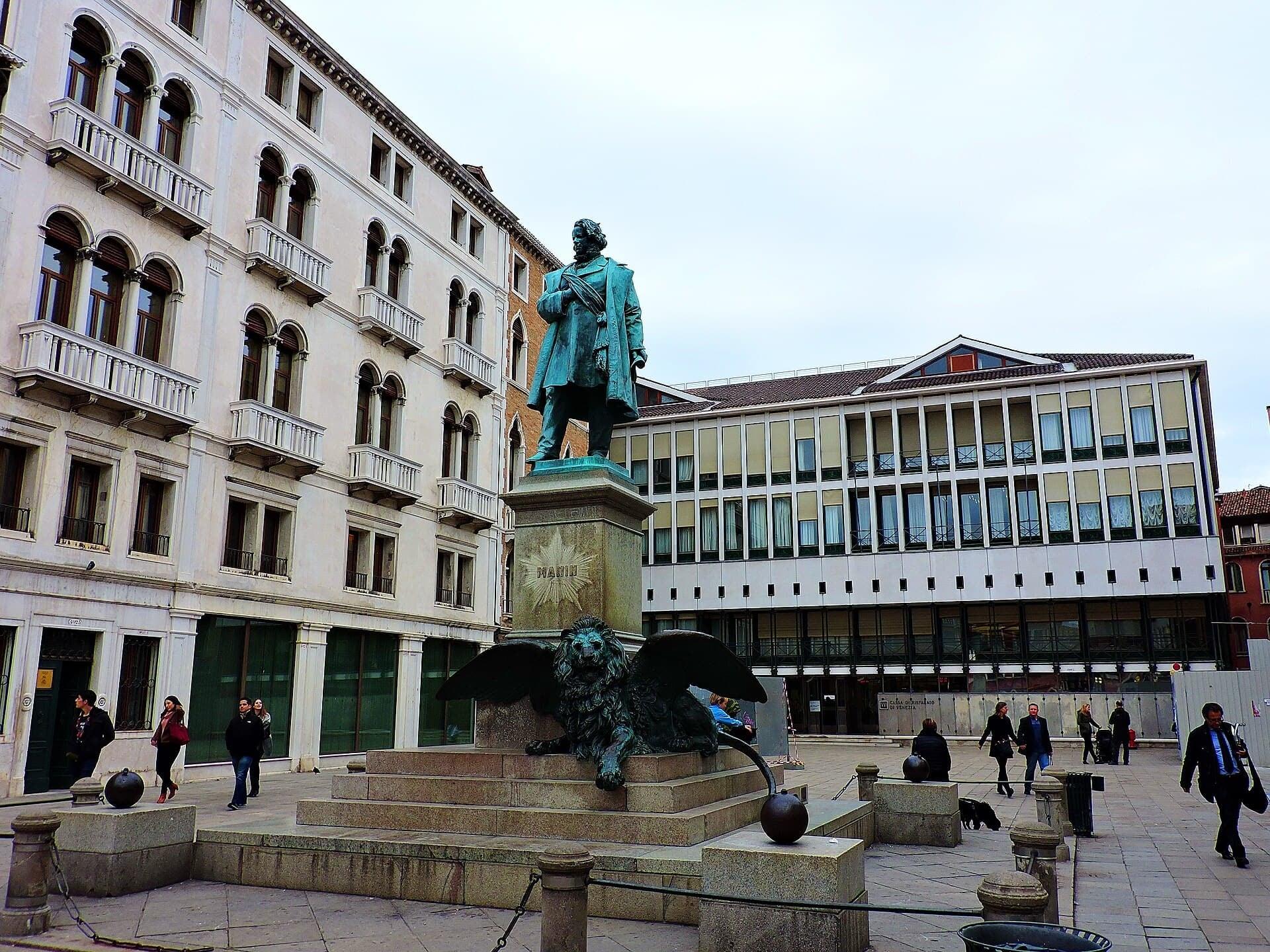
Campo Manin: Concrete Among the Gothic
A 1972 bank faces Daniele Manin's statue. Concrete, glass and steel by Pier Luigi Nervi and Angelo Scattolin, a modern front among old palaces.
- 6
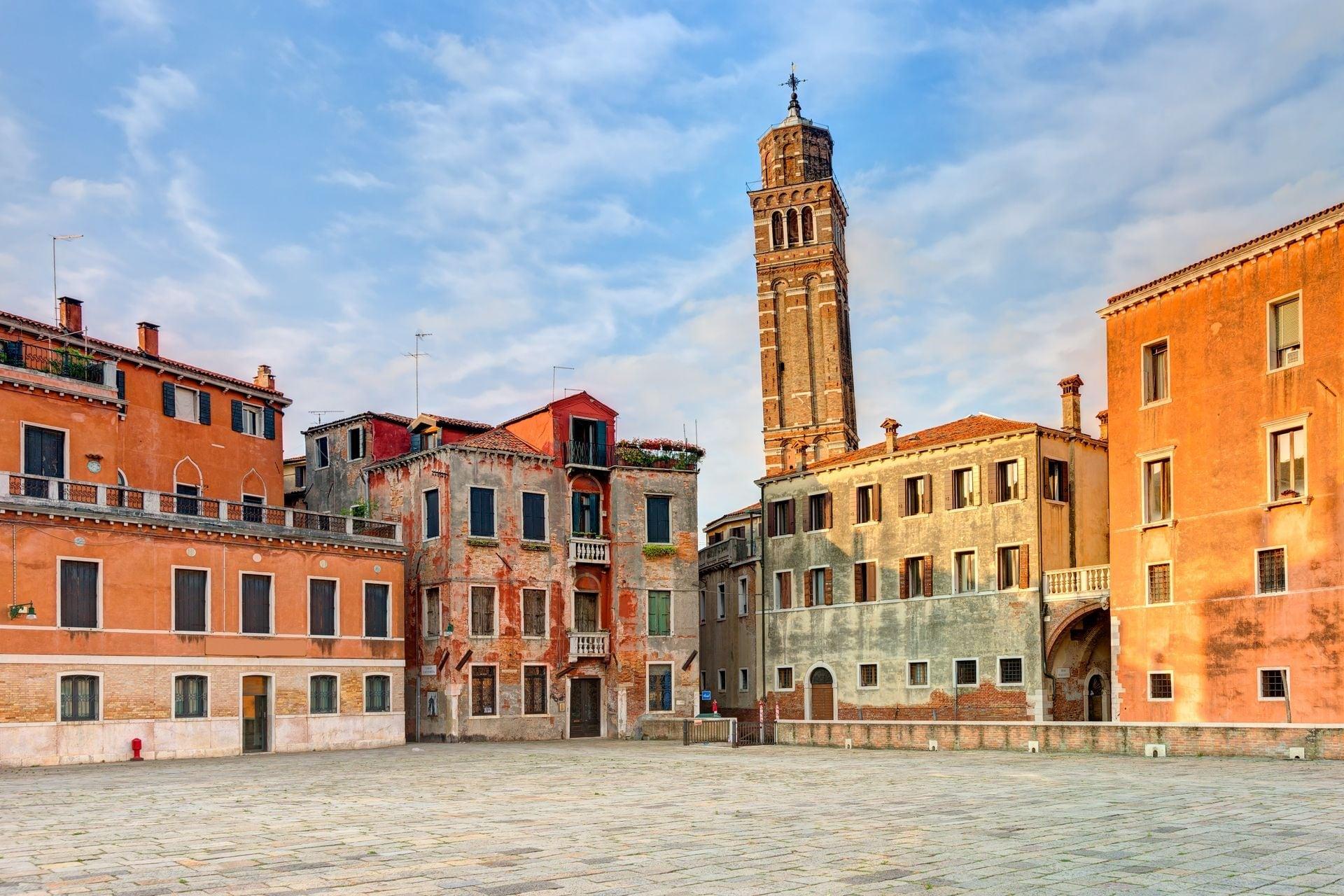
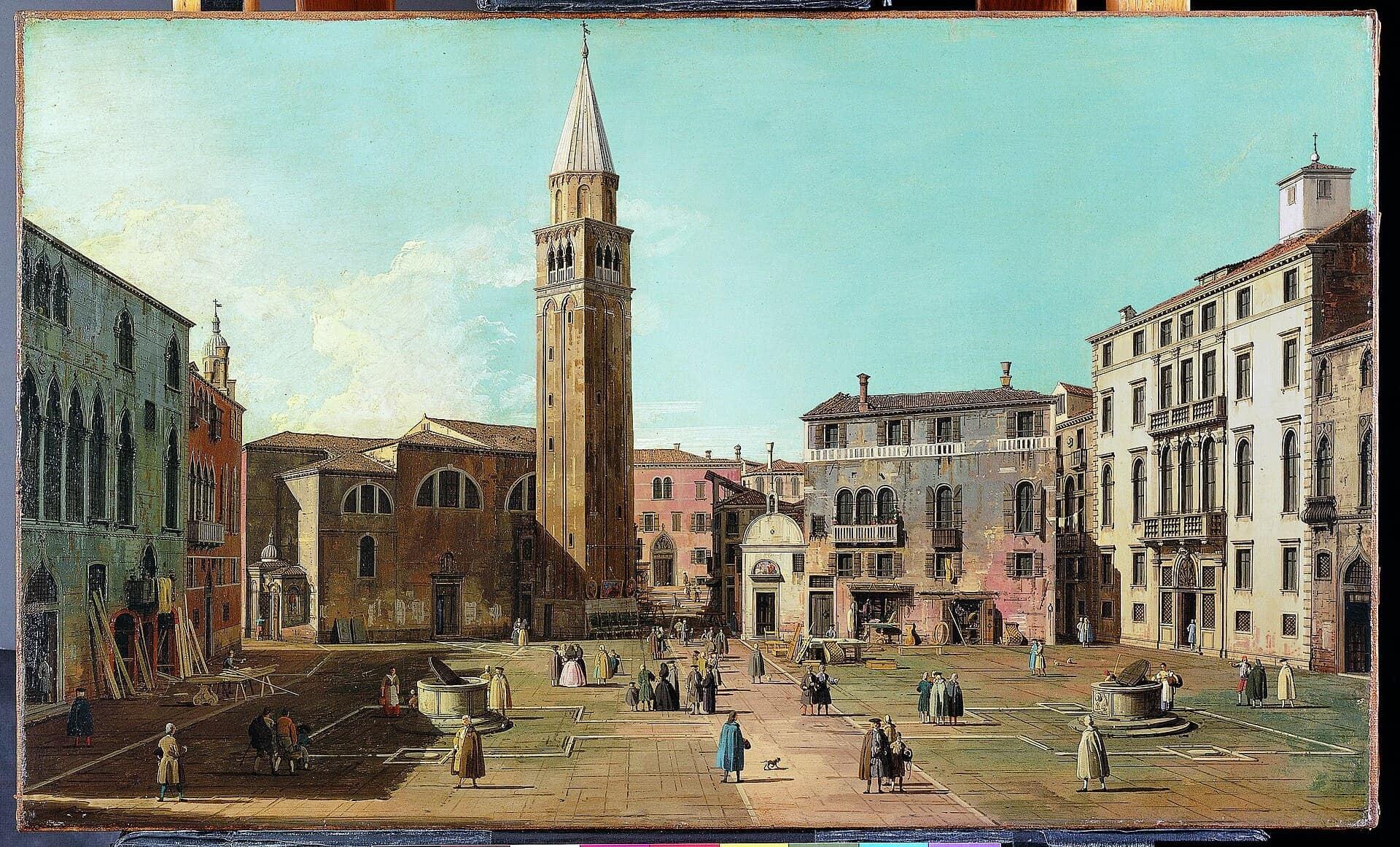
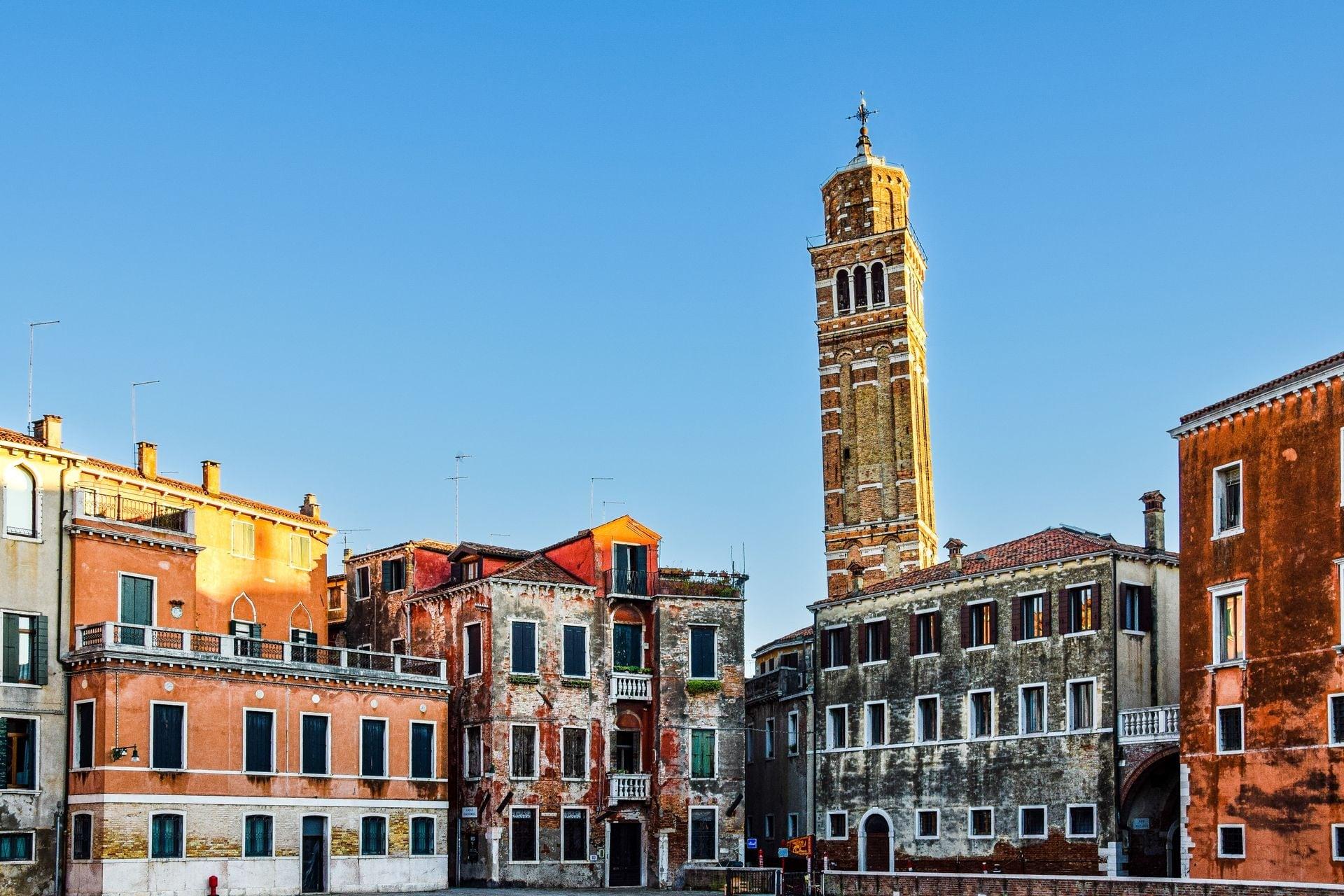
Campo Sant'Anzolo: The Leaning Tower
Santo Stefano's bell tower leans over the roofs. About two meters out of plumb at the top, on a stone footing that has shifted over the centuries.
- 7
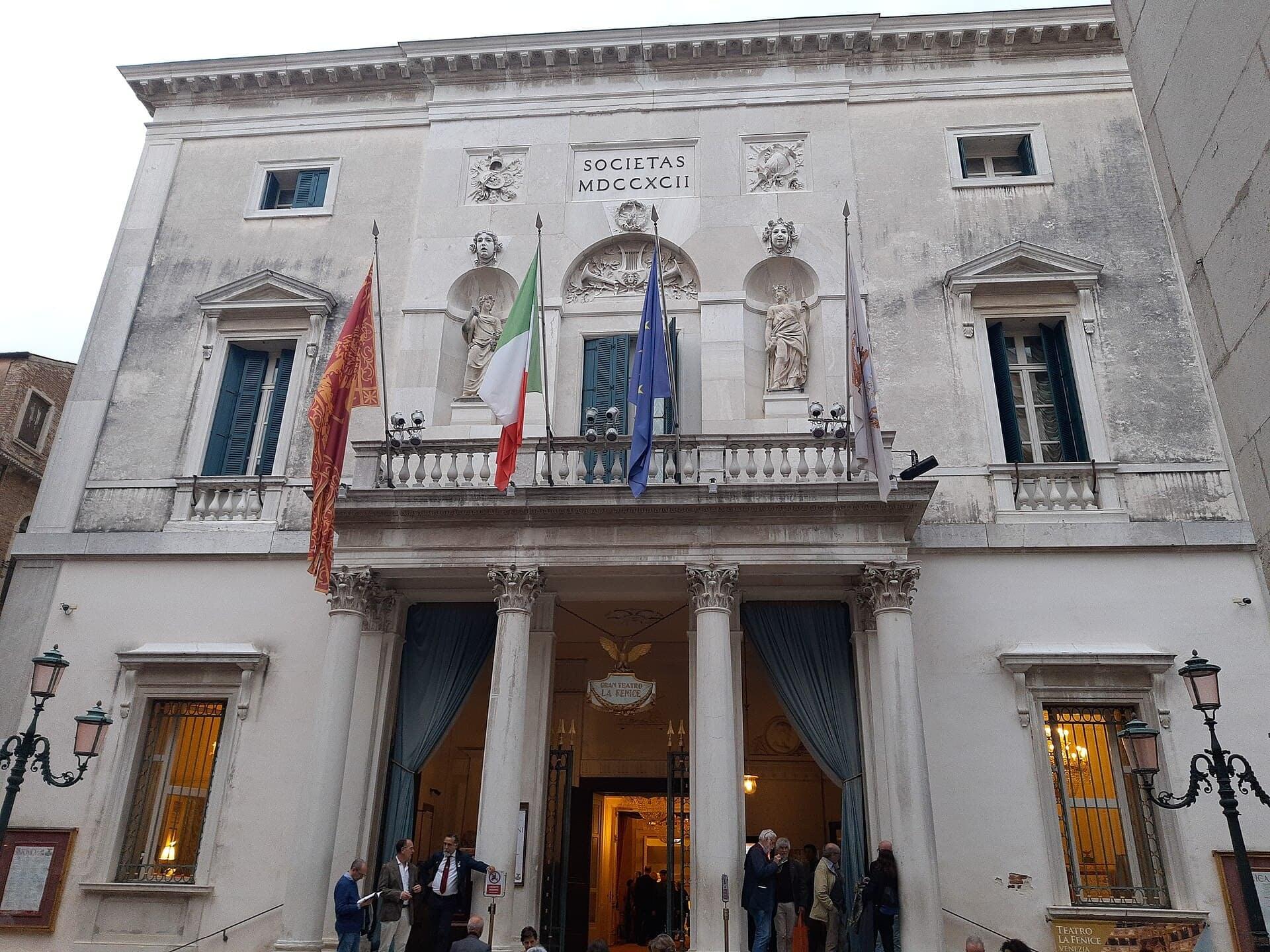
La Fenice: Burned Twice, Rebuilt Twice
Venice's opera house burned in 1836 and 1996. Each time it was rebuilt, the second time as it was, where it was; the interior visit is ticketed.
- 8
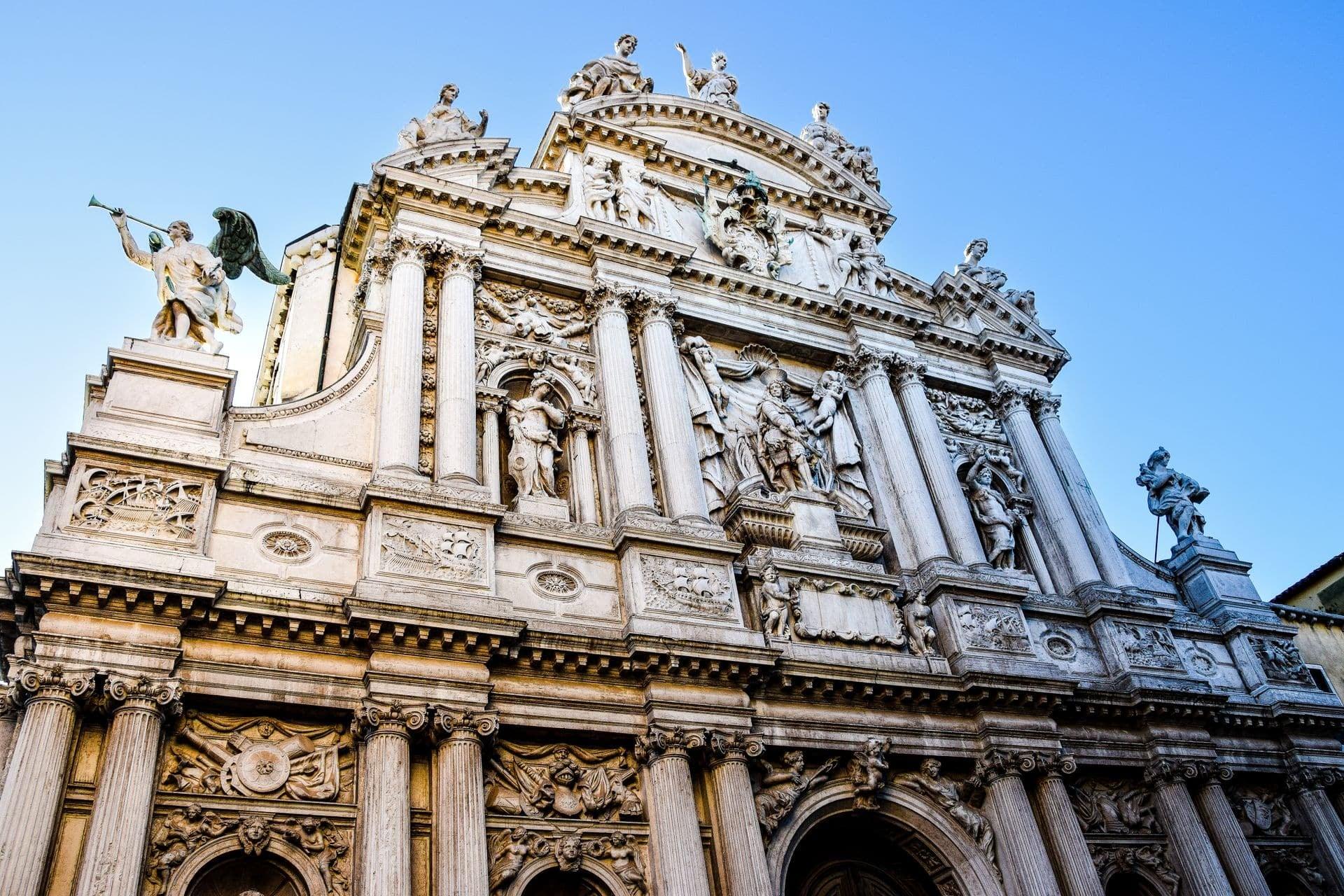
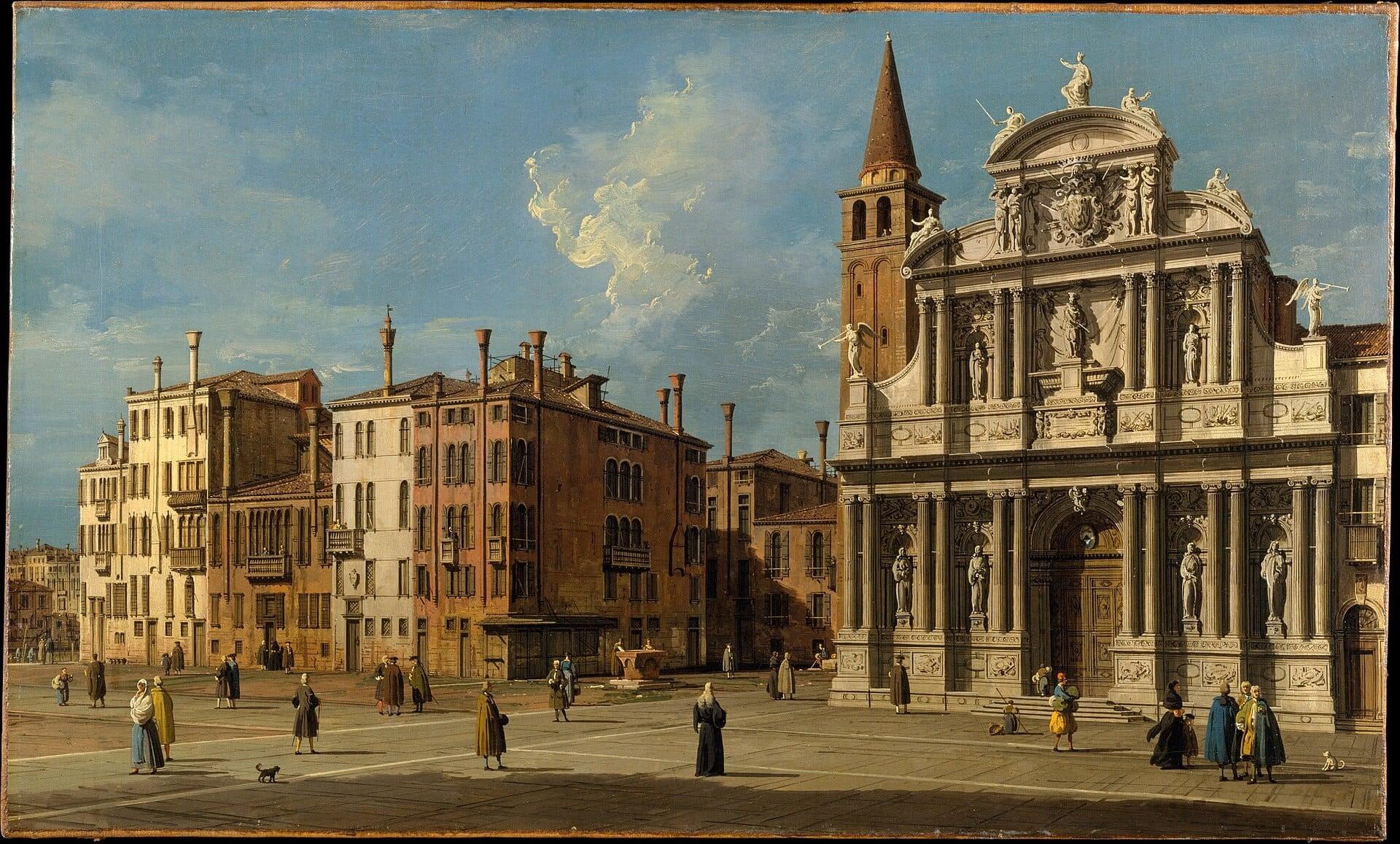
Santa Maria del Giglio: One Family's Front
A church front with hardly a saint on it. Paid for by Antonio Barbaro's bequest, it honors his family, with six city plans carved at its base.
- 9
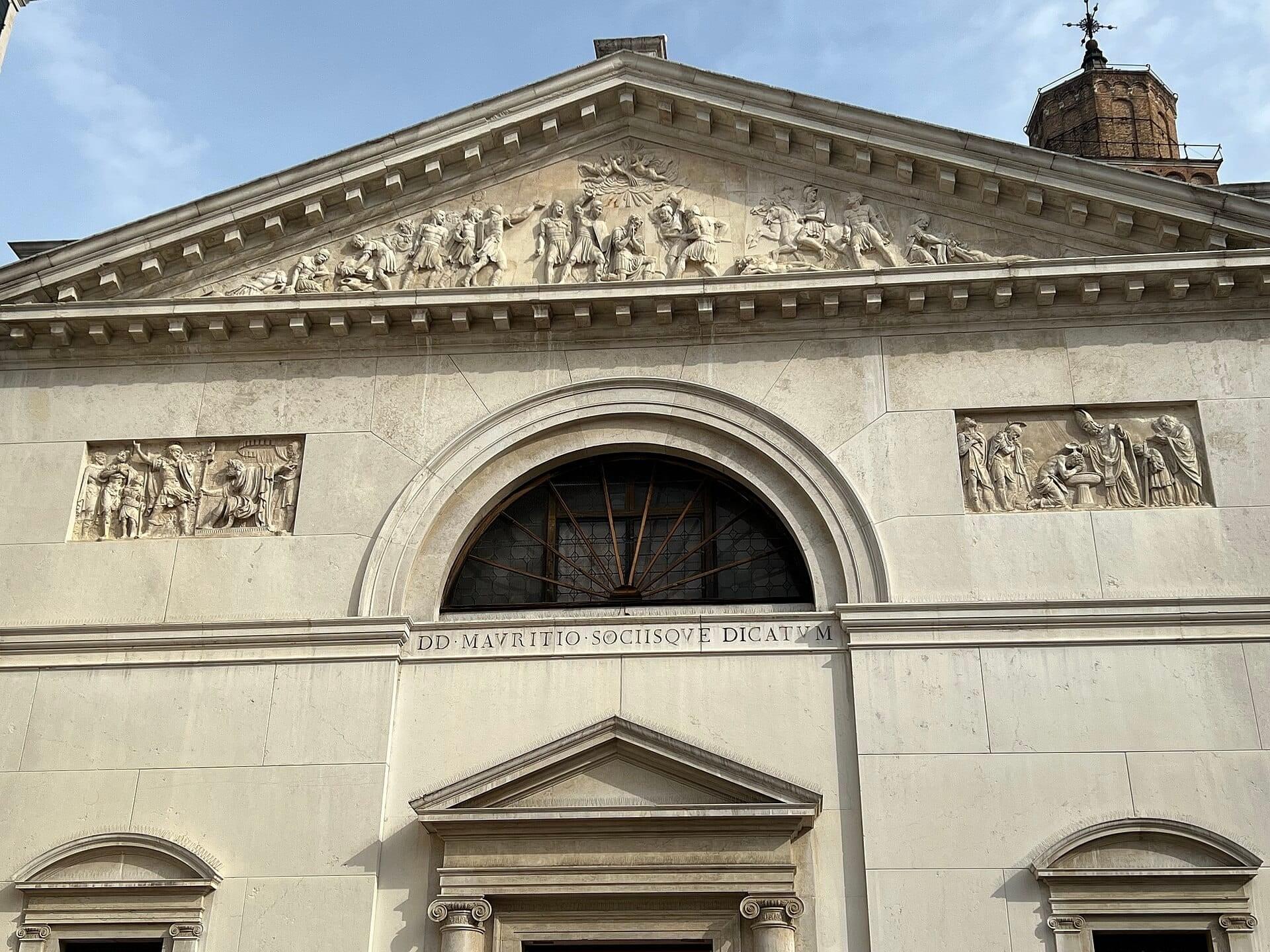
Campo San Maurizio: Selva Again
A church by La Fenice's architect, rebuilt from 1795. Here too is a second view of the leaning bell tower over the roofs.
- 10
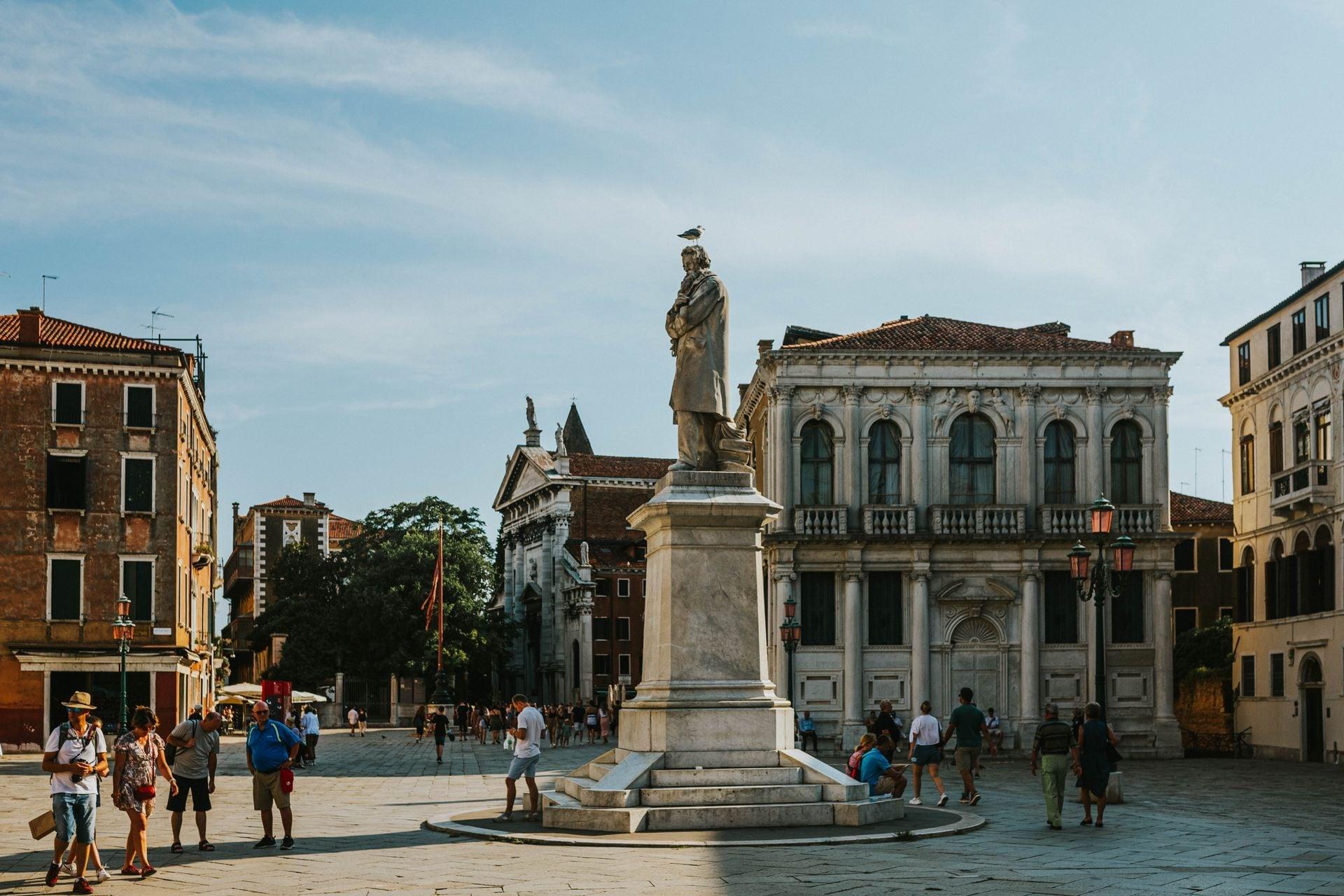
Campo Santo Stefano: A Ceiling Like a Ship
The walk's biggest square and a friars' church. Santo Stefano is free to enter, with a wooden ceiling shaped like a ship's keel.
- 11
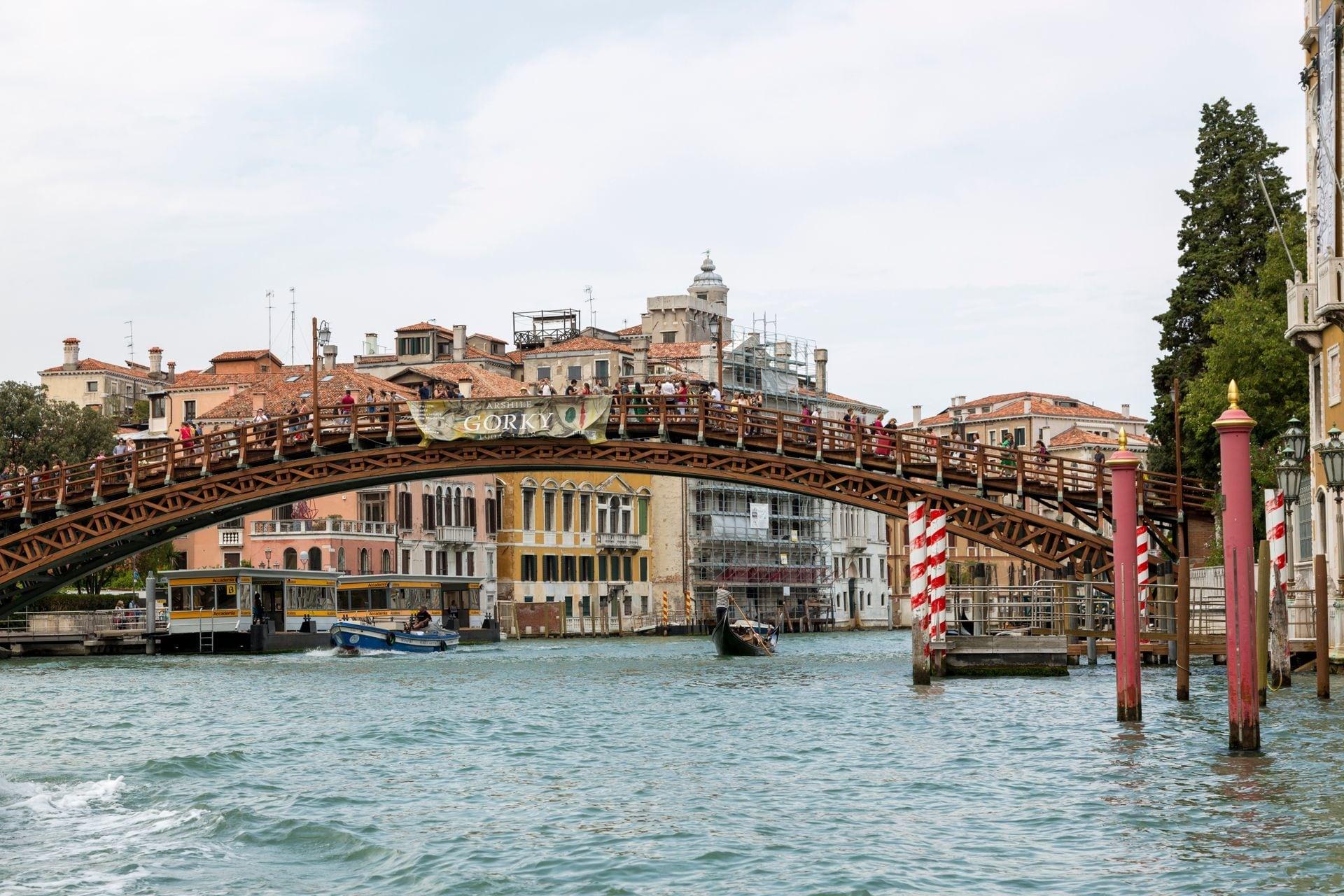
Campo San Vidal: At the Foot of the Bridge
The walk ends at the Accademia bridge's foot. An open square by the Grand Canal, where our Dorsoduro walk begins across the bridge.
Details
Best Time to Visit
Monday to Saturday between 10:30 and 17:00, when Santa Maria del Giglio and Santo Stefano are open to visitors (closed for visits on Sundays). Start early to pass the Rialto end before the midday crowd. La Fenice's visit hours are set day by day, usually from 9:30; check them before you plan the theater in. Campo San Vidal at the end fills at sunset. On high-water days walk after the tide's peak. Checked 7 November 2026.
Pro Tips
- •Getting to the start: Campo San Bartolomeo is at the San Marco foot of the Rialto Bridge. Vaporetto line 1 calls at Rialto (ACTV timetable in force from 2 November 2026); a second Rialto pontoon serves line 2 (Comune walkway atlas, 2022; not in the ACTV timetables read). The pontoons are on the Grand Canal quay about 150 meters from the start. Checked 7 November 2026.
- •Getting away from the end: the Accademia vaporetto stop, lines 1, 2 and the night line N, is at the Dorsoduro foot of the Accademia bridge, over its steps (Gallerie dell'Accademia's how-to-get-here page). Checked 7 November 2026.
- •La Fenice (stop 7): self-guided visit with a free audio guide, 12 EUR full, 9 EUR over 65, 7 EUR students aged 7 to 26, under 6 free; no booking, buy at the box office. Hours change daily, usually from 9:30; in November 2026 it is closed on Thursday 12 and Friday 13. Check festfenice.com on the day. Checked 7 November 2026.
- •Scala Contarini del Bovolo (stop 4): 9 EUR, 7 EUR reduced, free under 12; winter hours to 28 February 2027 daily 9:30 to 17:30, last entry 17:00. Booking is recommended. Checked 7 November 2026.
- •Santa Maria del Giglio (stop 8) and Santo Stefano (stop 10) are free to enter Monday to Saturday 10:30 to 17:00. Santo Stefano's museum, with four Tintorettos and a Canova stele, is 3.50 EUR. From the church circuit's pages as archived in 2026. Checked 7 November 2026.
- •The Istituto Veneto offers free guided visits of Palazzo Loredan on Campo Santo Stefano, booked by phone (istitutoveneto.it). Checked 7 November 2026.
- •Tide forecast: the City of Venice's tide center publishes the forecast and sounds sirens before high water. Raised walkways go down on Calle della Mandola from a forecast of 95 cm, and along the Riva del Ferro, the Riva del Carbon and Calle delle Ostreghe from 105 cm (city walkway atlas, 2022).
Safety & Precautions
- •Every bridge on this walk has steps: eight bridges, plus a few steps down in the covered passage near the start. There is no step-free version of this route.
- •High water: on a forecast of about 95 to 110 cm the MOSE barriers may stay open and the low stretches can flood, first Calle della Mandola (between stops 5 and 6), then the Grand Canal quay (stops 1 to 2) and Calle delle Ostreghe (before stop 8). Follow the raised walkways, or skip stop 2 by going inland from Campo San Bartolomeo to Campo San Luca, and walk after the peak. The barriers are raised for forecasts of 110 cm, in practice from about 101 cm (Ministry of Infrastructure; Il Post, 2026).
- •Campo San Bartolomeo and the Rialto end are pressed with people by day: keep bags closed and in front of you.
- •The Bovolo staircase stands at the end of a narrow dead-end lane. Keep to the side, let others pass, and walk back out the same way. Whether the small court in front of the tower is free to enter was not confirmed on 7 November 2026.
- •Santo Stefano's bell tower had foundation works due to end on 30 June 2026, and the town hall's fronts on the Riva del Carbon were approved for restoration in 2025: either may still be under scaffolding.
- •Venice's rules forbid sitting or lying on bridges, steps, monuments and wellheads, and eating sitting on the ground, with fines (city rules, 2020).
- •Calle Larga XXII Marzo, crossed between stops 7 and 8, is a busy shopping street by day.
- •Santa Maria del Giglio and Santo Stefano are working churches: during services keep to the back and keep voices low.
Travel advisory: Exercise Increased Caution (Level 2).
Gallery
Related Reading
Go deeper on what you'll see, hear, and walk through.
Thematic
Best Architecture Walking Tours in Venice (2026)
2 min
Companion
La Fenice and Campo Santo Stefano: A Walk Through Venice's Fronts Built to Be Seen
5 min
Deep dive
La Fenice and San Maurizio: Giannantonio Selva's Two Fronts on One Venice Walk
5 min
Deep dive
Santa Maria del Giglio: The Venice Church Front Built for One Family
5 min
Read the walk
The full story of La Fenice and Campo Santo Stefano: The Show Goes On, in words. Prefer to listen? Play it narrated, from home or on location.
Introduction
Venice, in the north-east of Italy, builds to be seen, and when something burns, it builds it again. The route crosses the inner San Marco quarter, between the Rialto and the Accademia bridge, through the squares Venetians call campi.
You will see a staircase built only to dress up a palace, a bank of concrete and glass among Gothic windows, a church front with hardly a saint on it, and an opera house that burned twice and, the second time, came back as it was, where it was.
Three people shape what you will see. Carlo Goldoni, the playwright who put Venetian merchants on the stage. Elena Cornaro Piscopia, whom the city calls the first woman in the world to earn a university degree. And Giannantonio Selva, the architect of La Fenice.
The walk is eleven stops over about one point six kilometers, a mile, and takes about an hour. It crosses eight bridges, all with steps. The Bovolo staircase and La Fenice charge to go in, and every stop works from outside. On high tides the city lays raised walkways on the low stretches, first on Calle della Mandola and along the Grand Canal, so check the city's tide forecast before you set out. The walk begins in Campo San Bartolomeo, at the foot of the Rialto Bridge, and ends in Campo San Vidal, at the foot of the Accademia bridge. When you arrive at Campo San Bartolomeo, begin with stop one.
1. Campo San Bartolomeo: The Merchants' Playwright
Welcome to Campo San Bartolomeo, where this walk begins. Walk on into the square and find the bronze figure on a tall stone pedestal in the middle. That is Carlo Goldoni, the Venetian playwright, put up here in eighteen eighty-three.
Goldoni was born in Venice in seventeen oh seven and died in Paris in seventeen ninety-three, three decades after he left for France. In between, he changed the comedy of his city. The old masked comedy had a stock figure called Pantalone, a Venetian merchant played for laughs. In Goldoni's early comedies, Italy's national biography says, Pantalone began to turn into something else: the serious, honest, honored Venetian merchant of his later plays.
So look where the city put him. This square sits at the land foot of the Rialto, among shops, in a crowd of people buying and selling. The playwright who gave merchants their dignity stands in the middle of them.
Now look at the pedestal, which his sculptor's biography calls an elegant rococo piece. The bronze is by Antonio Dal Zotto, and the same biography says it is held to be his masterpiece. Keep his name in mind: he comes back twice on this walk.
The Rialto Bridge is just round the corner, and our Rialto walk tells its story. This walk turns its back on it and heads along the Grand Canal, into the quieter half of the San Marco quarter.
This square fills with a pressed crowd by day, and crowds draw pickpockets, so keep your bag closed and in front of you.
Follow the route through a covered passage, down a few steps to the Grand Canal and over a small bridge. Next are two old palaces that became the town hall.
2. Riva del Carbon: Warehouses Turned Town Hall
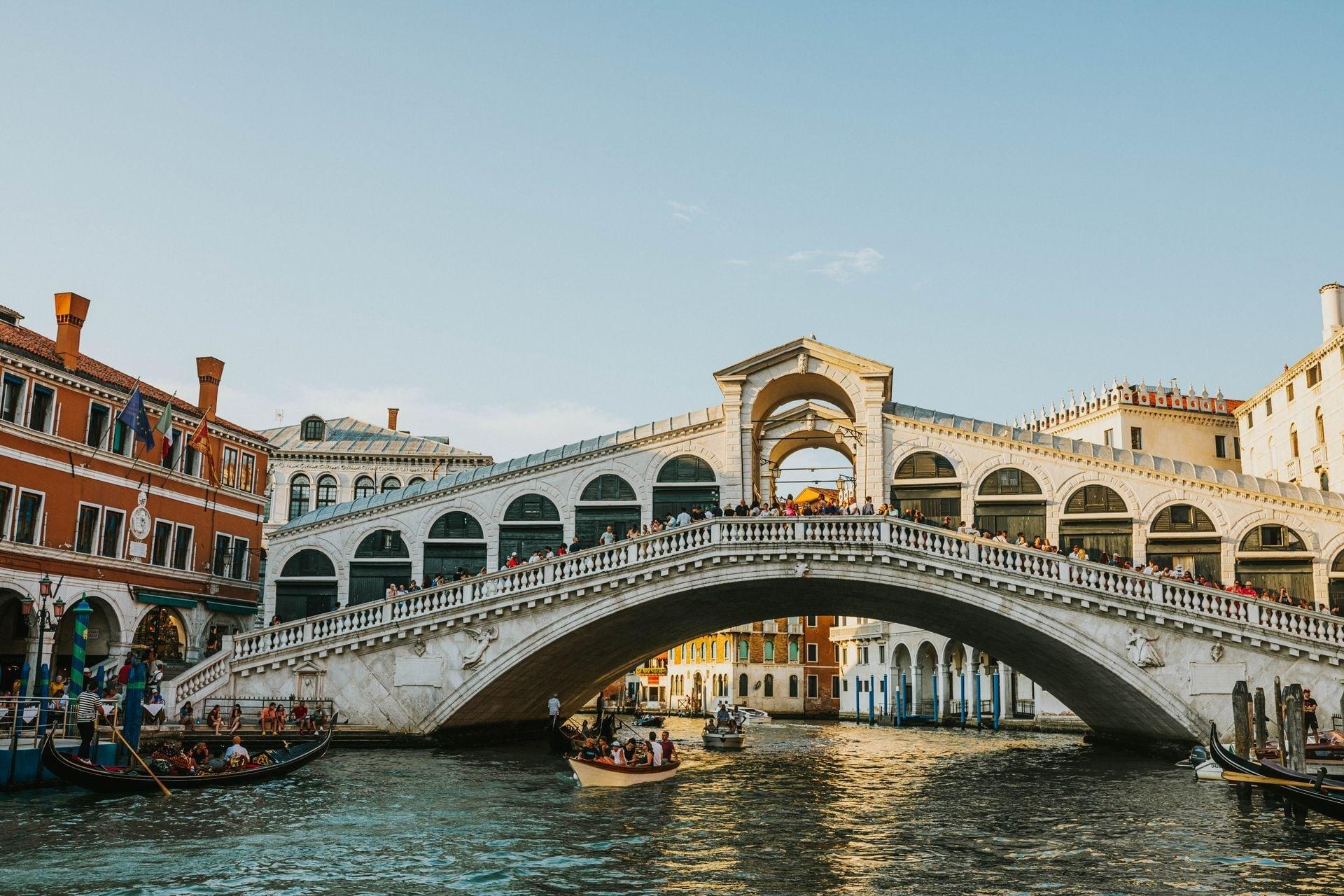
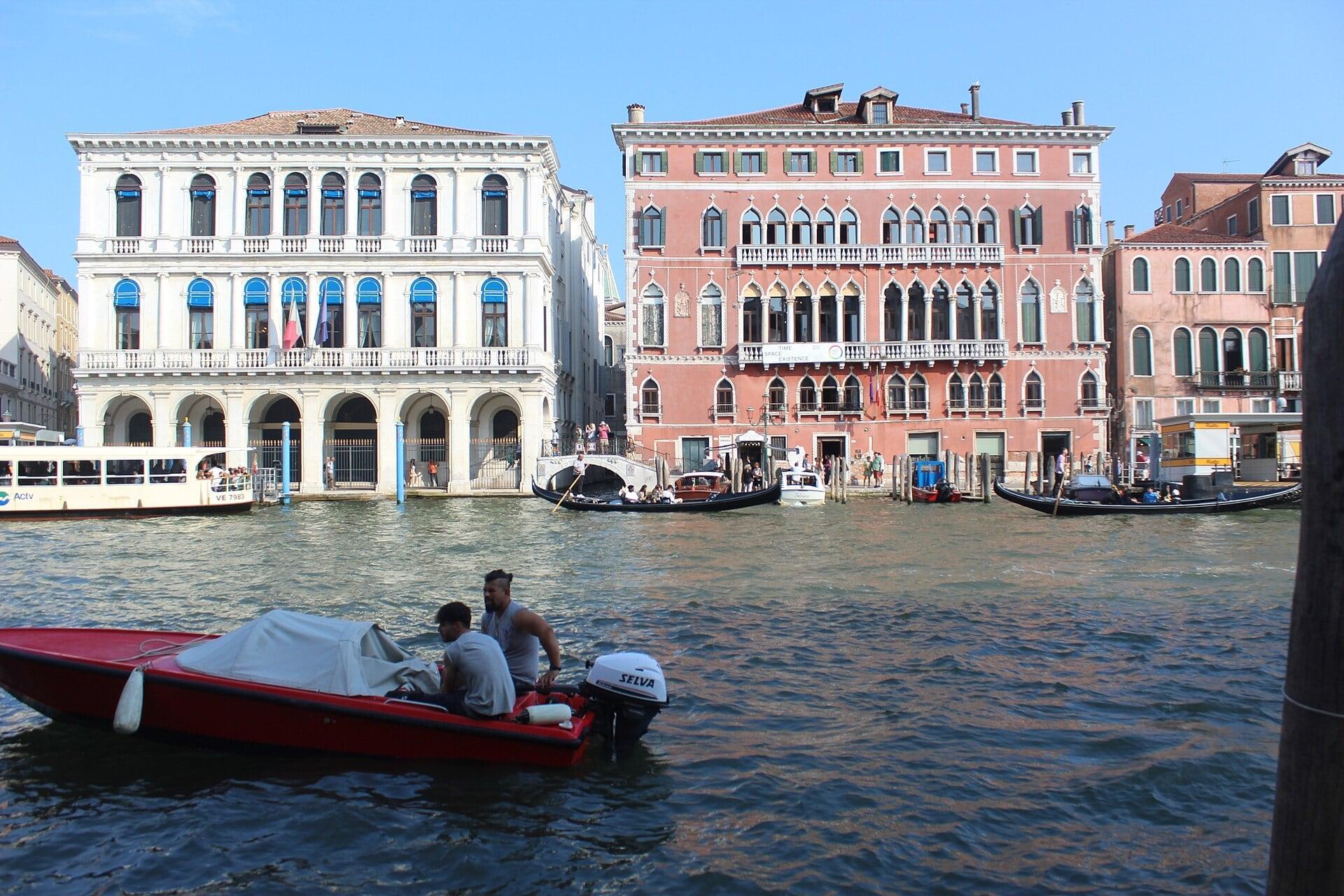
Walk on along the quay of the Grand Canal, the Riva del Carbon, and stop by the water. Up the canal, the Rialto Bridge is in view. Just ahead along the quay, find two palaces side by side, a narrow lane between them and arches at the water's edge. These are Ca' Loredan and Ca' Farsetti, and together they are Venice's town hall. They may be wrapped in scaffolding: the city approved the restoration of their fronts in twenty twenty-five.
The city calls them house-warehouses, built probably at the same time, around the year twelve hundred. That arcade at the quay was for business: goods came off the boats and straight into the house. Above it, on the first floor, an open gallery, a loggia, and the family's rooms. Trade below, home above, one building. The two top floors came later, added in the fifteen hundreds.
The palace nearer you, Ca' Loredan, brings in the second of our three people. In the thirteen hundreds it was bought by the Corner family, Cornaro in Italian, who added Piscopia to their name after one of them gave the King of Cyprus a large sum and was rewarded with an estate there called Piscopia. Elena Cornaro Piscopia, born in sixteen forty-six, took a degree in philosophy at Padua in sixteen seventy-eight. The city of Venice calls her the first woman in the world to earn a university degree, and this was her family's palace.
The other, Ca' Farsetti, was built by the Dandolo family. Later an owner, an abbot, opened his collection of plaster casts of ancient statues to young artists, and the young Canova came here to draw.
The city bought Ca' Farsetti in eighteen twenty-six and Ca' Loredan in eighteen sixty-eight. Two merchants' houses became the government of the city.
Follow the route inland, away from the canal. Next is a small square where Goldoni comes back.
3. Campo San Luca: Goldoni's Theater Corner
Walk on into Campo San Luca, a small square where five lanes meet, and stop near the flagpole base in the middle. This is a busy shopping crossroads, and it gives you a moment to look round between the lanes.
Goldoni comes back here. Just beyond this square, out of sight behind these buildings, stands the theater Goldoni wrote for, then called the Teatro San Luca and owned by a nobleman, Antonio Vendramin. Since eighteen seventy-five it has carried his name: the Teatro Goldoni. In seventeen fifty-three Goldoni moved there on a ten-year contract, and he wrote for that house until he left for Paris. Before that he wrote for a company at the Teatro Sant'Angelo. Both theaters took their names from parishes, and this walk crosses both: San Luca here, and Sant'Angelo a few stops on.
The square has an older story too, told by tradition. In thirteen ten, it says, the brotherhood of the painters and the brotherhood of Santa Maria della Carità fought here side by side against a band of rebels, drove them back, and the Carità brotherhood won the right to plant its banner in this square from then on.
Follow the route into the lanes. Next is a staircase built to be looked at. It stands at the end of a narrow dead-end lane, so you will walk back out the same way.
4. Scala Contarini del Bovolo: A Staircase for Show
Walk on to the very end of this narrow lane, where it opens out by a fence, and stop there. The staircase stands in a ticketed court: climbing it costs nine euros, and the details are on this stop's card. From the lane you see it through the fence.
There it is, beyond the little garden: a round tower of white Istrian stone and bare brick, about twenty-six meters high, with open arches climbing it in a spiral, and loggias that tie it to the palace beside it. A snail, in Venetian, is a bovolo, and that is its name: the Scala Contarini del Bovolo, the Contarini family's snail staircase.
The palace began in the thirteen hundreds as a house-warehouse, like the town hall you have just seen. The people who run it today say the family chose it for its place, halfway between the Rialto, where Venice traded, and Saint Mark's, where it was governed. In fourteen ninety-nine Pietro Contarini had this staircase added, to dress up this side of his palace, which was already painted with flowers. Who built it, nobody knows for sure. Some historians name a local master builder, Giovanni Candi; others, the architect Giorgio Spavento.
So this is a staircase as a front, made to be seen from where you are standing. Inside, eighty stone steps, each a single piece, wind up to a terrace over the roofs.
And look how it ended. In eighteen forty-nine the last owner gave the palace to the poor relief of San Luca's parish, and in eighteen eighty it became the seat of the city's charity board. A noble family's show staircase now belongs to the city's care for the poor.
The lane is narrow, so let others pass. Follow the route back out the way you came. Next is a square with a bank that dared to look new.
5. Campo Manin: Concrete Among the Gothic
Walk on into Campo Manin and stop near its far end, where the square narrows toward a bridge, with a bronze statue close by. The statue is Daniele Manin, whose name the square carries. It is by the sculptor Luigi Borro, from the eighteen seventies, and even Italy's national…
Full narration for this stop unlocks with the tour.
6. Campo Sant'Anzolo: The Leaning Tower
Walk on into Campo Sant'Anzolo and stop at its corner, where the lane comes in, with the whole square opening ahead. Look up over the roofs on the far side for a tall brick bell tower. That is the tower of Santo Stefano, and it leans. It may be under works when you are here; the…
Full narration for this stop unlocks with the tour.
7. La Fenice: Burned Twice, Rebuilt Twice
Walk on along the theater's side wall into the little square at its front, Campo San Fantin. La Fenice is ticketed inside, twelve euros with a free audio guide, on hours that change day by day; the details are on this stop's card. You are very close to the front, so step back…
Full narration for this stop unlocks with the tour.
8. Santa Maria del Giglio: One Family's Front
Walk on into Campo Santa Maria del Giglio and take a few steps out in front of the church, so you face its front square-on. The church is free to step inside on most days, Monday to Saturday, from mid-morning to five. Now look for saints. There is hardly one on this church…
Full narration for this stop unlocks with the tour.
9. Campo San Maurizio: Selva Again
Walk on into Campo San Maurizio and stop in its open middle. Face the pale church with the classical front. That is San Maurizio, rebuilt from seventeen ninety-five to eighteen oh six, and one of its three designers is Giannantonio Selva, the architect of La Fenice, working with…
Full narration for this stop unlocks with the tour.
10. Campo Santo Stefano: A Ceiling Like a Ship
Walk on into Campo Santo Stefano and stop by the statue near the middle. This is the biggest open square on the walk. Venetians once held bull-baiting in their big squares; it ended in the early eighteen hundreds. The statue is Niccolò Tommaseo, by the sculptor Francesco…
Full narration for this stop unlocks with the tour.
11. Campo San Vidal: At the Foot of the Bridge
Walk on past the front of San Vidal into the open square at the foot of the bridge, Campo San Vidal, and stop there. This is the end of the walk. Ahead rises the Accademia bridge, the way across the Grand Canal into Dorsoduro. Our walk of Dorsoduro and the Salute begins on its…
Full narration for this stop unlocks with the tour.
- Campo San Luca in Venice. — Didier Descouens, CC BY-SA 4.0 · source
- stop-4-v1.jpg — PatriPA, CC BY-SA 3.0 · source
- Daniele Manin monument, Campo Manin, Venice — Dimitris Kamaras from Athens, Greece, CC BY 2.0 · source
Images may be cropped or resized. Other photos via Unsplash and Pexels.