Plan about an hour for the highlights of the Van Gogh Museum in Amsterdam, or two hours to follow his whole life. Start with the self-portraits on the ground floor, go up to Floor 1 for The Potato Eaters, the Japanese courtesan, Sunflowers, The Yellow House and The Bedroom, then climb to Floor 3 for Irises, Almond Blossom, Wheatfield under Thunderclouds and Tree Roots. Entry is by a timed ticket booked online in advance, with no tickets at the door.
The Van Gogh Museum hangs his paintings roughly in the order he lived them, so the easiest way through it is to read the floors as chapters of one life: the dark Dutch years, Paris, Arles, the asylum at Saint-Rémy and the last weeks in Auvers. Most of what hangs here came from his own family. His brother Theo kept what Vincent sent him, and Theo's widow, Jo van Gogh-Bonger, spent her life making the world see it. Is it worth it? If you come for Sunflowers you will get it, and you will also get a bedroom painted to rest the mind, a Japanese courtesan surrounded by a hidden pun, and a branch of almond blossom painted for a newborn baby who grew up to found this museum. How long does it take? Plan about an hour for the highlights, or two to follow the whole life. Everything below comes from the museum's own collection pages and Roamer's fact-checked guide.
The building in one minute
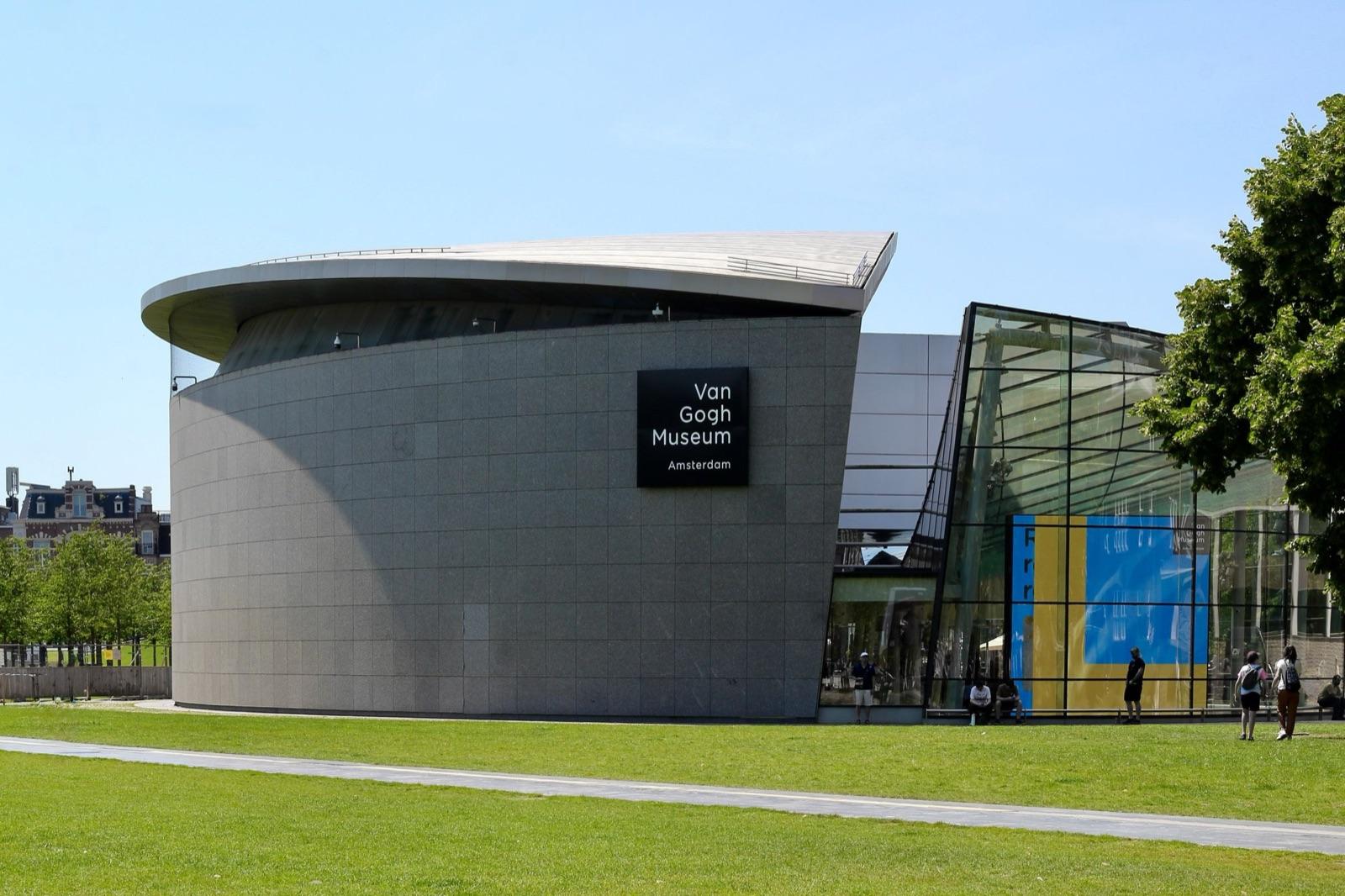
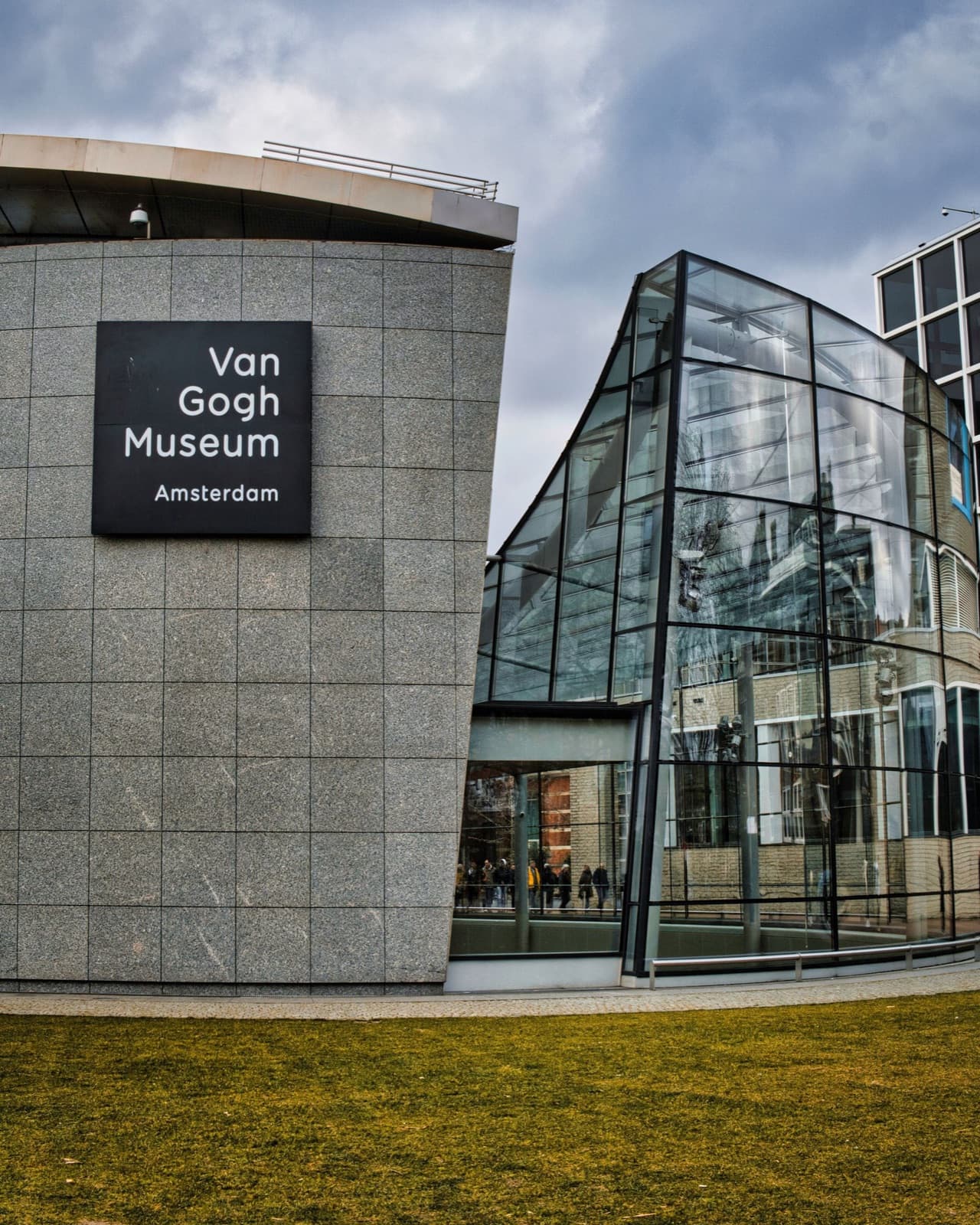
There are three pieces, and you see all of them from Museumplein.
- The Rietveld building (1973). The main building, where the permanent collection hangs. Gerrit Rietveld met the founder in 1963 and made sketches, but he died in 1964, and his partners finished the design. Queen Juliana opened it on 2 June 1973. It exists because of a family deal of 1962: the Van Gogh family transferred the collection to a new foundation, the Dutch state promised to build and run a museum to keep it together, and the city of Amsterdam gave the land.
- The Kurokawa wing (1999). The oval building beside it, by the Japanese architect Kisho Kurokawa, paid for with a gift from Japan through the Japan Foundation. Almost two thirds of it lies below ground. It holds the exhibitions that come and go.
- The glass entrance hall (2015). The curved hall of bent glass that joins the two, opened on 5 September 2015. This is where you come in.
Inside the Rietveld building the hang runs like this:
- Ground floor: the self-portraits, most of them from his two years in Paris.
- Floor 1: his life in order, from the first drawings and grey seascapes of The Hague, through Nuenen and The Potato Eaters, to Paris and then Arles, with Sunflowers, The Yellow House and The Bedroom.
- Floor 2: the painters around him: friends from Paris, the self-portraits Gauguin, Bernard and Laval posted to him from Brittany, the peasant painters he measured himself against, and a portrait of Jo van Gogh-Bonger.
- Floor 3: the last two years, the asylum garden at Saint-Rémy, his copies after Millet and Delacroix, Almond Blossom, and the final weeks in Auvers.
The museum does not number its rooms, so the floors and the periods are the map. The museum rehangs and lends paintings, so if one is not where this page says, look it up by name.
What to see in an hour
Hear a stop from this walk
Nieuwmarkt and the Waag: Gate, Scale, Surgeons
This is the Roamer guide's one-hour route, ten paintings that each earn a stop. It starts on the ground floor, works through Floor 1, and finishes on Floor 3.
Ground floor: the cheapest model
- Self-Portrait as a Painter. Van Gogh at his easel, palette in hand. The colours on the palette are three pairs, red and green, yellow and purple, blue and orange, and the same pairs fill the canvas: the blue smock against the orange-red beard. It was the last work he made in Paris, over the winter of 1887 to 1888, and soon after he left for Arles.
Floor 1: from Nuenen to Arles
- The Potato Eaters. Five people round a table under one oil lamp, painted in the spring of 1885 as a showpiece to prove he could handle a group of figures. He repainted the faces, he told Theo, something like the colour of a dusty potato, unpeeled. His friend Anthon van Rappard criticised it. Two years later he still called it the best thing he had done.
- Courtesan (after Eisen). In 1886 the Paris magazine Paris Illustré put a woodcut by the Japanese artist Keisai Eisen on its cover. Van Gogh copied the figure with a grid and enlarged it onto cotton about a metre tall, then added a pond of water lilies, cranes and frogs. In French slang of the time, grue, a crane, and grenouille, a frog, were both words for a prostitute.
- Sunflowers. One colour pushed as far as it will go, from pale lemon to deep orange. Of his first sunflower canvases he wrote that he used three chrome yellows, yellow ochre and Veronese green, "and nothing else". This one is a repeat, painted in January 1889 after the version now in the National Gallery in London, for a friend, Paul Gauguin, who had already gone.
- The Yellow House (The Street). A deep, solid blue sky over a sunlit yellow street in Arles. The corner house with green shutters is his: he took four rooms there in May 1888 and hoped to make it a home for painters working side by side. For two months that autumn, Gauguin lived and worked there with him.
- The Bedroom. His own room in that house. On 16 October 1888 he wrote to Theo that colour had to do the work here, and that looking at it should rest the mind. He left out the shadows and used flat tints, like a Japanese print. The walls and doors read as blue today but were once purple, and the slanting back wall is not a mistake: the corner of the room really was skewed. He painted the room twice more, and chose this first version as his best.
Floor 3: Saint-Rémy and Auvers
- Irises. Painted in May 1890, in his last days at the asylum. The flowers read as blue, but he painted them purple, and a red pigment has faded. The plan still shows: violet against yellow, opposites on the colour wheel, each making the other stronger.
- Almond Blossom. Branches against a clear blue sky, seen from below, with no ground and no horizon. On 31 January 1890 Theo wrote that his son was born and would be named after Vincent. Vincent began this painting for the couple's bedroom right away. The baby, Vincent Willem, grew up to found this museum.
- Wheatfield under Thunderclouds. Twice as wide as it is high: a field, a heavy sky, one line between them. In July 1890 he wrote to Theo and Jo that his new wheatfields under turbulent skies were meant to express sadness and extreme loneliness, and in the same letter hoped they would show what he found healthy and fortifying about the countryside.
- Tree Roots. A jumble of bright colour that slowly turns into a slope of knotted trunks and roots, like those in the quarries around Auvers. It was never finished, and it is probably the last painting he worked on.
Skip anything that does not hold you. The order is his life's order, so the plan walks itself.
Four ready-made routes
The Roamer guide groups the museum into four painting routes, all starting in the entrance hall, and every stop is a voiced story.
The Van Gogh Museum in an Hour. The ten paintings above, about 60 minutes.
Van Gogh's Life in Two Hours. Twenty stops, about 120 minutes, in the order he lived them: the sea at Scheveningen, the church at Nuenen, The Potato Eaters, a pair of shoes from Paris, The Pink Peach Tree and The Harvest from the Arles spring and summer, Gauguin's Chair, a Pietà after Delacroix, and the last fields of Auvers.
Copies and Borrowings. Five stops, about 40 minutes, on how he learned by copying: the courtesan after Eisen, a bridge in the rain after Hiroshige, The Sower, the Pietà after Delacroix and The Sheepshearer after Millet, each repainted in his own colours.
Flowers and Seasons. Seven stops, about 45 minutes: gladioli in Paris, a peach tree in an Arles spring, Sunflowers, Irises, a giant peacock moth from the asylum garden, Almond Blossom and Daubigny's garden in Auvers.
There is also a fifth route about the building itself, seven stops and about 40 minutes, from the glass hall and the Kurokawa wing up Rietveld's central stair to the skylight. The founder first meant to hang the dark Brabant paintings low and the sunny French canvases high, near that light. It proved impractical, but you can still feel the idea as you climb.
Check before you go
The museum rehangs and lends its paintings, and the works listed here were on view in the museum's own collection search on 22 October 2026. If one painting is the reason you are coming, look it up on the museum's website before you book. The exhibitions in the Kurokawa wing change and are not part of the Roamer guide.
What to know before you go
- Book a timed ticket online. The museum sells entry by timed ticket booked in advance, and there are no tickets at the door.
- Opening hours. On 22 October 2026 the museum listed daily opening from 09:00, closing at 17:00 or 18:00 depending on the season, and most Fridays open until 21:00. Check the date you want.
- Start at the bottom and climb. The floors follow his life, so going up is going forward in time. If you only have an hour, do the ground floor, Floor 1 and the last rooms of Floor 3.
- Stand back first. Wheatfield under Thunderclouds and Tree Roots both need distance before they make sense.
- Look for the lost purples. The Bedroom and Irises both had purple that has drifted to blue. Knowing that changes how they look.
- Bring headphones. Any audio guide on your own phone works best with them.
If you also want the city outside, Roamer's walks start a short walk or tram ride away: the Canal Ring and Jordaan, the Dam Square and Old Center walk and the Jewish Quarter and Plantage walk. The Rijksmuseum guide covers the other great museum on the same square.
How this fits the Roamer guide
Roamer has an independent audio guide to the Van Gogh Museum that works floor by floor. Walk into any part of a floor and play its story, or follow one of the routes above with directions from painting to painting. There is no group and no schedule, and every story is short enough to skip. You can find it here: the Van Gogh Museum guide. It is independent of the museum and not affiliated with it, and it is not a museum ticket.
Ready to experience it?
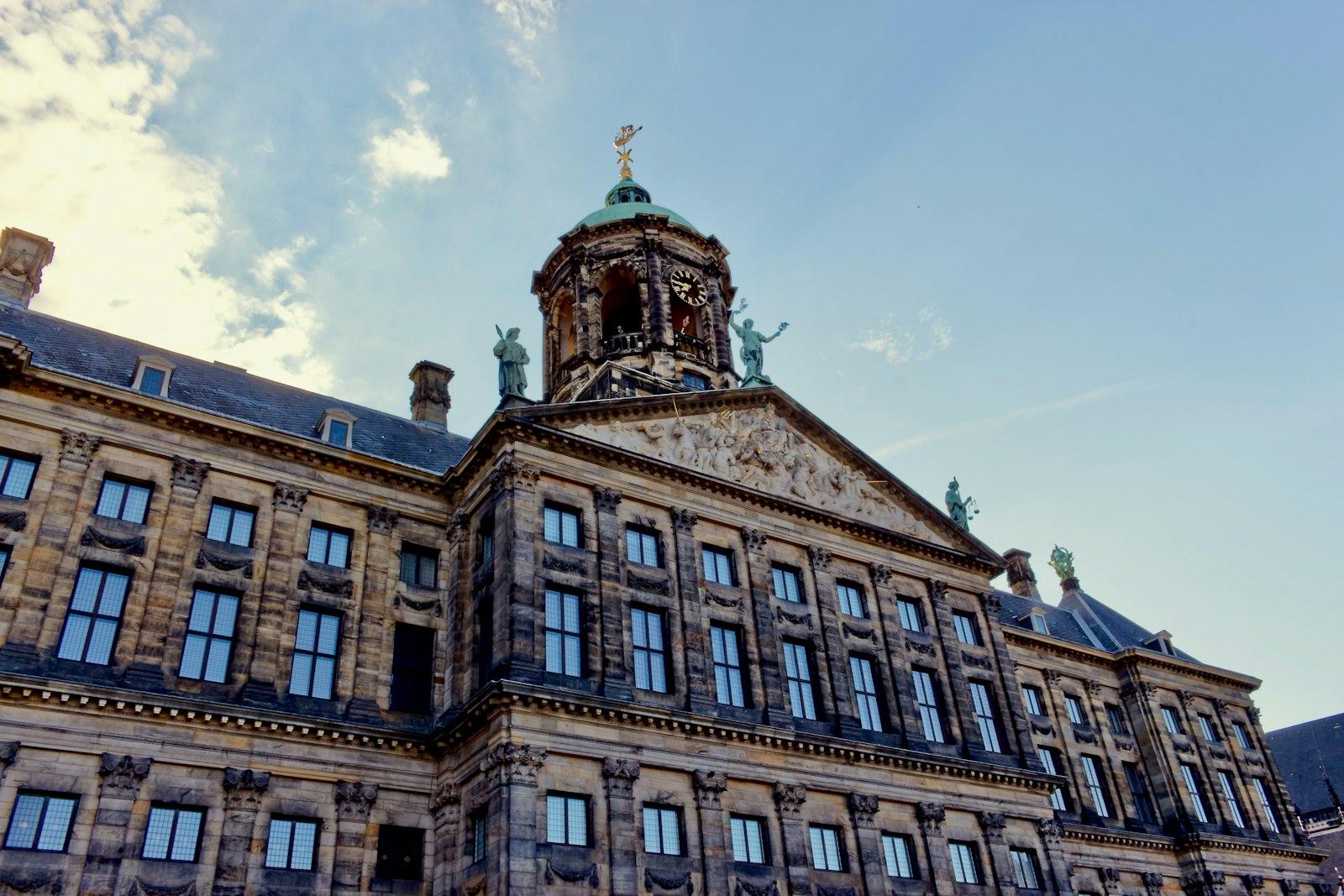
Dam Square and Old Center: The City That Reused Everything
70 min · 2.2 km · easy
More from Amsterdam
Explore more at your own pace.
Avercamp's Winter Landscape with Skaters: Hunting the Small Stories
Best History Walking Tours in Amsterdam (2026)
Petronella Oortman's Doll's House: The Miniature Canal House in the Rijksmuseum
Rembrandt's Self-Portrait of 1628: A Young Man and the Back of a Brush
The Night Watch: Why It Is Called That, and What Was Cut Off