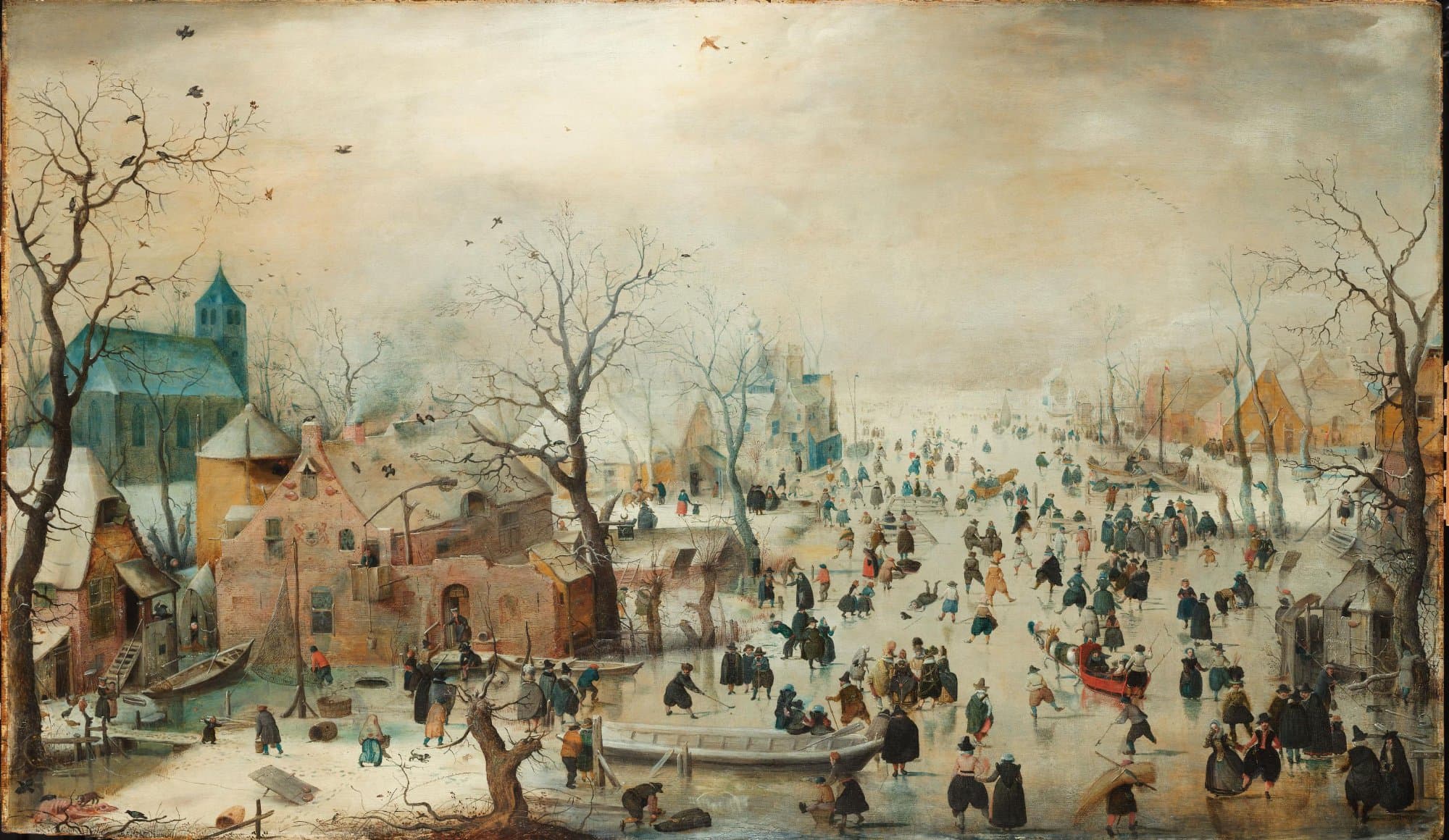
Winter Landscape with Skaters is an oil painting on panel by Hendrick Avercamp, made about 1608, 77.3 by 131.9 centimetres. The Rijksmuseum calls it the largest and most ambitious winter landscape he ever painted. It looks down on a frozen village full of skaters, kolf players, sleighs and distant ice boats. It hangs in room 2.6 of the Rijksmuseum, Amsterdam.
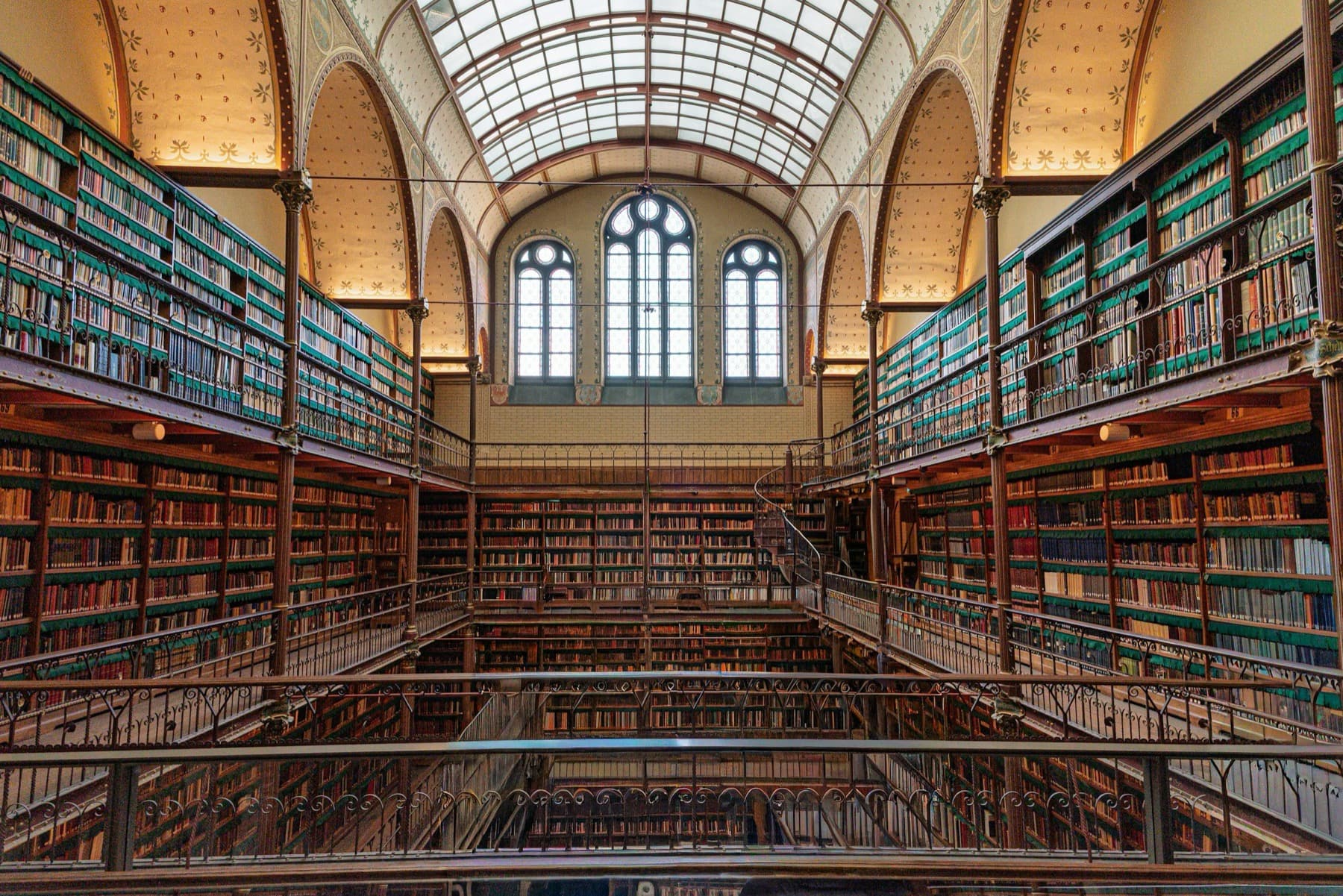
If you are asking where Avercamp's Winter Landscape with Skaters is: it hangs in room 2.6 of the Rijksmuseum in Amsterdam, a room the museum's record places under "Specialisation in painting" in the seventeenth-century collection.
How to look at it
Start with the ice. Hendrick Avercamp painted this panel about 1608, and the museum calls it the largest and most ambitious winter landscape he ever painted. It is 77.3 centimetres high and 131.9 wide, and he signed it with an H and an A joined together on the wall of a wooden shed on the right.
You look down from a high viewpoint on a frozen village. The museum's description lists skaters, kolf players and walkers on the ice, a sleigh on the right and a church on the left. Kolf is the game the museum calls the forerunner of golf, and ice boats sail far off. The people are small, and there are a great many of them.
Now do what the painting wants: hunt for the small stories.
Small stories to find
Hear a stop from this walk
Reguliersgracht and the seven-bridges view
- A fisherman carries an eel spear over his shoulder.
- A couple lies on a haystack.
- Someone's bare bottom hangs out over the lavatory on the left.
- In the left foreground, crows and a dog are feeding on a horse that froze to death.
The museum's catalogue says people of all social classes play and work on this ice. The horse is the grim note: the museum says such details have prompted readings of the painting as a reflection on the fragility of life. The catalogue also says the bird trap in the snow was borrowed from Pieter Brueghel the Elder's 1563 Landscape with Skaters and Bird Trap.
Why the trees matter
The tall bare trees at the sides work like stage scenery, pulling you in. The high viewpoint and the bare trees recall Flemish predecessors, the museum says. The composition is a stage with wings.
The painter known as the mute of Kampen
Hendrick Avercamp was born in Amsterdam, where he was baptised in 1585, and he died in Kampen in 1634. Wikipedia says he moved to Kampen in 1608. The Rijksmuseum's catalogue says he was deaf from birth and was known as "de Stomme", the mute. Wikipedia words it more carefully, "mute and probably deaf", and records the nickname as "de Stomme van Kampen", the mute of Kampen.
According to Wikipedia he studied with the Amsterdam painter Pieter Isaacsz and perhaps with David Vinckboons, a follower of Pieter Brueghel the Elder. He is best known for winter scenes, which a Rijksmuseum catalogue entry for another of his works says the seventeenth-century Dutch called wintertjes, a diminutive that means "little winters". Wikipedia says he was born in the last quarter of the sixteenth century, one of the coldest stretches of the Little Ice Age. The museum's catalogue goes as far as to call him the first Dutch artist to depict winter and its pastimes; Wikipedia is more cautious and calls him one of the earliest, so treat "first" as the museum's claim.
How the museum got it
The record's provenance is unusually short. The panel was in a sale in Amsterdam on 1 June 1897, the collection of Gijsbert de Clercq, where it went for 345 guilders to the dealer C.S. Roos. From him the museum bought it that year for 550 guilders, with support from the Vereniging Rembrandt. An earlier possible sale, in Rotterdam in 1748, is noted in the record with a question mark.
Questions people ask
What is kolf? The museum calls it the forerunner of golf. You will find people playing it on the ice in this painting.
Is it a happy picture? Mostly, and not entirely. The museum's catalogue says people of all classes play and work on the ice, and it says the frozen horse, being eaten by crows and a dog, has led some to read the painting as a comment on the fragility of life.
Who was Avercamp? A painter baptised in Amsterdam in 1585 and buried in Kampen in 1634, best known for winter scenes. He was mute and, the museum says, deaf from birth.
How big is it? 77.3 by 131.9 centimetres, oil on panel, dated about 1608.
Is the landscape real? The museum's text describes a village scene and names no real place, so we do not say which village it is.
Seeing it in the museum
Room 2.6 is a seventeenth-century room, and this is a painting you want time with. Stand back for the whole village, then move in on one corner at a time, the way you would read a page. Pick a patch of ice and count what is going on in it.
The museum's collection also holds a later skating scene, Enjoying the Ice near a Town, about 1620, on loan from private collectors. The museum's data listed it in room 2.6 on 11 October 2026, but loans come and go, so check on the day.
How this fits the Roamer guide
Roamer's independent audio guide to the Rijksmuseum has a short story for this panel in room 2.6, built around the same hunt for the eel spear, the haystack couple and the frozen horse. Play it in front of the painting, at your own pace, and skip ahead whenever you like. You can find it in the Rijksmuseum guide. For the other end of the Golden Age, read the Night Watch story.
Cover image: Hendrick Avercamp, Winter Landscape with Skaters, about 1608, Rijksmuseum, Amsterdam, public domain, via the Rijksmuseum collection (SK-A-1718).
Ready to experience it?
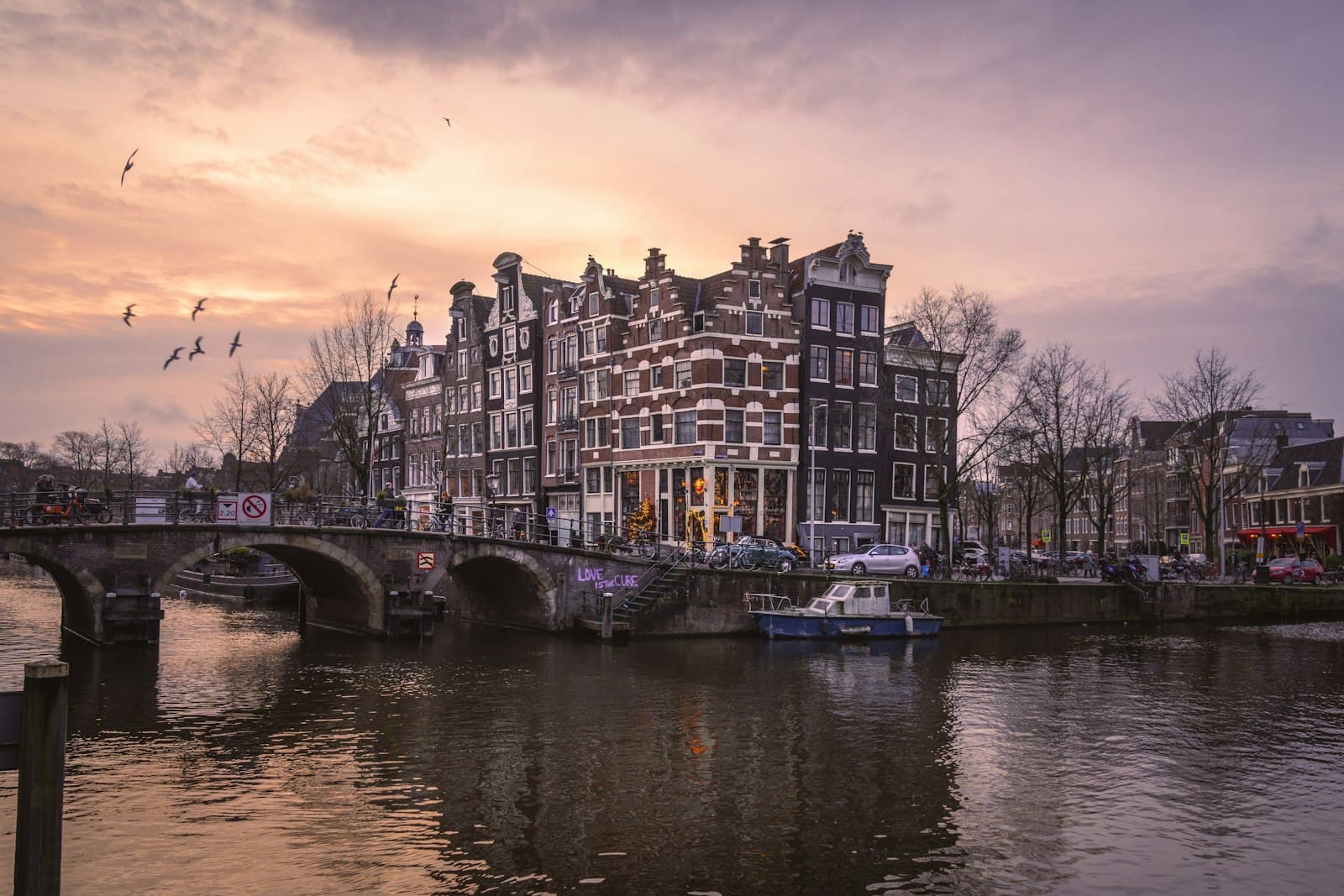
Canal Ring: The City That Planned Its Water
100 min · 3.8 km · easy
More from Amsterdam
Explore more at your own pace.
Petronella Oortman's Doll's House: The Miniature Canal House in the Rijksmuseum
Rembrandt's Self-Portrait of 1628: A Young Man and the Back of a Brush
Rijksmuseum: What to See, Room by Room, and a Two-Hour Plan
The Night Watch: Why It Is Called That, and What Was Cut Off
Van Gogh at the Rijksmuseum: The 1887 Self-Portrait and What Else You Can See