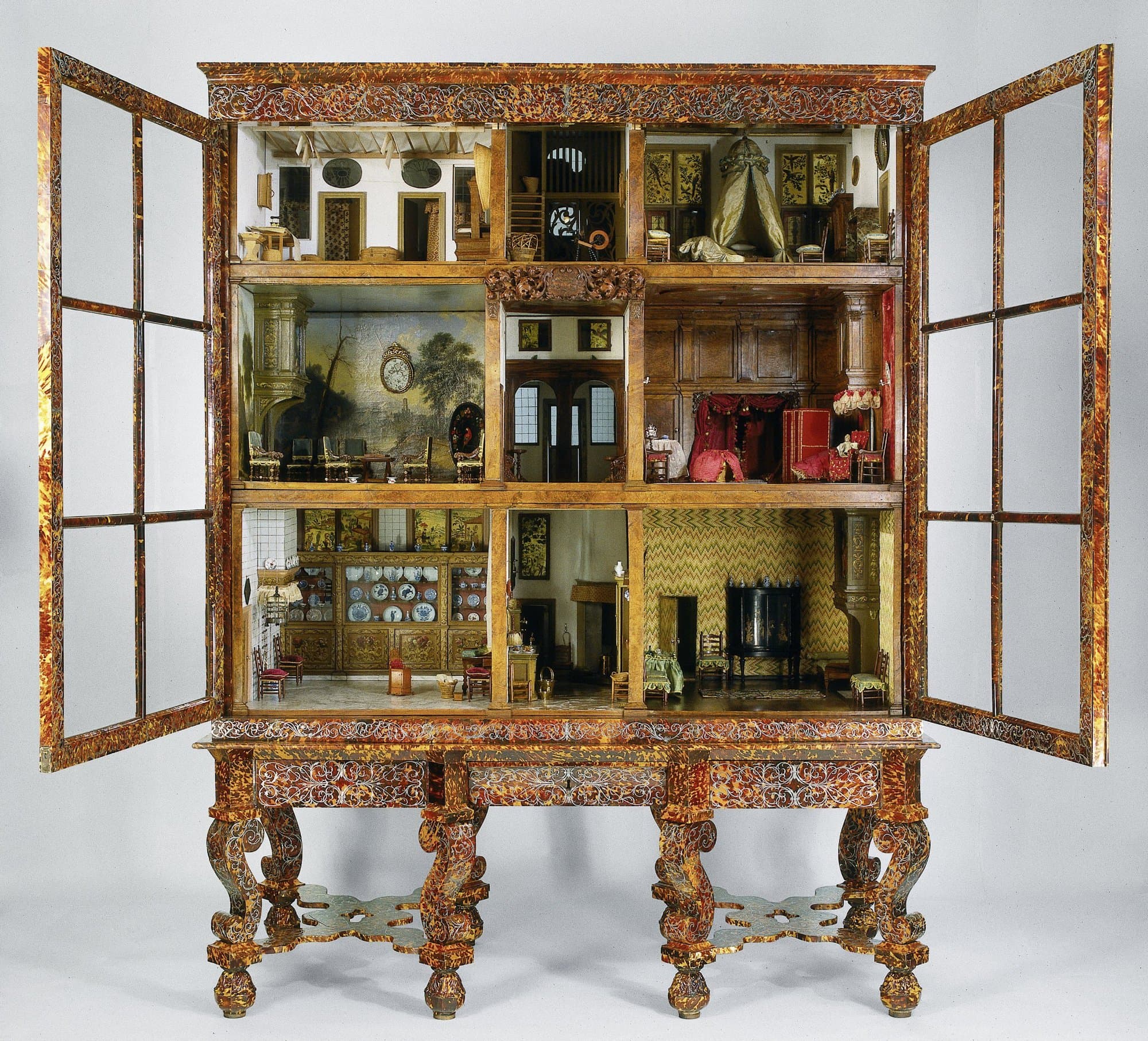
Petronella Oortman's doll's house is an oak cabinet veneered with tortoiseshell and pewter, about 2.55 metres high, in which a miniature Amsterdam home was furnished from the late 1680s to about 1710. Oortman was the wife of the silk merchant Johannes Brandt. It was a collector's showpiece for adults, not a toy. Only one of its original dolls survives, a baby in a cradle. It is in room 2.20 of the Rijksmuseum, with a painting of the house by Jacob Appel and a second dolls' house, the Dunois house.
If you are asking what Petronella Oortman's doll's house is: it is a tall cabinet in the Rijksmuseum that opens to show a complete Amsterdam home in miniature, furnished over many years from the late 1680s. It is not a children's toy. It was a showpiece for adult visitors.
If you are asking where it is: it is in room 2.20 of the Rijksmuseum, the museum's records call it part of the "Dolls' houses" display, with the painting of the house beside it.
What the house is
The cabinet is oak, veneered with tortoiseshell and pewter. The museum gives it as 2.55 metres high, 1.9 metres wide and 78 centimetres deep, and the sides carry the initials B O. Inside, it is a house of several floors and rooms, furnished in the styles of a rich Amsterdam household. The museum mentions marble floors, fabric wall coverings and walnut wainscoting. There are two kitchens, a show kitchen that served as a dining room and displayed porcelain, and a working kitchen beside it. There is also a lying-in room, where after childbirth a mother might stay in bed for up to six weeks while friends and family visited, so the room had to look picture perfect. The museum also lists real running water in the kitchen, a working fountain and 83 leather-bound books in the library, all made to scale from authentic materials, and Cornelis Dusart's miniature paintings hang in the nursery.
Details are where it gets uncanny. The Rijksmuseum also owns a miniature parrot cage that belongs to the Oortman house. It is 11.4 centimetres high, made of tinned iron and copper wire with ebony feet, and the museum's record describes it as a detailed miniature of the cages painters such as Jan Steen, Gerrit Dou and Pieter de Hoogh show in their pictures. It hangs in the show kitchen on a cord and pulley. Everything in the house was made at this level. The point was that a visitor could study it, not just glance.
Who Petronella Oortman was
Hear a stop from this walk
Reguliersgracht and the seven-bridges view
Petronella Oortman was born in 1656 in Amsterdam, as one of seven children of a gunmaker, according to Wikipedia. In 1686 she married the silk merchant Johannes Brandt. The Huygens biographical dictionary of Dutch women dates the wedding to 28 March 1686, and the museum describes her as the wife of the silk merchant Johannes Brandt. It was her second marriage.
She is one of two women named Petronella connected with Dutch doll's houses, and the second causes confusion. Petronella Oortmans-de la Court, who lived from 1624 to 1707, had a different cabinet, which Wikipedia says is now in the Centraal Museum in Utrecht. If you read about "Petronella's doll's house" in Utrecht, that is the other one.
What it cost, and what the number really means
The cost of the house is the part everybody repeats, and it is worth being careful with. Wikipedia and the Huygens biography both say that her daughter Hendrina claimed her mother spent about 30,000 guilders on it. The museum's own story says the house was valued at 20,000 to 30,000 florins, about the price of a real house on an Amsterdam canal. In 1718 a German visitor, Zacharias von Uffenbach, saw it and valued it at 20,000 to 30,000 guilders, again according to Wikipedia.
Yet a later inventory told a very different story. Wikipedia and the Huygens biography put the house at only 700 guilders in an inventory, which the Huygens text calls an estimate and not a record of cost. The big figure is therefore a claim, and the small one a later valuation. If you want a single honest line: the family said it cost as much as a house on the canals, and a few decades after her death an inventory put it at a fraction of that.
Neither number should be used to judge the artistry. What the house really shows is how much money and care a wealthy Amsterdam woman could put into a hobby that doubled as a status symbol.
Why only one doll is left
When it was complete the house had dolls living in it. Today only one of the originals survives, a baby in a cradle. The museum describes it as an infant with a wax face and hands, swaddled in a pink and blue silk christening gown. The rest are lost.
That raises a question: how do we know what the house looked like when it was in use? The answer is the painting.
The painting of the house
Around 1710, Jacob Appel painted the Oortman house, and it hangs beside the cabinet. The museum records it as oil on parchment on canvas, 87 by 69 centimetres, signed "Jacob Appel F.". The painting shows the house with its dolls, and the museum points to a Black servant in the left room on the middle floor. It also shows something the cabinet itself has lost. According to the museum, the house was originally protected by yellow curtains, and when it was closed it looked like a bedstead.
Compare the two. The painting records the cast that has gone and the curtains the cabinet has lost, which makes it a key to the cabinet.
The other doll's house in the room
Room 2.20 holds a second dolls' house, which is easy to walk past. It is the house of Petronella Dunois, older than the Oortman house, with objects marked 1676. The museum says the oak cabinet is veneered with walnut root and decorated with eight-pointed stars on the sides, and gives it as 2 metres high, 1.5 metres wide and 56 centimetres deep. The museum calls Dunois a wealthy orphan who lived with her sister in Amsterdam, and its portrait record of her says the house was one of the most valuable things she brought to her marriage to Pieter Groenendijk.
Unlike the Oortman house, this one still has its dolls: the museum counts 21. The museum lists eight rooms: a peat loft, a linen room, a nursery, a lying-in room, a reception room, a cellar, a kitchen and a dining room. If the Oortman house is the better showpiece, the Dunois house is the better household.
Why people search for it
Many visitors first heard of the house from Jessie Burton's 2014 novel The Miniaturist, which Wikipedia says was inspired by it. The novel is fiction, and the real Oortman and her house should be read from the museum's records, not from the book.
What to look for in the room
Start at the cabinet and read it floor by floor, the way a guest would have been shown it. Find the kitchen and the lying-in room. Then look for the smallest things: the parrot cage, the furniture, the tiny objects that had to be made by specialist craftsmen. Then turn to the Appel painting and look for the people the cabinet no longer has.
How this fits the Roamer guide
Roamer's independent audio guide to the Rijksmuseum has short stories for the Oortman house, the Appel painting, the Dunois house and the parrot cage in room 2.20. Play them in front of the objects, at your own pace, and skip ahead whenever you like. For the rest of the building, read what to see at the Rijksmuseum, or open the Rijksmuseum guide. For the world these houses imitate, see the Golden Bend on the Herengracht.
Cover image: Dolls' house of Petronella Oortman, c. 1686 to c. 1710, Rijksmuseum, Amsterdam (BK-NM-1010), public domain.
Ready to experience it?
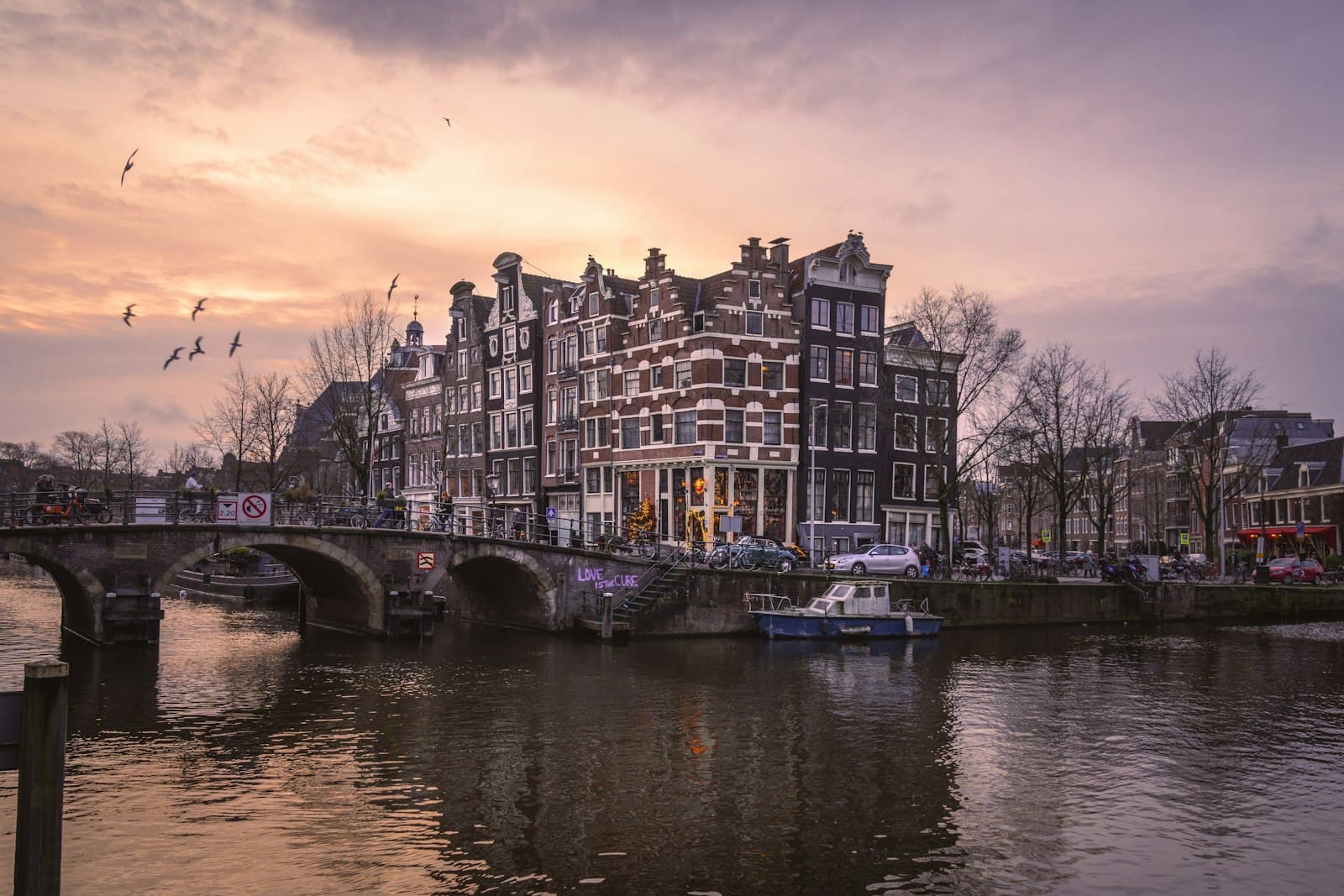
Canal Ring: The City That Planned Its Water
100 min · 3.8 km · easy
More from Amsterdam
Explore more at your own pace.
Avercamp's Winter Landscape with Skaters: Hunting the Small Stories
Rembrandt's Self-Portrait of 1628: A Young Man and the Back of a Brush
Rijksmuseum: What to See, Room by Room, and a Two-Hour Plan
The Night Watch: Why It Is Called That, and What Was Cut Off
Van Gogh at the Rijksmuseum: The 1887 Self-Portrait and What Else You Can See