Old City: The Room Where the Country Was Argued
85 min · 1.8 km · easy
Philadelphia has a slogan and a problem, and they are the same fact. The slogan is "the birthplace of the nation." Both the Declaration of Independence and the Constitution were argued into being in a single room here, and for a decade the city was the capital of the country it had helped invent. The problem is that the ground carrying those monuments was never empty. Under the founding story sits a second story, of the enslaved, the immigrant, and the working poor, whose lives the marble left out for most of two centuries. The honest way to walk this city is to read both layers at once.
The official layer is real
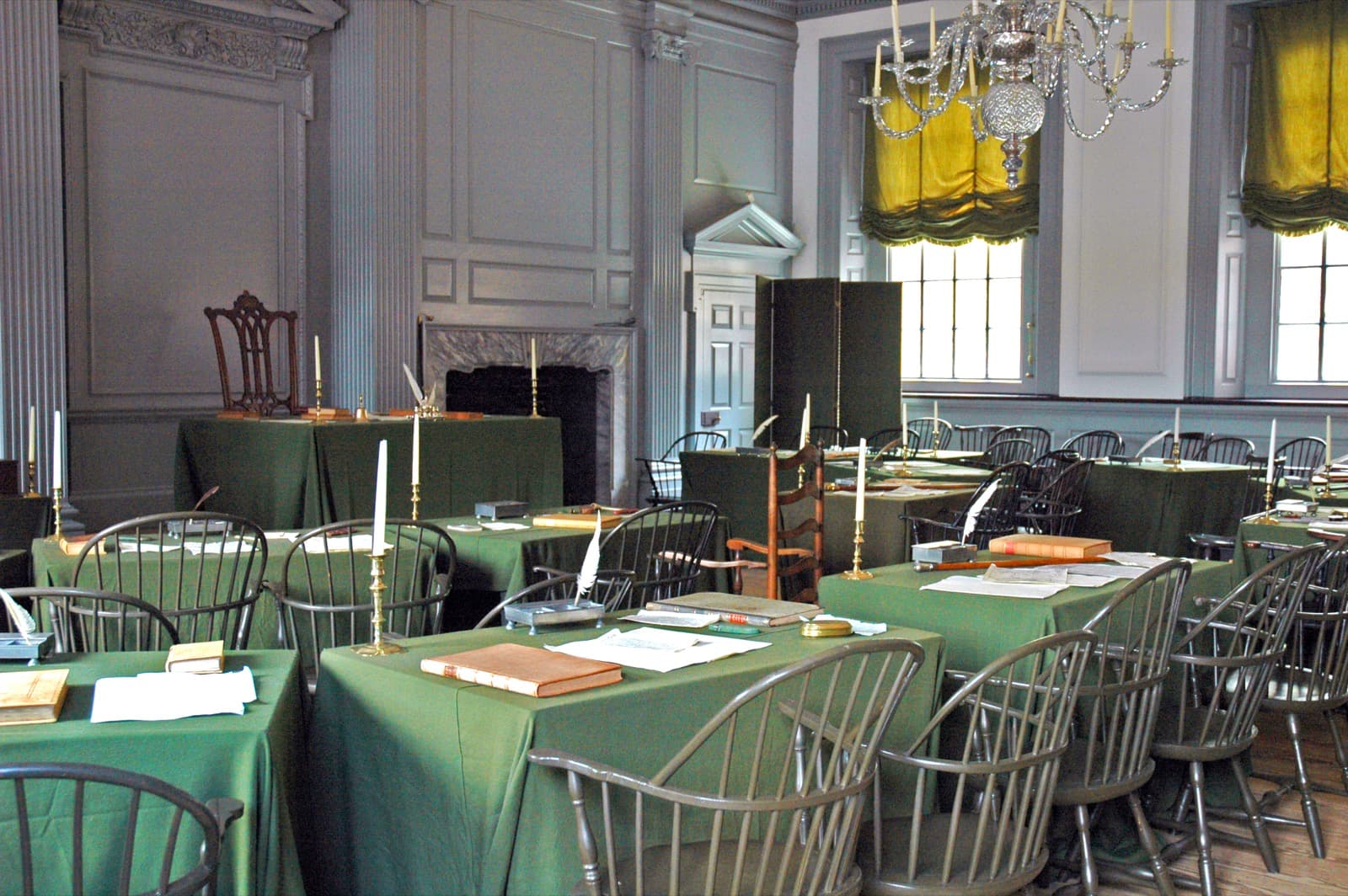
Start with what is true and celebrated. In the Assembly Room of Independence Hall, delegates adopted the Declaration of Independence on July 4, 1776, and the same room hosted the Constitutional Convention from May to September 1787. Benjamin Franklin looked at the half-sun carved into the back of the presiding officer's chair and said he had finally decided it was a rising and not a setting sun. That chair is still in the room. This is the founding-era Philadelphia that the Old City history tour walks: the hall, the Liberty Bell, Carpenters' Hall, Christ Church. None of it is invented. The country was in fact argued into existence on these blocks.
But the founders did not arrive on empty land, and they did not live saintly private lives while writing about liberty.
The layer underneath, one block from the Bell
Hear a stop from this walk
Old City Hall and the Second Bank: The Institutions the Room Built
Walk one block from the Liberty Bell to the corner of 6th and Market and you reach the ground that holds both stories at once. This was the site of the President's House, the executive mansion where George Washington and then John Adams governed while Philadelphia was the national capital from 1790 to 1800. Washington brought nine enslaved Africans here from Mount Vernon to staff the house of the man leading a republic founded on the claim that all men are created equal.
Pennsylvania had passed a Gradual Abolition Act in 1780. Its terms freed enslaved people who were held in the state for six continuous months. Washington's response, documented in his own correspondence, was to rotate his enslaved workers in and out of the state so that none of them ever established the six months of residence that would have triggered their freedom. Two of them freed themselves anyway. Oney Judge, an enslaved seamstress, walked out of the house in May 1796 and escaped to New Hampshire. Hercules Posey, the celebrated cook, escaped in early 1797. Neither was ever recaptured.
For most of the twentieth century, none of this was marked. The house itself was demolished, its site partly paved as an approach to the Liberty Bell. The memorial that finally tells this story, naming all nine enslaved people, opened on the spot in 2010. It sits, deliberately, in the sightline of the Bell. That is the whole argument of this city in one view.
The layer that kept arriving
The founding is not the only history Philadelphia buried and then partly recovered. The city's grid, laid out by William Penn's surveyor Thomas Holme in 1682, is covered in detail in the Center City history tour. But that grid became a container for people Penn never imagined. South Philadelphia filled with Italian immigrants at the end of the nineteenth century and became the 9th Street Italian Market, one of the oldest outdoor markets in the country. Over the last several decades those same blocks absorbed Mexican, Vietnamese, and Cambodian arrivals, so the "Italian Market" now sells birria and pho a few doors from the century-old Italian butcher.
And the walls themselves became a record. The Mural Arts program, the largest public art initiative in the United States, began in 1984 not as an art project but as an anti-graffiti campaign, and turned the outer walls of working-class Philadelphia into a public archive of the people the monuments had skipped.
Why walk it this way
The founding sites give you the official Philadelphia. The President's House, the Italian Market, and the murals give you the Philadelphia that lived on the same ground and, for a long time, went unrecorded. You can walk the birthplace of the nation as a shrine, and it will not lie to you. But if you walk it as a set of layers, the founding room and the enslaved household one block away, the planned grid and the immigrants who filled it, the marble and the painted walls, you get the truer and more interesting city. That is the argument for taking more than one of these tours.
Frequently asked questions
- Why is Philadelphia called the birthplace of the nation?
- Both the Declaration of Independence (adopted July 4, 1776) and the United States Constitution (drafted in 1787) were argued and signed in the Assembly Room of Independence Hall in Philadelphia, which served as the young country's capital from 1790 to 1800.
- Whose enslaved people lived at the President's House in Philadelphia?
- George Washington brought nine enslaved Africans from Mount Vernon to serve in the executive mansion at 6th and Market Streets, including Oney Judge and the cook Hercules Posey. The memorial that opened on the site in 2010 names all nine and tells their story alongside the presidency's.
- What is the best way to see both sides of Philadelphia's history on foot?
- Pair the Old City and Center City history tours with the Italian Market and Mural Arts tours. The founding sites give you the official story; South Philadelphia and the murals give you the immigrant and neighborhood history that grew up around it.
- Is Philadelphia's history only about the founding era?
- No. The same ground carries three centuries of layered history: William Penn's planned grid of 1682, waves of Italian, Mexican, and Vietnamese immigration in South Philadelphia, and the largest public mural program in the United States, begun in 1984.
Ready to experience it?
Old City: The Room Where the Country Was Argued
85 min · 1.8 km · easy
More from Philadelphia
Explore more at your own pace.
One Day in Philadelphia: A Walkable Historic-Core Itinerary (2026)
From Crackdown to Canvas: A Mural Arts Companion
One Market, Three Immigrations: A South 9th Street Companion
Penn's Green Country Town: A Center City Companion
The Room Where the Country Was Argued: An Old City Companion