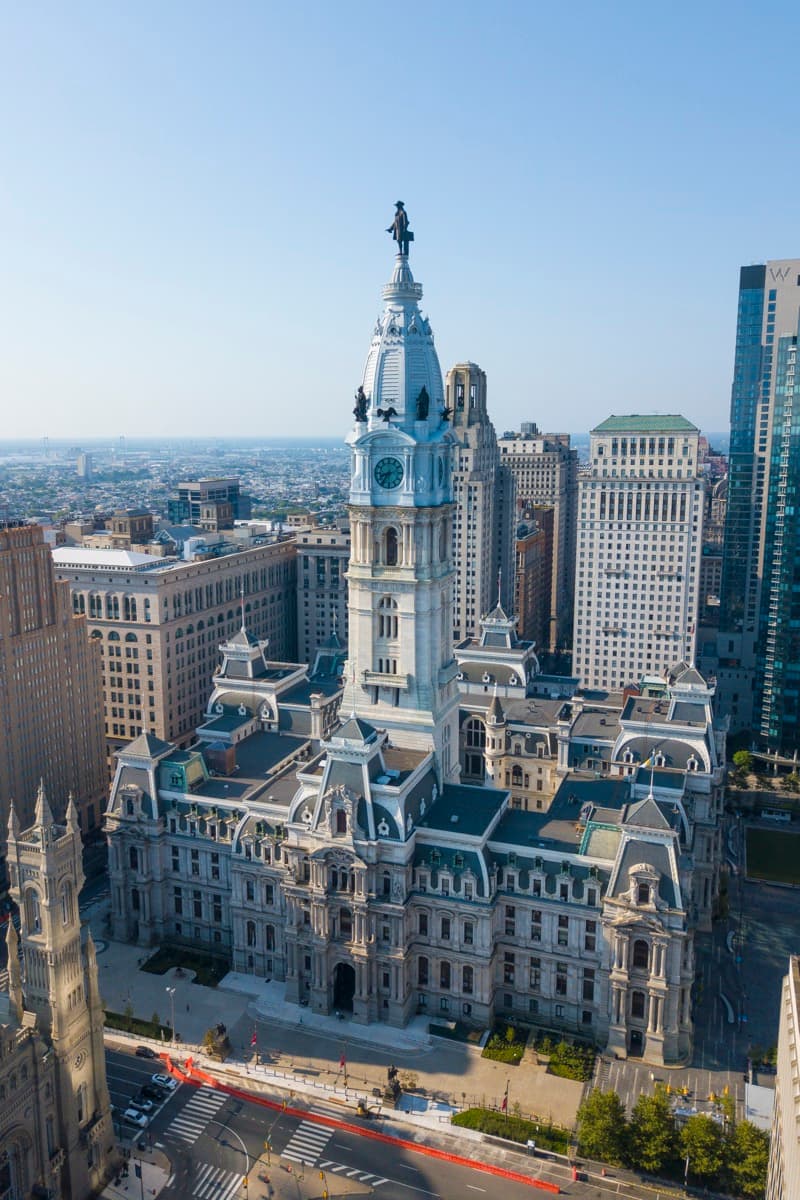
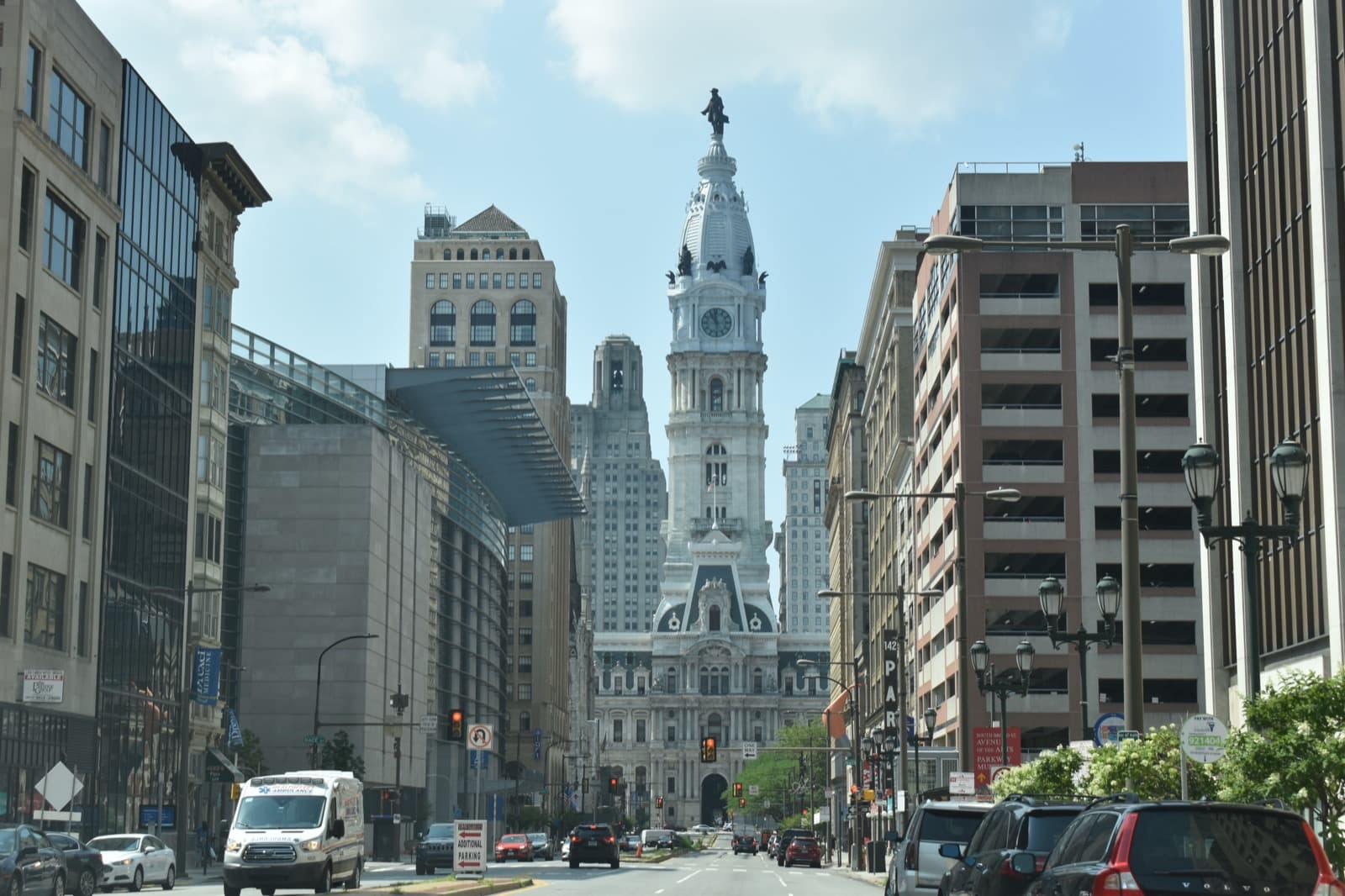
The Center City tour begins at Philadelphia City Hall because everything about the grid meets here. William Penn left the center of his 1682 plan as an open public square. Two hundred years later the city filled it with the most emphatic building it would ever construct, put a statue of Penn himself on top, and then spent a century refusing to build anything taller. This is the story of that tower and the superstition it produced.
The largest masonry building in the country
City Hall was built from 1871 to 1901 to a design by John McArthur Jr., in the French Second Empire style, with Thomas Ustick Walter contributing. It is the largest free-standing masonry building in the United States, made of load-bearing brick and stone rather than a steel frame, with roughly 700 rooms. When its tower was completed in 1894 it became the tallest habitable building in the world, a title it held until 1908.
That is worth pausing on. For fourteen years, the tallest building people actually lived and worked in, anywhere on earth, was a city hall in Philadelphia, and it was holding itself up with masonry rather than a steel skeleton. It is a monument to a construction method that skyscrapers were about to make obsolete, built right at the edge of that transition.
The statue that set the ceiling
Hear a stop from this walk
Logan Square and Swann Memorial Fountain: The Amended Corner
On top of the tower stands a 37-foot bronze statue of William Penn by Alexander Milne Calder. It is the tallest statue on any building anywhere in the world. Penn faces northeast, toward the site where he signed his treaty with the Lenape.
For most of the twentieth century, an informal understanding known as the "gentlemen's agreement" held that no building in Philadelphia should rise higher than the top of Penn's hat. It was never a law. It was a shared civic sense that the founder should keep the highest point in his own city. That agreement kept the entire skyline below the statue for decades, which is why Philadelphia, alone among big American cities, had a low skyline well into the 1980s.
The line breaks, and the curse begins
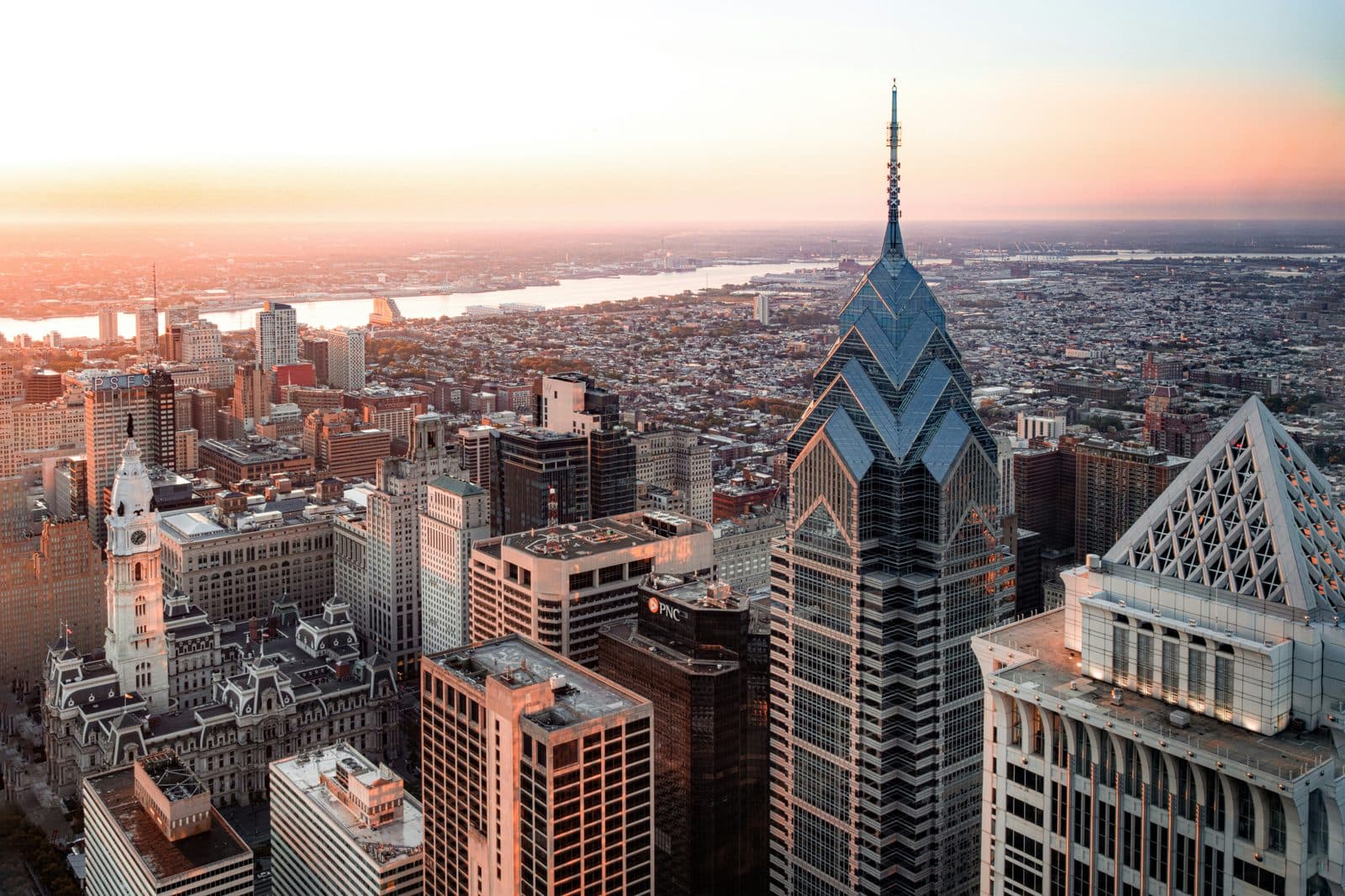
In 1987, One Liberty Place rose above the Penn statue and broke the gentlemen's agreement. And then Philadelphia's major sports teams stopped winning championships. Fans, only half-joking, named the drought the "Curse of Billy Penn," blaming the founder's slighted ghost for the city's losing seasons. The superstition became genuine local folklore, retold every playoff season.
Whether or not you believe in curses, the story is a real and revealing piece of Philadelphia's self-understanding: a city so attached to its founder that it read a sports drought as his displeasure at being built over. The tension between Penn's empty 1682 square and the skyscrapers that eventually towered over his statue is the whole modern history of the city center in one sightline.
Why this stop opens the tour
This is the right place to start the Center City walk because it holds all three time layers at once. Under your feet is Penn's 1682 center square, kept open for two centuries. Above you is the 1901 tower that filled it and briefly topped the world. And around you is the skyline that finally overruled the founder in 1987. The Center City tour companion sets the grid in full, and the founding-city thesis explains why Philadelphia keeps arguing with its own founding in stone. Stand at the base, look up at Penn, and you are reading 340 years of the city's argument with itself.
Ready to experience it?
Center City: William Penn's Three-Hundred-Forty-Three-Year Experiment
85 min · 3 km · easy
More from Philadelphia
Explore more at your own pace.
One Day in Philadelphia: A Walkable Historic-Core Itinerary (2026)
The Founding City on Top of Erased Histories
From Crackdown to Canvas: A Mural Arts Companion
One Market, Three Immigrations: A South 9th Street Companion
Penn's Green Country Town: A Center City Companion