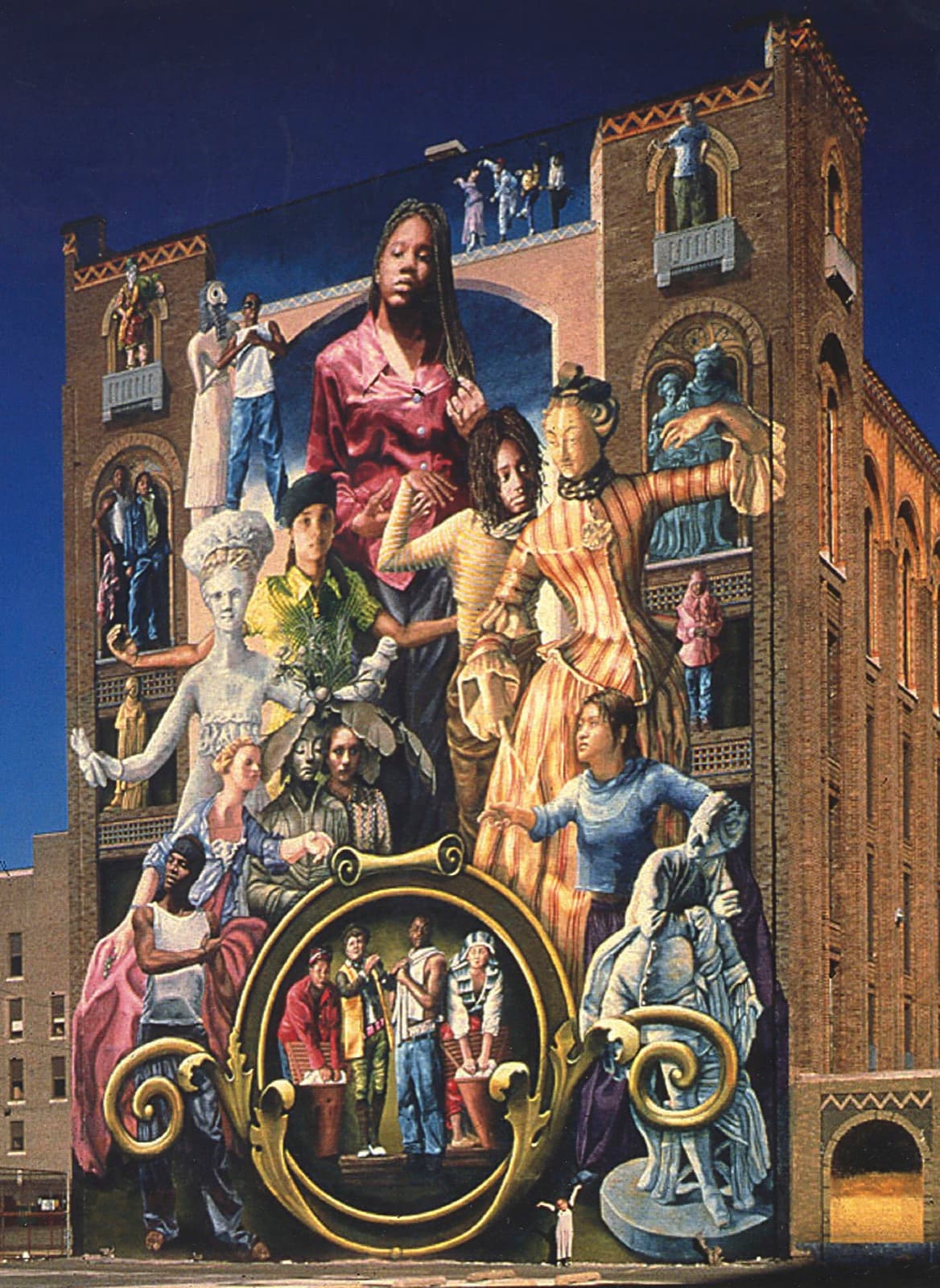
Six stories of paint, more than four thousand walls citywide, and one question the program has been asking since nineteen eighty-four: who gets to paint what, where, and when. The tour reads Philadelphia as a chromatic event and reads each mural as a three-way contract between an artist, a property owner, and a community.
Start · Common Threads: The Pose That Traveled Down the Wall
DirectionsStops
- 1
Common Threads: The Pose That Traveled Down the Wall
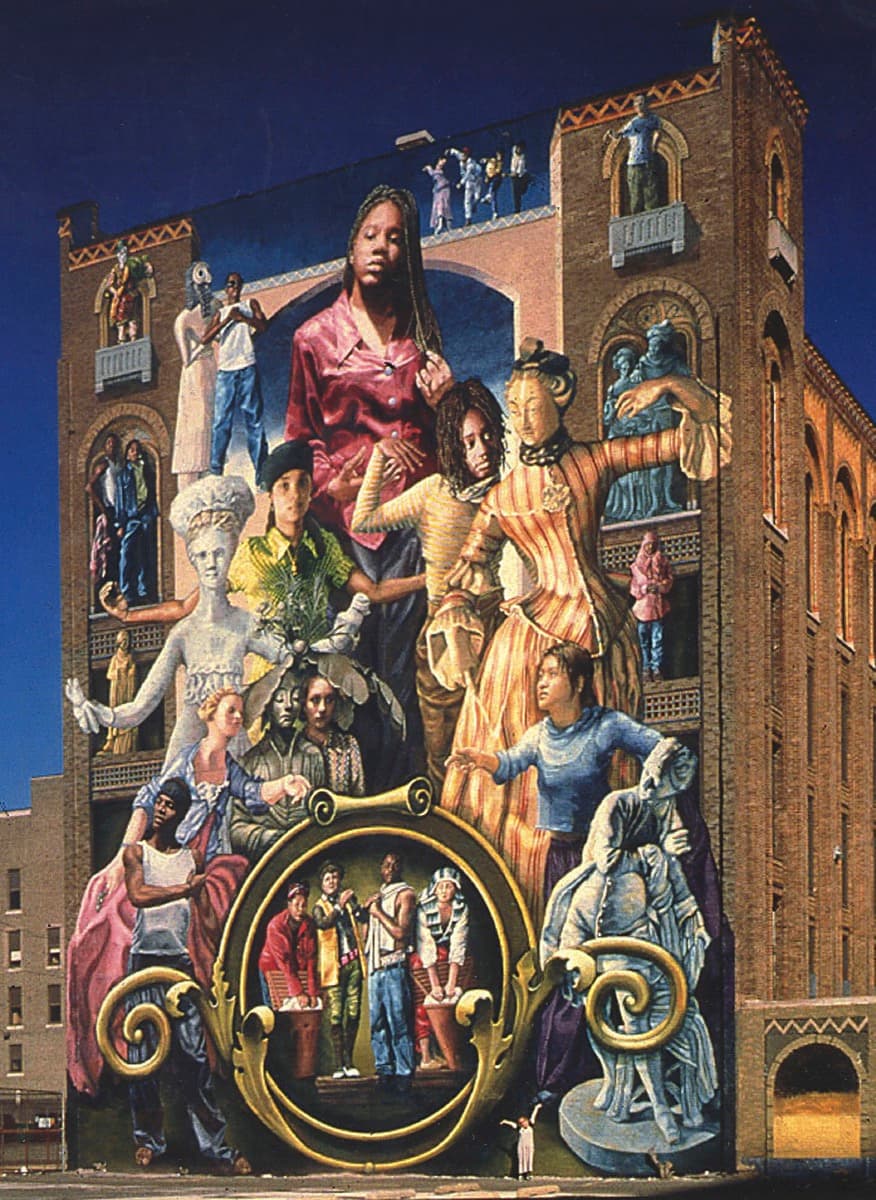
Meg Saligman, 1997, restored 2011, at Broad and Spring Garden. The mural that placed porcelain figurines in court dress at the top of the wall and African American teens in denim at the bottom in the same poses, with Tameka Jones at center as the named community participant. Mid-period community-collaboration register.
- 2
Era 2: The Contract That Looks Like Decoration
Editorial-slot Stop 2. A mid-period community-collaboration mural visually distinct from Common Threads, selected at field walk from the muralarts.org catalog. The narration carries the hidden-second-thing reveal: every Mural Arts mural is a three-way legal and social contract between artist, property owner, and community, not a painted surface.
- 3
Era 1: The Anti-Graffiti Wall
Editorial-slot Stop 3. An early-program-era mural from the period 1984 to ~1996, selected at field walk. The narration names the program's anti-graffiti diversion origin: jail or work on the city beautification initiative. Era 1 register: the paint arrived as an alternative to a criminal charge.
- 4
Era 2: The Wall Painted With Named Residents in the Room
Editorial-slot Stop 4. A mid-period community-collaboration mural from the period 1996 onward, selected at field walk. The narration names the 1996 transition to a comprehensive community service program and the participatory-design register: longer commissioning, named community members in the work, multi-year design processes.
- 5
Era 2 Contested: The Wall That Could Be Painted Over
Editorial-slot Stop 5. The climax beat. A mid-period public-argument mural with a documented history of defacement, restoration controversy, or community protest. The narration references the Frank Rizzo mural at 9th and Montrose (1995, painted over June 7, 2020 during the George Floyd protests) as the editorial pivot. The program's record is reversible.
- 6
Era 3: The Artist Who Came Home to Paint
Editorial-slot Stop 6. A recent-era restorative-justice or reentry mural from 2015 onward, selected at field walk. The narration names the program's third editorial era: the Restorative Justice and Reentry programs that employ formerly-incarcerated artists. The 2016 rebrand to Mural Arts Philadelphia context.
- 7
Resolution: Who Paints the Next Wall
Editorial-slot Stop 7. A recent-era mural at a corridor terminus vantage where the listener can stand back. The narration carries the closer: more than four thousand painted, about two thousand still visible, fifty to one hundred new every year, ~10-year survival rate. The question of who decides the next yes stays open.
Details
Best Time to Visit
Spring and fall are the easiest months on the corridor. Light from late March through mid May, and again from mid September through late October, is angled enough to side-light the murals without flattening their color. Most Mural Arts walls face into open intersections or parking lots, which means midday in summer washes out the surface, while overcast days can soften the chromatic punch the tour is built around. Morning light, roughly nine to eleven, is the cleanest read on the southwest-facing walls including Common Threads at Broad and Spring Garden. Late afternoon light, roughly four to six, is the cleanest read on the east-facing walls further south in the corridor. Weekends bring more pedestrians but also more open street life around the murals, which suits the tour's reading of the walls as community-facing. Weekday mornings before lunch are the quietest. Winter mornings are cold but the murals read cleanly against a low sun.
Pro Tips
- •Stop 1, Common Threads, reads best from the southwest corner of Broad and Spring Garden, stepped back to the edge of the curb so the full six stories of the wall are in your field of view. The named central figure, Tameka Jones in the pink blouse, is roughly mid-wall; the porcelain couple at the top and the teens in denim at the bottom are the figural inheritance argument the mural is making.
- •Stops 2 through 7 are editorial slots in the lens. The specific murals for these stops are selected from the Mural Arts Philadelphia online catalog at muralarts.org during a field walk, on the basis of extant-status as of 2026 plus walking-distance feasibility from Stop 1. The tour as walked locks the final mural identities at the field-walk stage.
- •The Mural Arts Philadelphia online map at muralarts.org is the program's living catalog. If you want to read more murals after the tour, the map is the canonical source. The program does not maintain a single branded mural mile route; the corridor this tour walks is the tour's editorial route, not a program designation.
- •The Frank Rizzo mural referenced in Stop 5 stood at the corner of Ninth and Montrose in the Italian Market from nineteen ninety-five to June seventh of twenty twenty, when it was painted over during the protests following the killing of George Floyd. The wall is not on this corridor, but a walk through the Italian Market, the subject of our companion Italian Market tour, passes the site.
- •Mural Arts Philadelphia offers its own guided tours, including trolley and walking options. Those tours are run by program staff with current catalog access and are the right complement to this independent walk if you want to go deeper after the tour.
- •Jane Golden's two thousand and two book, Philadelphia Murals and the Stories They Tell, co-written with Robin Rice and Monica Yant Kinney and published by Temple University Press, is the first-person account by the program's founder. The twenty fourteen retrospective, Philadelphia Mural Arts at Thirty, co-edited with David Updike and also published by Temple, covers the community-collaboration era and the beginnings of the restorative-justice era. Those are the two readings if the program's record holds your attention.
- •The tour deliberately holds the program's anti-graffiti origin and its community-art and restorative-justice record on the same wall, without collapsing into a savior framing. If you read further, watch for sources that flatten the program into either pole. The honest record is both.
Safety & Precautions
- •The corridor walks along Broad Street and adjacent Center City and Callowhill blocks. Broad Street is a major arterial with active traffic; use the marked crosswalks at Spring Garden, Vine, Race, and Arch. Side streets in the corridor have rowhouse parking and irregular curbs.
- •Most Mural Arts walls face onto parking lots or side-street alleys. Look up and step back to read the full wall. The tour's standing positions are on public sidewalks; private parking lots may have signage restricting pedestrian access, and the tour does not require entering any private property.
- •Center City and the Callowhill area are walkable but the corridor crosses several major streets, including Broad. Stay on marked sidewalks and use signaled crossings. The corridor is well-lit during daylight hours; the tour is intended as a daytime walk.
- •Photography of the murals is permitted from public sidewalks. The program encourages documentation. If the corridor passes a wall with active restoration scaffolding or in-progress painting, give the work space.
- •Weather: the tour is outdoor for the full ninety to ninety-five minutes. In summer, carry water; the Philadelphia heat island reads strongly on south-facing rowhouse blocks in July and August. In winter, the walk is brisk but exposed; wind on the Broad Street corridor can be sharp. Spring and fall are the recommended seasons.
Travel advisory: Exercise Normal Precautions (Level 1).
Gallery
Related Reading
Go deeper on what you'll see, hear, and walk through.
Read the walk
The full story of The Wall as Argument: Philadelphia's Mural Mile, in words. Prefer to listen? Play it narrated, from home or on location.
Introduction
Six stories of paint above the southwest corner of Broad and Spring Garden. The mural is called Common Threads. The figures near the top are roughly the size of a small car, and the same pose travels down the wall, across two centuries and across class, from a porcelain couple in eighteenth century court dress to African American teens in casual denim at street level.
Philadelphia wears its arguments on its walls, and the Mural Arts Program has produced more than four thousand of them since nineteen eighty-four, each one a three-way transaction between an artist, a property owner, and a community asked to read the result every day.
The program did not start as public art. It started inside the Philadelphia Anti-Graffiti Network, with a binary deal for prosecuted graffiti writers: jail, or work on the city beautification initiative. A Stanford-trained muralist named Jane Golden was hired that year to lead the muralist outreach. The program became a comprehensive community service program in nineteen ninety-six, and was renamed Mural Arts Philadelphia in twenty sixteen. About half of those four thousand walls are still publicly visible.
The walk is seven stops, about three point five kilometres and ninety minutes, running south from Broad and Spring Garden through the Mural Arts corridor. It starts at Common Threads and closes on a resolution wall that holds the question every wall in the program has had to answer: who gets to paint, and who gets painted. When you arrive at Broad and Spring Garden, begin with stop one.
1. Common Threads: The Pose That Traveled Down the Wall
You are still at Broad and Spring Garden, with Common Threads above you. Stay on the southwest corner. Step back to the edge of the curb so you can see the full six stories. Now look slowly from top to bottom. The painted alcove near the top of the wall shelters a porcelain couple in eighteenth century European court dress. The figures are larger than life. Their poses are the formal stillness of decorative figurines on a mantelpiece. Now follow the wall down. Halfway down, more young Philadelphians in casual contemporary clothes, holding the same composed attitudes. At street level, the African American teens in denim are posed exactly the way the porcelain figures are posed at the top. The pose is the subject. It has come down the wall, intact, across two centuries.
The central figure, the young woman seated cross-legged in the pink blouse, is Tameka Jones. The program documents her by name on its catalog page for this mural. At the time of the painting in nineteen ninety-seven, she was a student at the Philadelphia High School for the Creative and Performing Arts, the public arts magnet school a few miles south of here. Her face was the result of a participatory casting, not a generic study. The lead artist, Meg Saligman, has been one of the program's signature muralists for nearly four decades. The mural was completed in nineteen ninety-seven and restored in twenty eleven.
Here is what the wall is arguing. The poses of European porcelain figurines, the small expensive objects of court culture, are inherited by Philadelphia teenagers two centuries later. The inheritance is uninvited. Nobody asked the teens in denim to hold the pose of the woman in pale blue at the top. They are holding it anyway. The wall says that the formal language of one class has been quoted, at full scale, into the bodies of another class. The pose persists. The wall makes that persistence visible.
This is also, by the program's own catalog, one of the most photographed Mural Arts works in the city. It is a Stop 1 because it carries the scale and the contract at once. Six stories of paint by a named artist, on a wall whose owner signed an agreement, depicting a community participant who is named on the record. Every layer of the three-way transaction is here, in the open, on Broad Street.
Now walk south on Broad. Cross Spring Garden if you have not already. Continue south for about three blocks. The next wall is on a side street to the east. The visual register is going to change.
[VERIFY at field walk: exact mid-corridor turn from Broad to the Stop 2 mural; final mural selection for Stop 2.]
2. Era 2: The Contract That Looks Like Decoration
You have arrived at the second wall. Stand on the sidewalk across the street if there is room, so you can see the whole composition at once. The visual register is different here. The colors, the scale, the way the figures or the patterns sit on the surface, none of it is reading the way Common Threads read. That is on purpose. The eye needs the contrast. The city is not painting the same painting four thousand times.
Now notice what your brain wants to do with this wall. The standard reading, the one most people land on, is that this is a decorative intervention. A pleasant surprise on a side street. A pop of color in a working block. Here is the move this stop wants you to make. What looks like decoration is a contract.
Every mural in this program is a three-way legal and social document. Three parties signed off on this wall existing. The first party is the artist, the lead muralist whose name goes on the catalog page, sometimes working with assistants and sometimes leading a multi-artist team. The artist has signed a commissioning agreement with the program. The second party is the property owner. The person or the entity that owns this building has granted a permanent intervention on their wall. They have said yes to having a public artwork on their structure for years, possibly decades. The third party is the community. The neighborhood whose image, or story, or memory the mural carries, and whose consultation runs on a spectrum from one neighborhood meeting to multi-year participatory design with named residents painted into the work.
Three parties, three signatures, one wall. The program calls this the three-way transaction. From this stop forward, every wall you pass on this walk is going to read differently. The decoration was never just decoration. It was always a record of an agreement.
That reframes everything. The murals you have been walking past on side streets and rowhouse blocks all the way down from Spring Garden, those are not painted advertisements. They are not graffiti the city decided to keep. They are the visible record of contracts that have been in force, in some cases, for thirty or forty years. The wall is a document.
We are going to walk to an older one next. Continue east, then south. The next wall belongs to the program's earliest era, and the deal that produced it was different.
[VERIFY at field walk: specific mural title, lead artist, completion year, property owner credit, and community-collaboration credits for this stop. Selected from muralarts.org catalog at field walk.]
3. Era 1: The Anti-Graffiti Wall
You have arrived at the third wall. Step back and take it in. The paint here is older. You may be able to read that in the surface itself, in the small ways the color has weathered, in the way the figures or the lettering sit on the brick. The composition is from the program's first editorial era, the period from nineteen eighty-four to nineteen ninety-six, before the program transitioned to its current form. This wall is what Era 1 of the program looks like.
Now hear the deal that produced it. In nineteen eighty-four, during the Wilson Goode administration, the city of Philadelphia ran a unit called the Anti-Graffiti Network. Its job was not public art. Its job was to reduce graffiti citywide. One arm of that unit was the muralist outreach component, and the deal that arm offered to graffiti writers caught and prosecuted by the city was binary. Two options. Jail, or work on the city beautification initiative. Sign on with the program, paint walls under supervision, and the criminal charge would go a different direction. Refuse, and the charge would proceed.
The muralist hired to lead that outreach component was Jane Golden. She had graduated from Stanford in the late nineteen seventies, painted large murals in Santa Monica and other Los Angeles beach communities, and co-directed the Los Angeles Public Art Foundation. She was diagnosed with lupus, and relocated to Philadelphia in nineteen eighty-five. She joined the Anti-Graffiti Network in nineteen eighty-four to lead the muralist work. The program you are looking at right now started inside that unit, under those terms, with that founder.
This is the part of the program's record the tour holds honestly. The walls of the first era are real community art, painted by real artists working with real neighborhoods. They are also the visible product of a diversion-from-prosecution deal. The two facts coexist. The paint on this wall arrived, in many cases, as an alternative to a criminal charge. That is not a softer version of the program's history. That is the program's history. The walls of Era 1 are not less artful for it, but they are not innocent of it either.
The person who painted on this wall, or worked on a wall like this in the eighties or early nineties, may have come to it through that deal. The record holds both the painting and the route to the painting.
Now we are going to walk to a mural from the program's next era. The deal will look different. Continue south. The next wall is about four blocks down.
[VERIFY at field walk: specific mural title, lead artist, completion year, and corridor location for this stop. Selected from muralarts.org catalog at field walk, prioritizing extant murals from the 1984 to 1996 period.]
4. Era 2: The Wall Painted With Named Residents in the Room
You have arrived at the fourth wall. Look at it for a moment without trying to decode it. Then start looking at the faces, if there are faces. Or at the patterns and the symbols, if it is the kind of work that holds a community's symbols rather than its portraits. Notice the…
Full narration for this stop unlocks with the tour.
5. Era 2 Contested: The Wall That Could Be Painted Over
You have arrived at the fifth wall. Stand back. Take it in. This is one of the walls in the program's record that has been part of a civic argument. Maybe it has been defaced and restored. Maybe it has been the subject of a community protest. Maybe the imagery on it has been…
Full narration for this stop unlocks with the tour.
6. Era 3: The Artist Who Came Home to Paint
You have arrived at the sixth wall. Look at it. The work here is newer. The composition belongs to the program's third editorial era, the period from the early twenty tens to today. In twenty sixteen, the program was renamed Mural Arts Philadelphia. That rebrand happened inside…
Full narration for this stop unlocks with the tour.
7. Resolution: Who Paints the Next Wall
You have arrived at the seventh wall, the last one on this walk. Stand where you can see this wall, and if possible, where you can also see some part of the corridor you walked through to get here. A glimpse of an earlier wall. The skyline behind a rooftop. The rhythm of the…
Full narration for this stop unlocks with the tour.