Capital by Decree: The Habsburg-Bourbon Spine of Madrid
130 min · 6.5 km · moderate
Madrid is the capital of Spain because a king decided it should be. That is the whole story, and it is not the usual story.
Most European capitals earned the role. London sits on a tidal river that made it a port. Paris grew on trade and a defensible island in the Seine. Rome was Rome. Madrid had none of that. In 1561, when Philip II moved his court there, it was a landlocked town of roughly 20,000 to 30,000 people, with no major river, no port, no cathedral of consequence, and no commercial history that would have marked it out. Its single decisive advantage was where it sat: close to the geographic center of the Iberian Peninsula, roughly equidistant from the crowns Philip had inherited.
That origin is not a piece of trivia. It is the key to the entire city. A capital by decree has to be built, quickly, on top of a town that was never sized for the job. Everything Madrid became follows from that.
The town that got a court
When Philip II relocated his court from Toledo in 1561, he was not founding a city. He was overloading one. A royal court in the sixteenth century was an enormous machine: the monarch, the councils, the household, the clergy, the ambassadors, and the vast service population that fed, dressed, housed, and moved them all. Dropping that machine onto a town of 20,000 multiplied its population within a generation.
The court even wavered. Under Philip III it moved to Valladolid from 1601 to 1606, a brief experiment that failed, and then returned to Madrid for good. Since 1606 the capital has never moved again. But the near-miss is telling. Madrid's status was a decision that could be reversed, which is exactly what a capital of geography and commerce cannot be.
The consequence you can still walk is the split between the imperial center and the neighborhoods built to serve it. The Lavapiés tour starts at precisely that seam, the historic boundary between the walled court spine and the arrabal, the outside-the-walls district Madrid built for the labor a sudden capital needed, a story we tell in full in Lavapiés: the neighborhood Madrid built when it became a capital. Lavapiés is not incidental to the capital-by-decree story. It is the same story from the servants' entrance.
The Habsburg spine
Hear a stop from this walk
Buen Retiro: The Habsburg Park the Bourbons Opened
The Habsburgs ruled Spain from 1516 to 1700, and their Madrid was a court city organized around ritual and religion. You can read their priorities in the squares they left. Plaza Mayor, built between 1617 and 1619 under Philip III by the royal architect Juan Gómez de Mora, was a purpose-built ceremonial stage, an enclosed rectangle where the court staged its public life: proclamations, autos-da-fé, bullfights, royal weddings. Plaza de la Villa, a few blocks west, stacked the machinery of municipal government in one small square.
What the Habsburgs did not build is as revealing as what they did. They never replaced the old fortress, the Alcázar, with a palace worthy of a global empire. They governed a court, not a planned city. Their Madrid is dense, inward, and ceremonial, a capital measured in processions.
The Bourbon rewrite
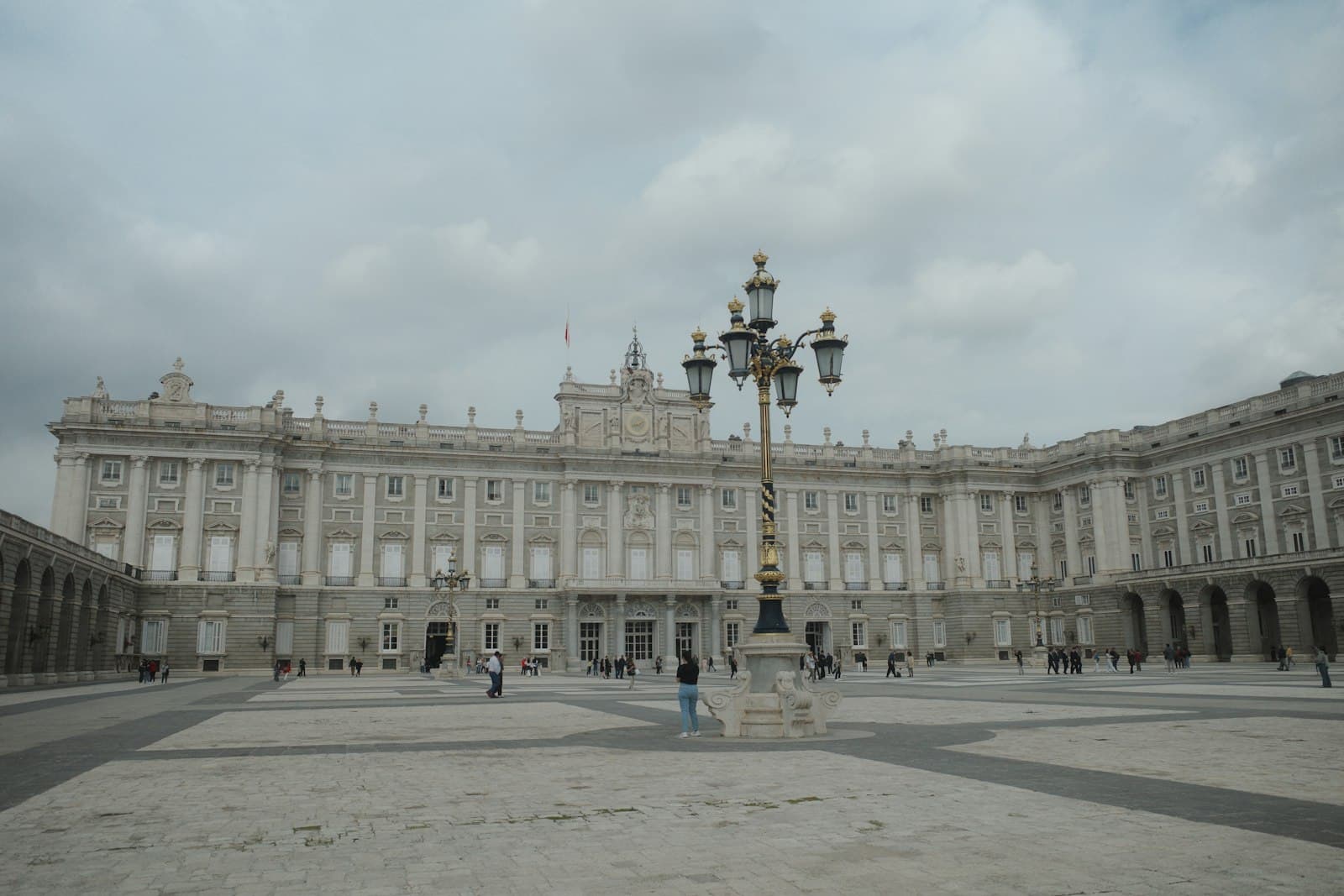
In 1700 the Habsburg line died out and the French Bourbons took the Spanish throne. They inherited a court capital and set about turning it into an enlightenment one. The turning point was literal fire: the Habsburg Alcázar burned on Christmas Eve 1734, and rather than restore it, the Bourbons commissioned an entirely new Italian-designed royal palace on the ashes. The Palacio Real that stands today is the dynastic break rendered in stone.
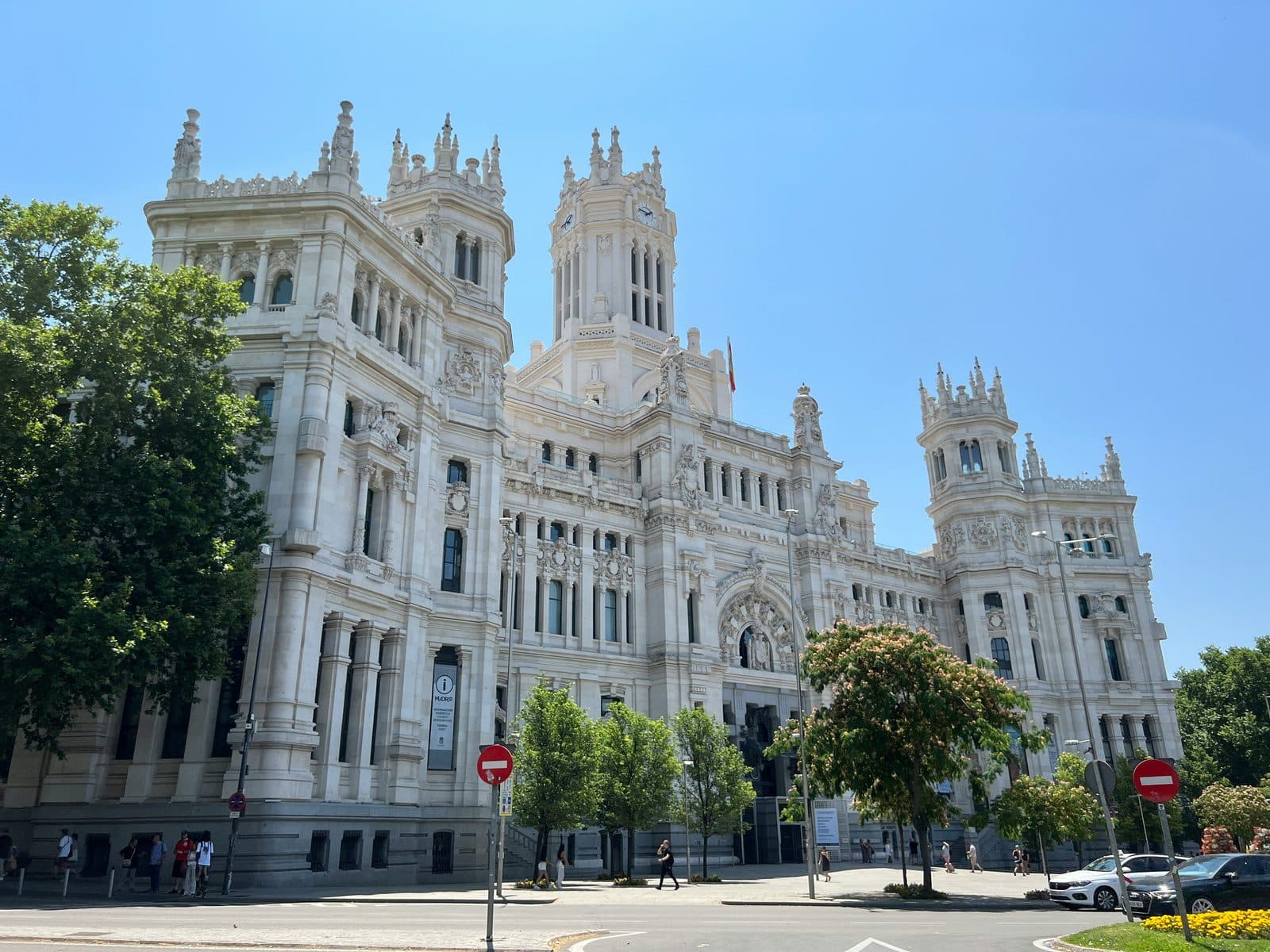
The Bourbons kept going. Under Charles III in the 1770s, they laid out the Salón del Prado, a tree-lined promenade with monumental fountains at Cibeles and Neptuno, and lined it with public institutions: a natural history cabinet that became the Prado, a botanical garden, an observatory. This is the enlightenment idea of a capital, one that displays knowledge and civic order rather than only court ceremony. The Paseo del Arte tour walks that Bourbon boulevard and reads it as a single argument Spain has been staging about itself ever since.
The Habsburg-Bourbon Spine tour is the fullest reading of this layering: seven stops west to east, from the Habsburg ceremonial Plaza Mayor to the Bourbon palace to the enlightenment boulevard to the royal park the Bourbons eventually opened to the public. It is the physical archive of how one dynasty's capital became another's.
Why the decree still explains the city
A capital by decree never stops being one. Because Madrid was made rather than grown, it kept absorbing whatever the state required. The court summoned labor, so Lavapiés filled. The enlightenment monarchy wanted institutions, so the museum mile appeared. In the twentieth century the state again drew people in, and the same outside-in neighborhoods absorbed new waves of migration. The city imports the people it needs because that is what a capital does when it was never a market town.
Toledo has a cathedral older and grander than anything in central Madrid. Seville had the river and the wealth of the Americas. Barcelona had the sea. Madrid had a king's decision and the geometric center of a peninsula. Everything else, the palace, the boulevard, the museums, the neighborhoods, is what a court builds when it has to conjure a capital out of a town.
Walk the spine and you are walking the decree.
To see all three routes side by side, start with our guide to the best self-guided walking tours in Madrid.
Frequently asked questions
- Why is Madrid the capital of Spain?
- Madrid became the capital because Philip II moved his court there in 1561. It was not a natural capital: it had no port, no major river, and no great commercial history. Its main advantage was its position near the geographic center of the Iberian Peninsula, roughly equidistant from the crowns Philip had inherited. The capital was a royal decision, not the outcome of trade or population growth.
- Was Madrid always the capital of Spain?
- No. Before 1561, the Spanish court moved with the monarch and often sat in Toledo, Valladolid, or Seville. The court briefly relocated to Valladolid from 1601 to 1606 under Philip III, then returned to Madrid permanently. Madrid has been the continuous capital since 1606.
- What is the difference between Habsburg and Bourbon Madrid?
- The Habsburgs (1516 to 1700) built Madrid as a court city organized around ceremony and religious institutions, leaving squares like Plaza Mayor and Plaza de la Villa. The Bourbons, who took the throne in 1700, rebuilt Madrid as an enlightenment capital, adding the Palacio Real, the tree-lined Paseo del Prado boulevard, and public institutions like the Prado building and Botanical Garden.
- How big was Madrid when it became the capital?
- Madrid was a modest town of roughly 20,000 to 30,000 people in 1561. The arrival of the court multiplied its population within decades, drawing in labor, servants, clergy, and courtiers. This sudden growth is why neighborhoods like Lavapiés exist: the capital had to house the workforce it summoned.
Ready to experience it?
Capital by Decree: The Habsburg-Bourbon Spine of Madrid
130 min · 6.5 km · moderate
More from Madrid
Explore more at your own pace.
Eating Through Lavapiés: A Neighborhood You Can Taste in Layers
Goya's Black Paintings: Saturn, the Dog and the House That No Longer Exists
Las Meninas: Who Is Looking at Whom, in Room 12
Museo del Prado: What to See, Floor by Floor
The Garden of Earthly Delights: What It Means and Why It Is in Madrid