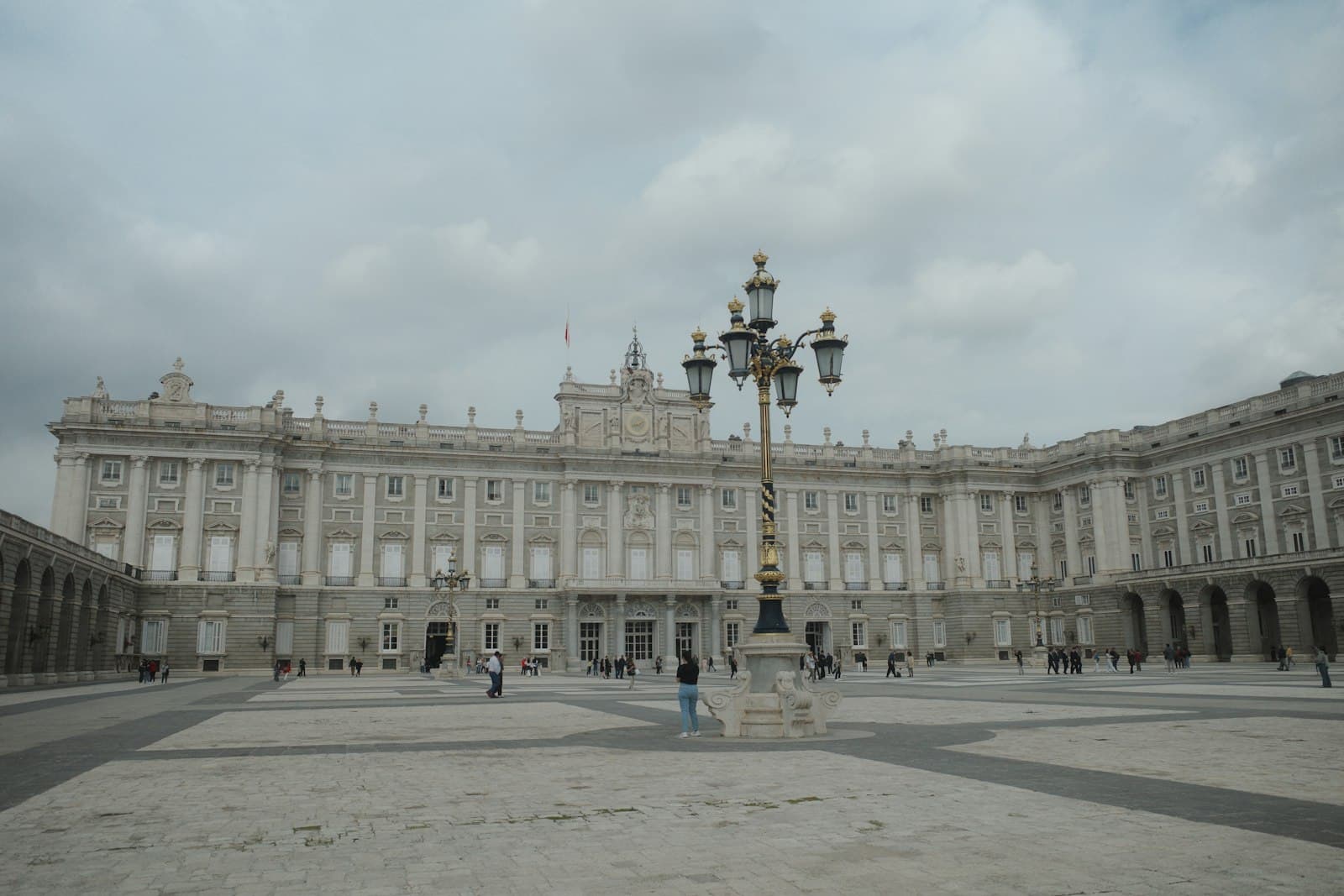
Capital by Decree: The Habsburg-Bourbon Spine of Madrid
130 min · 6.5 km · moderate
You can read Lavapiés on a plate. Madrid's most layered neighborhood wears its history in its cooking, and eating across it, one cuisine to the next, is the most direct way to understand a district that five centuries of migration built. The Lavapiés tour reads that history as a four-wave immigrant stack. The food is the same stack, made edible.
Start at the market
Begin at the Mercado de San Fernando on Calle Embajadores. It opened in 1944 as a traditional neighborhood market, and it is now the clearest single place to taste the whole neighborhood at once. Under one roof you will find Senegalese, Latin American, Chinese, and Spanish stalls, alongside vendors from across the wider food world. It is a working market, not a tourist showpiece, which is exactly why it is the right first stop: the mix on the stalls is the mix on the streets.
It helps to know what the market is not. Near Plaza Mayor sits the Mercado de San Miguel, a polished gourmet hall built for visitors. San Fernando is its neighborhood opposite, cheaper, less curated, and far more representative of how Lavapiés actually eats. If you have walked the Habsburg-Bourbon Spine tour and grazed San Miguel by the imperial center, San Fernando is the same idea seen from the workers' side of the old walls.
Eat the waves
Hear a stop from this walk
Buen Retiro: The Habsburg Park the Bourbons Opened
The neighborhood's cuisines line up with its migration history, and you can taste them in order.
The oldest layer is Castilian Madrid itself. Lavapiés was the arrabal built to house the labor a new capital summoned after 1561, and traditional Madrid cooking survives here in old taverns: a slow-cooked cocido madrileño, the chickpea-and-meat stew that is the city's defining dish, or callos, tripe in a paprika sauce, food built for a working population.
The most visible modern layer is South Asian. The post-1990 wave of migration brought Madrid's Bangladeshi community, whose spatial core the tour locates around Calle Amparo. The restaurants that grew with it, Bangladeshi and Indian, now cluster along Calle Amparo and Calle Lavapiés, and they are the neighborhood's best-known food today. A curry in Lavapiés is not a novelty. It is the newest chapter of the same five-century pattern of a capital importing the people, and the cooking, it needs.
Between and around those layers you will find Senegalese and West African plates, Latin American arepas and ceviche, and Chinese kitchens, each corresponding to a community that settled here. The point of a food walk in Lavapiés is not to find the single best restaurant. It is to notice that the cuisines are stacked, wave on wave, in a few dense blocks.
Why the food and the history belong together
A guidebook will tell you Lavapiés is "multicultural" and leave it at that. The neighborhood's tour, and its food, tell you why. Each cuisine here marks a wave of people the capital drew in, from the post-1561 Castilian labor to the nineteenth-century industrial proletariat around the royal tobacco factory to the post-1990 South Asian arrivals. Our companion on Lavapiés as the neighborhood Madrid built when it became a capital sets out that stack in full, and it is worth reading before or after you eat, because it turns a good meal into a lesson.
The practical version is simple. Come hungry, walk the compact streets between Plaza de Lavapiés and Calle Embajadores, start at the Mercado de San Fernando, and let each block change cuisines. Pair the walk with the self-guided Lavapiés tour and you will be tasting the exact migration history the audio is describing, one plate at a time.
New to Madrid's food and history on foot? Start with our overview of the best self-guided walking tours in Madrid.
Frequently asked questions
- What food is Lavapiés known for?
- Lavapiés is Madrid's most multicultural neighborhood, so its food is layered by immigration. It is best known for South Asian restaurants, especially Bangladeshi and Indian, clustered around Calle Amparo and Calle Lavapiés, alongside Senegalese, Latin American, and Chinese cooking. The neighborhood also keeps traditional Madrid dishes, so you can eat a bowl of cocido or a plate of curry within the same block.
- Where should I eat in Lavapiés?
- The Mercado de San Fernando on Calle Embajadores is the single best entry point: a 1940s covered market that now runs Senegalese, Latin American, Chinese, and Spanish stalls under one roof, so you can graze several cuisines in one visit. Beyond the market, Calle Amparo and Calle Lavapiés hold the South Asian restaurant cluster.
- Is Lavapiés good for a food walk?
- Yes. The neighborhood is compact and dense, and its cuisines are stacked street by street rather than spread out, so a short walk crosses several food cultures. Pairing a meal with a self-guided history tour of the same streets lets you taste the migration waves you are learning about.
- What is the difference between Mercado de San Fernando and Mercado de San Miguel?
- Mercado de San Miguel, near Plaza Mayor, is a polished tourist-focused gourmet market. Mercado de San Fernando in Lavapiés is a working neighborhood market with a strong immigrant and local character and lower prices, better for tasting the district's multicultural food than for a curated tapas experience.
Ready to experience it?
Capital by Decree: The Habsburg-Bourbon Spine of Madrid
130 min · 6.5 km · moderate
More from Madrid
Explore more at your own pace.
Capital by Decree: Why Madrid Is the Capital of Spain

Goya's Black Paintings: Saturn, the Dog and the House That No Longer Exists

Las Meninas: Who Is Looking at Whom, in Room 12

Museo del Prado: What to See, Floor by Floor

The Garden of Earthly Delights: What It Means and Why It Is in Madrid