Historic Center: The Wall Madrid Built Over
75 min · 2.4 km · easy
The Historic Center tour walks twelve stops through the old Habsburg town, from the Puerta del Sol past the Descalzas Reales, San Ginés, the Plaza Mayor and the Mercado de San Miguel, across Plaza de la Villa and the ravine of Calle de Segovia, and on through La Latina and the Cava Baja to Puerta Cerrada. It covers about 2.4 kilometers in about an hour and a half. The audio moves stop to stop. What it does not have time to lay out in one place is the single idea that ties the stops together.
That idea is a wall you almost never see. Madrid grew up inside a Christian town wall begun after the conquest of Toledo under Alfonso VI and worked on until 1212. Almost all of it has gone. But nearly everything on this walk is arranged around it: a square named after one of its gates, a great square built just outside it, a street running in its ditch, and the gate where the walk ends.
A square named after a gate
The Puerta del Sol is not named for the sunrise. According to the city's own heritage catalogue, it takes its name from a small gate, a postern, in the medieval wall that was decorated with a sun, and that wall was pulled down in the seventeenth century.
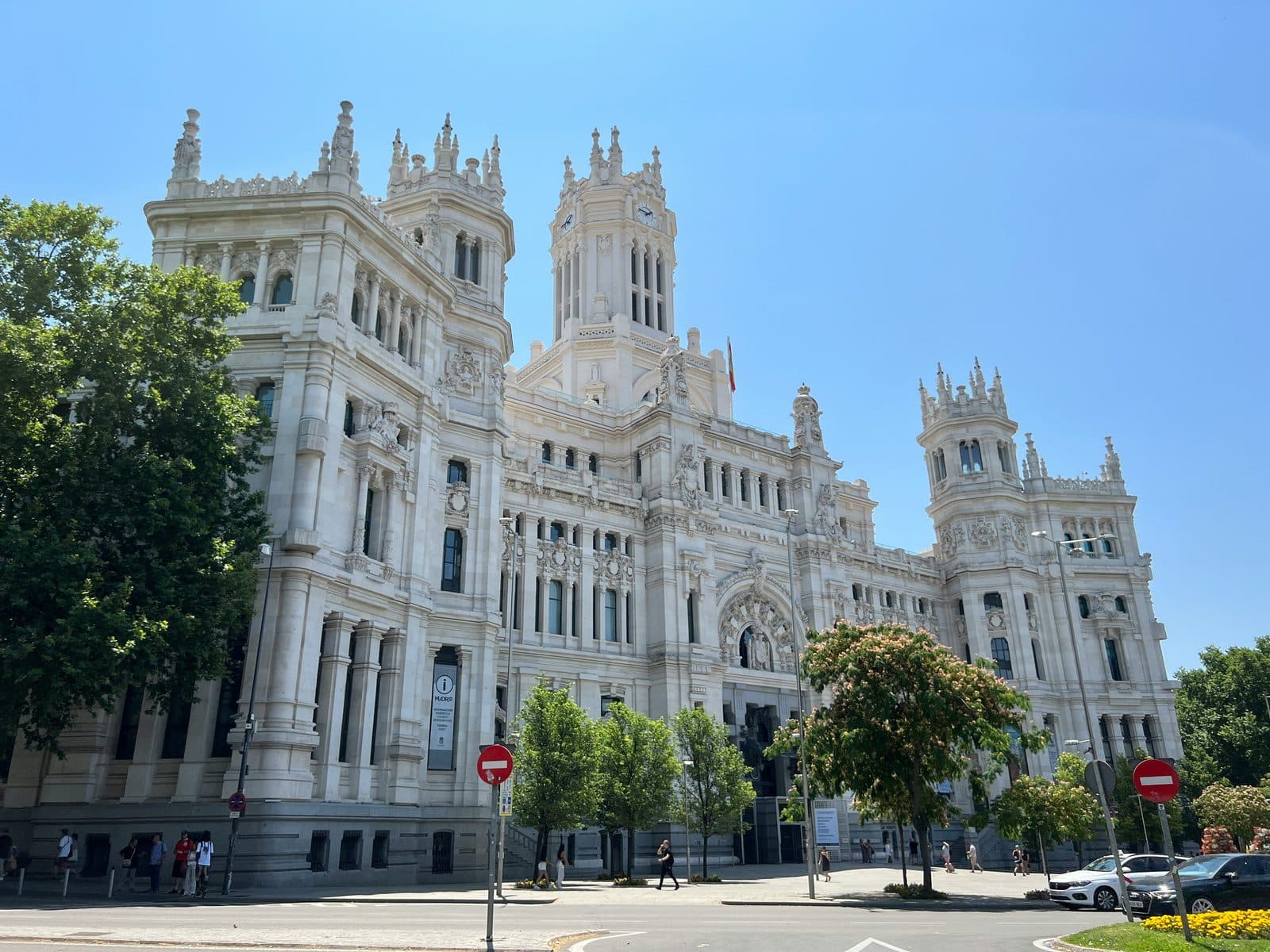
The square itself has two halves. The straight side is the Real Casa de Correos, the post office that the French architect Jaime Marquet finished for Carlos III in 1768, in brick and white stone. The curved side opposite was designed as one front in a competition of 1857 and built from 1859 to 1862. In front of the Correos door is Kilómetro Cero. Since 1854 the square has been the point from which Spain's radial national roads are measured; the first official plaque went down in 1950, the granite and brass one you see is from 2009, and since 2023 it has sat inside a compass rose naming the provincial capitals.
Brick, granite and slate
Hear a stop from this walk
Puerta Cerrada: The Closed Gate
The next stops teach the building materials of Habsburg Madrid. The Descalzas Reales, the convent Joanna of Austria founded in 1559 in the palace where she was born, shows a wall of rough granite framed by bands of brick. San Ginés, a parish church rebuilt in 1645, has had a chocolate shop in the passage behind it since 1894.
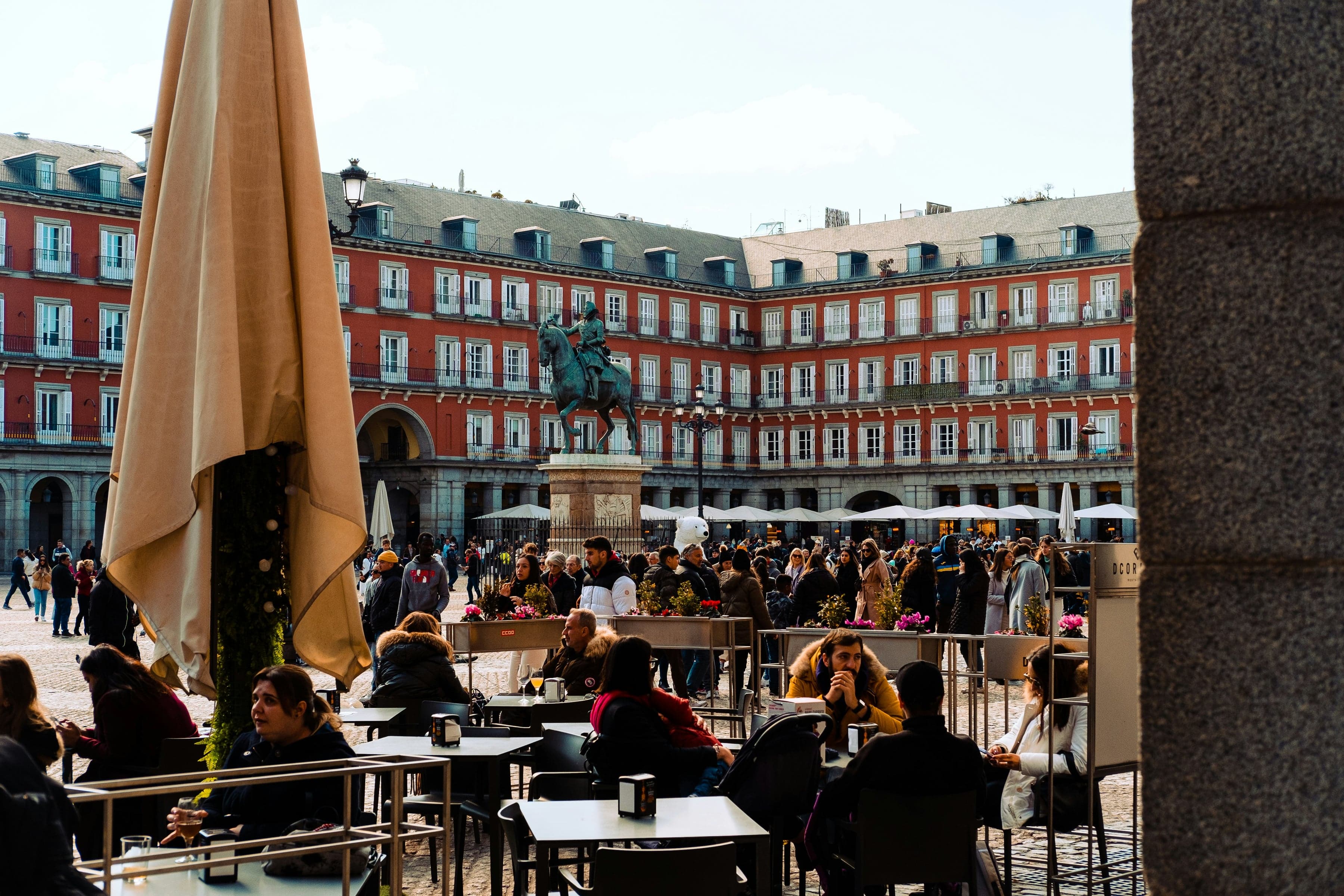
Then the Plaza Mayor. It began outside the medieval town as the Plaza del Arrabal, the square of the outskirts, where the Toledo and Atocha roads met. From 1617 Juan Gómez de Mora closed it in with exposed red brick, timber frames and lead roofs, and that is why it kept burning: in 1631, in 1672 and, worst of all, in 1790. Juan de Villanueva led the rebuilding after 1790, holding every building to the height of the bakers' house, the Casa de la Panadería, which had survived; the works ran until 1854. The painted figures on the bakers' house are modern, by Carlos Franco in 1992. Our piece on the Plaza Mayor as a stage rebuilt by fire reads that single square in depth.
A square on a terrace, a street in a ditch
The Plaza Mayor holds the walk's best mechanism. The city's own plan for the square explains that making a regular square meant reshaping the ground: a big bank of earth, held up by the massive walls of the houses on its west side. So the level floor is man-made. At the Mercado de San Miguel, the iron-and-glass hall built between 1913 and 1916 and the only iron market hall left in Madrid, you see that terrace from the side: the backs of the square's houses rise on a granite base over the Cava de San Miguel. Cava means ditch, and the town's defensive ditch ran here, outside the wall.
Plaza de la Villa is Habsburg civic building in one sight: the Casa de la Villa, begun in 1644 and finished in 1696 to hold the city council and the town jail, with a granite plinth, brick walls and slate spires on its corners. Across the square stands the Casa de los Lujanes, one of the few fifteenth-century house-palaces left in Madrid; its small door on the Calle del Codo has a horseshoe arch, the only one of its kind in the city.
South of the Calle de Segovia ravine the walk climbs into the oldest corner of the town. The Basílica de San Miguel, built from 1739 for Queen Elisabeth Farnese, bows its front outwards into a medieval lane. San Pedro el Viejo keeps a brick mudéjar tower from the mid-1300s. The Capilla del Obispo, built between 1520 and 1535 as a family burial chapel, is one of the few Gothic buildings left in Madrid. From the Plaza de los Carros you see the dome of the chapel built from 1643 to 1669 to hold the remains of San Isidro, the city's patron saint; it burned in 1936, and its inside was rebuilt between 1986 and 1991 from surviving fragments and old photographs.
Then the Cava Baja. Along this stretch the wall still exists, hidden in the party walls between the houses on one side of the street and the houses of Calle del Almendro behind them. The houses have their backs against the wall, and the street runs in its ditch. The curve you walk is the curve of the wall.
The Closed Gate
The walk ends at Puerta Cerrada. A gate of the wall stood here, first called the Serpent Gate. Its passage was bent, robbers hid in it at night, and it was walled up for so long that Madrid called it the Closed Gate. It was pulled down in 1569. The cross in the square, of white Colmenar limestone on grey granite, dates from about 1783 and marks a place of executions.
Look up Calle de Cuchilleros from here and you see the tall backs of the Plaza Mayor's houses again, their fronts slanting like buttresses, and the steps climbing up into the square. They are the same walls you saw from the market, now from below: the terrace of the great square, standing over the ditch of the wall it was built just outside.
Where the rest of the old story went
The old version of this walk ran west to east across two dynasties, from the Plaza Mayor to the Palacio Real, Cibeles and the Retiro. Those places now have walks of their own. The palace, the Plaza de Oriente and the Almudena are on the Royal Palace and Temple of Debod walk; Cibeles and the boulevard of museums are on the Paseo del Prado walk; and the park has its own Retiro Park walk. The wider story of how a town became the seat of a court is in our essay on Madrid as a capital by decree.
When you are ready, start the Historic Center tour at the Puerta del Sol and follow the wall yourself. The introduction and first stop are free to hear in full.
Ready to experience it?
Historic Center: The Wall Madrid Built Over
75 min · 2.4 km · easy
More from Madrid
Explore more at your own pace.
Best History Walking Tours in Madrid (2026)
Best Nature Walking Tours in Madrid (2026)
Goya's Black Paintings: Saturn, the Dog and the House That No Longer Exists
Las Meninas: Who Is Looking at Whom, in Room 12
The Garden of Earthly Delights: What It Means and Why It Is in Madrid