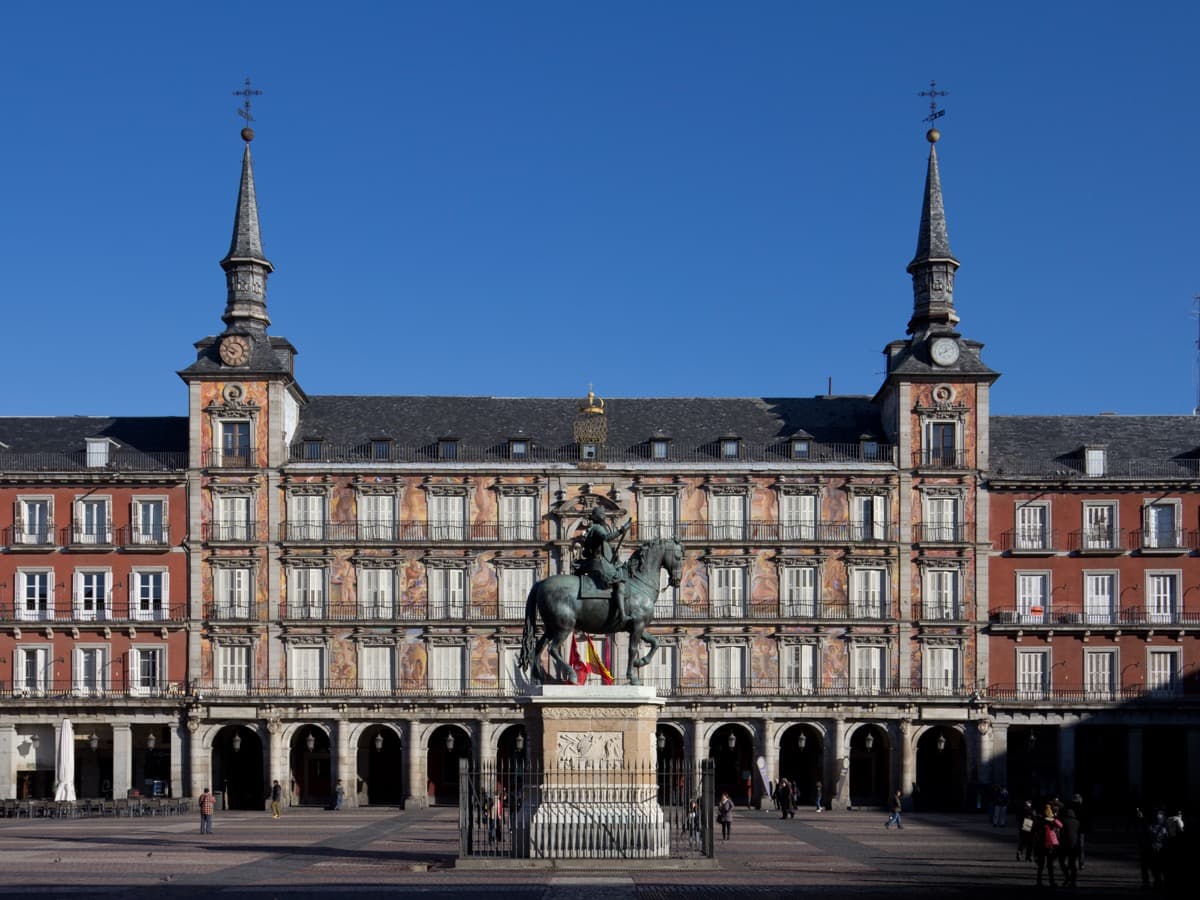
Most great European squares grew. A market spread, buildings crept up around it, and over centuries the space acquired the accidental grandeur of a place that was never planned. Plaza Mayor is the opposite. It was designed, all at once, as a stage. And the square you stand in today is not even the one that was designed, because it burned three times.
A square built on purpose
The site had been the Plaza del Arrabal, a medieval market square just outside the old walls. When the Habsburg court settled in Madrid, it needed a controlled public space worthy of a capital, and Philip III commissioned one. The royal architect Juan Gómez de Mora built the enclosed rectangular plaza between 1617 and 1619, sweeping away the informal market and replacing it with a single unified composition: continuous facades, uniform arcades, balconied apartments on every side.
The design was not decorative. It was functional theater. An enclosed square with balconies on all four sides is a purpose-built auditorium, and the Habsburg court used it as one. Proclamations, royal weddings, bullfights, autos-da-fé, executions: the public life of the monarchy was staged here, watched by a court seated at the windows and a city packed into the rectangle below. When you read the plaza as an architecture of ceremony, its regularity stops looking like mere order and starts looking like sightlines.
This is why Plaza Mayor opens the Habsburg-Bourbon Spine tour. It is the purest surviving statement of what the Habsburgs wanted a capital to be: a court city organized around ritual, with a stage at its center.
Three fires and a rebuild
Hear a stop from this walk
Buen Retiro: The Habsburg Park the Bourbons Opened
Here is the fact that surprises most visitors: the harmonious square in front of you is largely a reconstruction. Fire took it three times.
The first fire, in 1631, damaged a large part of the plaza, and Gómez de Mora himself led the rebuilding. The second, in 1670, brought another restoration, this one overseen by Tomás Román. The third and most destructive fire struck in 1790 and consumed close to a third of the square. The reconstruction after 1790 was directed by Juan de Villanueva, the leading Spanish architect of the age, and it is his hand that most defines the plaza's present appearance. Villanueva lowered the buildings, closed the corners with the arched passages that now seal the square, and gave it the more uniform, grounded profile you see today. The work was not fully completed until 1854.
So the plaza carries a quiet irony. It is the signature square of Habsburg Madrid, yet its final form was shaped by Villanueva, the same architect who was rebuilding the enlightenment institutions of Bourbon Madrid down the road. Villanueva designed the building that became the Prado, the anchor of the Paseo del Arte tour. His fingerprints are on both the Habsburg stage and the Bourbon museum mile, which is a small proof of the city's larger truth: Madrid is a layered palimpsest, and even its most iconic Habsburg square is partly a later rewrite.
Reading the square today
Stand in the center and look up. The uniform four-story facades, the continuous balconies, the arcades running unbroken around the base, the closed corners: none of it is accidental, and none of it is entirely original. It is a seventeenth-century ceremonial design, refined by three rounds of fire recovery, finalized by a Bourbon-era master. The bronze equestrian statue of Philip III at the center was cast earlier, in the early seventeenth century, and installed in the plaza in the nineteenth, a Habsburg monarch placed in the middle of his own stage two centuries after he ordered it built.
That is the plaza's real story: not an old market that became grand, but a stage that was designed, burned, and rebuilt into permanence. It is the reason the square feels so composed. It was always meant to be looked at.
To understand how Plaza Mayor fits the two-dynasty spine of the city, read our companion on reading Madrid's spine, or the wider story of Madrid as a capital by decree. Then start the Habsburg-Bourbon Spine tour and stand where the court once watched.
Ready to experience it?
Capital by Decree: The Habsburg-Bourbon Spine of Madrid
130 min · 6.5 km · moderate
More from Madrid
Explore more at your own pace.
Eating Through Lavapiés: A Neighborhood You Can Taste in Layers
Goya's Black Paintings: Saturn, the Dog and the House That No Longer Exists
Las Meninas: Who Is Looking at Whom, in Room 12
Museo del Prado: What to See, Floor by Floor
The Garden of Earthly Delights: What It Means and Why It Is in Madrid