Plan about two hours for the highlights of the Uffizi in Florence. Start on the second floor with the giant Madonnas of Cimabue, Duccio and Giotto, then Botticelli's Primavera and Birth of Venus in room A9, Leonardo in A35 and Michelangelo's Doni Tondo with Raphael in A38. Go down to the first floor for Titian's Venus of Urbino in D23 and Caravaggio in E4 and E5. The museum rearranges rooms, so check a work by name if it is not where you expect.
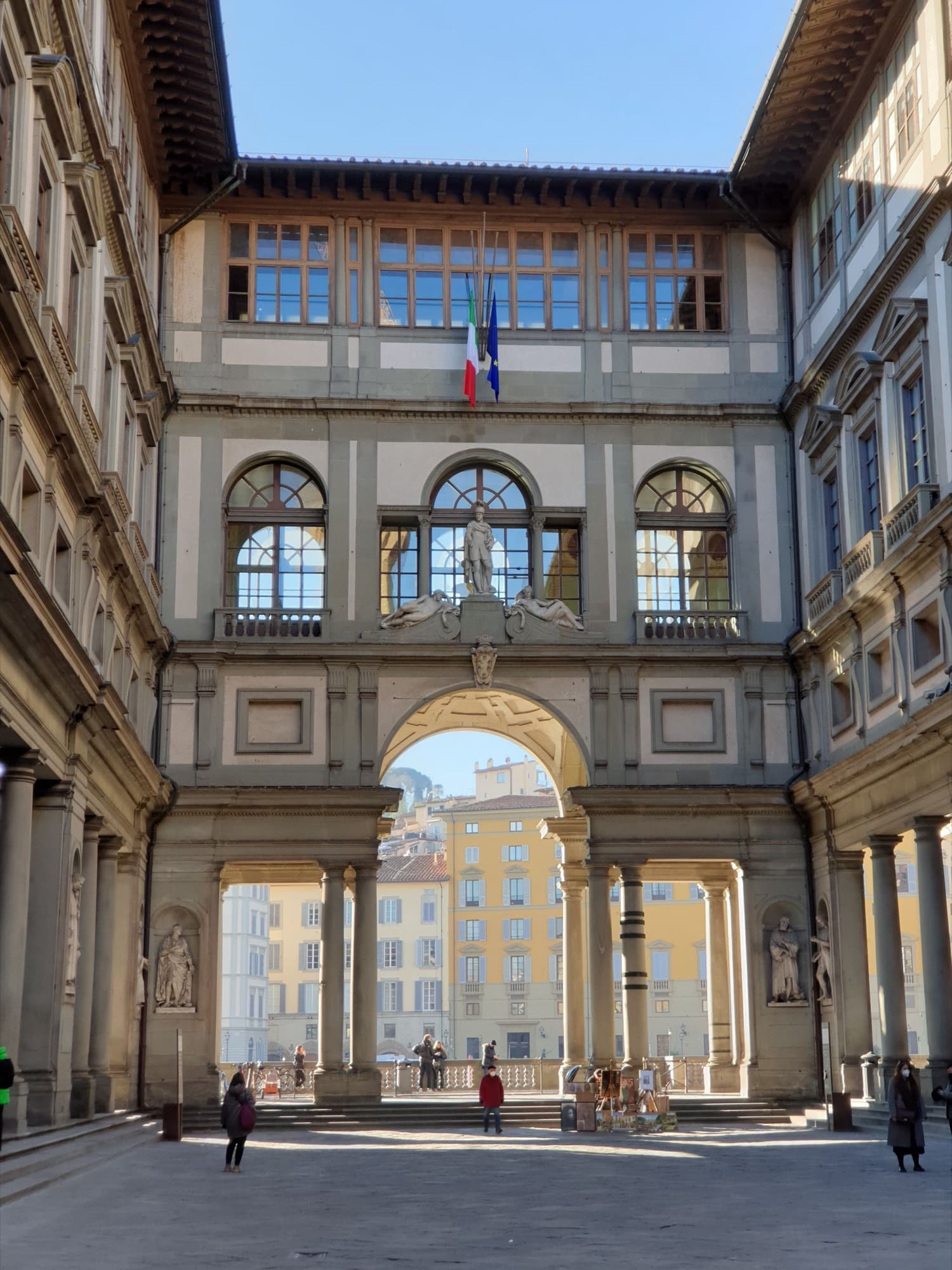
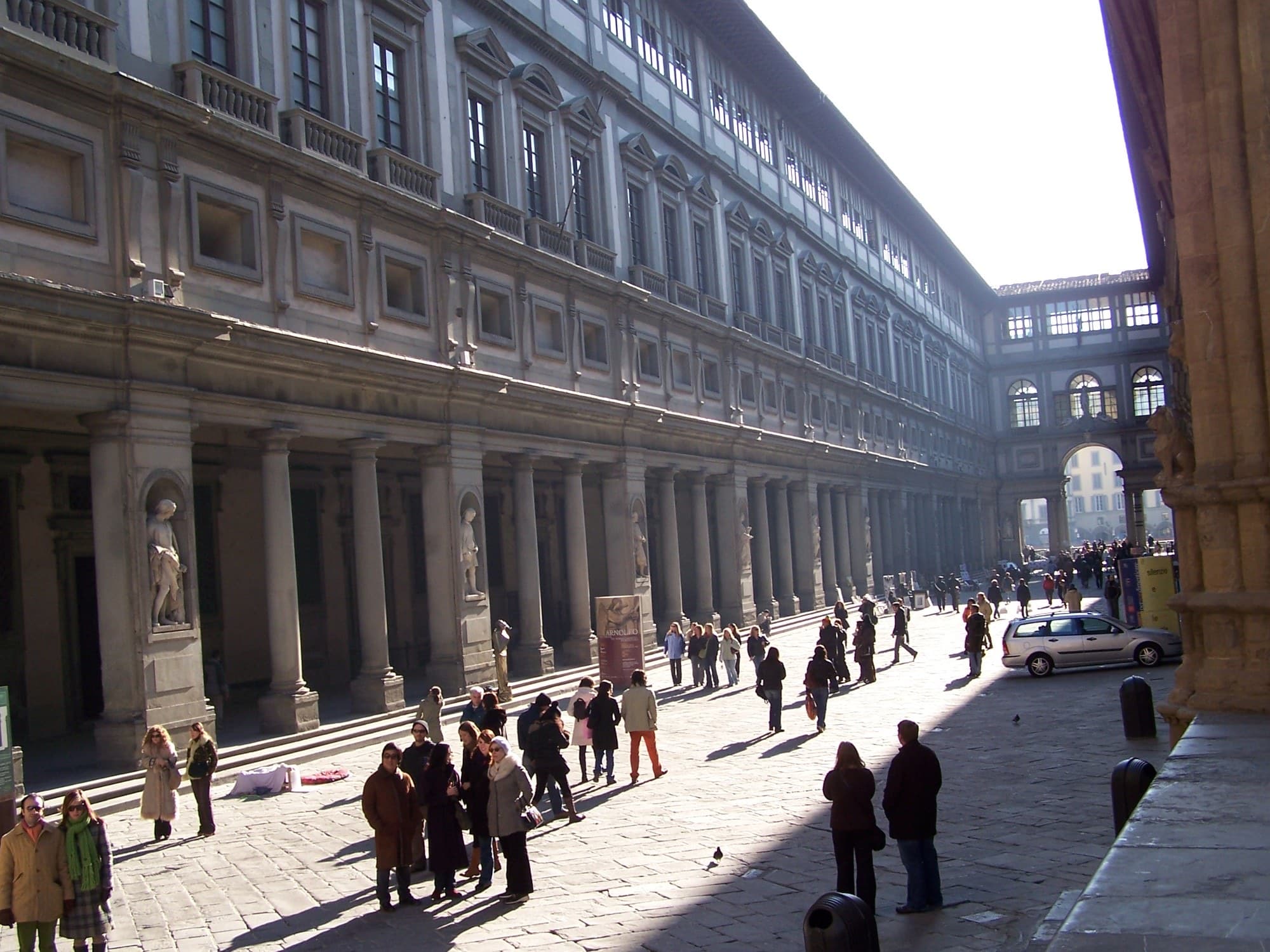
The Uffizi is two floors of paintings in time order, wrapped round a long courtyard in the middle of Florence. Once you know that, the visit almost plans itself: the top floor runs from gold-ground altarpieces to Botticelli, Leonardo, Michelangelo and Raphael, and the floor below carries on with Titian, Bronzino, Caravaggio and Rembrandt. How long does it take? Plan about two hours for the highlights, or one hour if you keep to the short list below. Is it worth it? If you came for the Birth of Venus you will get it, and you will also get a painting Michelangelo nearly took back over the bill, an altarpiece Leonardo walked away from, and a shield with a screaming head on it.
The building in one minute
The name means offices. Giorgio Vasari designed this long U for Duke Cosimo the First in the 1560s to house the city's magistrates, and the Medici turned its top floor into a gallery for their treasures. In 1737 Anna Maria Luisa de' Medici, the last of the family, signed a pact that kept the collection in Florence, and in 1769 the gallery opened to the public. For the full story of how an office block became a museum, read the Uffizi was an office block.
Floor by floor
Hear a stop from this walk
Brunelleschi's Dome: Two Rivals, One Vault
You enter at Door 1, under the loggia on the east side of the courtyard, and the visit starts at the top.
- Second floor (rooms A1 to A42). Three corridors lined with ancient statues run round the courtyard, and the rooms open off them in time order. The east side holds the earliest paintings, the Tribune and Botticelli. The short south corridor looks over the Arno. The west side holds Piero della Francesca, Leonardo, Michelangelo and Raphael, and the Niobe Room.
- First floor, D and E rooms. The fifteen and sixteen hundreds: Parmigianino, Bronzino's Medici portraits, Titian's Venus, then Caravaggio, Artemisia Gentileschi and Rembrandt. The door to the Vasari Corridor is here too.
- First floor, B and C rooms. Near the Lanzi staircase: the rooms of the Contini Bonacossi bequest, with a teenage Bernini's marble Saint Lawrence, and the self-portrait collection that Cardinal Leopoldo de' Medici began.
The museum's own visitor path climbs the Granducal staircase, walks the second floor round its U, and comes down by the Buontalenti or the Lanzi staircase. A newer exit, opened in 2018, lets you out into the Piazza della Signoria beside the Loggia dei Lanzi.
A two-hour plan, room by room
Room numbers are from the museum's map of October 2026.
Second floor
- Three Madonnas (A4). Cimabue, Duccio and Giotto painted the same subject, Mary enthroned, for churches in Florence within about twenty years of one another. Duccio's, commissioned in 1285, is four and a half metres high. Walk between them: in Giotto's, the bodies finally have weight and the light seems to fall on them.
- Simone Martini's Annunciation (A5). Painted in 1333 for Siena Cathedral. The angel's greeting is raised in relief on the gold.
- Gentile da Fabriano's Adoration of the Magi (A7). International Gothic at full shine, 1423, with the kings' journey told in three small scenes under the frame's arches.
- Uccello's Battle of San Romano (A8). The Florentine lances tilt forward while the enemy's lean back. The silver on the armour has tarnished dark; the gold on the bridles still shines. It is the middle panel of three, with the others in London and Paris.
- The Primavera and the Birth of Venus (A9). Botticelli's two great mythologies, together in one room. Read the Primavera from right to left, the way spring arrives, then look at the gold in Venus's hair. More in the Birth of Venus and the Primavera.
- The Tribune (A16). Buontalenti's eight-sided treasure room of the early 1580s, with a dome set with mother of pearl. The ancient Medici Venus stands here, the statue Grand Tour travellers crossed Europe to see, with the Knife Grinder crouched beside her.
- The Duke and Duchess of Urbino (A25). Piero della Francesca's two small panels, each 47 by 33 centimetres. Federico lost his right eye in a joust, which is why his portraits show his left profile.
- Leonardo (A35). Three panels from his first decade: the Baptism of Christ he shared with his master Verrocchio, the Annunciation, more than two metres wide, and the Adoration of the Magi he left unfinished when he moved to Milan, the drawing still showing.
- Michelangelo and Raphael (A38). The Doni Tondo, Michelangelo's round Holy Family in its carved frame, beside Raphael's Madonna of the Goldfinch, a panel that once broke into pieces in a landslide. More in the Doni Tondo.
- The Niobe Room (A39). A hall made for one family of statues, found in a Roman vineyard in 1583: Niobe shielding her youngest daughter while her children flee.
First floor
- The Madonna with the Long Neck (D4). Parmigianino left it unfinished at his death: look for the bare columns and the single painted foot of a missing saint.
- Eleonora of Toledo with her Son (D15). Bronzino painted the duchess against a blue of lapis lazuli, the most costly blue pigment. In the same room is little Bia de' Medici, who died at about five.
- The Venus of Urbino (D23). Titian, 1538. She lies on white sheets and looks straight back at you, while two maids work at a chest in the room behind her. The buyer called her "the naked woman" in a letter.
- Caravaggio's Medusa and Artemisia's Judith (E4). A screaming head painted on canvas stretched over a wooden parade shield, which the museum calls Caravaggio's most famous self-portrait, and Artemisia Gentileschi's Judith beheading Holofernes, painted for Grand Duke Cosimo the Second.
- Caravaggio's Bacchus (E5). The god of wine holds out his glass to you over a bowl of fruit with a rotting apple. It was found in the museum's storerooms in 1913.
- Rembrandt's old man (E7). A late portrait, signed and dated 1665, near Sustermans' portrait of Galileo in his last years.
Skip anything that does not hold you. The order is the building's order, so the plan follows the path, and every story is short.
Five ready-made routes
The Roamer guide groups the museum into five routes that all start at Door 1.
The Uffizi in an Hour. Eleven works from Giotto to Caravaggio: the Ognissanti Madonna, San Romano, the Primavera, the Birth of Venus, the Duke of Urbino, Leonardo's Annunciation, the Doni Tondo, Titian's Venus and the Medusa.
The Masterpieces in Two Hours. Twenty-five works in the order you meet them, from Cimabue's gold to Rembrandt, on both gallery floors. It is the long version of the plan above.
The Medici and Their Collection. About an hour on how one family filled these rooms: Uccello's battle, a pope's boar, Eleonora of Toledo, Cardinal Leopoldo, the Medusa and Galileo.
Statues of the Gallery. About fifty minutes with the marbles that have lined the corridors since the fifteen hundreds: the Medici Venus, the Knife Grinder, the Boy with a Thorn, Niobe and the Medici Vase.
Faces and Self-Portraits. About 45 minutes of small portraits worth stopping for: the Duke of Urbino, Raphael's young self, Bronzino's Bia, Rembrandt's old man and Galileo.
There is also a route about the building itself, from Vasari's offices to the night of the 1993 bomb that struck the Niobe Room.
Rooms move: check before you go
The Uffizi is rearranging several rooms in 2026. On the October 2026 map, rooms A10 to A12, the new Botticelli rooms, are marked work in progress, so the Primavera and the Birth of Venus hang together in A9 for now. Correggio's Adoration of the Child, which usually hangs with Parmigianino in D4, is away on loan. The museum also lends works and closes rooms at short notice. If one painting is the reason you are coming, look it up by name on the museum's website before you go, and if it is not where this page says, ask a guard for it by name.
What to know before you go
- Book a timed ticket. Admission is booked with the museum, and the Vasari Corridor needs its own reservation and supplement. The corridor walk runs one way and ends in the Boboli Gardens, so you do not come back into the gallery.
- Climb first, then wander. The best-known paintings are on the second floor. If you only have an hour, stay up there and let the first floor be a reason to come back.
- Look up in the corridors. The east corridor's vaults are painted with grotesques commissioned in 1581, and the ancient statues below were often pieced together by restorers. Spotting the joins is half the fun.
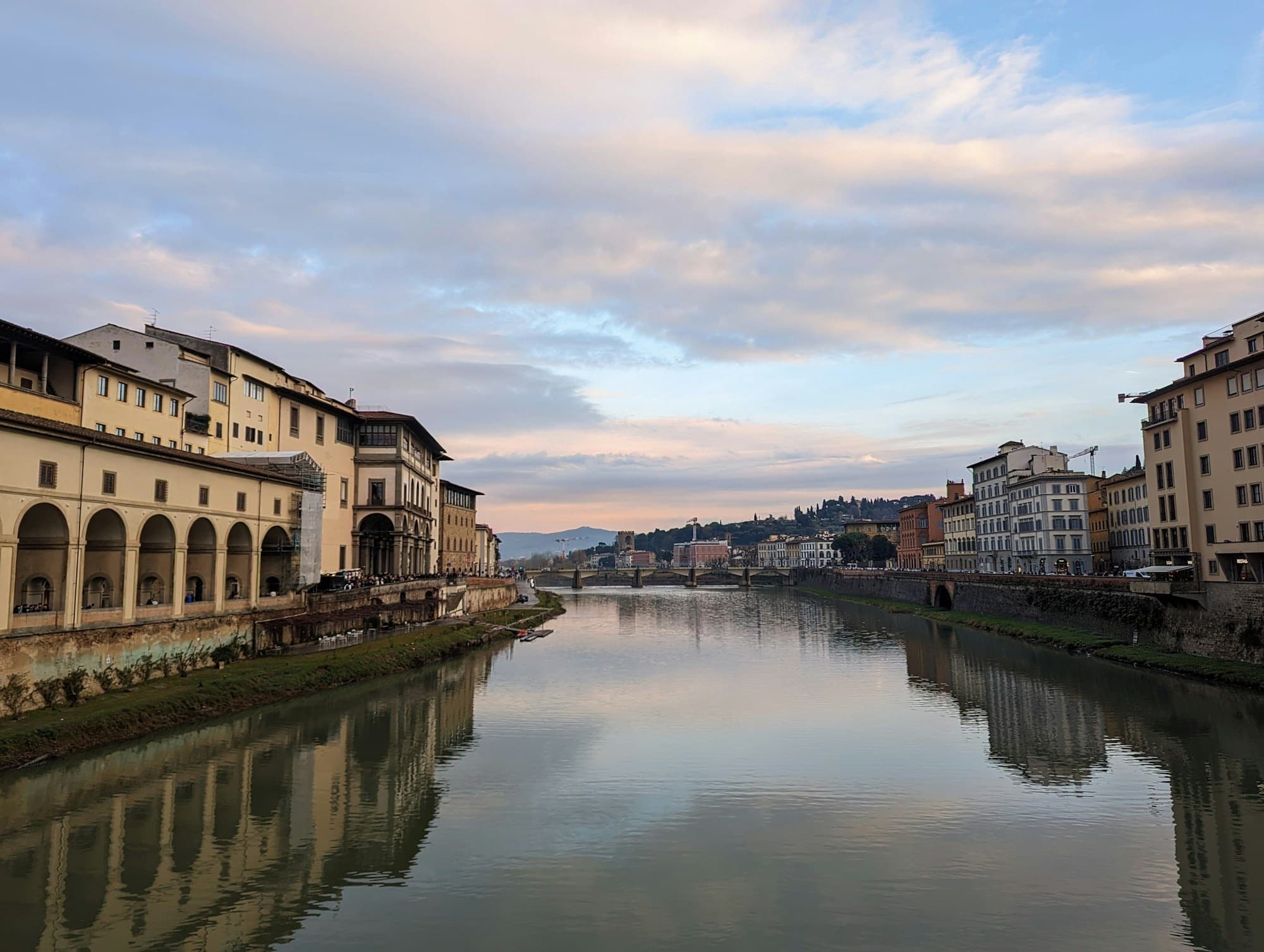
- Stop at the windows. The south corridor looks down the Arno to the Ponte Vecchio, with the Vasari Corridor running along the top of the bridge.
- There is a terrace. The roof of the Loggia dei Lanzi, where the Medici watched ceremonies in the square, is now the museum's cafe, facing the Palazzo Vecchio.
The city the paintings came from is right outside. Roamer's walks start where the gallery ends: Piazza del Duomo and the Oltrarno, across the river.
How this fits the Roamer guide
Roamer has an independent audio guide to the Uffizi that works room by room. Open any room and play its story, or follow one of the routes above with directions from room to room. There is no group and no schedule, and every story is short enough to skip. There are no photographs of the works, only their stories: Italian law asks for the museum's licence to reproduce them commercially. You can find it here: the Uffizi guide. It is not affiliated with the Gallerie degli Uffizi.
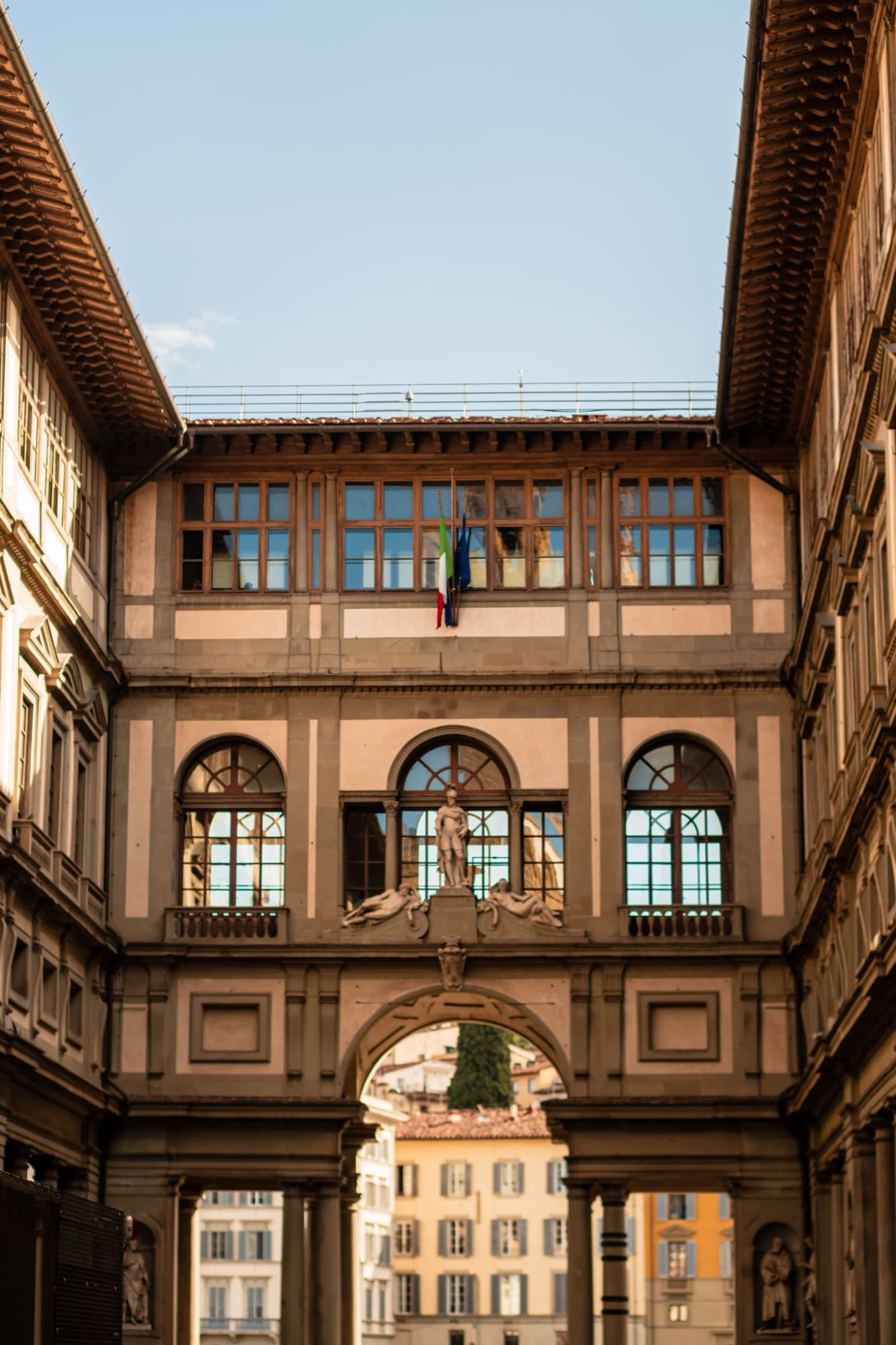
Cover photo: Kevin Gabbert, the courtyard between the two wings, via Wikimedia Commons (public domain).

Ready to experience it?
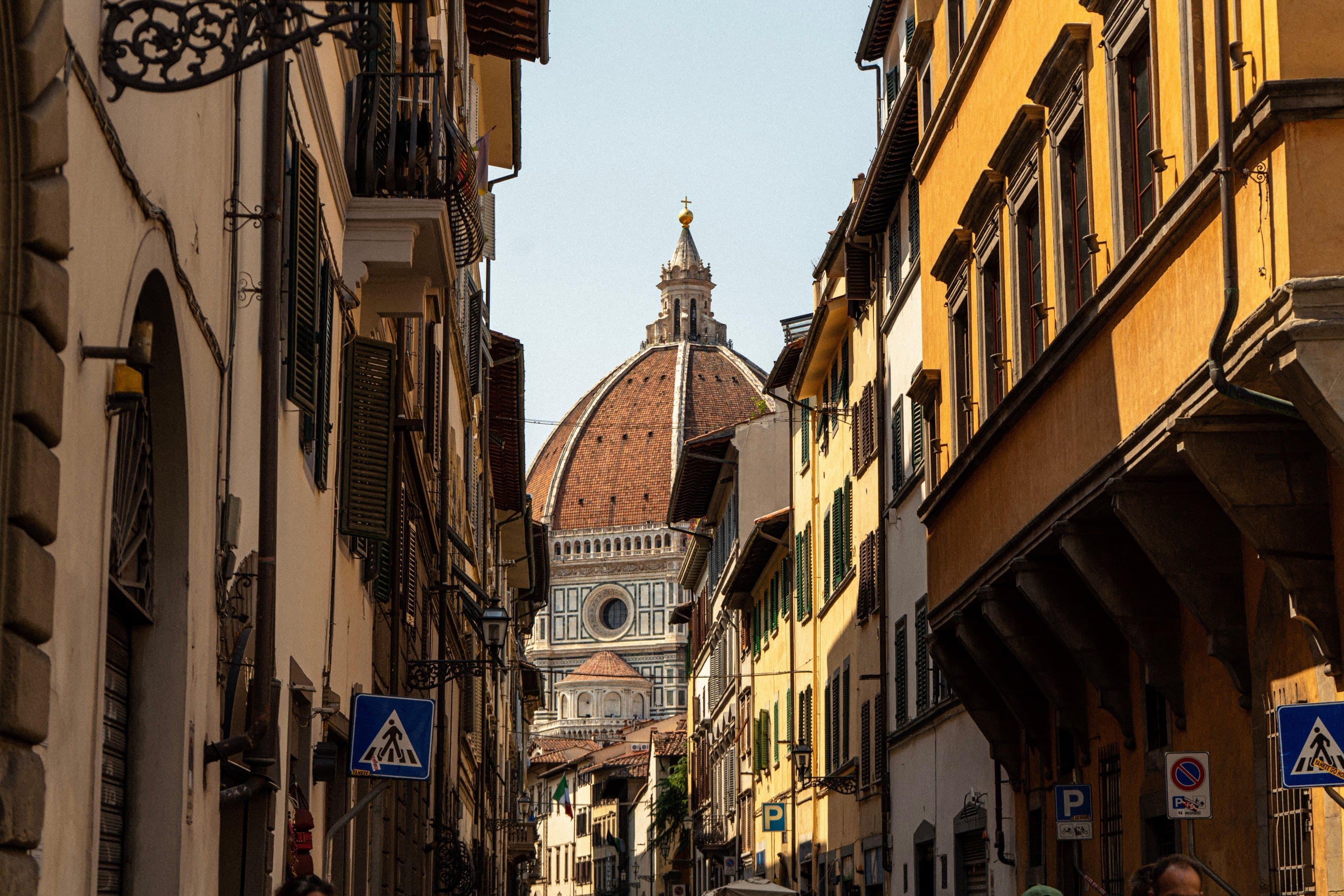
Historic Center: Duomo to Ponte Vecchio
90 min · 1.8 km · easy
More from Florence
Explore more at your own pace.
Botticelli's Primavera at the Uffizi: Where It Hangs and How to Read It
Michelangelo's Doni Tondo at the Uffizi: The Painting, the Frame and the Bill
The Birth of Venus at the Uffizi: Where It Hangs and What to Look For
Palazzo Medici Riccardi: How to Read a Banker's Balance Sheet in Stone
The Baptistery Door Competition That Started the Renaissance