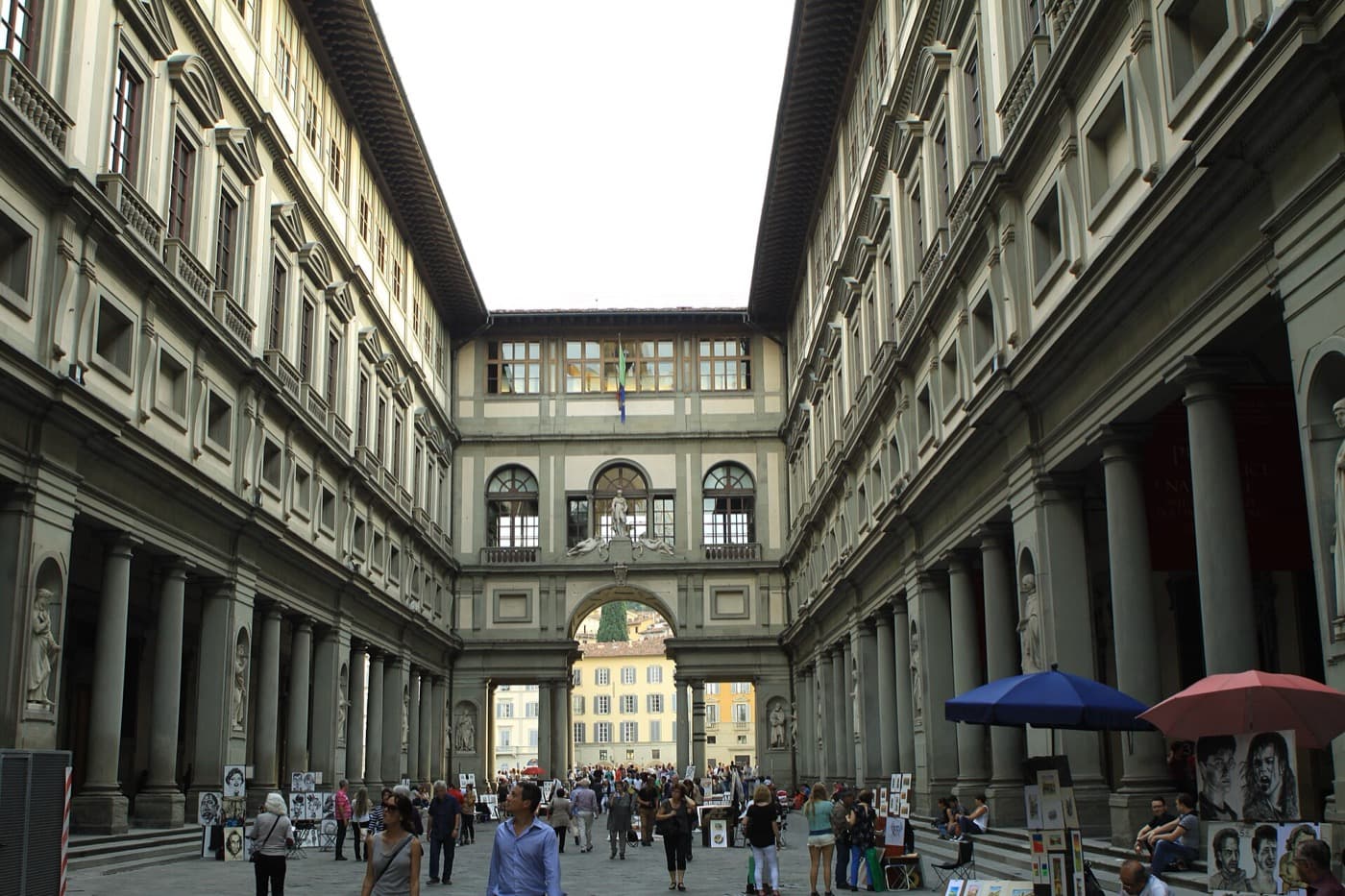
The Galleria degli Uffizi was built as an office block. Not as a gallery, not as a temple to art, but as an administrative headquarters for the government of a duchy. The name says so plainly: uffizi means offices. Stand in the narrow courtyard between its two long parallel wings, the Piazzale degli Uffizi, and you are not standing in front of a museum that happened to look like a bureaucracy. You are standing inside the bureaucracy itself, which only later became a museum. That single fact, that one of the most visited art galleries in the world started life as paperwork, is the key to reading the building, and it marks the exact moment a Florentine banking fortune finished its long transformation into the machinery of a state.
Why a Bank Built Offices
To understand why the Uffizi exists, you have to follow the arc of the family that paid for it. The Medici began as bankers, and for generations they exercised power the way money does: quietly, from behind a plain stone palace, through influence and patronage rather than open command. By the middle of the sixteenth century that had changed completely. The family no longer merely swayed Florence. It ruled Tuscany outright, and ruling a duchy is not an art. It is administration. It takes magistrates, tribunals, clerks, ledgers, and archives, and in Florence those state bodies were scattered across the city in borrowed rooms.
Duke Cosimo the First set out to fix that. He commissioned Giorgio Vasari, the painter and architect who also wrote the founding biographies of the Renaissance artists, to gather the offices of the state under one roof, and to make room for it a piece of the old medieval town of towers and small houses was cleared. Construction began in 1560. When Cosimo and Vasari both died in 1574 the work was well advanced, and Francesco the First and his architect Bernardo Buontalenti finished it about twenty years after it began. Vasari gave the building a severe, elegant discipline: two long wings of repeating bays running down to the Arno, joined at the river end, framing that famous slot of a courtyard. There is nothing playful about it. It is the architecture of a filing system, and that is precisely what it was.
Reading the Building as Offices
Hear a stop from this walk
Brunelleschi's Dome: Two Rivals, One Vault
This is the one thing to understand standing in the Piazzale degli Uffizi. Look down the colonnade toward the river and read the rhythm of it. The endless identical bays are not decoration. They are rooms for magistracies, each department of the Florentine state given its own uniform compartment in a single rational machine. An office block, in other words, and a strikingly modern one. There is something almost startling in realizing that the most Renaissance building imaginable, the one people cross oceans to enter, was conceived as the sixteenth-century equivalent of a civic administration center.
The art came later, and it came from above. In the 1580s Cosimo's son Francesco the First turned the top floor of the complex into a gallery for the Medici family's own collection, the accumulated spoils of generations of patronage and purchase; the first corridor ceilings there were frescoed in 1581. Buontalenti also turned the magistrates' assembly hall into the Medici theatre, and built an octagonal treasure room called the Tribuna, completed in 1584, to display the finest pieces where the duke could show them off to favored guests. So even the art began as a private amenity layered on top of a government building, not as a public offer. The offices came first. The gallery was an afterthought that swallowed its host.
The Corridor That Ties the Tour Together
There is a detail here that connects the Uffizi to the buildings on either end of this walk. In 1565, a year Cosimo pushed to finish in roughly five months to mark his son Francesco's wedding, Vasari built an elevated enclosed passage of about 750 meters, linking the Palazzo Vecchio, through the Uffizi, along the north bank of the Arno, and across the Ponte Vecchio to the Palazzo Pitti on the far side of the river. This is the Vasari Corridor. Its purpose was blunt: it let the duke move between his seat of government, his offices, and his home without ever setting foot on a public street, in a city that had good reason to resent a former republic now ruled by a prince. Where one family, the Mannelli, refused to give up their tower at the far end of the bridge, the corridor still bends around it on stone brackets. Closed in 2016, the corridor reopened to visitors on 21 December 2024.
Hold that image. The corridor threads all three of Cosimo's power centers into one continuous private artery, above the heads of the citizens. It is the physical diagram of the whole story: private wealth, become public office, become princely residence, all stitched together and lifted off the ground. The Uffizi is the middle link in that chain, the working core where the money did its governing.
From Bureaucracy to Museum
The building only slowly became what we now assume it always was. It was opened to the public as a museum in 1769, under Grand Duke Peter Leopold, two centuries after Vasari laid its foundations. And it survived at all as a Florentine collection because of one remarkable act. When the Medici line was dying out, Anna Maria Luisa de' Medici, the last of the dynasty, signed a document in 1737 known as the Patto di Famiglia, the Family Pact. In it she left the family's collections to the state of Tuscany on the condition that nothing ever leave Florence, that the art remain in the city for the use of the public and, in the pact's own phrasing, to attract the curiosity of foreigners. A banking family that had spent three centuries acquiring made its final transaction a gift, and it is the reason the collection is still here.
So the visitor's mistake, understandable and nearly universal, is to read the Uffizi backward, as a gallery that occupies an old building. Read it forward instead. A bank became a government, the government built itself an office, the office happened to be beautiful, and the beauty outlived the government. What you are looking at is the address where money finished becoming administration. The paintings hang inside a filing cabinet.
You do not need a ticket to see the part that matters. The Piazzale degli Uffizi courtyard is free and open, and the argument of the building is legible from the pavement. This courtyard is stop ten of twelve on Roamer's Historic Center: Duomo to Ponte Vecchio walk, a self-guided route of about 1.8 kilometers and ninety minutes that starts at the Medici church of San Lorenzo and ends on the Ponte Vecchio under the Vasari Corridor, reading the Medici fortune as a set of documents left out in stone. If this is the kind of looking you enjoy, browse more Florence walking tours, or start planning from the Florence city page and walk the whole ledger yourself, at your own pace.
Sources
- Uffizi Galleries, "The Palazzo degli Uffizi" (uffizi.it). Cosimo the First's commission to unite the magistracies, the clearing of the medieval houses, construction from 1560, and completion under Francesco the First and Buontalenti after 1574.
- Uffizi Galleries, gallery corridors and entrance staircases pages (uffizi.it). The 1581 corridor frescoes and Buontalenti's Medici theatre.
- Uffizi Galleries, official "About Us" page (uffizi.it). The 1769 public opening and the 1737 Family Pact and its stated purpose to keep the collections in Florence for the public.
- Uffizi Galleries, Vasari Corridor reopening news (uffizi.it). The 1565 construction in five months, the route over the Ponte Vecchio, its length of about 750 meters, and the reopening on 21 December 2024.
- Tour transcript, Roamer "Historic Center: Duomo to Ponte Vecchio" (Uffizi stop).
Ready to experience it?
Historic Center: Duomo to Ponte Vecchio
90 min · 1.8 km · easy
More from Florence
Explore more at your own pace.
Florence Travel Guide: How Many Days, Getting Around, and What to Book
How Money and Competition Built the Renaissance in Florence
Palazzo Medici Riccardi: How to Read a Banker's Balance Sheet in Stone
The Baptistery Door Competition That Started the Renaissance
The Oltrarno: Reading Florence's Working Half From Santo Spirito Onward