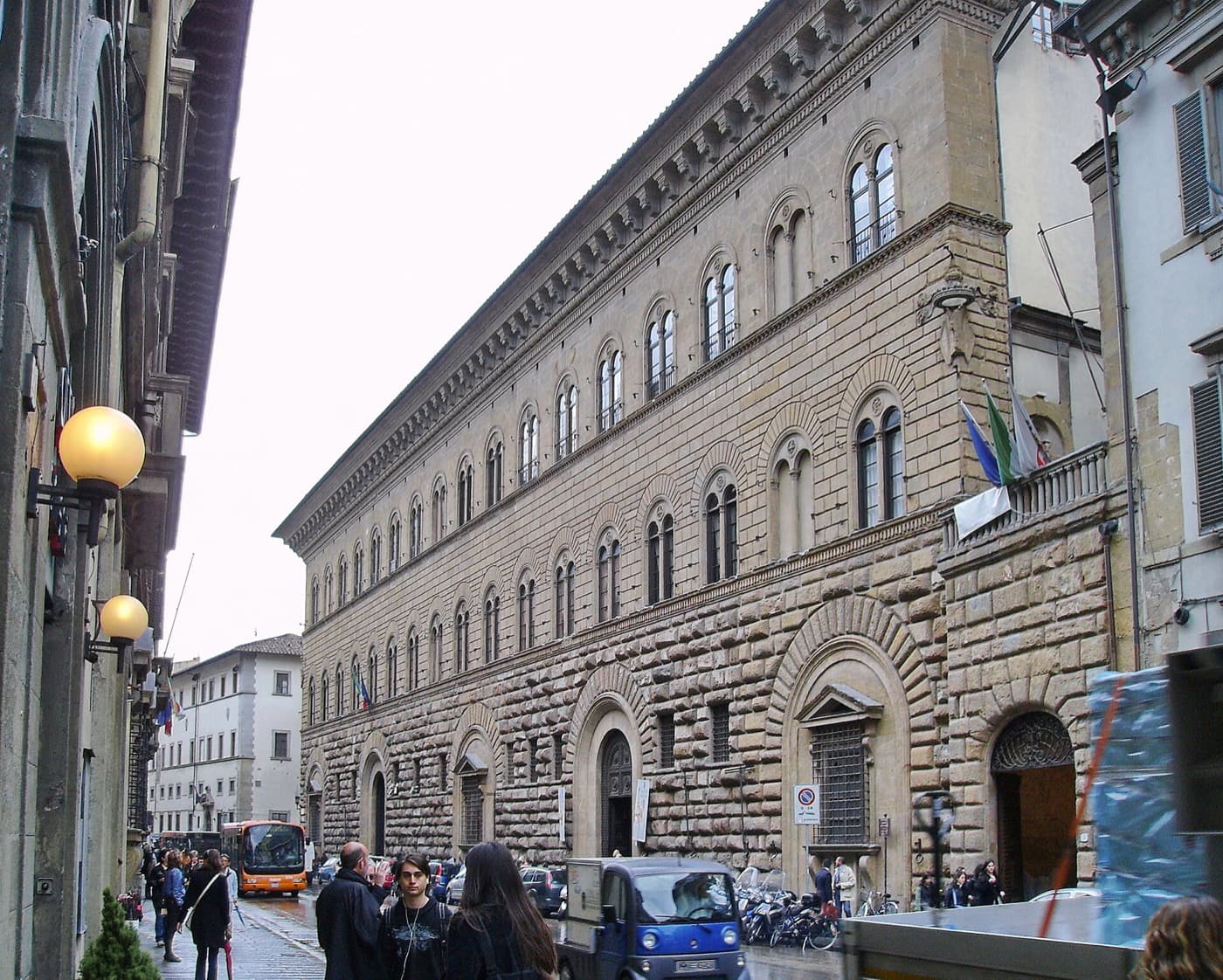
Palazzo Medici Riccardi is a banker's balance sheet written in stone, and once you learn to read its calculated restraint, the whole Medici quarter of Florence stops being a queue of galleries and becomes a set of financial documents. The money bought influence, legitimacy, and finally eternity, and it left the receipts out in the open on the facades. Stand at the corner of Via de' Gori and the old via Larga, today via Cavour, and the first entry in that ledger is right in front of you: a front that is heavy, rusticated, dignified, and, if Vasari is right, restrained on purpose.
The restraint is the message
Cosimo de' Medici, the man history calls Cosimo the Elder, commissioned this palace in 1444 from the architect Michelozzo di Bartolomeo, and the facade went up over roughly the next fifteen years. Vasari, writing more than a century later, says Cosimo had first been offered a design by Filippo Brunelleschi and turned it down as too grand, fearing it would arouse the envy of his fellow citizens. Michelozzo gave him a face of rough stone that reads as ancient and grave, meant to be seen from this corner, looking toward the cathedral. Nothing on the exterior shouts. That restraint, as Vasari tells it, was a deliberate act of political caution, and it is the reason this building is widely regarded as the model for the Renaissance urban palace: wealth balanced against civic gravity, in public.
Look at the corner itself, because it has a second story to tell. It was once open. Two arches led into a public loggia, not connected to the house, where citizens met and did business under the Medici arms. When the family returned from exile in 1512 they parked four cannons in it. In 1517 Lorenzo, Duke of Urbino, had it walled up, and Michelangelo, then in Florence for the San Lorenzo commission, designed the windows set into the filled arches. The palace's own museum calls them the first "kneeling" windows, named for the brackets under the sill that look like legs bent at the knee, and they became a standard on Florentine ground floors. The arches are still visible around them.
The performance happened inside. Behind these walls Michelozzo built a small private chapel, and there Benozzo Gozzoli painted the Journey of the Magi around 1459. In that fresco the family and its allies ride in the procession of the three kings, and the museum identifies Galeazzo Maria Sforza among the riders. An old tradition also finds the Byzantine emperor John the Eighth Palaiologos in the crowd, but the museum's own scholarly notes list that identification as one recent scholarship rejects. Read the accounting in the commission. The bankers painted themselves into a sacred procession on their own private wall where only invited eyes would ever see it. A restrained exterior for the public street, a dazzling devotional theater for the inner circle. That is money learning discretion.
The family held the palace until 1659, when Grand Duke Ferdinando the Second sold it to Marquis Gabriello Riccardi for 40,000 scudi, which is why a Medici building now carries two names. The Riccardi lengthened the front along via Cavour between 1679 and 1689 in Michelozzo's style, with stone from the same quarries, and swapped the Medici balls in the window medallions for their own key. The building passed to the state in 1810 and to the Province in 1874, and today it houses the administration of the Metropolitan City of Florence. Even that afterlife fits the pattern: private wealth becomes public institution. But the lesson is on the outside, in that intentionally unshowy stone.
Once you can read one stone, you can read the quarter
Hear a stop from this walk
Brunelleschi's Dome: Two Rivals, One Vault
The palace works so well on the walk because it teaches you the reading method the rest of the route depends on. Everything around it is a variation on the same question: where did the money choose to be seen, and where did it choose to stay quiet?
The walk begins two minutes away at the Basilica di San Lorenzo, where the question flips into something almost startling. This was the parish church of the Medici, the church they rebuilt into a monument to themselves. Filippo Brunelleschi rebuilt it from 1421, when its first stone was laid, and the interior became one of the calmest, most rational spaces of the early Renaissance. The family buried its principal members here and in the chapels behind. And yet the front of the church is bare stone and brick, raw and unclad to this day. On 19 January 1518 the Medici pope Leo the Tenth signed a contract with Michelangelo for a marble facade, and a large wooden model of the design survives in the Casa Buonarroti. Michelangelo spent years in the quarries, but on 10 March 1520 the contract was cancelled, and the marble already cut was used to pave the cathedral. The most powerful family in Florence filled the interior with tombs and light and left the one thing the whole city would look at unfinished. A few years earlier, a hundred metres away, the same family had walled up its public corner. You are standing between two decisions about visibility.
Behind the church, in the Medici Chapels, a separate ticketed museum off the walk, the money stops buying influence and starts buying eternity. The New Sacristy was Michelangelo's first work as an architect, built between 1519 and 1524. Its two ducal tombs carry four reclining marble figures. One elegant wrinkle in the record: Michelangelo left no note naming them, and the identification as Night, Day, Dusk, and Dawn was first offered by the writer Benedetto Varchi in 1549. The names we repeat as gospel were a critic's reading, not the sculptor's caption. Nearby rises the later Chapel of the Princes, an octagonal domed mausoleum conceived under Cosimo the First and carried out under Ferdinand the First. This is what a bank builds when it has become a dynasty and wants its dead to lie in imperial splendor.
The office block, the corridor, and the takeover
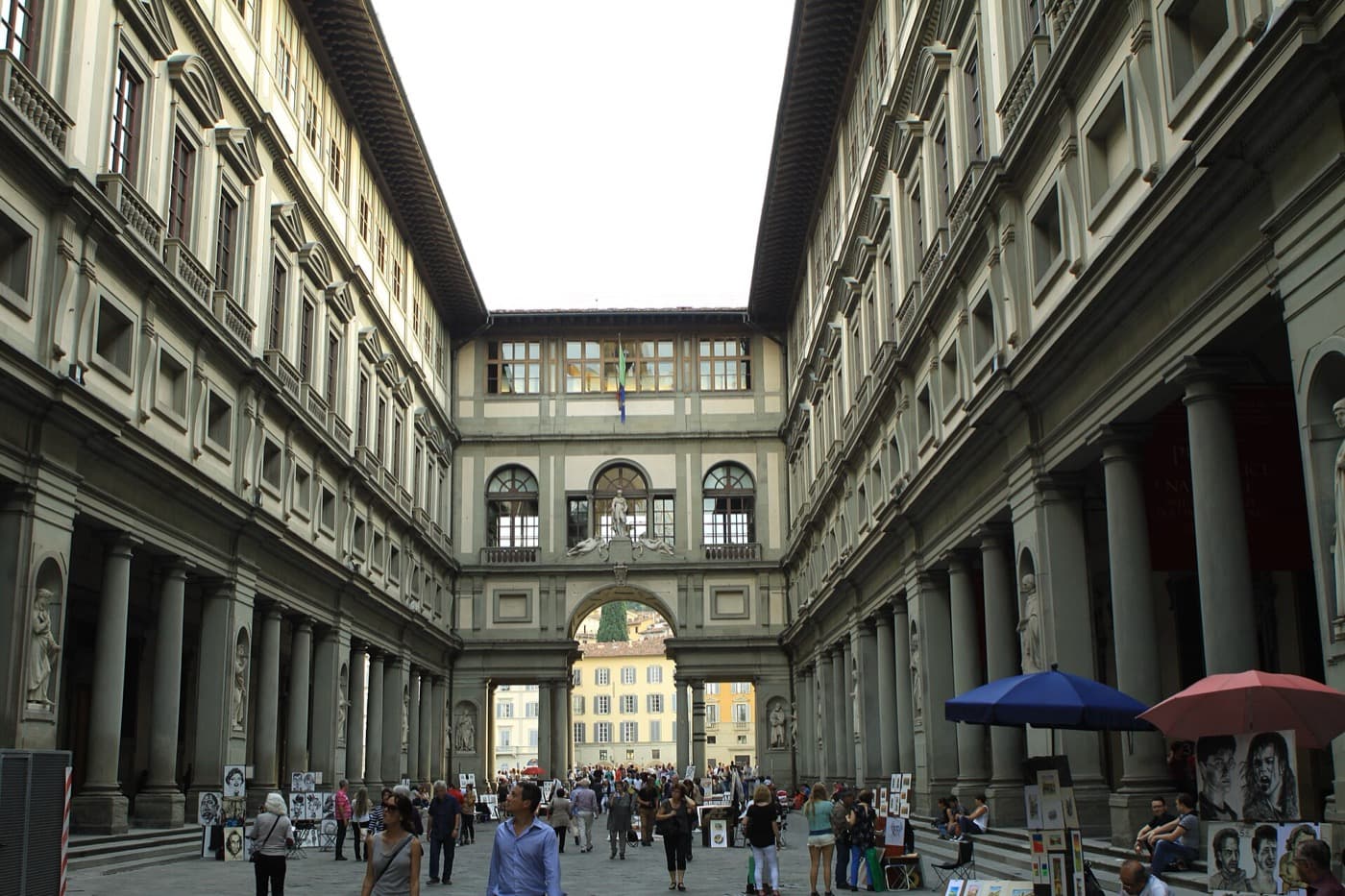
From the Medici quarter the Historic Center walk runs south past the Baptistery, the dome, Dante's quarter, Orsanmichele and the markets, and at its far end the money changes state again. It becomes bureaucracy. The Galleria degli Uffizi was not built as a gallery. Uffizi means offices. Duke Cosimo the First had Giorgio Vasari design it to gather the magistracies of the Tuscan state under one roof. It was begun in 1560, and when Cosimo and Vasari both died in 1574 it was finished by Francesco the First and his architect Bernardo Buontalenti, about twenty years after work began. The art came later. The offices came first.
The boldest move sits beside it. Palazzo Vecchio was begun at the end of the thirteenth century as the Palazzo della Signoria, the seat of the Florentine Republic. In 1540, Cosimo the First moved his ducal seat into the town hall of the old Republic and had Vasari remodel it around him. Private banking wealth did not merely influence public power from outside. It walked into the house of the Republic and made it a residence. The bank became the government. The receipt is the whole building. In 1565 Vasari added the last line of the ledger, a private corridor built in five months that carried the duke from these offices over the Ponte Vecchio to his palace across the river.
Read together, the stones tell you what happens when a bank decides to purchase immortality and largely succeeds. The Historic Center walk is a street walk, not a museum crawl: twelve stops over about 1.8 kilometers in about ninety minutes, from San Lorenzo to the Ponte Vecchio, every one legible from the pavement, and you never need a ticket to see what the tour is really about. If you want the fuller context first, browse the Florence walking tours guide, or start planning around the wider city on the Florence page. Then stand at the corner of Palazzo Medici Riccardi and begin reading the money.
Sources
- Palazzo Medici Riccardi, museum history page and Mediateca (palazzomediciriccardi.it). The 1444 commission, Vasari's account of Cosimo rejecting Brunelleschi's design, the corner loggia, the cannons of 1512 and the closing of 1517, Michelangelo's kneeling windows, the Journey of the Magi and the rejected identification of John the Eighth Palaiologos, the 1659 sale to the Riccardi, the 1679 to 1689 extension, and the building's later owners.
- Casa Buonarroti. Michelangelo's San Lorenzo facade contract of 19 January 1518, its cancellation on 10 March 1520, and the surviving wooden model.
- Treccani, Dizionario Biografico degli Italiani: Filippo Brunelleschi. The rebuilding of San Lorenzo from 1421.
- Uffizi Galleries. The building of the Uffizi from 1560 and its completion under Francesco the First and Buontalenti, and the Vasari Corridor of 1565.
Ready to experience it?
Historic Center: Duomo to Ponte Vecchio
90 min · 1.8 km · easy
More from Florence
Explore more at your own pace.
Florence Travel Guide: How Many Days, Getting Around, and What to Book
How Money and Competition Built the Renaissance in Florence
The Baptistery Door Competition That Started the Renaissance
The Oltrarno: Reading Florence's Working Half From Santo Spirito Onward
Brunelleschi's Dome: How a Goldsmith Built the Impossible in Florence