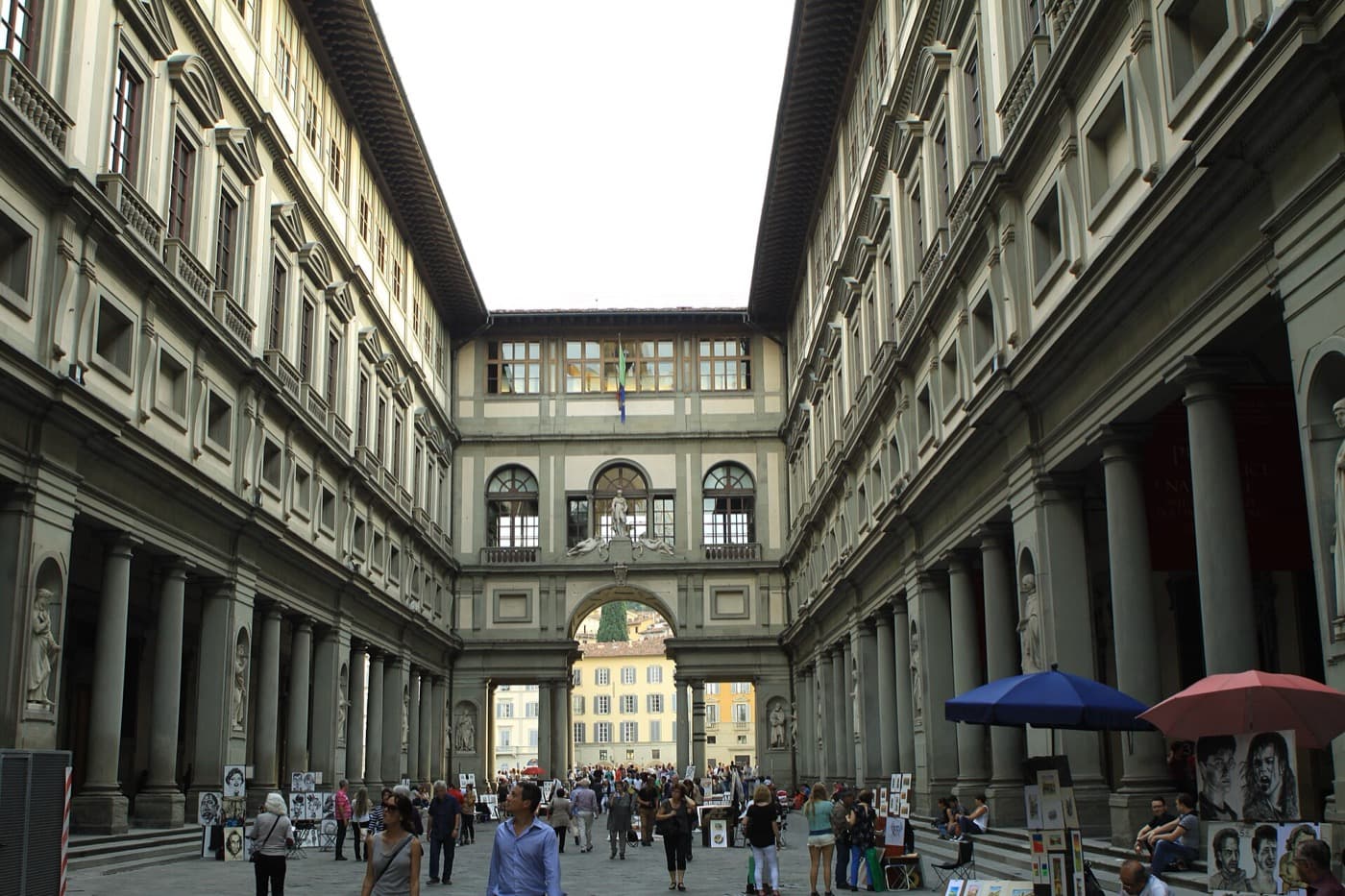
The Renaissance did not fall from the sky. It was engineered, deliberately, by a city of wool merchants and money-changers, and the moment many historians choose to date its beginning is a competition for a set of bronze doors held in 1401 at the Baptistery of San Giovanni. Money, competition, and civic pride, applied first to a door and later to a dome and a public square, are the engine behind everything you see in central Florence. The Baptistery is where that engine first turns over, and it is one stop on a compact walk that reads the city as the place where a banking town taught the modern world to see.
An old building at the center of a new idea
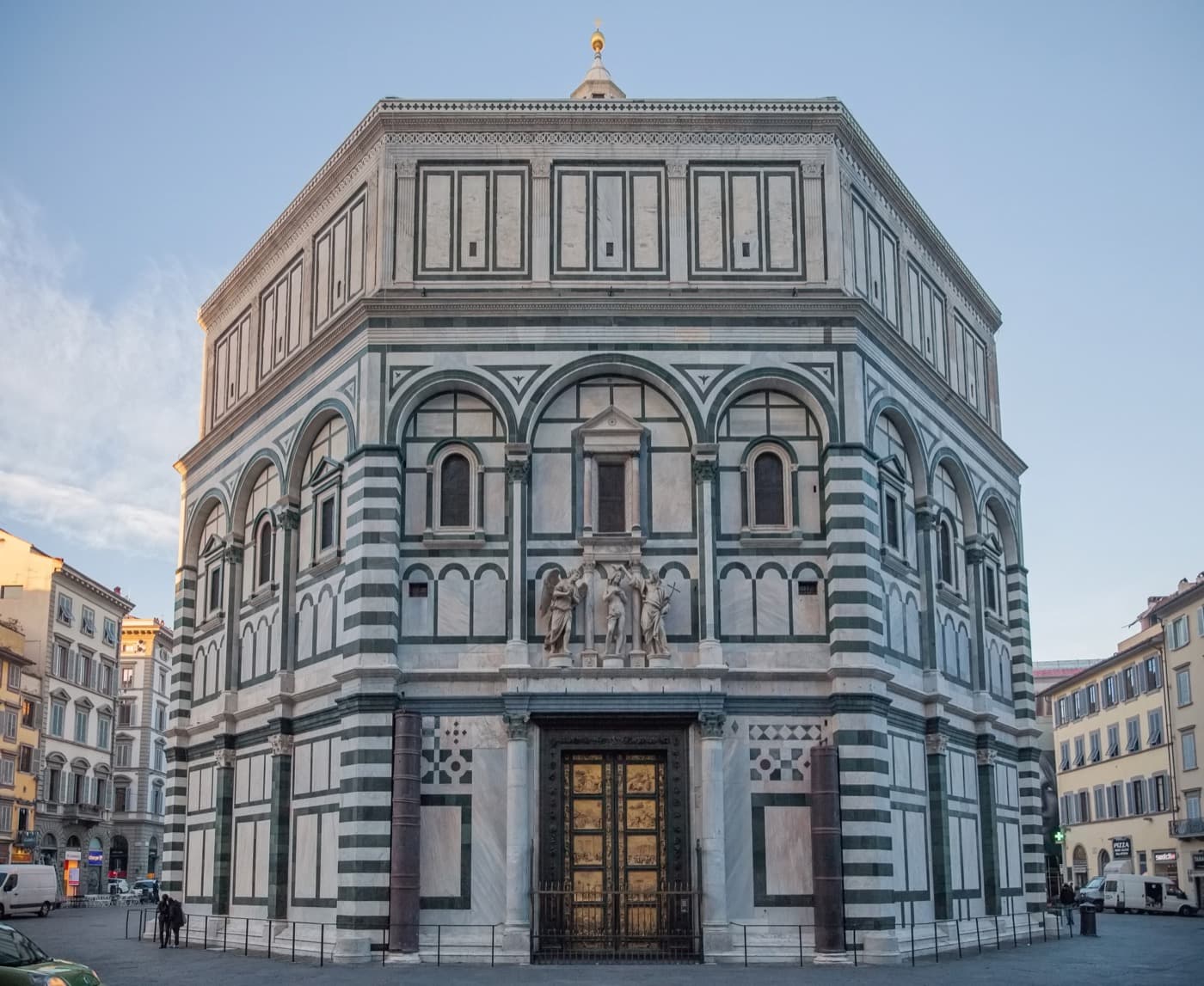
Stand in Piazza del Duomo and the Baptistery is the older, smaller, octagonal building faced in white and green marble, sitting just west of the cathedral. Its age is still argued over. The cathedral works, the Opera di Santa Maria del Fiore, record a consecration in 1059 and a place dedicated to Saint John as early as 897, and scholars split between an early Christian building later clad in marble and a Romanesque one of the eleventh or early twelfth century. Either way it is one of the oldest buildings in Florence, and its eight-sided shape borrows from the idea of ancient Rome. That detail matters more than it first appears. The men who reinvented Florentine art were not inventing from nothing. They were looking hard at Roman models, and here was a Roman-looking building the whole city already used and revered. The Renaissance, at its root, was a conversation with the ancient past, and this is one of the rooms where the conversation happened.
The contest of 1401
Hear a stop from this walk
Brunelleschi's Dome: Two Rivals, One Vault
In 1401 the city held a competition to design new bronze doors for the Baptistery. Seven artists competed, among them Lorenzo Ghiberti and Filippo Brunelleschi, each casting a trial panel of the Sacrifice of Isaac. Only two of those panels survive, Ghiberti's and Brunelleschi's, and both are in the Museo del Bargello, where you can still compare them side by side. Historians conventionally take that pairing as the beginning of the Renaissance in Western art, and it is easy to see why. Two rivals, a shared subject, a public judgment, and a permanent object at the end of it. Competition was not a side effect of Florentine art. It was the method.
Ghiberti won. He spent roughly the next two decades on a set of doors, the north doors of the Baptistery, finished in 1424. Then came a second commission, worked from 1425 to 1452 with his son Vittore: ten gilded Old Testament panels, first meant for the north side. On 13 July 1452 the Calimala guild of cloth merchants decided to place them on the east side instead, facing the cathedral, because of their beauty. Where the name Gates of Paradise comes from is less certain. The ground between a baptistery and its church was traditionally called the Paradiso, and there was a cemetery here. Vasari later credited the phrase to Michelangelo, and the Opera itself says nobody knows whether Michelangelo spoke the words or Vasari invented them. It is worth keeping the sequence straight, because guidebooks blur it constantly: the 1401 competition produced the north doors, and the Gates of Paradise were the separate, later work. Earlier still, the south doors were cast in the 1330s by Andrea Pisano, decades before Ghiberti ever entered the contest. The Gates of Paradise you see outdoors are a copy, installed in 1990. The original panels, restored over about twenty-seven years, are in the Museo dell'Opera del Duomo.
Why the loser matters as much as the winner
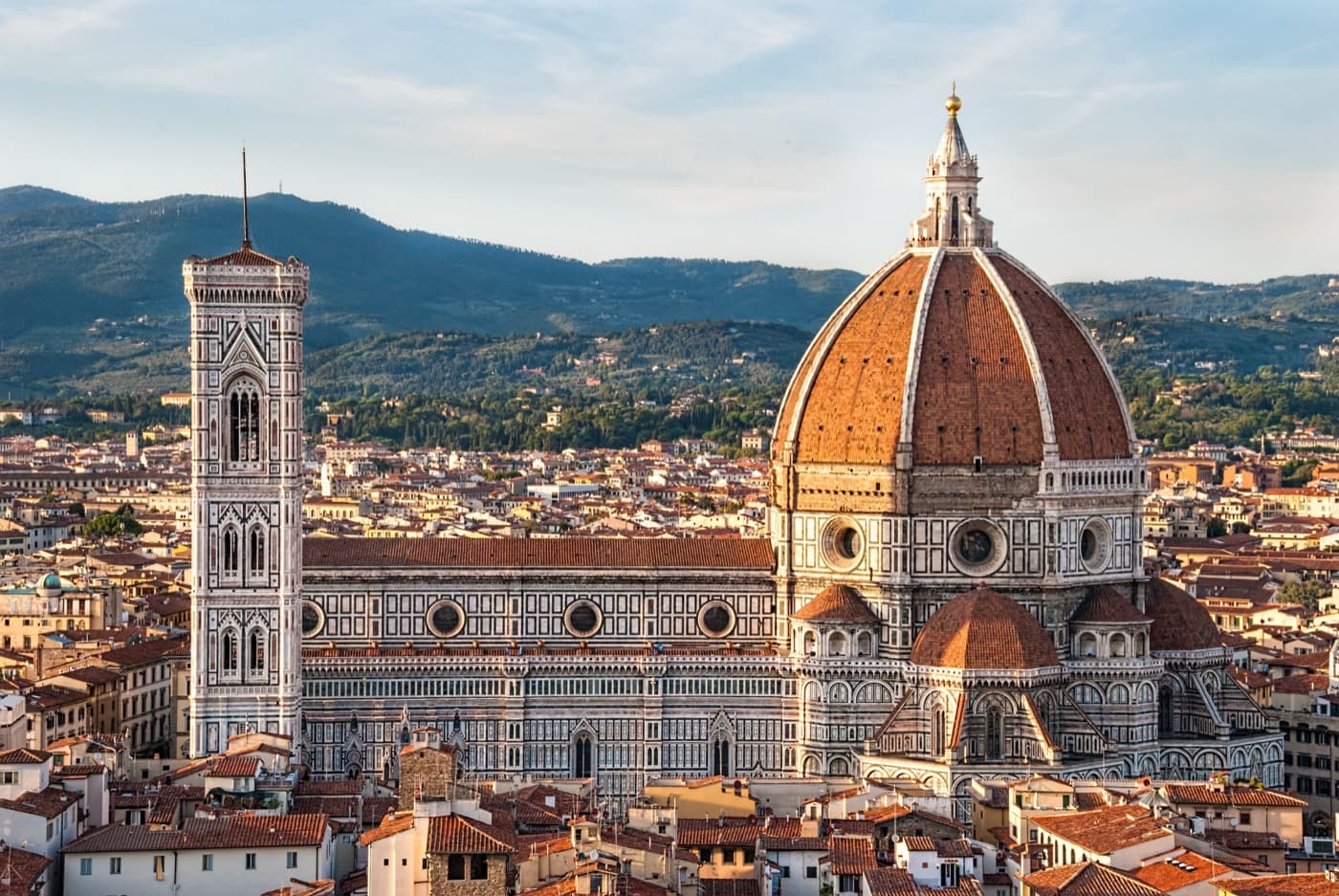
Here is the quiet twist that makes this stop the key to the whole tour. Brunelleschi lost. The goldsmith who did not win the door competition entered the 1418 competition for the cathedral's dome with a masonry model, and in 1420 the works office put his design into construction. It did not hand him the job alone: Brunelleschi and Ghiberti, his rival from 1401, were appointed joint master builders. The dome went up between 1420 and 1436 without wooden centering, and the Opera calls it the largest masonry vault in the world. His answer lived in the bricklaying itself, a herringbone pattern that let each ring support itself as it climbed inward. Stand at the Baptistery and you are standing between two contests that the same two men fought, a few steps and a few years apart. The city that staged both is the real protagonist. If you want the fuller argument in the stones, the tour continues from here to the Florence landmarks that carry it forward.
The rest of the route follows the same logic
The Historic Center walk runs north to south over about 1.8 kilometers and twelve stops, in about ninety minutes at your own pace, which means you can linger at the Baptistery as long as the light and the crowds allow. It opens at San Lorenzo, whose bare front is what was left when the contract for Michelangelo's marble facade was cancelled in 1520, and at the Medici palace, whose open corner loggia was walled up in 1517. After the doors and the dome, it passes through Dante's quarter to Orsanmichele, where the guilds and the city's merchant court filled the outer niches with their patron saints. Ghiberti's Saint John the Baptist for the cloth merchants, cast while he was still working on the north doors, was the first bronze statue on the building. Every statue in the niches today is a copy; the originals stand upstairs in the same building.
Then comes Piazza della Signoria and Palazzo Vecchio, the fortress-tower town hall begun in the late thirteenth century and traditionally attributed, on Vasari's word, to Arnolfo di Cambio, the master builder who laid the cathedral's first stone in 1296. Michelangelo's original David stood at the palace entrance from 1504 until 1873, placed there by a committee that included Leonardo and Botticelli as a symbol of the strength and independence of the Florentines. The one there now is a marble copy, set in place in 1910, standing exactly where the city once chose to make its statement. A few steps away, the Loggia dei Lanzi is an open-air sculpture gallery that costs nothing and never closes its arches, holding Cellini's bronze Perseus and Giambologna's spiraling group of three figures, known as the Rape of the Sabine Women, a title the Uffizi says was probably given after it was carved.
The walk ends at the water, past the Uffizi and under the Vasari Corridor. The Ponte Vecchio was built in the first half of the fourteenth century, after a flood took the earlier bridge in 1333, and it has carried the city's craft across the Arno for nearly seven centuries. On the night of 3 to 4 August 1944 the retreating German army blew up every other bridge in the city and spared this one, though it mined the streets at both ends to block it with rubble. The oldest bridge is the one that carried the city's luck.
Walk it in order
The argument only lands when you take the stops in sequence, because the tour is built as an origin story: the Medici corner sets up the money, the doors begin it, the dome proves it, the guild wall sells it, the square governs it, and the bridge outlasts it. Standing at the Baptistery with the 1401 contest in mind changes how you read every stop after it. This companion piece is one of several deeper reads that pair with the routes in our Florence walking tours collection, and the audio tour picks up exactly where this leaves off, in the piazza between the dome and the door.
Sources
- Opera di Santa Maria del Fiore (duomo.firenze.it). The debated dating of the Baptistery and its 1059 consecration, the dates of the three sets of doors, the 13 July 1452 decision to place the Gates of Paradise facing the cathedral, and the two explanations of the name.
- Opificio delle Pietre Dure. The restoration of the Gates of Paradise and the 1990 copy.
- Italian national heritage catalogue (catalogo.beniculturali.it). The two surviving 1401 trial panels in the Bargello.
- Treccani, Dizionario Biografico degli Italiani: Filippo Brunelleschi. The 1401 competition, the 1418 dome competition and the 1420 joint appointment with Ghiberti.
- Treccani, Dizionario Biografico degli Italiani: Arnolfo di Cambio. The attribution of Palazzo Vecchio as Vasari's tradition.
- Galleria dell'Accademia di Firenze. The David's placement in 1504 and its removal in 1873.
- Uffizi Galleries. The Loggia dei Lanzi and the later title of Giambologna's group.
- Comune di Firenze, Memorie di Resistenza. The night of 3 to 4 August 1944 on the Florentine bridges.
Ready to experience it?
Historic Center: Duomo to Ponte Vecchio
90 min · 1.8 km · easy
More from Florence
Explore more at your own pace.
Florence Travel Guide: How Many Days, Getting Around, and What to Book
How Money and Competition Built the Renaissance in Florence
Palazzo Medici Riccardi: How to Read a Banker's Balance Sheet in Stone
The Oltrarno: Reading Florence's Working Half From Santo Spirito Onward
Brunelleschi's Dome: How a Goldsmith Built the Impossible in Florence