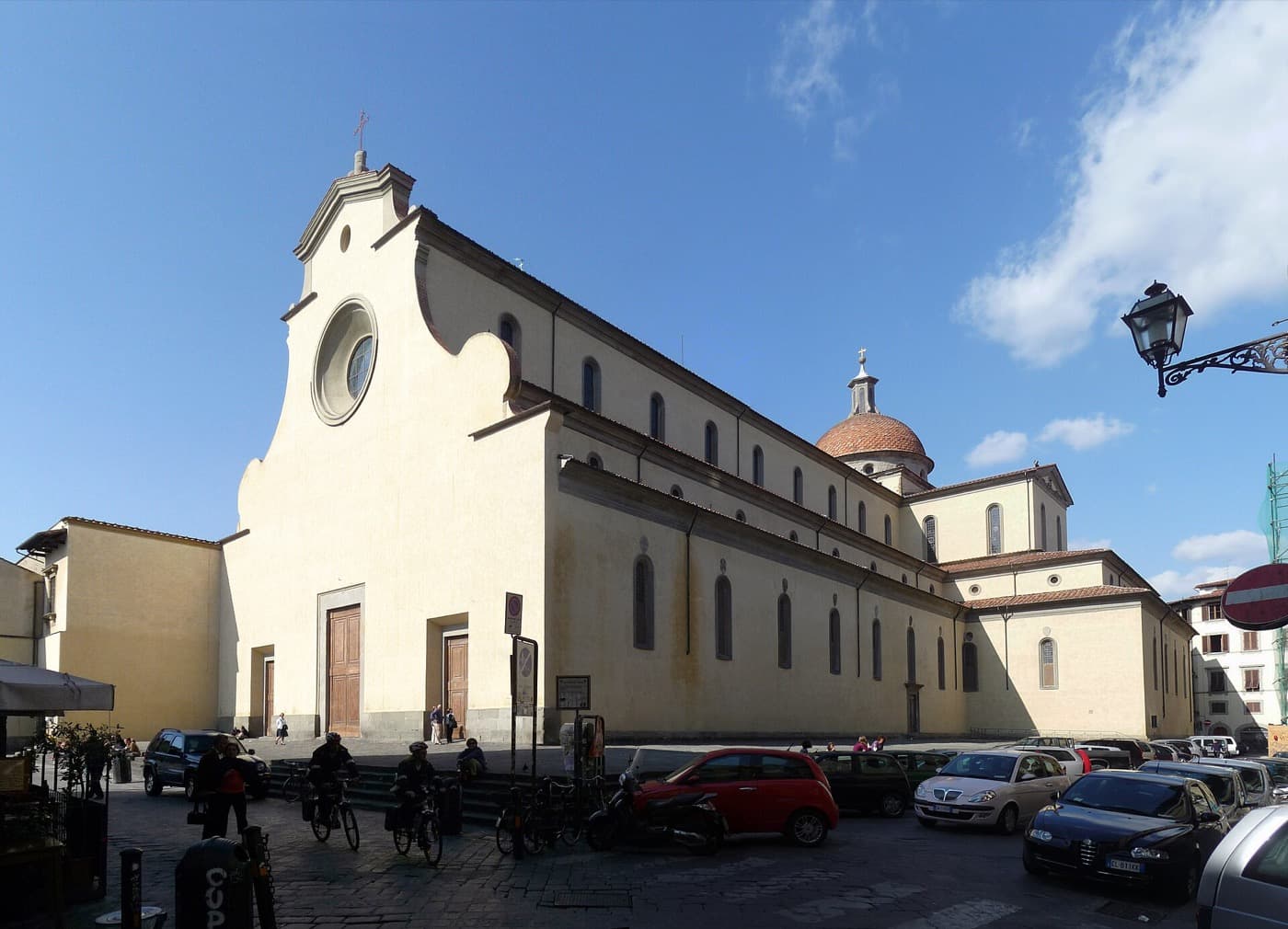
Cross the Arno into the Oltrarno and the whole logic of a Florence walking tour inverts: instead of queuing for the famous half of the city, you read the working half that made it, and the plain unfinished front of the Basilica di Santo Spirito is where that reading begins. Filippo Brunelleschi's last great church presides over the neighborhood's liveliest square with a facade left deliberately blank, and that blankness is the argument. Everything the architect cared about went inward. Start there, in Piazza Santo Spirito, and the six-stop route earns its name: the other side of the river, walked as the making of the city rather than the showing of it.
Why the blank facade is the whole idea
Stand in the square and notice what is not there. The broad whitewashed front of Santo Spirito was meant to carry a grand facade that was never built, so for centuries the church has worn a plain face over one of the most rational interiors of the Renaissance. Brunelleschi, the same mind behind the great dome across the river, designed the church as early as 1428, though groundbreaking waited until 1446, the year he died, ten days after the first columns arrived. Followers carried it to completion. It was consecrated in 1481 and finished around 1487.
Step inside if the doors are open and the point becomes physical. The plan is a Latin cross, and forty side niches of identical size run the entire perimeter in an unbroken rhythm. The nave stretches roughly 97 metres. This is geometry you can walk through, cool and rational, the opposite of the gilded spectacle across the Arno. The square outside is the neighborhood's living room, carved out of houses purchased back in 1301, and today it fills with residents, students, and the slow rhythm of an artisan quarter. That contrast, a masterpiece of proportion wearing a plain face in a square where ordinary life happens, is the thesis the rest of the walk expands. If you want the wider context for how these routes fit together, the Florence walking tours hub sets the scene.
Power that moved overhead, unseen
Hear a stop from this walk
San Miniato al Monte: the sacred hill above it all
A short walk toward the Ponte Vecchio brings you to Santa Felicita, an unassuming church with a covered passage crossing its facade. That is the Corridoio Vasariano, the Vasari Corridor, built in 1565 by Giorgio Vasari on the orders of Cosimo the First de' Medici. Its purpose was convenience for the powerful: it connected the Palazzo Vecchio, then the seat of government, with the family's new home at the Palazzo Pitti, so the Medici could cross the city above the crowds without touching the street.
The detail that captures the whole idea sits inside. Where the corridor crosses the church, a large grated window opens onto a private covered loggia, and from behind it the grand dukes could hear mass without ever descending among ordinary worshippers. Set that against the spirit of this walk. You move through the city at street level, part of it. They built an entire raised passage precisely to avoid doing that. Entry is free, and in the Capponi Chapel hangs Pontormo's Deposition, painted between 1525 and 1528, a swirling, weightless composition of pale figures that is one of the early landmarks of Mannerism. You are standing in the exact seam between the working city below and the power that passed above it.
Ambition, relocated across a river
Walk up to the sloping paved square before the Palazzo Pitti and take in the scale. The stone face rises like a cliff, and it was meant to. The twist is that the Medici did not build it. It was commissioned by a rival Florentine banker, Luca Pitti, who lived from 1398 to 1472. Construction began in 1458 and was still unfinished when he died. Then, in 1549, the palace was acquired for the Medici by Eleonora di Toledo, wife of Cosimo the First.
Read that carefully. The ruling family of Florence bought their way across the river into a house that had belonged to a rival, and made it the grandest address in the city. It grew from an occasional lodging into the principal Medici home, permanently occupied under Eleonora's son Francesco the First, who moved the family art collection inside. The artisan quarter you have been walking, with its plain doors and working hands, sits in the shadow of a palace bought precisely to dominate it. The museums run roughly 16 to 19 euros if you want to go in, but the story is legible from the free square.
Geometry on the hillside, then the climb
Behind the palace rises the Giardino di Boboli, and even from the entrance you sense its ambition. This is not a garden that follows the land. It commands it. Spread across roughly 45,000 square metres, about eleven acres, it climbs the hillside in deliberate axes, imposing straight lines where nature would have wandered. Laid out in the mid-sixteenth century, the work began under Niccolo Tribolo, who died in 1550, and continued through Bartolomeo Ammanati, Vasari, and Bernardo Buontalenti. It is the outdoor counterpart to what Brunelleschi did indoors: human reason imposed on space, the medium here being cypress avenues and fountains rather than stone niches. An ancient Egyptian obelisk and a Mannerist grotto by Buontalenti sit within, and the garden opened to the public in 1766. Entry runs roughly 10 to 18 euros. It is also the pivot of the walk. From here the ground rises.
The oldest register, and the reward
The final stretch is a real climb, optional but the payoff. San Miniato al Monte crowns one of the highest points above Florence, often called one of the finest Romanesque structures in Tuscany. Its facade is a crisp composition of green and white marble that predates the Renaissance flowering below. Construction began in 1013 under Bishop Alibrando, with imperial patronage from Emperor Henry the Second. Inside, entry free, the interior layers age upon age: an inlaid marble floor dated 1207, an apse mosaic of Christ dated 1297, Michelozzo's freestanding Chapel of the Crucifix from 1448. An Olivetan monastery is still attached, and the adjoining Porte Sante cemetery, established in 1854, holds Carlo Collodi, author of Pinocchio, and the filmmaker Franco Zeffirelli.
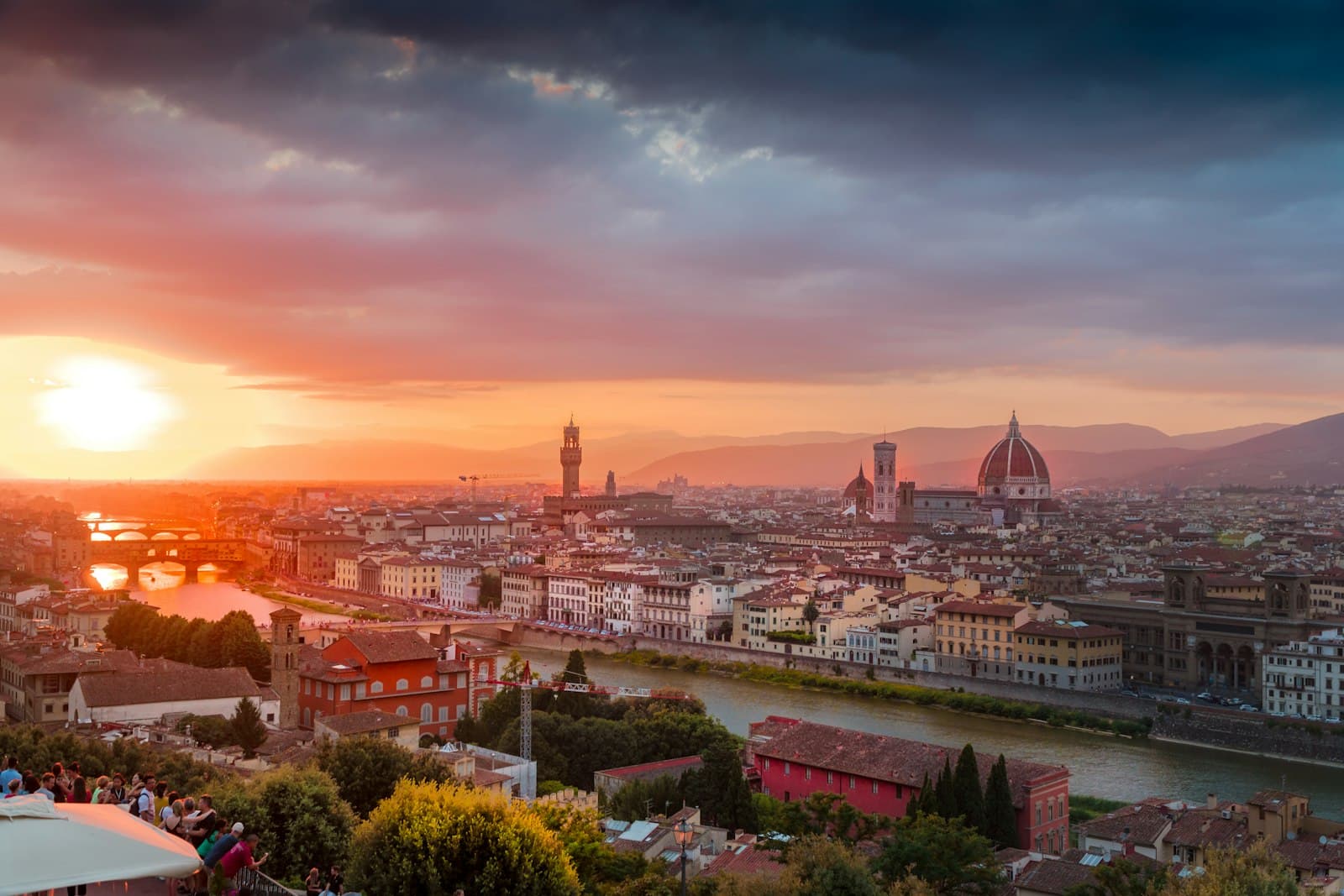
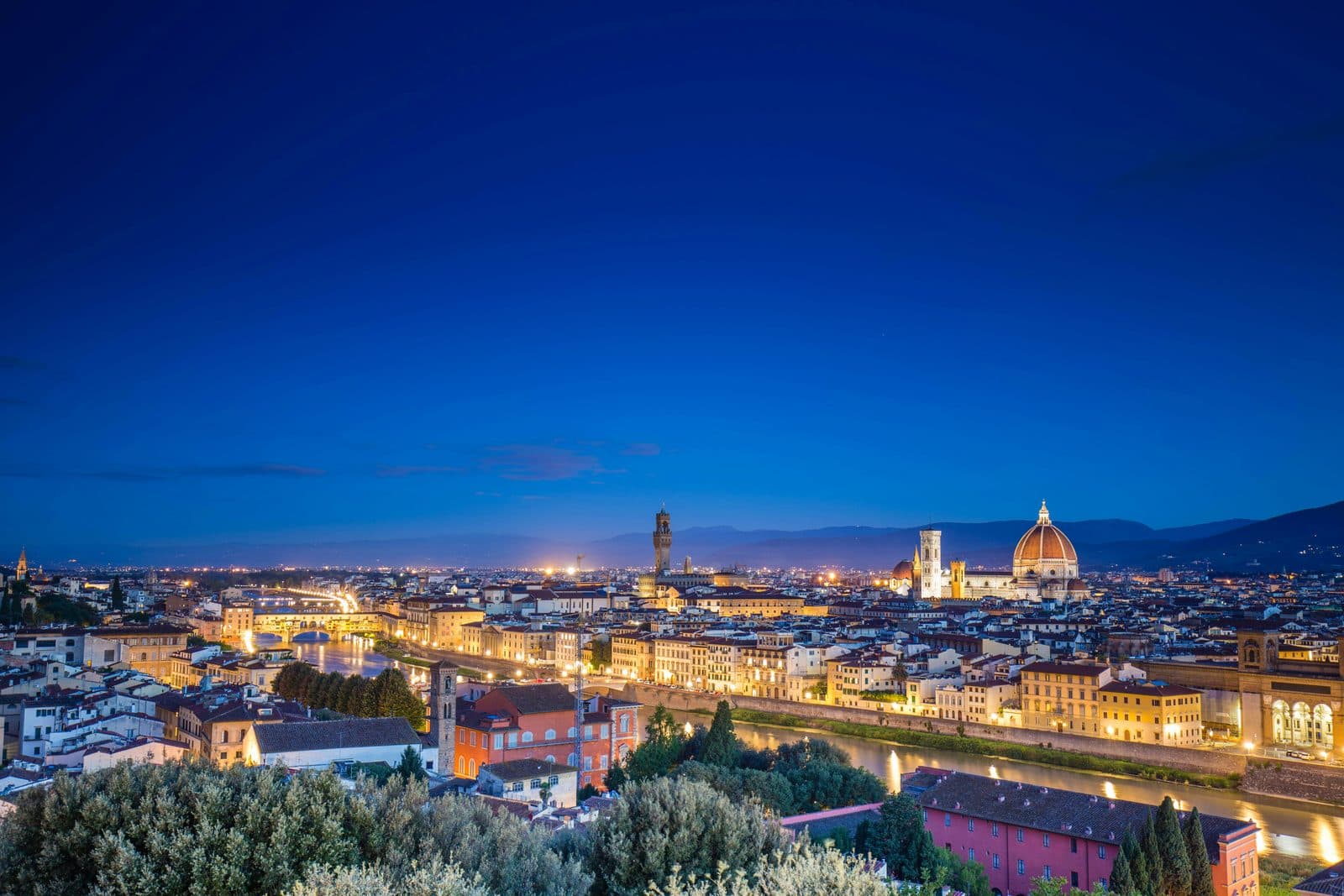
Then Piazzale Michelangelo. Step onto the terrace and everything you turned your back on at the start reassembles below: the Ponte Vecchio, the red dome of the Duomo, the tower of the Palazzo Vecchio, the whole skyline in a single sweep. The terrace itself is nineteenth century, designed and built in 1869 by Giuseppe Poggi during the brief window when Florence served as capital of a newly unified Italy. You did not fight a ticket line to earn this. You walked the other side of the Arno and the reward is the entire monumental city, seen from the half of Florence that made it. Ready to walk it? Start in Florence.
Sources
- Santo Spirito, Florence (Wikipedia): design attribution to Brunelleschi, construction dates, and the forty-niche interior plan.
- Santa Felicita, Florence (Wikipedia): the Vasari Corridor, the grated ducal window, and Pontormo's Deposition in the Capponi Chapel.
- Palazzo Pitti (Wikipedia): Luca Pitti's commission, Eleonora di Toledo's 1549 acquisition, and the palace's role as grand-ducal seat.
- Boboli Gardens (Wikipedia): the garden's designers, scale, Egyptian obelisk, and 1766 public opening.
- San Miniato al Monte and Piazzale Michelangelo (Wikipedia): the basilica's 1013 founding, its mosaics and chapels, and Poggi's 1869 terrace.
Ready to experience it?
Oltrarno: The Other Side of the Arno
110 min · 5 km · hard
More from Florence
Explore more at your own pace.
Florence Travel Guide: How Many Days, Getting Around, and What to Book
How Money and Competition Built the Renaissance in Florence
Palazzo Medici Riccardi: How to Read a Banker's Balance Sheet in Stone
The Baptistery Door Competition That Started the Renaissance
Brunelleschi's Dome: How a Goldsmith Built the Impossible in Florence