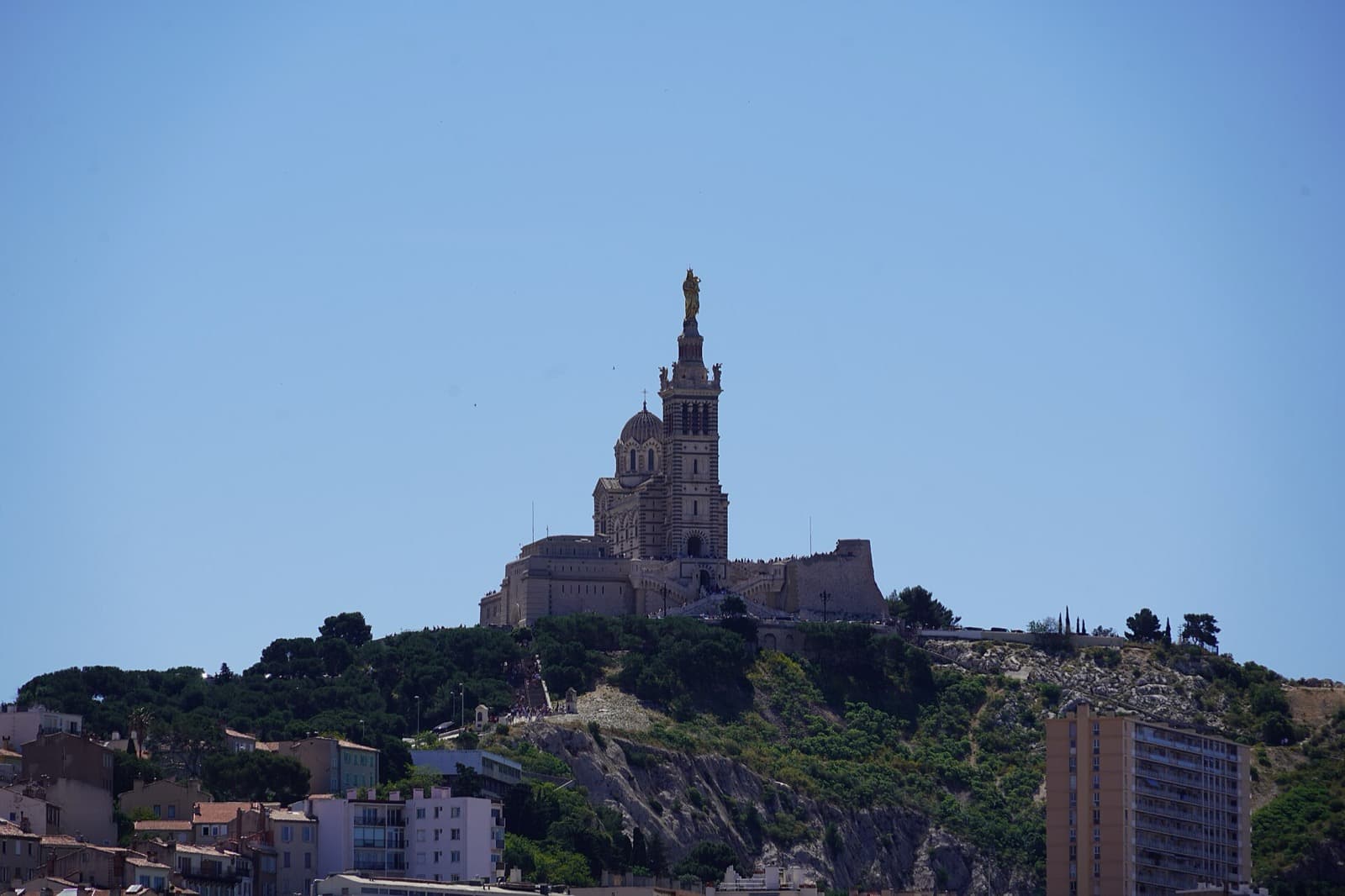
You do not so much find Notre-Dame de la Garde as look up and realise it has been finding you all along. From almost anywhere in Marseille, from a market stall in Noailles, from a ferry crossing the Vieux-Port, from a tram that swings around a corner, the gilded figure appears above the rooftops, small and bright against the sky. The locals do not call her the basilica or the sanctuary. They call her la Bonne Mère, the Good Mother, and they mean it the way you mean the name of someone in your own family. This companion piece is the deep background to the tour's opening stop, the story of how a rock chosen for war became the most watched-over place in the city.
The rock that guarded the city
Long before there was a basilica, there was a hill, and the hill mattered because it was high. La Garde rises to 149 metres above the sea, the highest natural point in Marseille, a bare limestone outcrop that lets you see everything and be seen from everywhere. That combination is a soldier's dream, and so the hill became a fortress before it became a church.
The fortification here was begun for King Francis I to defend Marseille, a sixteenth-century military work perched on the outcrop. It was not decorative. In 1536 the fortified sanctuary was pressed into service to help repel the troops of Charles V, the Holy Roman Emperor whose armies pushed into Provence. The stones that hold up today's votive basilica were first laid to hold off an invasion. When you stand at the summit, it helps to remember that the panoramic view you are enjoying was, for the people who built the first walls here, a field of fire.
That double identity, guardian in the military sense and guardian in the spiritual sense, is the key to the whole place. The hill was always about watching over Marseille. Only the meaning of the watch changed.
Building the basilica
Hear a stop from this walk
The Corniche: Where the Whole City Faces the Sea
By the middle of the nineteenth century the old chapel on the summit could no longer hold the crowds who climbed to it, and Marseille decided to build something grand on the fort's foundations. The architect chosen was Henri-Jacques Espérandieu, and the first stone of the new basilica was laid by the city's bishop, Monseigneur de Mazenod, on 11 September 1853. The building was consecrated just over a decade later, on 5 June 1864.
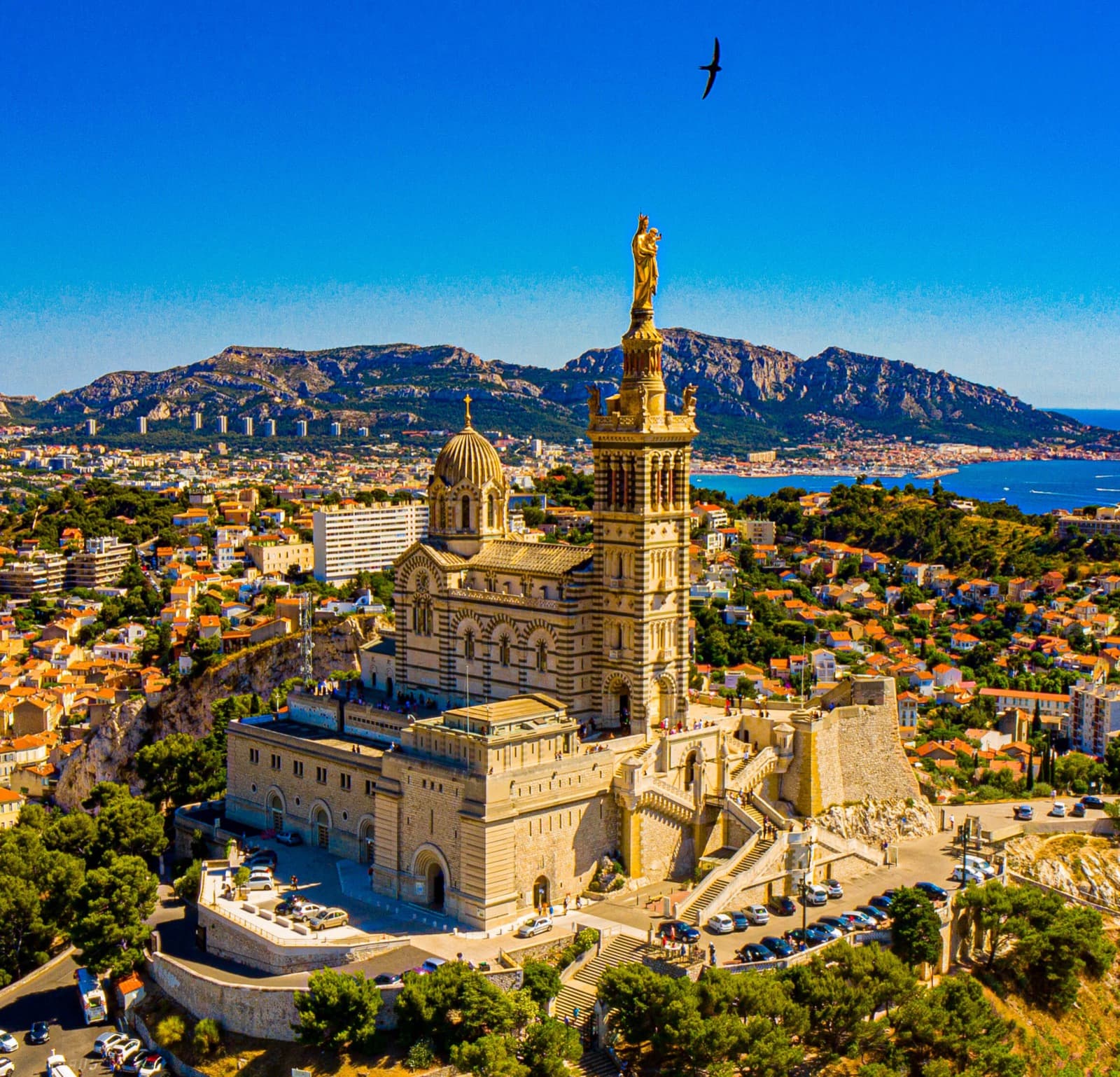
What Espérandieu produced was a basilica in the neo-Byzantine manner, and the surface tells you so at a glance. The exterior alternates bands of white Calissane limestone and green sandstone, giving the whole structure a striped, layered look that catches the Mediterranean light differently at every hour. It is a Catholic basilica built to feel a little like the churches of the eastern Mediterranean, which suits a port that has always faced that sea.
Inside, the ambition continues. The upper church holds roughly 1,200 square metres of mosaics, laid between 1886 and 1892, an expanse made up of something on the order of 12 million tesserae, the tiny cut stones and glass that mosaicists set one at a time. Beneath the upper church sits a Romanesque-Revival crypt, cut into the rock, quieter and heavier than the glittering sanctuary above it.
The Madonna set in gold
The image everyone carries away is the statue. Crowning the belfry, atop a square bell tower, stands a monumental gilded copper Madonna and Child, 11.2 metres tall, the work of the sculptor Eugène-Louis Lequesne. She was not carved or cast in the traditional way. She was made by galvanoplasty, an electro-forming process that builds the metal shell layer by layer, and then covered in gold leaf, about 500 grams of it, enough to make her burn bright against the blue on a clear day and to catch the last light long after the streets below have gone into shadow.
That gold is why she is visible from so far, and visibility is the entire point. Notre-Dame de la Garde is the most-visited site in Marseille and the traditional guardian of the city's sailors and fishermen, and the Madonna is the figure they looked back to as they left the harbour and looked for as they returned. To sail out of Marseille was to watch la Bonne Mère shrink behind you, and to come home was to watch her grow again over the horizon. For a city of the sea, that is not sentiment. It is navigation and faith folded into one bright landmark.
A sanctuary of the saved
The interior makes the sailors' bond literal. The sanctuary is filled with ex-votos, offerings left in gratitude for a prayer answered, and here they take the forms you would expect from a port. There are model ships, plaques, and paintings, many of them left by sailors who survived shipwrecks and came up the hill to thank the Good Mother for their lives. Walk the walls and you are reading a ledger of near-disasters at sea, each one recorded not as a statistic but as a personal debt paid to a statue on a hill.
This is the quiet argument of the whole basilica, and of this tour's first stop. The fort was built to guard the city against enemies. The basilica reframed the guarding as something tenderer: watching over the people who go out on the water and hoping to see them come back. The same commanding view that once let gunners track an approaching army now lets a mother, in the local imagination, keep an eye on her children as they scatter across the Mediterranean.
If you want to see how this cult of the sea sits inside the larger story of Marseille, the tour also carries you down toward the harbour's oldest Christian ground. That is the subject of its own companion, the port that was Christian before France was France, and together the two pieces frame the city's long relationship with the water. For the wider context you can read the Marseille city page and browse the full best walking tours of Marseille.
Stand at the summit a moment longer before you go. The view is the whole reason the hill was ever fortified, and it is the whole reason the Madonna was set here in gold. Marseille built a fort to look outward in fear, and then it built a basilica to look outward in hope. From 149 metres up, both views are exactly the same.
Sources
- Wikipedia, "Notre-Dame de la Garde" (en.wikipedia.org)
- Roamer audio tour transcript, "Notre-Dame de la Garde," stop 1
Ready to experience it?
Notre-Dame de la Garde: The Good Mother Watching the Sea
150 min · 4.4 km · moderate
More from Marseille
Explore more at your own pace.
Reading the Empire in Stone: A Companion to the Canebière Architecture Tour
The Belly of Marseille: Noailles, the Marché des Capucins, and the Truth About Bouillabaisse
The Port-City France Hasn't Decided About: A Companion to the Noailles and Cours Julien Tour
Abbaye Saint-Victor: The Port That Was Christian Before France

The Bridge Between 1660 and 2013: Fort Saint-Jean and the MuCEM
