The Philosopher's Path is a canal dug in 1890 to power a factory district that electricity made unnecessary. That is the plain fact under Kyoto's gentlest walk. When the court and capital moved to Tokyo, Kyoto dug a canal from Lake Biwa through the eastern mountains to bring the lake's water and its power into town. The factories never came. The bank became a path of temples, a painter's cherries and philosophers' walks. Roamer's walk goes upstream against the water's north-flowing current, from Yoshimasa's never-silver pavilion to the brick aqueduct that carried the industrial dream and is now a National Treasure.
It is ten stops over about 3.1 kilometers and takes about ninety minutes, longer if you go inside. It is gentle, with one short climb to Honen-in and a few steps at Nanzen-ji. Ginkaku-ji and Eikan-do charge for entry, and so does the upper floor of Nanzen-ji's great gate, but every stop works from outside.
A pavilion that was never silver
Stop 1 is the gate of Ginkaku-ji, formally Jisho-ji. The retired shogun Ashikaga Yoshimasa began his Higashiyama villa in 1482, raised the frame of the Kannon-den in 1489 and died in 1490 before it was finished. The temple says the name Silver Pavilion arose only in the Edo period, in contrast to Kinkaku-ji, and Japan's Tourism Agency notes it was never silver. Start with that idea. On this walk the names are later than the things.
Walking upstream through a factory town that never was
Hear a stop from this walk
Suirokaku: The Aqueduct in the Temple
Stop 2 is the bridge where the path begins. The branch canal, completed in March 1890, runs along the foot of the Higashiyama hills. Kyoto City's canal map explains why it flows south to north, unlike the city's rivers: it follows the contour lines to reach as wide an area as possible. Watch the water beside you. You are walking against it.
Stop 3 is the thesis. Governor Kitagaki Kunimichi planned to use water wheels on this canal to drive machinery in an industrial zone around Shishigatani, and an 1880s plan held by the family of the engineer Tanabe Sakuro marks land north of Nanzen-ji in red as a factory site. Then Tanabe toured the United States in 1888, and the plan switched to hydroelectric power. Keage became what Kyoto City calls Japan's first hydroelectric power station, sending current to the city instead. The factory scheme had already proved too costly, and the land along the canal stayed rice fields, where philosophers and writers settled from the Taisho era.
The bank becomes a path
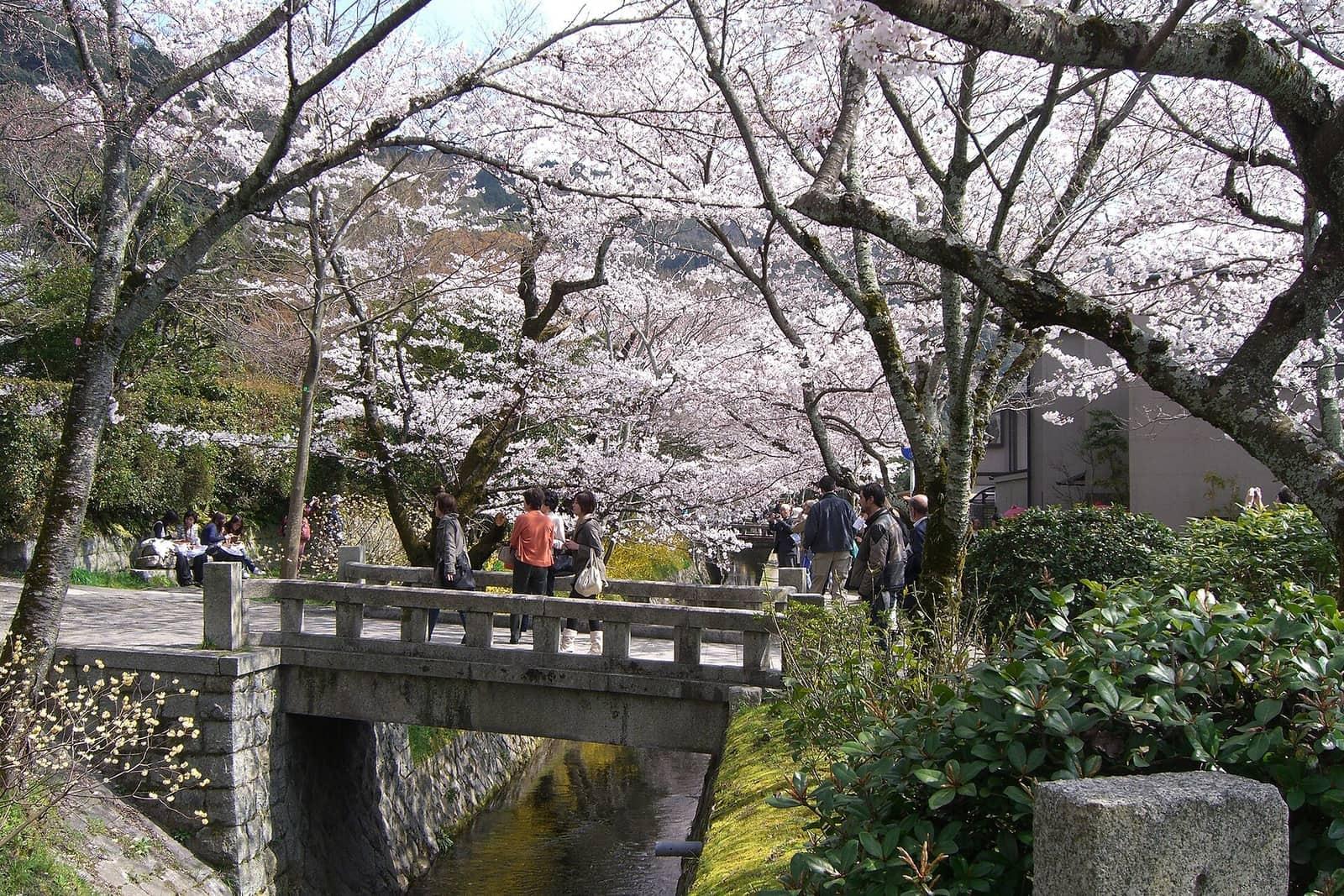
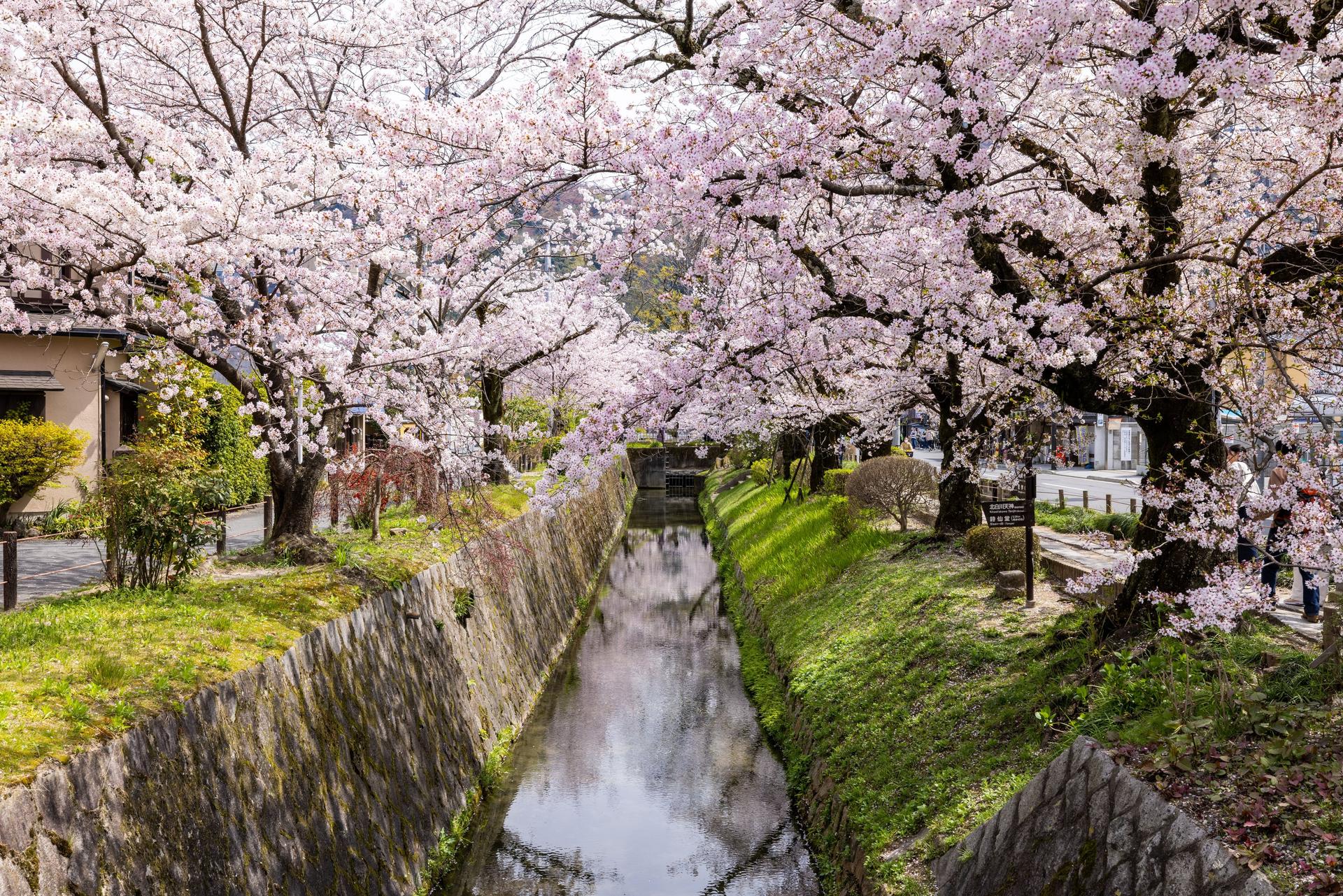
Stop 4 climbs briefly to Honen-in, whose gate opens onto two raked sand mounds the temple says represent water. Stop 5 is the Kansetsu cherries. The painter Hashimoto Kansetsu, who built his villa near the Ginkaku-ji end, planted young cherry trees along the canal in 1922. Kyoto City says the path takes its name from Nishida Kitaro and others said to have walked here deep in thought, and it was improved as a promenade around 1970. Stop 6, Otoyo Shrine, has guardian mice in place of lion-dogs, after a myth in which a mouse saves the god Okuninushi.
Stop 7, beside Kumano Nyakuoji Shrine, is where the path ends and the water appears out of the hill: upstream, the canal runs through brick tunnels of 1888 and 1890. Stop 8 is Eikan-do, whose principal image, the Mikaeri Amida, is a Buddha looking back over his shoulder. The temple tells that in 1082 Amida stepped down and led its priest Eikan, then turned and said, "Eikan, you are slow."
The gate and the aqueduct
Stop 9 is Nanzen-ji's Sanmon, about 22 meters tall, rebuilt in 1628 by Todo Takatora to mourn retainers killed in the Osaka Summer Campaign. Stop 10 ends at the Suirokaku, a brick aqueduct of fourteen arches completed in 1888 to carry the canal across the temple grounds. Kyoto City says Tanabe designed it with the terrain and scenery in mind. In 2025 it became one of five canal structures designated National Treasures, which the city calls the first among modern civil-engineering works. And the canal still works. The water you walked beside was flowing the other way all along.
The path suits your own pace: slow in cherry season, quick on a grey morning, with temples you can enter or simply pass.
The cherries are stop 5 of Philosopher's Path: From the Silver Pavilion to Nanzen-ji, which ends at the aqueduct a short walk from Keage station. See all routes on the Kyoto page.
Sources
- Nanzen-ji, the canal aqueduct: the red brick arched aqueduct in the temple grounds.
- Eikan-do Zenrin-ji: the Mikaeri Amida as principal image and Important Cultural Property, and Eikan, 1033 to 1111, after whom the temple is named.
- Lake Biwa Canal Museum of Kyoto, access: the free canal museum near Keage station.
- Roamer's audited tour research for this walk (Ginkaku-ji and Japan's Tourism Agency, Kyoto City's canal map and 2025 National Treasure notice, the Kansetsu museum chronology, Honen-in, Otoyo Shrine, Nanzen-ji), as summarised in the stops' historical notes.
Ready to experience it?
Philosopher's Path: From the Silver Pavilion to Nanzen-ji
90 min · 3.1 km · easy
More from Kyoto
Explore more at your own pace.
Arashiyama Walking Tour: Who Arranged Kyoto's Most Famous Views
Fushimi Inari Hike: How Ordinary People Filled a Burned Mountain With Gates
Gion Walking Tour: Reading Kyoto's Geiko Quarter Through Its Thresholds
Higashiyama Walking Tour: Kyoto's Old Hillside Was Kept on Purpose
Nishiki Market to Pontocho: A Kyoto Walk That Follows the Water