War burned the shrine on Mount Inari and at its foot in 1468, and that fire explains almost everything you see on the climb. The shrines on the peaks were never rebuilt to last, so the gods of the three summits came down to share one hall at the bottom. The empty mountain did not stay empty. Ordinary people filled it with vermilion gates and with more than ten thousand stones of their own. Fushimi Inari Taisha counts the whole mountain as its grounds, and walking up it is reading that story in wood and stone.
Roamer's walk has eleven stops over about 2.7 kilometers to the last stop, then back down the way you came. It climbs more than two hundred meters, much of it on stone steps, with the steepest stairs late. Allow two to three hours there and back, carry water, and start with plenty of daylight.
The gods on the peaks
The shrine dates its founding to 711, when three deities were enshrined on the three peaks of Mount Inari. Its oldest story, from a fragment of the Yamashiro gazetteer, tells of Hata no Irogu shooting a rice cake that turned into a white bird and landed where rice grew. The shrine now heads about 30,000 Inari shrines across Japan by its own count.
Then came the Onin War. In 1468, the shrine records, troops stormed the mountain and the halls on the peaks and at the foot burned. Only the lower shrine was rebuilt, rededicated in 1499. The shrine's own FAQ says rebuilding on the summit was tried several times, but storms and other causes destroyed the new buildings, and only a shinseki, a former shrine site, remains.
The foot: a warlord's gate and the main hall
Hear a stop from this walk
San-no-mine: The Lower Shrine Site
Stop 1 is the great torii at the start of the approach. Stop 2 is the Romon, the two-storey tower gate the shrine says Toyotomi Hideyoshi built in 1589 after vowing rice for his mother's recovery. When it was taken apart for repair in 1973, an ink inscription dated 1589 was found inside. Behind it stands the main hall, rebuilt after 1468, where all the shrine's deities are worshipped together. This is the hall that the gods of the peaks came down to.
The gates: an Edo-period habit
Stop 3 is Senbon Torii, the twin rows of gates everyone photographs. The shrine says the custom of giving torii along this approach began in the Edo period, and explains a torii as an offering for a wish that passes, or has passed. It estimates around 10,000 gates of all sizes on the mountain. Each is given by a person or a company, the name and date written on the uphill side, so turn and look back down to read them. The carpenters plane cedar pillars from an octagon to round and give them four or five coats of vermilion, and the smallest gates rot in about seven or eight years, so the tunnels are always being renewed.
Stop 4 is the Okusha, a hall for worshipping the mountain from afar with the peaks directly behind it, and the Omokaru stones: lift a lantern top after making a wish, and if it feels lighter than you expected, the wish will be granted.
The stones: a mountain of personal shrines
At stop 5, Kumataka-sha beside the Echo Pond, the otsuka begin to stand out. These are stones carved with a deity's name chosen by the person who dedicated them. The shrine says they spread after the Meiji period fixed seven former shrine sites on the mountain, and it counts over ten thousand of them in English, tens of thousands in Japanese. They cluster around the old sites, and they are the clearest sign of the thesis: where the official buildings did not return, people built their own.
Stop 6, Mitsutsuji, begins about 400 stone steps to Yotsutsuji. Around the year 1000 the court writer Sei Shonagon described a Horse Day visit and how exhausting the climb was, which is a comfort here. Stop 7, Yotsutsuji, at about 162 meters, has the walk's open view, an old lookout whose former name means a peak with a good view, and is the natural place to turn back if you are tired.
The loop over the three peaks
Above Yotsutsuji the walk makes a loop. Stop 8 is Gozendani, the valley where the paths between the peaks meet, where offerings to all three were once made. Stop 9 is Ichi-no-mine, the summit at 233 meters, the site of the former Upper Shrine. Stops 10 and 11, Ni-no-mine and San-no-mine, are the sites of the Middle and Lower Shrines. At each, there is no hall. There is a mound of stones, small gates and offerings, left by the people who kept coming after the buildings stopped.
This is a walk to do at your own pace. There is no group to hold up on the steps and no schedule to beat the light, and you can stop at Yotsutsuji and still have heard the heart of it.
The thousand gates are stop 3 of Fushimi Inari: Senbon Torii to the Mountain Top, which climbs from the great torii to San-no-mine. See all routes on the Kyoto page.
Sources
- Fushimi Inari Taisha, FAQ: around 10,000 torii, torii as an offering for a wish that passes, the custom from the early Edo period, failed rebuilding of the summit shrine and the remaining shinseki.
- Fushimi Inari Taisha, history: the enshrinement of 711, the rice cake legend, the fire of 1468, the rebuilding of 1499, Sei Shonagon's visit about 1000.
- Roamer's audited tour research for this walk (the shrine's map pages, the Agency for Cultural Affairs on the Romon, the Kyoto Prefecture Mountaineering Federation trail notes), as summarised in the stops' historical notes.
Ready to experience it?
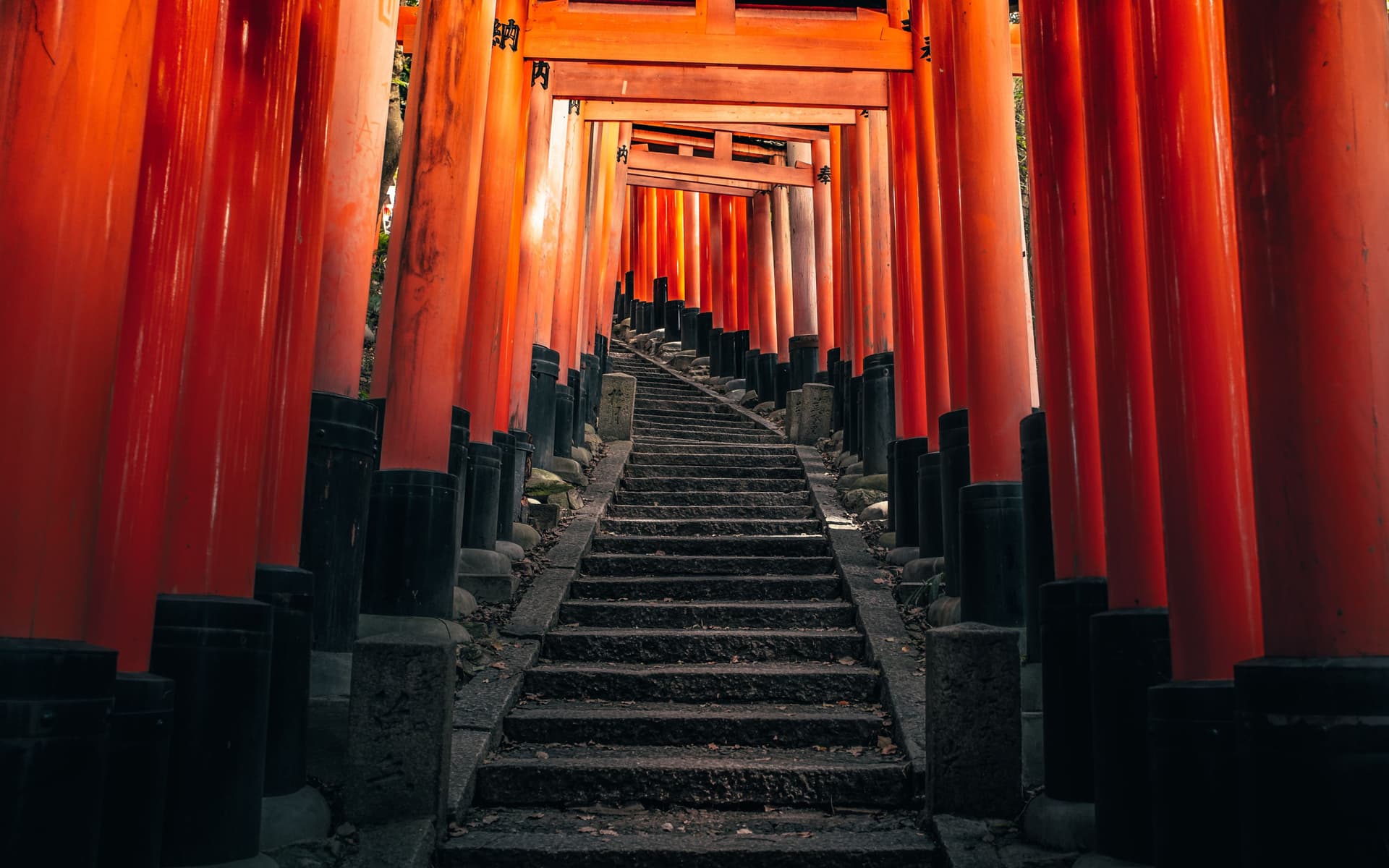
Fushimi Inari: Senbon Torii to the Mountain Top
120 min · 2.7 km · hard
More from Kyoto
Explore more at your own pace.
Arashiyama Walking Tour: Who Arranged Kyoto's Most Famous Views
Gion Walking Tour: Reading Kyoto's Geiko Quarter Through Its Thresholds
Higashiyama Walking Tour: Kyoto's Old Hillside Was Kept on Purpose
Nishiki Market to Pontocho: A Kyoto Walk That Follows the Water
Philosopher's Path Walk: The Factory Canal That Became Kyoto's Quietest Stroll