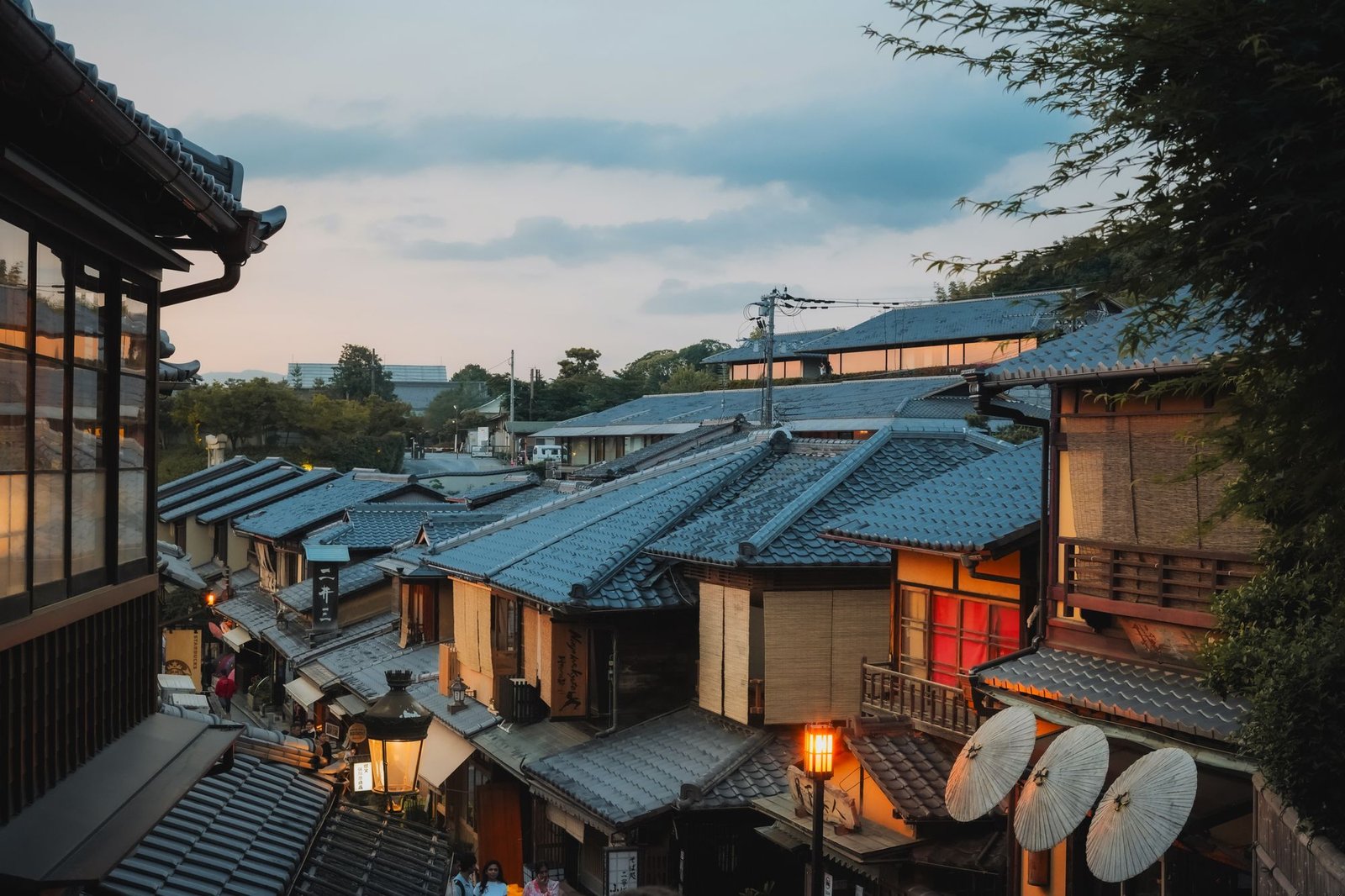
Higashiyama's old look is not a lucky survivor but a choice made again in every generation, and often by neighbors rather than rulers. Fire burned the temples on this hillside again and again, and each time they were rebuilt. In the 1970s Kyoto City wrote rules for the roofs, walls and windows of the lanes. Later the residents themselves asked for a street without power poles, and for their own stone lane to be protected. Roamer's Higashiyama walk is built on that idea: each stop shows one visible act of keeping, from a gate that came through the 1629 fire to a shrine gate moved in 1913 so the new tram street could see it.
The walk is nine stops over just under two kilometers and takes about an hour. It runs mostly downhill on stone steps and sloping stone lanes, from the gate of Kiyomizu-dera to Yasaka Shrine's West Gate at the head of Shijo-dori. Wet stone is slippery, so take the steps slowly in rain.
Kept through fire
Stop 1 is the Niomon, Kiyomizu-dera's main gate, seen from the free forecourt. The temple dates its founding to 778 and reports more than ten great fires over its history, with most of the present halls rebuilt in 1633. The Niomon is one of only three buildings that came through the fire of 1629. It had burned once already, in the Onin War, and was rebuilt around 1500: a two-storey gate about 14 meters to the ridge, painted in red lead, under a roof of cypress bark. The famous stage beyond stands on eighteen zelkova pillars more than four hundred years old, and the temple has been growing zelkova since 2000 for its next great repair. Keeping, here, is planned centuries ahead.
Kept by rules
Hear a stop from this walk
Yasaka Shrine West Gate: Moved to Be Seen
Stop 2 is Sannenzaka, a slope with three names in Edo-period guidebooks. Kyoto City began protecting it under its own townscape ordinance of 1972, and on 4 September 1976 the national government selected the 8.2 hectare Sanneizaka district, which the city calls the nation's first Important Preservation District for Groups of Traditional Buildings. The plan sets details down to the paint: woodwork in red iron oxide or left natural. Look at the eaves, lattice and wall colors as you walk down. They match because someone wrote them down.
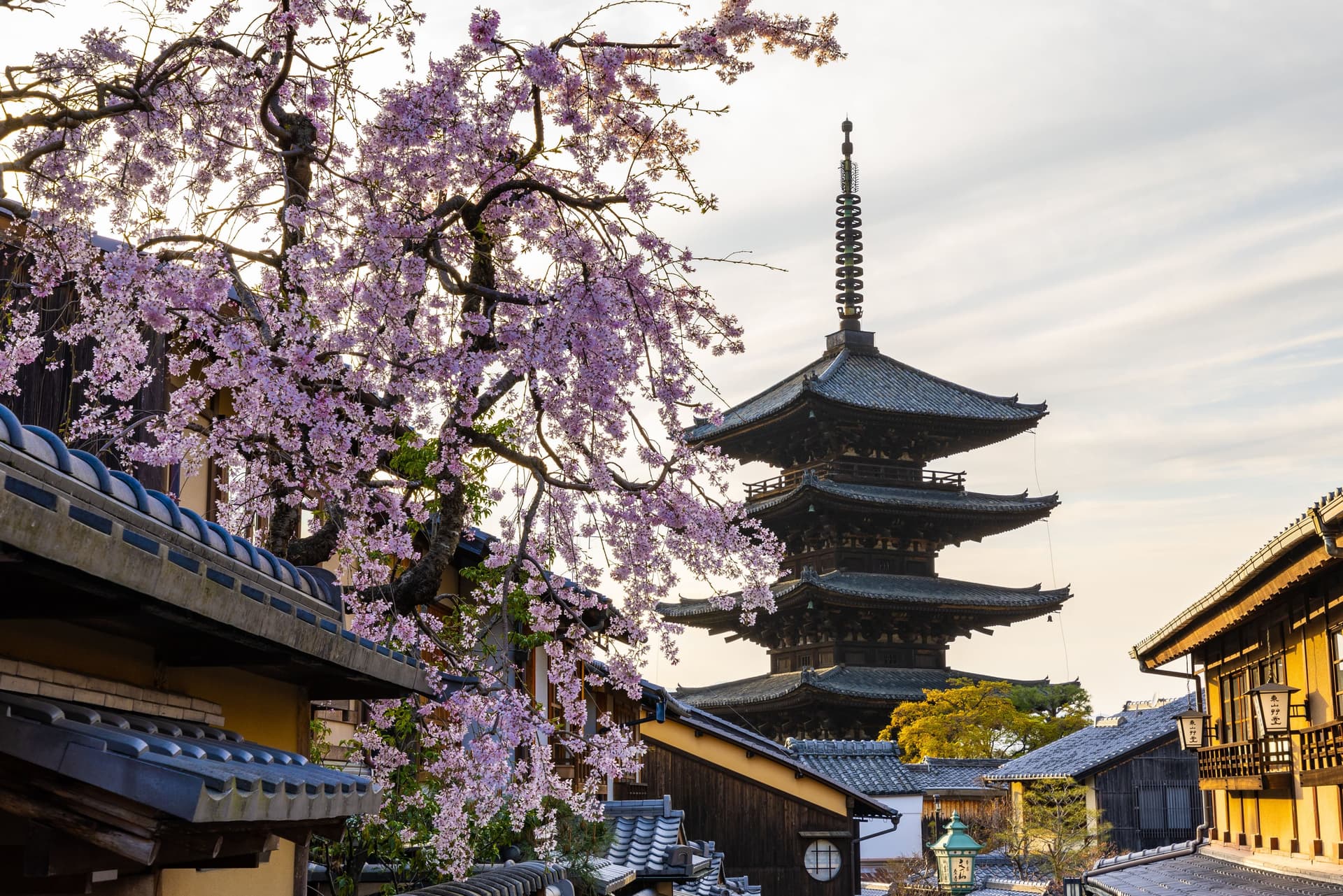
Stop 3, the Yasaka Pagoda, shows keeping in its oldest form. The five-storey pagoda of Hokan-ji, 46 meters high, burned in 1179, 1291 and 1436 and was rebuilt each time. The present tower dates from 1440, and its underground foundation stone is thought to be the original, so it stands on its seventh-century site. Stop 4, Yasaka Koshin-do, is hung with bright cloth balls called bound monkeys, a temple custom of giving up one desire to have a wish granted.
Kept by neighbors
Stop 5 is on Ninenzaka, where a coffee chain opened in 2017 inside a two-storey house more than a hundred years old. Its main house and great street wall are designated traditional buildings in the preservation plan, and the company says the wall is the only one on the slope that remains as it was. A modern business fits inside because the rules protect the shell.
Stop 6, Nene-no-michi, is where neighbors led. After residents asked for the street's scenery to be improved, a study began in 1992, work to bury the power lines started in fiscal 1995, and about twenty poles came down. Look up: the sky above the paving is clear. The street is named for Nene, wife of Toyotomi Hideyoshi, who founded Kodai-ji above it in 1606 to pray for him.
Stop 7, Ishibe-koji, the stone lane, was rental housing developed from the end of the Meiji period. Its continuous stone paving and stone walls preserve an early Taisho townscape, and in December 1995 it was added to the preservation district at the strong request of local residents, nearly twenty years after Sannenzaka.
Kept to be seen
Stop 8 is Yasaka Shrine's South Gate and the lantern-hung dance hall, with a main hall of 1654 whose later repairs were funded by the Gion Matsuri neighborhoods. Stop 9 ends at the West Gate, rebuilt in 1497 after the Onin War. In 1913, when Shijo-dori was widened for the city tram, the gate was moved 6 meters east and 3 meters north so that it would stand in the center of the street's view. Of all the acts of keeping on this walk, this is the most deliberate: a gate moved so the city could keep seeing it.
The lanes are busiest by midday, so the walk suits an early start at your own pace, with no group to herd through the crowds and every stop readable from the public street.
The pagoda is stop 3 of Higashiyama: Kiyomizu-dera to Yasaka Shrine, which ends at the West Gate. See all routes on the Kyoto page.
Sources
- Kiyomizu-dera, history: founding in 778, more than ten great fires, most halls rebuilt in 1633, the eighteen zelkova pillars over four hundred years old.
- Agency for Cultural Affairs, list of Important Preservation Districts: Sanneizaka, selected 4 September 1976, 8.2 hectares, temple-approach town.
- Roamer's audited tour research for this walk (Kyoto City preservation plan and signboards, the Kyoto City Archaeological Research Institute on Hokan-ji, the Construction White Paper of 2000, Yasaka Shrine), as summarised in the stops' historical notes.
Ready to experience it?
Higashiyama: Kiyomizu-dera to Yasaka Shrine
75 min · 1.9 km · moderate
More from Kyoto
Explore more at your own pace.
Arashiyama Walking Tour: Who Arranged Kyoto's Most Famous Views
Fushimi Inari Hike: How Ordinary People Filled a Burned Mountain With Gates
Gion Walking Tour: Reading Kyoto's Geiko Quarter Through Its Thresholds
Nishiki Market to Pontocho: A Kyoto Walk That Follows the Water
Philosopher's Path Walk: The Factory Canal That Became Kyoto's Quietest Stroll