Arashiyama: Bamboo Grove and Togetsukyo Bridge
75 min · 2.3 km · easy
Every famous view in Arashiyama was arranged by someone. That is the quiet surprise of Kyoto's western edge, where people have come for well over a thousand years simply to look at a river leaving the mountains. The fabric grove at the station dates from 2013. The Zen garden borrows the mountain across the river. A hill was named as the place to stand in 1927. The bamboo is a forest that is kept, and the old-looking bridge is concrete with cypress rails. Underneath all of it runs a working river, cleared for boats by a merchant in 1606. Roamer's Arashiyama walk asks one question at every stop: who arranged this view, and how?
The route is nine stops over about 2.3 kilometers and takes about seventy-five minutes. It starts in the Kimono Forest at Randen Arashiyama Station and ends on Togetsukyo Bridge, a few minutes from where you began. It is a daylight walk, because the park on the hill has no lights.
A grove made of cloth
Stop 1 is the newest arrangement on the walk. The Kimono Forest is part of the Keifuku railway's station square: about 600 poles wrapped in Kyo-yuzen, Kyoto's dyed kimono fabric, set out to suggest a grove. The designer Yasumichi Morita of the firm GLAMOROUS laid it out, and it opened in 2013. Look at it as a design move rather than decoration. A tram terminus became a forest you walk through, which tells you, before you have seen a single old thing, how this district works.
Borrowing a mountain
Hear a stop from this walk
Togetsukyo Bridge: Cypress Rails on Concrete
Stop 2 is the gate of Tenryu-ji, founded in 1339 by the shogun Ashikaga Takauji with Muso Soseki as its first abbot. Muso's pond garden is the classic example of borrowed scenery: it takes in Arashiyama across the river and Kameyama to the west as part of its own composition. The temple lists eight fires between 1358 and 1864, and its main halls date from 1899 to 1934, yet it says the garden looks much as it did in a guidebook of 1799. The buildings changed. The view was the thing that was kept.
Bark, fences and bamboo
At stop 3, Nonomiya Shrine, the arrangement is old and deliberately rough. Its torii is oak with the bark left on, which the shrine calls the oldest style of torii in Japan, and the fence is spicebush brushwood. This was where an unmarried imperial princess purified herself before going to serve at Ise, and the Sakaki chapter of The Tale of Genji describes the place.
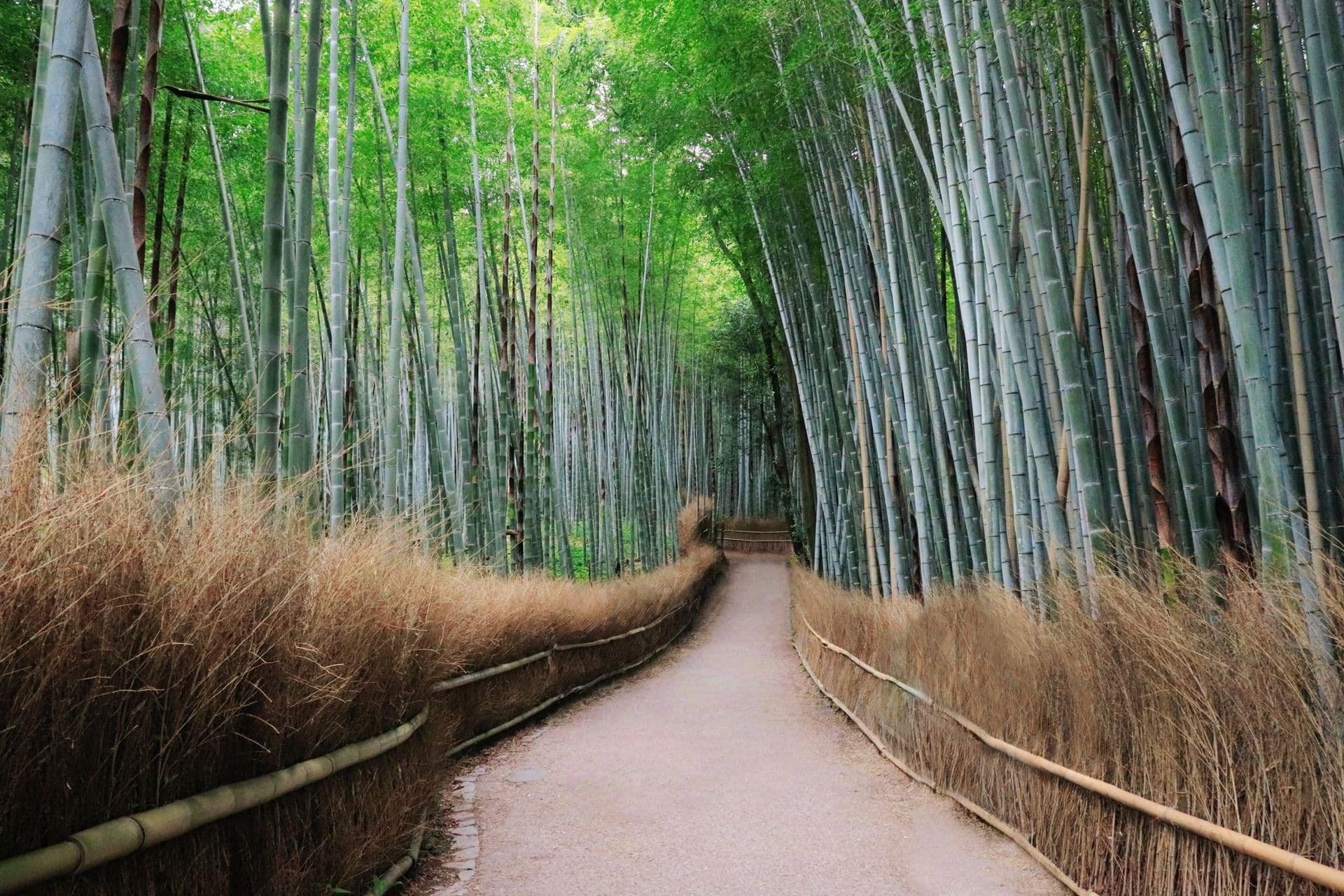
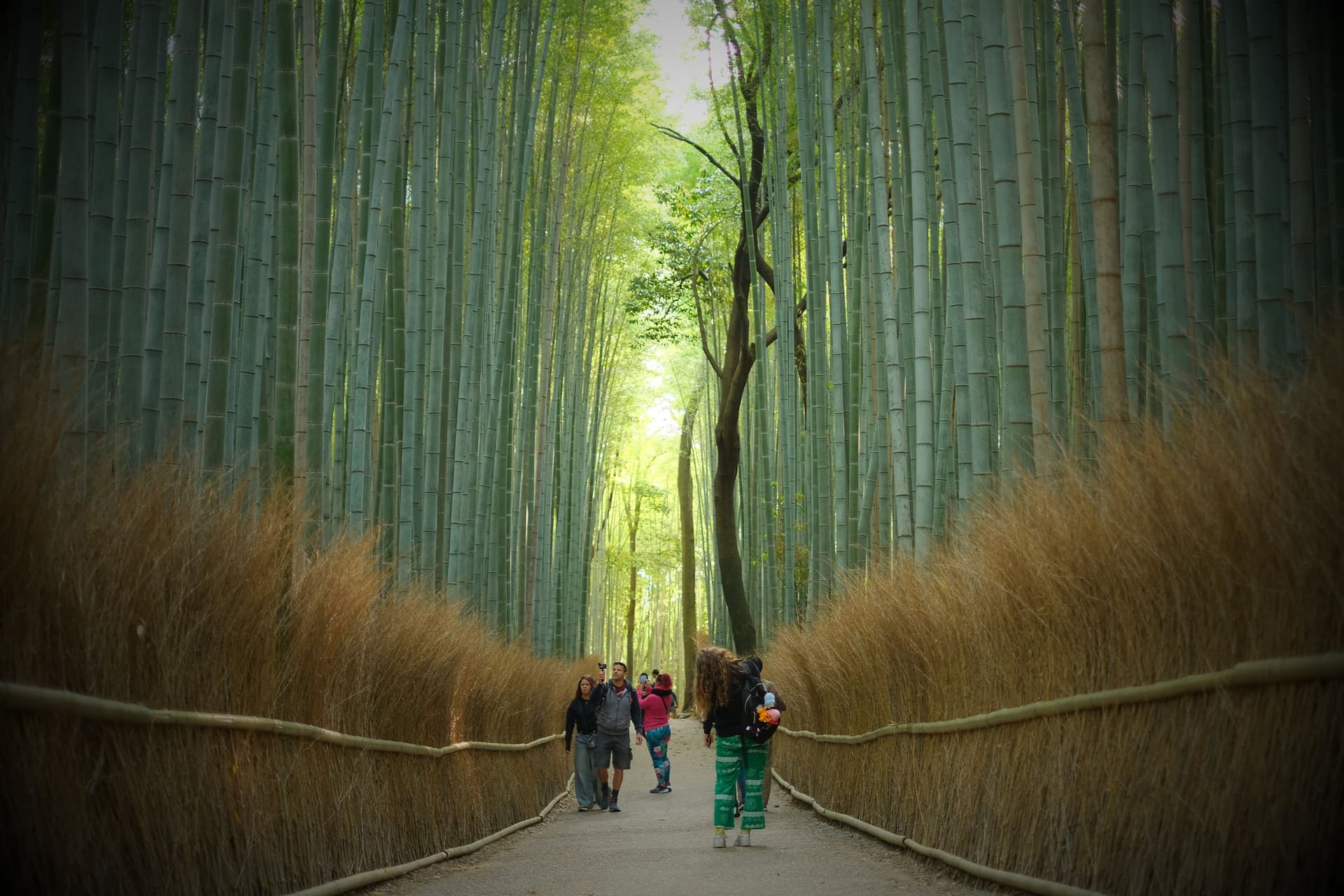
Stops 4 and 5 walk the bamboo grove, and here the word is kept. The path runs through a Historic Climate Special Preservation District, so cutting bamboo needs the city's permission. Kyoto's tourist association has asked visitors for years not to carve the stalks, because a carved stalk cannot heal and has to be cut. In November 2025 the city and a local group cut about twenty damaged stalks as a trial, and in April 2026 the aging brushwood fences along the path were repaired. At the top of the grove, stop 5 looks at the garden of the film actor Okochi Denjiro, which Kyoto Prefecture says he designed himself and built over about thirty years.
The viewpoint and the working river
Stop 6 climbs into Kameyama Park, where a short track reaches a lookout over the Hozu gorge. The 1927 designation of Arashiyama as a Historic Site and Place of Scenic Beauty names this park, on the opposite bank, as the place to view the mountain's blossom and autumn leaves. The viewpoint was written into law.
From here the walk turns to the river as work. Suminokura Ryoi began clearing the Hozu in 1606 so that flat-bottomed boats could carry rice, wheat and charcoal down to Kyoto. Stop 7 is the landing where today's tourist boats come in after about 16 kilometers from Kameoka. Until about 1949 the boatmen hauled their boats back upstream on ropes, and rope grooves remain in the rocks. Stop 8 follows the promenade beside a river with three names: the Katsura in law, the Oi in the 1927 designation, the Hozu in the gorge. The weir just upstream of the bridge, rebuilt in 1951, merged more than ten older ones. The forested slope opposite is a national scenic forest managed as a backdrop and closed inside because of steep slopes and rockfall.
Cypress rails on concrete
Stop 9 is Togetsukyo, 155 meters long. A flood in 1932 washed away half of the old bridge, and the present one was completed in 1934 with reinforced concrete columns and beams. Japan's national tourism organization notes that only the parapets are cypress. The river office adds that the girders were covered to keep a wooden look in harmony with the scenic site. It is the walk's thesis in a single structure: modern engineering, dressed so the old picture of river, bridge and mountain stays whole.
The walk works best at your own pace, with no group to keep up with. Linger at the gorge, skip the climb if your legs say no, or go early to have the bamboo quieter. Every stop makes sense from the public path.
The Kimono Forest is stop 1 of Arashiyama: Bamboo Grove and Togetsukyo Bridge, which ends on the bridge itself. See all routes on the Kyoto page.
Sources
- Japan National Tourism Organization, Togetsukyo Bridge: the first bridge of 836, the present bridge of 1934, concrete supports and beams, parapets of cypress.
- Nonomiya Shrine, English page: the black unbarked torii and brushwood fence, the Saio's purification before Ise, the Tale of Genji.
- Kyoto City Tourism Association, please do not damage bamboos: the request not to carve the bamboo and why.
- Roamer's audited tour research for this walk (Keifuku, Tenryu-ji, Kyoto Prefecture, the Hozu boat operator, the Yodo River office and the 1927 designation), as summarised in the stops' historical notes.
Ready to experience it?
Arashiyama: Bamboo Grove and Togetsukyo Bridge
75 min · 2.3 km · easy
More from Kyoto
Explore more at your own pace.
Fushimi Inari Hike: How Ordinary People Filled a Burned Mountain With Gates
Gion Walking Tour: Reading Kyoto's Geiko Quarter Through Its Thresholds
Higashiyama Walking Tour: Kyoto's Old Hillside Was Kept on Purpose
Nishiki Market to Pontocho: A Kyoto Walk That Follows the Water
Philosopher's Path Walk: The Factory Canal That Became Kyoto's Quietest Stroll